
The Sweet Sounds of Havana: Space, Listening, and the Making of Sonic Citizenship

 Welcome to the third and final installment of Unsettling the World Soundscape Project, a series in which we critically investigate the output of early acoustic ecology and assess its continuing value for today’s sound studies. In our first post, Mitchell Akiyama addressed the WSP’s ten-hour Soundscapes of Canada radio series from 1974 to situate the broadcast’s innovative work historically and explore how it attempted to represent a diverse nation by way of sound. In my follow-up post, I focused on the WSP’s Vancouver research, their only output since returning from Europe in 1975, assessing shifts in the ideologies and practices over its two official releases and arguing for the best path that future iterations of the project might follow.
In this final entry, Vincent Andrisani puts the “world” back into the World Soundscape Project by carrying his experience as the recordist for the WSP’s last archiving mission in Vancouver out into his solo doctoral research in Havana, Cuba. Andrisani lends an unsettled ear to one of the city’s most beloved sounds, the tune of the ice cream vendor, unpacking its social and historical significance to make an argument about the role that sound plays in local self-definitions of citizenship. Inspired by the WSP’s continuing quest to discover how people’s relationship to places can be defined through sound, Andrisani’s work offers an example of what contemporary soundscape research can be while demonstrating how to deal with many of the concerns raised about the WSP’s output over the course of this series.
It has been a great pleasure acting as editor for this series over the past few weeks and it is our hope that these posts will provide further fuel for celebrating, expanding, critiquing and rethinking the work of acoustic ecology in the broader context of contemporary sonic research.
— Guest Editor Randolph Jordan
—
To conceive of Havana in sound is to think not of the material spaces of the city, but rather, across them. From inside the home, residents participate in conversations taking place in the streets, while those in the streets often call for the attention of their friends or family indoors. Through windows, open doors, and porticoes, residents engage in interpersonal exchanges that bring neighbourhood communities to life. To listen across these spaces is to listen trans-liminally from the threshold through which sounds must pass as they animate the vibrant social life of the city. Such an act is made most apparent by the voices of vendedores ambulantes, or, mobile street vendors. “¡El buen paquete de galleta!” (“The good packs of cookies!”), “¡Se compran y se vendan libros!” (“I’m buying and selling books!”), and most famously, “¡Mani! ¡Mani!” (“Peanuts! Peanuts!”) are some of the pregones—the musical cries—heard through the streets and into the home.
But not all vendors are pregoneros. El heladero, the ice cream vendor, uses the jangly melodies of the electronic music box to make ears perk up, mouths water, and children’s shoes hit the ground running. The sound signals a respite from the sweltering Caribbean heat and is symbolic of a novelty food item for which Cubans have a strong cultural affinity. But most of all, the ice cream vendor’s melodic tunes bring people out of their homes and into the street, giving life to a moment that is as social, participatory, and convivial as it is savory.
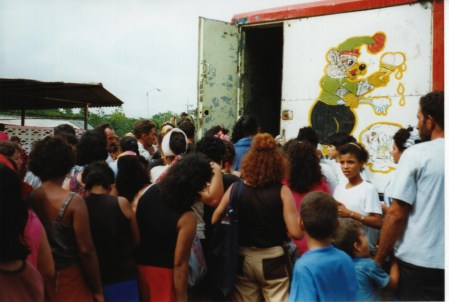
Ice Cream Vendor in Cuba, 2008, Courtesy of Flickr User berg_chabot
For over a century, ice cream vendors have been heard on the streets of Havana. Throughout this time, the city’s spaces have been contested by external regimes of power that include the Spanish Crown, U.S. business interests, Cuba’s own socialist government, the Soviet Union, and since the 1990s, Cuba’s resurgent tourist economy. Yet, in spite of the exclusionary logic imposed by each of these systems of power, the sound of the ice cream vendor still remains. To listen to it is to listen to Havana according not to the agenda of outside interests, but rather, according to the collective interests of residents themselves.
Borrowing from the work of Saskia Sassen (2006) who maintains that “citizenship practices have to do with the production of ‘presence’ of those without power and a politics that claims rights to the city” (315), I regard the tacit, communicative, trans-liminal act of listening as a means through which residents assert their embodied presence amidst both the spatial and political landscapes of the city. Listening to the sound of the ice cream vendor, I argue, constitutes an act of citizenship—an act of sonic citizenship—that momentarily claims Havana’s spaces according to the aims, aspirations, and desires of those who live there.
Citizenship, in this sense, is conceived of not as an institution bound to the political-juridical architecture of the nation-state, but rather, as a place-based “practice and project” (Sassen, p281) that, over time, has the potential to condition changes in the formalized institution itself. It emerges in the everyday, rather ordinary moments during which the city’s spaces are produced and given meaning by those with unequal access to political power. Just as Jennifer Stoever (2011) and Michael Francis O’Toole (2014) have discussed elsewhere, I too contend that citizenship is articulated in sound, but in order to hear it, we must listen historically to—and through—the spaces of Havana’s built environment.
The above clip, which I captured while conducting fieldwork in Havana, represents a moment of everyday life in the municipality of Centro Habana. While speaking about it with friends, colleagues, and acquaintances, I came to realize that only recently had the ice cream vendor’s heralding music become part of the local soundscapes. “Where was it before that?”, I asked. “Before that,” they all said, “it was gone.” In 1990, the Soviet Union collapsed and brought Cuba’s economy along with it. Shortages of food, petrol, and material resources were so severe that satisfying basic needs took precedence over the delivery of frozen novelties. The result was the loss of the ice cream vendor—and its corresponding sound—which, for decades, was part of the ongoing, everyday life of the city.
Fittingly, the collective sentiment surrounding that loss is captured in song. “Helado Sobre Ruedas,” or “Ice Cream on Wheels” by Gema y Pavel was released in 1994, during the height of Cuba’s economic crisis. In it, the duo lament the disappearance of the ice cream vendor from the streets of Havana and reflect on what it meant not only to them, but to all residents of the city. They speak about the presence of the ice cream vendor as a ‘refreshing’ event on hot days; as a source of joy, pleasure, and happiness that offered much more than a simple respite from the heat, but as one that “made family problems disappear.” The “sweet melody” of the vendor was the cause for celebration in neighbourhoods across the city, and is a sound that the duo recalls with both warmth and affection.
Throughout most of the twentieth century, ice cream sales in Havana looked and sounded much like it did in the United States. Minnesota-based Nichols Electronics developed the technology of the electronic music box in the mid-1950s, and within a few years, its chime-y sounds were heard on the streets of Havana. The frozen novelty itself can be traced back to 1920 in Youngstown, Ohio. Harry Burt, the eventual founder of the Good Humor brand paired, first, the lollipop’s wooden stick with chocolate covered vanilla ice cream, and subsequently, ice cream sales and automobility. In Havana, brands such as Hatuey, Guarina, and El Gallito borrowed Burt’s developments, and by the time the city underwent its westward suburbanization in the 1940s and ’50s, mobile ice cream sales were booming.
But if we listen further still into Havana’s past, we can discern the ways in which the ice cream vendor’s music echoes the complex history of the city. During Cuba’s struggle for independence in the late 1800s, American traditions and customs such as baseball, Protestantism, and new habits of hygiene began emerging in Havana. At once a rejection of the perceived backwardness of Spanish culture and an appeal to modernizing the island, this cultural appropriation was, as both Louis A. Pérez Jr. (1999) and Marial Iglesias-Utset (2011) have carefully observed, a way for residents to perform acts of citizenship with the intent of defining the customs of the impending nation.
It is perhaps no coincidence, then, that the practice of street side ice cream vending arrived in Havana at this very moment following its proliferation in cities such as Barcelona, London, and notably New York. These vendors performed a series of decisive functions amidst the city’s political geography, the most discernible of which was that they offered an opportunity for the working class to indulge in what historically was a bourgeois delight. Of equal importance however, was that ice cream vendors were also participants in Havana’s project of cultural modernization, and their street side presence enabled locals to inhabit the acoustic spaces of the city on their own terms and not those of the Spanish Crown.

Ice cream vendor on the streets of Havana between 1890 and 1910. Courtesy of the Library of Congress Archives.
This photograph, taken in Havana some time between 1890 and 1910, can be read not only as a silent image, but as an audiovisual text. Without any visible technology with which to herald his presence, it’s likely that this vendor relied on his own voice in the form of a pregón. We might imagine the slow rumble of the cart’s wooden wheels as they rolled over the unpaved road, glass cups jangling as the cart bounced along, and enthusiastic voices congregating in the street to buy what was known as a “penny lick.” Each of these sounds moved across the liminal spaces of the built environment, each marking a moment of savory indulgence and neighborly dialogue in the life of the city—as they do again today.
Listening to, documenting, and as historian Bruce R. Smith (2004) terms it, “un-airing” the history of Havana’s ice cream vendors offers a means through which to cultivate unexplored encounters with the city. It animates a narrative grounded not in political rupture, but in historical continuity; it locates a geography characterized not by unequivocal exclusion, but one that, quite simply, belongs to those who live there; and in so doing, it develops an account of the city not from the top-down, but rather, from the bottom-up. Such an approach renders audible the enactment of citizenship by listening for the sounds that firmly ground citizens in the very spaces that, time and again, have been destabilized by forces imposed from above.
To hear the ways in which citizens inhabit the city of Havana, we must simultaneously listen trans-liminally, across the open spaces of the built environment, and into the city’s history, which resonates through the sounds of neighbourhood communities, interpersonal dialogue, and social interaction. The heralding music of the ice cream vendor is one sound that does precisely that: for some, it offers a sense of childhood nostalgia, for others, it conjures the taste of a delicious frozen snack. But in every case, to listen to it is to enact a form of civic memory that orients residents according to both the spaces they inhabit, and the social and cultural history to which they belong. It comprises a moment, liminal as it may be, during which the city is lived, experienced, and imagined according to the interests of no one other than citizens themselves.
Acknowledgements: A sincere thanks to my extended family in Havana, to the academic community at Fundación Fernando Ortiz, and in particular, to Dr. Aurelio Francos Lauredo for his time, guidance, and for his attentive and compassionate ear.
—
Vincent Andrisani is a PhD Candidate and an instructor in the School of Communication at Simon Fraser University. He has written and lectured on the topics of popular music, broadcast media, and the politics of audio documentation in the context of Soundscape Studies, and has presented his research in a number of artistic and academic venues; the most recent of which was at the Pan-American Mobilities Conference in Santiago, Chile in 2014. Intersecting the areas of Sound Studies, Urban Geography, and Cuban Studies, Vincent’s doctoral research explores the relationship between sound, space, and citizenship in the city of Havana. In addition to the ice cream vendor, the sounds of water pipes, international travelers, and street musicians performing “Guantanamera” and other likely tunes form the basis of the study. http://www.vincentandrisani.com.
—
Featured image:Ice cream vendor in Havana, courtesy of University of Miami Libraries, Cuban Heritage Collection.
—
 REWIND! . . .If you liked this post, you may also dig:
Radio de Acción: Violent Circuits, Contentious Voices: Caribbean Radio Histories — Alejandra Bronfman
Snap, Crackle, Pop: The Sonic Pleasures of Food — Steph Ceraso
Listening (Loudly) to Spanish-Language Radio — Doloris Inés Casillas
Share this:

Blog-o-Versary 6.0 : Keep on Pushing (Our 400th Post!!!)

Click here for Sounding Out!‘s Blog-O-Versary “Keep on Pushing” mix 6.0 with track listing
Happy 6th Blog-o-Versary Team SO!
This year was tough, y’all. We know it. You know it. 2014-2015 was a year of rolling up sleeves, raging against the machine, typing furiously into the night, blocking the trolls, crying tears of frustration and anger, organizing heated meetings, fitting shoulders uncomfortably to various wheels while questioning exactly why and for whom, hugging our folks closer while unfriending Facebook “friends” like mofos, facing the millionth revision—or worse, the next police shooting, and the next and the next.
 All of us have reeled at one time or another at what sometimes seemed like a Niagara Falls of quicksand: mounting challenges, unexpected setbacks, pay and budget cuts (if you had a budget to begin with), hashtag memorials, calculated attacks, haters far more malevolent than your basic Taylor Swift variety, general piling on, restrictive and invasive university policies, less jobs/more adjuncts, and racist, sexist, and classist aggressions, macro, micro and everywhere in between.
But to quote one of my favorite poems from Langston Hughes, especially in these times, we are STILL HERE. And that really is everything. We can move mountains with that. We can. And, to cite the ethos of the Sounding Out! Editorial Collective: We remain committed, undaunted,
AND.  WE. CLAP. BACK.
Here, for example, is SO! regular writer, Cornell Science and Technology Studies PhD Candidate, and producer Enongo Lumumba-Kasongo performing as her (m)other brain rapper SAMMUS at Ithaca Fest in May 2015, where she debuted her powerful new song protesting state violence against black people, “Three Fifths,” produced by DNilz for the upcoming independent film “Rodney.”
Sammus closed her performance with a stirring sonic memorial to the unarmed black men and women who have been murdered by police in the U.S. over the last 20 years, as well as a call to action for white listeners to acknowledge their complicity in the “law and order” state and the agency they have to end the deadly terror of white supremacist policing.
***

We see you Sandra. And we’re listening. Image by J. Stoever, Ithaca, NY, 26 July 2015
***
Sammus’s music and lyrics have long inspired the SO! crew to keep on pushing–you’ll hear another of her songs on our mix–but especially this year. We talked a lot about how and why SO! continues to matter, specifically how can the collective labor here that seeks to understand sound as a medium of power be useful in struggles to make #blacklivesmatter once and for all, for example, or to end violence against transpeople? To dismantle debilitating gender stereotypes about women? To stop the marginalization and exploitation of immigrants and undocumented workers in the U.S.? And how to push the boundaries of US-centric sound work with local and/or comparative research from other countries–and vice versa? This year, we redoubled our collective efforts to produce top notch applied scholarship that intervenes in the challenges of our contemporary moment, not just the field of sound studies.
Not that we don’t plan to keep on pushing interventions there as well. Team SO! spent a lot of time earlier this year reflecting, in real time, on our origin story for an article we co-authored for the new Digital Sound Studies anthology edited by the Soundbox Crew (forthcoming on Duke University Press, digital entries already live here). We were grateful for the opportunity to articulate the politics of our founding and why SO! remains so vitally important to us (and we hope to you). Here’s an exclusive sneak peek of our upcoming chapter “The Pleasure (is) Principle: Sounding Out! and the Digitizing of Community”:
When we met in a humid apartment in upstate New York to plot a sound studies blog back in 2009, one of our key goals was to provide indelible visibility to the top-notch contributions we knew were being made to sound studies by scholars of color, graduate students, junior scholars and other groups marginalized in/by academia, so that their role in building this growing field could not be erased, ignored, silenced, hijacked, buried, or claimed by others better positioned by social and institutional privilege and its attendant cultural capital to gain conference spots and find publishers for their work. There is solidarity in the affects produced by giving voice, making visible, and, above all else: listening. Because connections undeniably matter, we decided to build our own, and to do so in a way that celebrated the people and the scholarship perpetually at the fringes of most fields, but especially those involving technology and music.
 Through the experience of collaboratively reviewing our history and together calling a new creation into being once again, we realized—on an entirely new frequency—how Sounding Out! and the community it kindles consistently sustains the three of us through stormy times: personally, professionally, and politically. I am not sure if it clicked in while scowling through the umpteenth revision or LMAO-ing through yet another Hangout, but we all came around to the truth that the right kind of work, performed with your ride-or-die people, can energize rather than enervate, center rather than scatter, and make you want to keep on pushing, especially when being pushed. For us, it never has been just about sound.
 So this year, for our 6th Blog-o-Versary, our theme, “Keep on Pushing,” honors the fact that sound can be both a balm and a motivator for years like this one and for times when the news is ENOUGH but we need to keep going. We also want to express our respect and gratitude for all the heavy lifting, daily grinds, and labors of love, pleasure, and sometimes frustration—both Tweeted and unsung—of ourselves and our ever-growing community of readers, writers, Twitter Followers, Facebook friends, Link sharers, survey respondents, sticker distributors, folks who archive us, writers who cite us, teachers who assign us, and peeps who talk us up and give word of mouth. We are all putting in work in a thousand and one ways, big and small, to make this community bigger, badder, and deffer each and every year. And *that’s why we are still here.
Thank you and here’s to lucky number seven in 2016!
Team SO!
—
 Liana’s back!!: We had a bit of a personnel shuffle last summer, but in the end the stars aligned and we got Liana back. She edited this year’s February forum on gender and voice (which you can check out here) and selected the tracks for this year’s mixtape for the second year in a row. Outside of Sounding Out! she’s been publishing more, getting her break in the Houston Chronicle online column Gray Matters, developing a column for Chronicle Vitae, and working on a book proposal due later this year. You can keep up with her writerly adventures on Twitter: @lianamsilva
 INDEXING: We told you this year was all about the grind. We are working hard over here to make SO! more searchable. With 400 posts and counting over 6 years, we recognize that finding what you need grows more challenging every Monday. This spring, we debuted an alphabetical index of all of the themed series and forums and soon we will have completed full indexes by author soon and title soon, as well as some themed lists for teaching and general inquiry.
 MLA INDEX IS UP AND RUNNING!: For folks privileged to have access to the Modern Language Association’s digital bibliography—perform a search for Sounding Out! and you will find links to all of our posts categorized as “articles.” The index is also searchable by author. Now we are officially, as Hammer would say, 2 legit 2 quit.

WE KEEP ON PUSHING THE ENVELOPE: Now that sound studies is increasingly becoming canonized and institutionalized, we feel it is increasingly important to continue looking for new avenues of interest and inquiry and to experiment with the form of the blog and podcast. This year we debuted a series of online sonic installations by artists and thinkers such as Salomé Voegelin (“Sound Art as Public Art”), the Berlin arts collective La Mission who performed a full series of sound and video installations in honor of José Esteban Muñoz for our Round Circle of Resonance series, and sound artists Sonia Li, Mendi + Keith Obadike and Anne Zeitz and David Boureau. We also began a new running series called “SO! Amplifies,” which allows us the opportunity to scout out innovative organizations, artists, installations, exhibits, community engagement projects, radio programs, etc. and bring them to your attention.

THURSDAYS STILL ON POINT! Special Editor Neil Verma has continued to rule the Thursday airwaves with his specially curated series of guest editors emphasizing sound and media. For a rundown of 2014’s programming see his excellent year in re-hear post from November 2014. Right now we are in the midst of the “Sonic Shadows” series with more excitement to come! And of course, Multimedia editor Aaron Trammell continues to curate an exciting and innovative open format podcast series on the last Thursday of every month. This year’s Blog-O-Versary mix is our 45th podcast!
 RELAX! DON’T DO IT!: This year SO! started doing its part to promote healthier work habits by taking a week off here or there. We hope that, rather than disappointing our avid Monday morning readership, we have encouraged our community to stop and gather strength too (or at least to explore our extensive back catalog. 400 posts!). SO! is a marathon rather than a sprint and we are just getting started.
SPEAKING OF. . .

WE’RE ALWAYS LOOKING FOR NEW FOLKS FOR TEAM SO! Don’t forget we have our latest Call For Posts on “Sound and Affect” up and running with a deadline of August 15th. Please submit a pitch and/or spread the word!!
—
Highlight Reel: See what’s new with SO! authors and community members this year! Congratulations everyone (and don’t forget to keep those cards and letters coming!).
- Regina Bradley was selected as a 2016 Nasir Jones HipHop Fellow, Harvard University. She is also and incoming Assistant Professor of African American Literature at Armstrong State University in Georgia.
- Steph Ceraso finished her first year as an Assistant Professor at the University of Maryland, Baltimore County. Her audio-visual project, “A Tale of Two Soundscapes: The Story of My Listening Body,” appeared in the open access collection Provoke! Digital Sound Studies and her article, “(Re)Educating the Senses: Multimodal Listening, Bodily Learning, and the Composition of Sonic Experiences,” was featured in College English. She gave talks at Duke University, The University of Virginia, UCLA’s “Inertia: Sound, Media, and the Digital Humanities” Conference, the Conference on College Composition and Communication, and MITH (Maryland Institute for Technology in the Humanities). Ceraso was also interviewed by The Guardian about teaching the podcast Serial. You can find more about her work and current book project at www.stephceraso.com.
- Stuart Fowkes’ Cities and Memory hit the 700 mark in terms of numbers of sounds, with more than 150 contributors and now over 200,000 listens. They’ve run open call sound project every few months, which have included: Oblique Strategies: more than 50 artists reimagining field recordings using Eno and Schmidt’s oblique strategy cards for inspiration; Quiet Street: a sound map of the city of Bath that was installed as part of the Fringe Arts Bath festival; Sound Waves: for World Listening Day 2015, a sound map and edited piece looking at the role water plays in our lives; and Dreamland: a commission by the Dreamland amusement park in Margate, UK, to reimagine the sounds of a theme park.
- Enongo Lumumba-Kasongo passed her Ph.D qualifying exams and has just returned from a research trip to Congo. She also has recently had the opportunity to put together some music and a sound installation for a stage play that will premiere at the National Black Theatre Festival in Winston Salem in early August 2015. The organizers have put together a fundraising campaign via Indie Gogo; they’re trying to raise $15,000, right now they’re just shy of $10,000–please join SO! in supporting her work here. As Sammus, she went on her first tour with rapper Mega Ran which included a performance at the SXSW festival in Austin, TX. You can follow her on Twitter (@sammusmusic) or listen to her music, including her latest releases at http://sammusmusic.bandcamp.com/.
- Kristin Moriah’s article on Uncle Tom’s Cabin/Onkel Tom’s Hütte was recently published in Lateral, the Cultural Studies Association’s online journal. She will be presenting a paper entitled “Singing Books: The Curation of Sound in Sissieretta Jones’s Scrapbook” at the 2015 American Studies Association convention in Toronto.
- Visual Editor Will Stabile is still out there every day, making it happen. He asked that we not worry about him. We still check in on him regularly though.
- Justyna Stasiowska put together for the international conference “Post-technological experience. Art-Science-Culture” (Poznań 23-27 October 2014) the presentation “Soft machine – somaintrument,” on modes of programming perception in Maryanne Amacher’s instalations. She also presented “Ephemeral performance or how does sound smell,” focused on programing a synaesthetic expierience in Ephemera and creating a new academic format during “Fluid Sounds” (lectures, perfomances, performances and audio papers in Amager 18-21 June 2015). Lastly, she created a sound mix for a drag queen-inspired performance called Valentine Tanz, which focused on being a performance artist. The episode (the project is a series of performances), that she worked on juxtaposed the ballroom queer scene aesthetic with Marina Abramovic’s work on trying to deconstruct persona of a performer.
- Kyle D. Stedman is co-editing a digital collection on sound and writing pedagogy. If you’re interested on submitting an idea for how you use sound in the classroom, read the CFP or listen to the audio version at the Soundwriting Pedagogies project page. He also podcasts every month or so at Plugs, Play, Pedagogy, a show about teaching writing and rhetoric in the 21st century, which led to a workshop and presentation on academic podcasting at the 2015 Computers and Writing conference.
- Jennifer Stoever published three articles this year, “Fine-tuning the Sonic Color-line: Radio and the Acousmatic Du Bois” in Modernist Cultures, “‘Just Be Quiet Pu-leeze’: New York’s Black Press Fights the Postwar ‘Campaign Against Noise,’” in Radical History Review, and “Toward a Civically Engaged Sound Studies, or (Re) Sounding Binghamton,” in the Proceedings of Invisible Places / Sounding Cities. Sound Urbanism and Sense of Place (you can download the full volume here). She was also named an Engaged Teaching Fellow by the Binghamton Center for Civic Engagement and enjoyed the hell out of herself co-teaching a radio arts course with filmmaker and Sound Artist Monteith McCollum. They produced an accompanying live radio show (listen here!).
- Aaron Trammell will defend his dissertation in September 2015 and will begin a two year postdoctoral fellowship at the Annenberg School of Communication at the University of Southern California.
-
Neil Verma has had a busy year: the WOTW article ran in Velvet Light Trap, published a chapter on noir in Kiss the Blood of My Hands, wrote an article on Wyllis Cooper in the Journal of Sonic Studies, did a review about Sean Borodale’s “Mighty Beast” in RadioDoc Review, wrote an article on Game of Thrones in Critical Quarterly, did a short piece on listening in Lang’s Hangmen Also Die in Cine-Files, then this post on using podcasting to study podcasting in Antenna. He also co-programmed the conference Sonic Boom: Sustaining Sound Studies here at Northwestern, and did Network Director stuff for the Library of Congress RPTF.
- Alyxandra Vesey published three articles: “Mixing in Feminism.” Popular Music and Society (39) 4: 1-20; “Putting Her on the Shelf: Pop Star Fragrances and Post-feminist Entrepreneurialism.” Feminist Media Studies 15 (6): 1-17; and “Working for @LateNightJimmy.” Spectator: Performing Labor in the Media Industries 35 (2): 47-56. Also, as the graduate representative for the Women’s Caucus, she helped put on SCMS’s “Participatory Pedagogy” networking event and workshop at last spring’s conference in Montreal.
—
The theme for this year’s Blog-o-Versary post and mix was of course inspired by Curtis Mayfield and his early group The Impressions. Thank you for this sonic uplift!
—
Jennifer Stoever is co-founder and Editor-in-Chief of Sounding Out! She is also Associate Professor of English at Binghamton University.
—
Click here for Sounding Out!‘s Blog-O-Versary “Keep on Pushing” mix 6.0 with track listing
—
REWIND! . . .If you liked this post, you may also dig:
-

- 2014
-

- 2013
-
- 2012
-
- 2011
-

- 2010
- 2014 #flawless 5.0 celebration and mix
- 2013 Blog-o-Versary 4.0: Solid Gold Summer Countdown!
- 2012 #Blog-O-Versary 3.0: Can’t Stop Won’t Stop (The Awesomeness)!
- 2011 “Awesome Sounds from a Future Boombox” 2.0
- 2010 First Blog-O-Versary party mix: A Celebration of Awesomeness
—
Share this:


Current Top Posts





April 2021

January 2020

November 2019

October 2019

August 2019

April 2014

November 2017

March 2015

December 2017

October 2015
 Sounding Out!
Recent Comments