
Radio and the Voice of the Aymara People

 Welcome back to our continuing series on radio in the Caribbean and Latin America: Radio de Acción. A consideration of the multilingual history of radio from Cuba, Jamaica, and Haiti to the Southern Cone and beyond, Radio de Acción turns this week to the Aymara in Peru, Chile, and especially Bolivia in a fascinating piece from anthropologist Karl Swinehart.
If you missed our first post, Alejandra Bronfman’s stunning history of radio and violence in the Caribbean, you can find it here. In the meantime, keep your dials tuned to Karl Swinehart’s study of the micropolitics of language and power on Aymaran radio.
– Guest Editor Tom McEnaney
—
“What do you like most about working at this radio station?” was a simple question I had asked Celia Colque Quispe, an Aymara language radio broadcaster on Radio San Gabriel in El Alto, Bolivia during an interview I conducted in 2007 as part of my dissertation research on Aymara-language media. Her response was simple, but profound.
“Clearly, here, being Aymara. I like to be Aymara.”

Celia Colque Quispe; photo by the author, all rights reserved
Quispe came to Radio San Gabriel from a small, rural community on the shores of Lake Titicaca. One day, she had heard an announcement on the radio that Radio San Gabriel would be hiring personnel through an open selection process involving an Aymara language fluency assessment. Competing against university-trained linguists and graduates of communications programs, Quispe stood out for her eloquent Aymara speech and was hired, beginning a career in radio where she came to not only to work as an announcer, but as a member of the Aymara Language Department where she wrote and approved scripts for the station’s programs. Stories like this are not unusual at Radio San Gabriel, but are otherwise rare in this multilingual Andean republic, still profoundly marked by anti-Indian racism. What “being Aymara” means in Bolivia remains highly contested. One thing was clear from my conversation with Quispe, however—her work at the radio allows her “to be Aymara.”
The presence of the Aymara language on Bolivian airwaves contrasts sharply with its general absence within other Bolivian media. There are some notable exceptions: Bolivian state television occasionally runs Aymara language programming on programs like Entre Culturas (‘Between Cultures’), and, famously, the neorealist director Jorge Sanjinés’ work has dramatized the struggles of highland Aymara and Quechua Indians in films like Yawar Mallku (Blood of the condor) and Nación Clandestina (Clandestine Nation).
These are exceptions, however, that prove the rule of Spanish language dominance within Bolivian television and film, leaving radio to stand out as the medium that most reflects the country’s multilingualism. In this post we will tune in to Radio San Gabriel, Bolivia’s oldest and most prominent Aymara language radio station, to ask how Aymara language radio might not just reflect Bolivia’s multilingualism, but also actively intervene in it, shaping how Aymaras hear their own language.
Aymaras and Bolivia

Geographic distribution of the Aymara language, public domain
The Aymaras are one of the the largest ethnolinguistic groups within Bolivia, a nation that is now officially a “Plurinational State” in which 36 indigenous languages are recognized as co-official with Spanish. Aymara is among the most widely spoken of these and Aymaras constitute a majority of the population in a contiguous territory surrounding the nation’s capital of La Paz, and crossing national borders into neighboring Chile and Peru. With approximately two and a half million people (and many more than this if speaking Aymara is removed as a criterion of ethnicity), Bolivia has the largest concentration of Aymaras in the region. Perhaps because Bolivia’s political capital sits within Aymara territory or because of their sheer numbers with respect to other indigenous populations, the Aymara have long played a significant role in Bolivian politics. Increasing the presence of the Aymara language in public space, on the airwaves or otherwise, is thus a prominent component of a multifaceted politics of indigenous resurgence in contemporary Bolivia.
Aymar Markan Arupa – “The Voice of the Aymara People” – Radio San Gabriel
As Bolivia’s first and longest running Aymara language radio station, Radio San Gabriel (RSG) calls itself “Aymar markan arupa” (the voice of the Aymara people). In the wake of the 1952 Bolivian revolution, a major social upheaval in which miners’ militias played a crucial role, Maryknoll Jesuit priests founded RSG in 1955 with aims of Christian evangelization within a broader effort at rural uplift. RSG’s mission was also in line with the new government’s hopes of integrating indigenous rural communities into national political life. Jesuits had experience with radio in mining communities, a broadcasting milieu dominated by radical syndicalist and communist political currents, where Jesuits had also founded radio stations of their own. Although miners are remembered as the central protagonists in the 1952 revolution, also crucial to its victory were the highland indigenous communities who overturned nearly feudal relations of the haciendas through insurrectionary land expropriations.

The offices and studios of Radio San Gabriel in El Alto, Bolivia; photo by the author, all rights reserved
In its early days, RSG approached the Aymara language as a bridge to Spanish language literacy and integration into the mainstream of the Catholic faith, an approach consistent with a mid-twentieth century view which formulated the “the Indian problem” as one of national integration. Yet these early assimilationist efforts would quickly change due to both developments in the Catholic Church, such as the Second Vatican Council (1962-1965) and the rise of “liberation theology,” and also political ferment in Bolivia in opposition to military rule. During the 1970s radical Aymara nationalism, or katarismo, was on the rise, finding institutional expression through organizations like the Movimiento Revolucionario Tupak Katari (MRTK, ‘Revolutionary Movement Tupak Katari’), and the founding of the Confederación Sindical Única de Trabajadores Campesinos Bolivianos (CSUTSB, ‘Trade Union Confederation of Rural Workers of Bolivia’) under katarista leadership in 1979.

“Tawa Chakana” by Wikimedia user Huhsunq, CC BY-SA 2.5
Influenced by Aymara nationalism, RSG made a dramatic shift in its orientation towards Aymara language and culture. Their adoption of an Aymara-centric idiom resonated with other nationalist currents, while maintaining Maryknoll Jesuit aims of social justice and service to the poor by reformulating “liberation theology” as a “theology of inculturation.” Practices earlier demonized by the Catholic Church as pagan were now celebrated as being essentially Christian—with the spilled blood of a sacrificed llama, for example, recast as analogous to the wine of the sacrament. This remains in many ways the orientation of RSG today, and the station positions itself as an authority on questions of Aymara linguistic and cultural authenticity.
Broadcast language – dehispanicized “pure” Aymara
One of the ways that RSG’s authority becomes audible to its Aymara audience is through the language used on the air. On RSG, radio announcers speak without using Spanish loan words, using what radio announcers and other Aymaras refer to as “Aymara puro” (pure Aymara). This is ensured through the radio’s Aymara Language Department, which intervenes prior to each broadcast by either writing or editing scripts, and is responsible, along with the radio’s director, for these scripts’ ultimate approval. However, its responsibilities do not end with broadcasts’ content. The department is also responsible for a protocol extending through and beyond the actual broadcasts called seguimiento, or “following.”
Seguimiento involves two procedures: the real-time monitoring of broadcasts for “aberrations,” and a follow-up interaction with those who utter them on air.The department finds alternatives or invents neologisms for the many loan words in Aymara from Spanish. These loan words include words as common as the verb “to speak”—parlaña from the sixteenth-century Spanish parlar—and are testament to 500 years of contact with Spanish. Contact, of course, is a euphemism for what was first colonial and later republican subjugation, making the aberración serve as a linguistic reminder of this painful history. This is why, rather than simply “Aymara puro,” a more apt term might be deshispanized Aymara. While Spanish loan words are purged from the broadcasts, many words shared between Quechua and Aymara escape the protocols of seguimiento, even though these also likely entered the language as the result of earlier subjugation of the Aymara under the Inca Empire. It was not the Inca period, however, but the domination of all Indians, whether Quechua, Aymara, or otherwise, by the Spanish under the colony, then by their descendants during the Republican period and into the 21st century that has most profoundly shaped Bolivia’s dynamics of race and class and, it turns out, the linguistic phenomena that accompanying them, leaving the loan word, the aberración, to be understood as the residue of this history.

Outside the studios of Radio San Gabriel in El Alto, Bolivia; photo by the author, all rights reserved
Decolonization over the Airwaves
Is the linguistic purism of the RSG any different from that of, say, the Academie Française? In terms of aims and procedures, much remains the same—both groups identify loan words and push for consensus to implement neologisms. Such a comparison, however, would obscure the starkly different social context in which this process unfolds in Bolivia. If “protecting” the language is commensurate with protecting the people, at RSG, this means targeting loanwords that serve as reminders of the painful processes of colonialism. In this light, many at RSG understand their work as fitting within a larger project of decolonization, a project not without its contradictions or ironies, particularly considering the role of the Catholic Church in both the past and the present. I explore these ironies more in a longer ethnographic account of the process of seguimiento at RSG.
Whatever the ironies, RSG’s cultivation of a model of refinement in Aymara speech has created opportunities for people who are otherwise profoundly marginalized in Bolivian society, particularly rural women, to advance professionally in a labor market that too often shuts them out. Where Celia Colque Quispe’s wearing of long braids, broached shawl, and full pollera skirt of rural Aymara women, for example, would have her barred from other employment whose job descriptions might demand of employees a euphemistically racist and sexist requirement of buena presencia, at RSG her traditional dress and status as a rural Aymara woman was valued and bolstered her authority within the institution. In a society still steeped in legacies of colonialism, it is no wonder, then, that what Quispe likes most about her work is simply that she can be Aymara.
In the broader media landscape, stations like RSG surely fill a gaping hole of Aymara language programming. Yet as “the voice of the Aymara people” extends across the high plain, radio introduces new absences: the absence of speech deemed too marked by colonialism to appear on air. Linguistically, then, the static on the frequencies of Aymara language airwaves are many. Both the neologisms of the voices cultivated for the airwaves and the incursion of Spanish into the speech of those whose tongues are less trained complicate any notion that the voice of the radio resonates free of the static of history.
—
Featured image: Aymaras marching to commemorate the uprising and massacre of 1921 in Jesús de Machaca, La Paz.
—
Karl Swinehart is Collegiate Assistant Professor and Harper-Fellow at the University of Chicago. He is currently working on a manuscript on hip-hop in Bolivia, Clear, Hidden Voices: Language, Indigeneity and Hip-Hop in Bolivia. He is a linguistic anthropologist with interests in media, popular music, social movements, racialization and multilingualism. He is co-editor of Languages and Publics in Stateless Nations, a special issue of Language and Communication. His work can also be found in the Journal of Linguistic Anthropology, Language in Society, and Social Text.
—
 REWIND!…If you liked this post, you may also dig:
“Violent Circuits, Contentious Voices: Caribbean Radio Histories”-Alejandra Bronfman
“Chicana Radio Activists and the Sounds of Chicana Feminisms”-Monica De La Torre
“On the Lower Frequencies: Norman Corwin, Colorblindness, and the ‘Golden Age’ of U.S. Radio”-Jennifer Stoever
Share this:

From Mercury to Mars: Vox Orson

 The problem of the voice has been at the center of sound studies for generations, but seldom has the knot of aesthetic and philosophical concerns — of vocal mechanics, of ontology, of desire — that “the voice” raises been brought to bear on a particular voice. As a result, ironically, a terrain deeply fascinated by materiality is often approached through abstraction. To amend this problem, what better case study could there be than Orson Welles, whose voice was without question one of the signature dramatic instruments of the twentieth century, and today retains a compelling power to instruct, to hypnotize and beguile.
As SO!’s last full installment in From Mercury to Mars, a six-month series commemorating the radio work of Orson Welles we’re doing with Antenna, we are honored to present one of the most insightful writers on cinema, Murray Pomerance of Ryerson University, who has prepared a special essay focusing on the question of Welles’ voice. Writer and editor of more than a dozen books, Pomerance’s own voice has been crucial in how contemporary scholars, critics and fans have thought about the cinema for decades, and we’re elated to have him help us to wrap up the series.
What you’re about to read, ladies and gentlemen (a little razzle-dazzle, why not?), is something never attempted before, to my knowledge: a study of Orson Welles’s voice itself — not what it does, how it was used, or what it “represents,” exactly — but a study that tries to get at what Pomerance calls “that instrumentation [Welles] cannot prevent himself from employing except by silence.”
It’s the voice that sticks to every thought about Welles, the voice through which everything else in his radio work passes, and ultimately the voice that continues to outlast him.
nv
—
“I know that the thing I do best in the world is talk to audiences.”
Orson Welles to Bill Krohn (“My Favorite Mask is Myself: An Interview with Orson Welles,” The Unknown Orson Welles 70).
Most radio listeners across America knew the voice of George Orson Welles, a voice particularly adept for broadcasting, before they saw what he looked like. Even when he appeared, staring wrinkle-browed and wide-eyed from page 20 of the Los Angeles Times the day after “War of the Worlds” or hiding under the thick eyebrows and beard of Capt. Shotover from George Bernard Shaw’s Heartbreak House, as framed by Paul Dorsey for the cover of Time May 9, 1938, they had to “fit” the picture to the sound (that is, one or more of his many sounds). The tall, doughy body generally produced a soft baritone—“I think it would be fun to run a newspaper”; “tomorrow is . . . forever”—worn at the edges like an heirloom tablecloth, thick as bisque, or evanescent as an Irish field seen distantly in foggy light.

Shot of the New York Inquirer, fictional newspaper from Citizen Kane (1941).
His sound was just slightly adenoidal, but burnished, like eighteenth-century mahogany furniture. Listening to Welles, indeed, one felt raised to a cultural height, where the light could gleam more purely and satisfyingly than elsewhere. His enunciation was crisp and precise, never failing. David Thomson types his voice as “word-carving” (Rosebud: The Story of Orson Welles 239). He breathed through, rather than around, his speech so that phrases would rise and fall with the body’s natural, “automatic” move to futurity; breathed with an overt will to reach the end of the phrase, of the sentence, of the story. In this he made talk the stuff of life. He was fond of long breaths and wordy deliveries, letting his stresses fall on vowels more often than not, as in singing Schubert. While as a performer he could produce any vocal gesture—hilarity, mockery, snideness, bitterness, pomposity—these clothed rather than inhabiting the voice, which was always, inevitably, excruciatingly, heart-rendingly clear and blunt. He had the ability to persuade us that what he said came from his heart, rather than a performer’s toolkit.

A visual rendering of Orson Welles’s voice (and pauses for breath) in the “Am I Richard Pierson” monologue from “War of the Worlds.”
Even the great John Barrymore, whose voice was an orchestra—the Barrymore whom Welles called “a golden boy, a tragic clown grimacing in the darkness, gritting his teeth against the horror” and who at the opening of Citizen Kane told a radio announcer that Orson was the bastard son of Ethel [Barrymore] and the Pope (Welles and Bogdanovich, This Is Orson Welles 24)– did not unfailingly invoke such sincerity. So it came to be, later in Welles’s life, that when on a talk show he told his host a story or gave her a lecture—cigar in hand he informed Dinah Shore in 1979 that her audience was not an audience, for example, because they had not paid to be there–one came to believe every syllable; and when he made F for Fake he counted on this vocal credibility, this urgently private and confessional key, to convey convincingly what had only been fabricated to convince. The convincing could be potent, and at the supremest level: Richard Wilson reports that it was after hearing “records of the Mercury’s radio production of The Magnificent Ambersons” (not, note, after reading a scenario) that George Schaefer, President of RKO, “gave Orson the okay for that film” (“It’s Not Quite All True,” Sight & Sound, Spring 1970, 191).

The shadow of Welles as Nazi Franz Kindler in The Stranger (1946).
If it is one thing to discourse upon how the voice is structured into a performance, a broadcast, a staging, invoking, to take a case, shunting, audiopositioning, overdubbing, personalizing (see Verma, Theater of the Mind 140; 35-45; 185), it is quite another to stand before, to confront, the voice. In one case we wonder what can happen to the voice, in the other we ask of the voice what it is. Orson Welles’s voice, not what he says, not what he means, not who he is pretending to be, but that instrumentation he cannot prevent himself from employing except by silence . . .? What is the voice which one takes for granted in quoting his dialogue, as though what he says were equivalent to his saying it? And given that Welles is now silent, can the reader who never heard him be brought to a sympathetic understanding through any form of argument or description? Youtubing him for the first time, what does one hear, that Welles repeatedly brought forward through the frame of his instrumentality and the agony of his breath? An urgent desire to be heard, certainly. Listen to this, listen to me, listen harder. Spitting words, or giggling like a little child.
Language as we speak it need pay no fealty to the speaker’s attitude toward—feeling about—what he says; the words have the power to contain both meaning and feeling, but it is not a requirement that they be enunciated, emphatically shifted, or turned to self-consciousness in the event that the speaker finds them, apt, silly, or simple. The voice is beyond the words. It is something for which we can have a taste. Taste “cannot be rendered by anything other than itself,” suggests Leroi-Gourhan, it is a “[part] of our sensory apparatus [that] must always remain infra-symbolic” (Gesture and Speech 281). Thus, the trick about voicing text for microphone is to pronounce, not utter. One must put some faith that English will hold meaning without the addition of the voice; so that—as regards meaning–in voicing one expresses a humble self-deprecation in the face of something greater than oneself.

Vienna’s Riesenrad, where Orson Welles gave a famous speech as Harry Lime in The Third Man. Photo from Wikimedia Commons, 2004.
Welles’s voice is filled to the brim with this humility, this self-deprecation, this ease, this insouciant presence. The words sound out, no matter their shape. And so: “The cuckoo clock!” as a punch line in that lengthy, magnificent speech of Harry Lime’s in the Viennese Ferris wheel in The Third Man. “KOO-koo.” With Welles’s great dignity (massive girth) and profound experience, this kindergarten word gives him over to self-mockery, disidentification; but Harry Lime just says it, with a little elevation of tone for comic punch, and a lifted eyebrow, since the cuckoo clock is a most unexpected answer to the question of what the Swiss can claim to have produced after five hundred years of peace.
Is it necessary if one is hearing the actor’s voice to consider his every line of dialogue? What he says is so unimportant next to the fact that he is saying it. In F for Fake (1973) he gives us Elmyr de Hory’s recipe for an omelette: “Steal two eggs”: but that first word is pronounced at length, shall we say “Hungarian style”? “Steeeeeal two eggs,” and with a growl, a feline growl. The speaker approves, thinks it hilarious, this recipe, but is also dutiful in trying to capture the way Elmyr, the Hungarian art forger, speaks, and thus thinks. Speaking is thinking. That’s “El-meeeer.” In voweling as he does, that is to say, reveling in the vowels, stressing them, privileging them as golden roots of speech, Welles makes a voice that is theatrically expansive, the raconteur’s exaggerations of effect and fact embedded in exaggerations of fundamental sounds. Peter Von Bagh: “Welles is the last important raconteur of tales” (“Some Minor Keys to Orson Welles,” The Unknown Orson Welles 5). The vowels open us, open our receptivity and tap our wellspring of sensibility. They are not technical, not bitten or chewed, not tongued against the palate, in brief, not tooled and machined through the body’s hard flesh but instead summoned in and thrown from the body as organ. “El-meeer”: all a kind of pretense, this apparently being Hungarian, this embedding Elmyr inside the voice, as any good raconteur will do with his prize character.
Joseph McBride becomes rapturous about a scene in the film outside the Chartres cathedral, in which, as he puts it, Welles speaks in his own voice, “dropping all pretense and facetiousness to deliver a magnificent soliloquy on the transcendent reality of art” (Orson Welles 189). Careful, I think: the form of the soliloquy instantly downgrades all enunciation into sincerity. We may think of Welles’s tendency to deliver every speech as though it were a soliloquy — to tell us, as Simon Callow notes the announcer taught on The Campbell Playhouse, “a great human story, welling up from the heart, brimming with deep and sincere emotion” (Orson Welles: The Road to Xanadu 419)—and the “magnificence” of the dialogue, carefully written to seem “magnificent,” augments our tendency to adore the voice that speaks it. Yet we do adore that voice, and adoration is part of the cinematic effect. As to whether this is Welles’s own voice: I never met him.

An Old Testament figure from the Chartres Cathedral featured in Welles’s F for Fake (1973).
Or can we think for just a moment of the singsong most frequently attributed to Welles, vitiated, almost dead: the word “Rosebud” in Citizen Kane. Ohhh–uh. Not “Rrrose-bbuddd” but “Rohhhhhz-buhd.” Billy Budd. Billy Rose. We can hear Joe Cotten (Jedediah Leland) say it, harsh, grating, perfunctory, pushing the “b”; and Everett Sloane (Mr. Bernstein), with emphasis on the “s”: “rose-bud.” A day hasn’t gone by he doesn’t remember that girl, but what’s Rosebud? Paul Stewart (Raymond)? Everything a question out of his mouth, even the time of day. Life a question, relations a question, existence a question. “Rosebud?” he hardly gives a breath to say it.
But Welles breathes it, with an expulsion of air that seems thick with embodiment: gigantic air, fulsome air, the air of the past lasting on through a winter memory preserved under glass. Again: not the meaning of the word, its tinny echo, what it connotes, how it is grammatically constructed, but what people feel when they say. It is certainly not—anticlimax of anticlimaxes—the thing itself, whose name Rosebud is. Inside Welles, in his organ of speech, in the interior of interiors, Rosebud is a future waiting to emerge. “With youthful exuberance, Welles was after a special space concept of his own,” writes Von Bagh, “a very personal dramaturgical form, a kind of relief of sound space which then, in the miraculous turn of Citizen Kane, was elevated into a kind of relief or multi-dimension of visual space” (5).
A certain delicious theatricality flavors much of what we hear from Welles, the sort of tone that caused Ernest Hemingway, as legend has it, to berate him for the “too flowery” delivery of narration in Joris Iven’s The Spanish Earth (1937) and inspire the slur that he was nothing but a “‘faggot’ from the New York theater” (McBride 204). Welles, of course, put up his dukes. But while I don’t think Orson Welles’s voice is ever flowery, it often floats up onto an imaginary British promontory, especially, in certain precise dramatic circumstances, with the effete (but feigned) pronunciation of the “high R.” (“High” as in Upper.) September 9, 1936 for the Columbia Broadcasting System, playing Hamlet: “‘Tis an unweeded garden/ That grows to seed; things rank and gross in nature/ Possess it merely (I.ii.339-41): on the East Coast we would say GARR-dn, with the “r” emerging from a mouth where the tongue is lifted back (and possibly also the lower lip), but Welles gives us “GAH-dn” with the lazy tongue staying put:

Welles in silhouette playing Winston Churchill in his unfinished One Man Band (1968-71)
Lazy: there is very frequently a sense of his lazy mouth, as though everything he says is obvious, yet he takes pleasure in the words dribbling in their channel through his mouth. His is not the striven-for, aggressive, punchy, muscular articulation of Jimmy Stewart. “An unweeded gahh-dn,” and it is possessed “meehh-ly.” To actually say the r is to try too hard, so there is something aristocratic, perhaps condescending about the style. Was it this provoked Hemingway so much? Welles’s Jean Valjean in his 1937 “Les Miserables” doesn’t talk this way at all, shows it as affectation. His is a deeper vocality— André Bazin suggests that Orson was encouraged, young, to make his voice “prematurely deep” (Orson Welles 5)—and is charged with his own masculine version of Californian vocal fry, thus seeming not only distinctively eroded, ruined, portentous, and artfully combative (in a way that we can hear as well in his insert into Manowar’s “Dark Avenger” track), but elevated in social status as well (see Ikuko Yuasa “Creaky Voice: A New Feminine Voice Quality for Young Urban-Oriented Upwardly Mobile American Women?,” American Speech 85: 3, 317). The voice of a prophet who has talked too much (perhaps to no avail).
By the middle of 1938 on “The Shadow,” Welles’s Lamont is climbing again, intoning like a bassoon but persisting in naming a ship the “Stahhh of Zealand” in an episode entitled “The Power of the Mind.” When you wish upon a “stahhhh,” you are high enough to be above wishing. Anglicism here, too, in the soft “u” sound of “news”: “The Shipping Nyews.” And hints of a “freighter” carrying “general cahhh-go.”
Dropping down to the common level again December 9, 1938 for “Rebecca” with Margaret Sullavan, but only for a fragmentary moment—“Yer not afraid of the fyew-chuh?”—before another ascension, “You’re cheap at ninety pounds a yee-ahhhh,” or “An empty house can be as lonely as a full hotel, the trouble is that it’s less impehhh—sonal.” Then when the play is done he tells his eager, and by now intimately proximate, listeners that the “STAR of ‘Rebecca’ is standing “beside me at the microphone”: “staRR,” and “mike-Ro-phone.”
In “The Hitchhiker,” September 2, 1942, he mentions a “licence number”: “num-beRR.” But for “The 39 Steps” on The Mercury Theater, August 1, 1938, he had gone for a breathy and plummy emphasis on vowels: “In the blue evening sky, I saw something . . .” spoken as “In the BLOO eeevning SKAH-eee.”
If it was true, as Charlton Heston reported, that “Orson has a marvelous ear for the way people talk” (James Delson “Heston on Welles: An Interview,” Focus on Orson Welles 62), he both relied and did not rely upon that ear, bringing out of himself a sound that was now from a street corner, now from a temple, now from an impossibly high aerie where experience is pure. That voice carried more in the imagination than in the atmosphere, and perhaps this is why it echoes so unendingly inside his listener’s desire.
* with thanks to Tom Dorey, Jeffrey Dvorkin, Bill Krohn, Sarah Milroy, Neil Verma
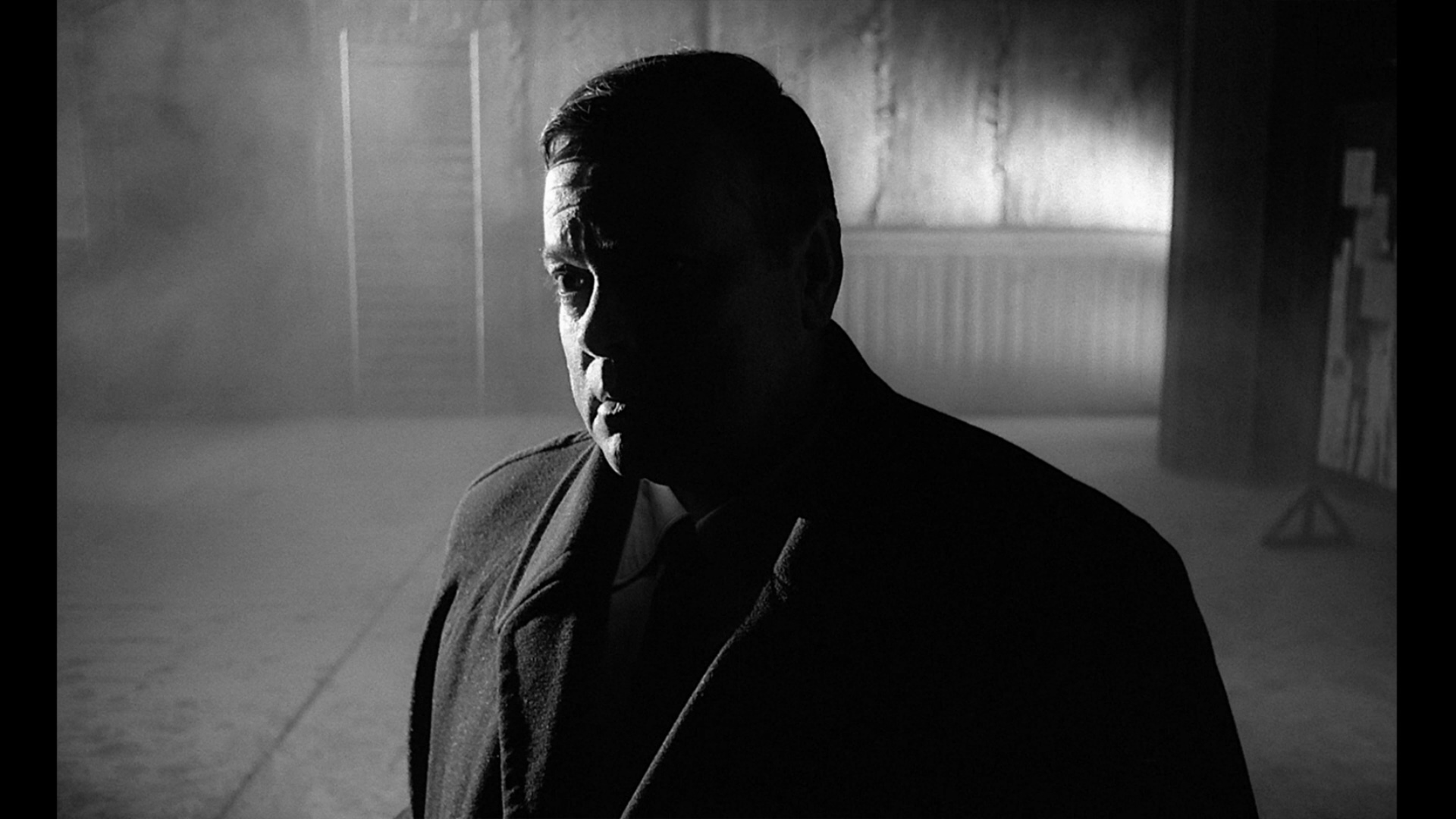
Welles in The Trial (1962).
__
From Mercury to Mars is a joint six-month venture between Sounding Out! and Antenna at the University of Wisconsin. The fifteenth and final post, by radio historian Jennifer Hyland Wang, is coming on Antenna in a few weeks.
To catch up on the series, check out our preceding posts.
- Here is “Hello Americans,” Tom McEnaney‘s post on Welles and Latin America
- Here is Eleanor Patterson‘s post on editions of WOTW as “Residual Radio”
- Here is “Sound Bites,” Debra Rae Cohen‘s post on Welles’s “Dracula”
- Here is Cynthia B. Meyers on the pleasures and challenges of teaching WOTW in the classroom
- Here is Kathleen Battles on parodies of Welles by Fred Allen
- Here is Shawn VanCour on the second act of War of the Worlds
- Here is the navigator page for our #WOTW75 collective listening project
- Here is Josh Shepperd’s post, “War of the Worlds and the Invasion of Media Studies”
- Here is Aaron Trammell‘s remarkable mix of the thoughts of more than a dozen radio scholars on “War of the Worlds.”
- Here is our podcast of Monteith McCollum‘s amazing WOTW remix
- Here is “Devil’s Symphony,” Jacob Smith‘s study of the “eco-sonic” Welles.
- Here is Michele Hilmes‘s post on the persistence and evolution of radio drama overseas after Welles.
- Here is A Brad Schwartz on Welles’s adaptations of Sir Arthur Conan Doyle.
Share this:


Current Top Posts





April 2021

January 2020

November 2019

October 2019

August 2019

April 2014

November 2017

March 2015

December 2017

October 2015
 Sounding Out!
Recent Comments