
And you will know us by the sound of vuvuzelas
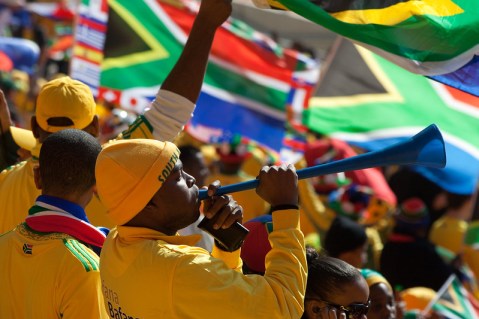
Despite some stunning matchups, the news story of the 2010 World Cup has undoubtedly been the vuvuzela. While there have been valiant efforts to the contrary (see Jennifer Doyle’s article in The Guardian about homophobia and sexual violence), not a newscycle goes by without some reference to this small plastic horn.
Designed in South Africa in the 1960s as a more portable facisimile of traditional kudu horns —and now mass-produced by the thousands in Chinese factories—the vuvuzela’s drone has been broadcast across the globe to the thrill of some and the annoyance of others. Non-African players have complained of headaches and difficulty playing because of the constant, loud sound; the BBC has created a special filter to block out some of the horn’s buzzing tones for at-home viewers. An oddly virulent backlash against the rising popularity of the horn outside of South Africa has effected bans against the vuvuzela at events as distant from South Africa and FIFA as one can get: the U.S. based Ultimate Fighting Championship, the Scottish T music festival, and, most recently, Nathan’s Coney Island Eating Competition, lest the horn “damage the competitive eating aesthetic.” The language used by many of these bans is that of contagion, like the sound of the vuvuzela is the herald of an infectious disease or a plague of locusts.
There have been many critiques of the horn at the level of decibels and hearing damage—the vuvuzela is reportedly 127 decibels, louder than a rock concert—although by that same logic the entire sport of NASCAR should be banned outright, as the New York Times reports it at a whopping 140 decibels. The pointed Nathan’s ban targeting “aesthetics” cuts to the quick of this heated debate. As an African instrument with its own particular history and cultural protocols, the vuvuzela seems to bother some people—namely members of Western and European nations—much more intensely than others, and for different reasons. Two of my husband’s coworkers, from the Ivory Coast and Grenada respectively, described the vuvuzela as a symbolic African diasporic sound of celebration that makes many white people uncomfortable; banning it outright would be not only an obvious pander to Western sensibilities—especially a preference for song over more random outbursts of sound—but also offensive, especially as South Africa is hosting the event. Or as the Botswana Voice Newsblog broke it down: “Hands Off the Vuvuzela!”
Dissenting voices have described the horn as annoyingly loud at best and disturbingly disruptive at worst. John Leicester, sports columnist for the Associated Press, managed to describe the sound of the horn as both “mindless” and “brainless” in his blog “Vuvuzela drone killing World Cup atmosphere,” as opposed to what he calls “football’s aural artistry”: the “ooohs,” “ahhhs,” and stadium chants of the “inventive” English who are “usually among the best-drilled noisemakers in football” but have been tragically drowned out by the “brainless” horns. After cultural comparisons like this—along the lines of the old racialized mind/body split concocted during the Enlightenment—it is difficult not to read Leicester’s closing plea, “Please, South Africa, make them stop. Give us a song, instead,” as a latent desire to control African people, not just their sonic output. At the very least, it is a tacit acknowledgement that the world is still divided along the lines of “us” and “them” and that sound plays a much larger role in facilitating these uneven power dynamics than previously thought.
It has also shown the world that struggles over the shifting border between sound and noise are rarely just that. It is precisely in such battles where sound studies can make an important intervention. . .so drop us a comment on the vuvuzela and the intense reactions it has elicited. What do you think? Has the vuvuzela been racialized? Is it a case of noise just being noise? Or is this phenomenon something else altogether? At the very least, blow one for yourself here and get a taste of what all the fuss is about.
JSA


Share this:

Reading the Politics Of Recorded Sound

Just released this past month, Social Text 102: The Politics of Recorded Sound is the latest special issue to take the temperature of the field of sound studies. Answering the provocative question posed by Michelle Hilmes in a 2005 review essay for American Quarterly (which will soon have its own special issue on sound), “Is There a Field Called Sound Culture Studies? And Does It Matter?” with a resounding “yes! and yes!”, the issue elegantly captures both the rigorous possibilities and the vexing challenges of this now-emerged interdisciplinary field. ST 102 is edited by Gustavus Stadler, Associate Professor of English at Haverford College, and the issue curates interdisciplinary essays by David Suisman, Mara Mills, Jennifer Stoever(yours truly), Stadler, Alexandra T. Vasquez, and Jayna Brown that challenge traditional technology-driven narratives of recording history by excavating the multiple, conflicted, and sometimes generative ways in which sound recording is tangled in networks of power like an old cassette tape gone wrong.

Given space limitations and my own vested excitement over the issue, my writing here will be more preview than review, slicing you off a tantalizing tidbit rather than chewing it all up for you. It really is something that critical sound studies heads will want to mull over on their own, and toward that end, I include links to each piece that take you to Social Text’s newly-revamped website where you can read the abstract, listen to hand-selected audio supplements, and download the article if you have an institutional subscription. My analog peeps can order hard copy of the issue here. Readers in the New York area can celebrate the issue’s release on Friday, April 30th @ NYU’s Tisch Center.
Gustavus Stadler’s “Introduction: Breaking Sound Barriers” takes the supposed transparency of recording technology to task and asks readers to consider not only what recording has enabled but what it has foreclosed. Eschewing technological determinism, Stadler writes, “what matters here is learning how to hear what power, history, culture, and difference sound like. Those categories are, ultimately, the ‘technology’ of sound recording” (10-11).
David Suisman’s “Sound, Knowledge, and the ‘Immanence of Human Failure’: Rethinking Musical Mechanization through the Phonograph, the Player-Piano and the Piano” recounts the forgotten history of the player piano, which once battled it out with the phonograph for the title of sound playback technology du jour. After reading Suisman, the ways in which scholars have tuned out the player piano will seem utterly surprising, given its importance as a forerunner of digital modes of reproduction.
Mara Mills’s “Deaf Jam: From Inscription to Reproduction to Information” tackles the complex history of the telephone, arguing for a more prominent place for telephony in media studies and exposing the submerged history of the use of disabilities within technoscience. Though deaf participants were invaluable in the quest to make speech more “streamlined,” scientists and marketers eventually redacted deaf populations themselves in the name of “efficiency.”
My “Splicing the Sonic Color-line: Tony Schwartz Remixes Postwar Nueva York” introduces readers to Tony Schwartz, sound artist and audio thinker, and reads his 1955 Folkways recording Nueva York as symptomatic of the ways in which listening experiences both reflect and generate ideas about racial difference and American citizenship. Using archival methods to reconstruct the soundscape of 1950s New York, I theorize the presence of what I call the “sonic color-line” in the U.S., linking sound and listening to bodily codes of race.
Gus Stadler’s “Never Heard Such a Thing: Lynching and Phonographic Modernity” explores the quiet-as-its-kept rumors of on-site lynching recordings made in the nineteenth century, using archival methods to expose their falsehood even as he notes how the presence and circulation of lynching (re)productions reveals another edge of the centuries-long white obsession with black voices and the marketability of black pain. Stadler very powerfully connects the “cheapness and tenuousness” of cylinder inscriptions with the “cheapness and tenuousness of black lives as shaped by the white supremacist turn-of-the-century United States” (103).
Alexandra T. Vasquez’s “Can You Feel the Beat”? Freestyle’s Systems of Living, Loving, and Recording” takes us into New York’s recording studios in the 1980s to amplify the suppressed experiences and unsung professionalism of Freestyle’s leading divas: Nayobe Gomez, Judy Torres, Cynthia. Vasquez’s critical labor enables us to hear these singers anew, exploring their work as theorists of the everyday, crafting pleasure, pain, and experience into a set of “bad ass armaments” for their listeners (122).
And finally, Jayna Brown’s “Buzz and Rumble: Global Pop Music and Utopian Impulse” reimagines both “world music” and “utopia” in her provocative essay on digital music’s newfound (and decentered) possibilities: to subvert national boundaries, evade corporate control, and heal bodies torn apart by capitalism and seemingly perpetual war. Tracing the complex links between Congotronics, Buraka Son Sistema, M.I.A. and kuduro music in Angola, Brown’s essay is not only a resonant reminder of the liberatory potential of music, but of scholarship as well.
JSA


Share this:


Current Top Posts





April 2021

January 2020

November 2019

October 2019

August 2019

April 2014

November 2017

March 2015

December 2017

October 2015
 Sounding Out!
Recent Comments