
SO! Reads: Zeynep Bulut’s Building a Voice: Sound, Surface, Skin

.

Voice and sound theorist Zeynep Bulut’s Building a Voice: Sound, Surface, Skin (Goldsmiths Press, 2025) is a remarkable work that reconfigures the ways we define “voice.” The text is organized into three sections—Part 1: Plastic (Emergence of Voice as Skin), Part 2: Electric (Embodiment of Voice as Skin), and Part 3: Haptic (Mediation of Voice as Skin)—each articulating Bulut’s exploration of the simultaneously personal and collaborative ways voice evolves among various sonic entities and environments. Through analyses of several artistic works that experiment with sound, Bulut successfully highlights the social effects of these pieces and how they alter our expectations of what it means to communicate and be understood.
It’s easy to reduce one’s understanding of voice to the purely spoken, the dialogic, the linguistically communicative, but Bulut’s conception of voice reaches beyond these forms. In her introduction, she states that she represents voice as something that “…evolves, through varied sounds, senses, bodies and technologies. In other words… distributed forms and instances of voice, which underlie the making of a voice, instead of giving a voice to something or someone, or being given a voice” (1). Whereas it may be easy to consider voice as something insular and complete, Bulut argues that it is in fact highly contestable, and shifts based on various environmental/social circumstances—this she aptly labels the “plasticity of voice.” Since Bulut envisions voice as something malleable, this unearths its responsive potentials, and eventually leads us to the image that Bulut will repeatedly return to over the course of the text—”voice as skin.”

Initially, “voice as skin” may seem perplexing, as these two elements appear in direct contrast to each other. However, I believe that the blending of these assumedly divergent facets is what makes Bulut’s work and scholarship so strong. None of her arguments complacently subsiston the known, the expected, and so when she presents voice as skin, it makes sense that she has formed this concept in order to continue extending her readers’ understandings of how we embody and experience sound.
Voice as skin is meant to illuminate the responses and sonic productions that often go unnoticed. It is a dynamic presence that defies static restrictions desperate to make it only one thing. It is “…imagining voice as a multisensory interface, a tactile and haptic affect across bodies of all kinds, without being limited to the human body, to human audition or the labels of verbal language” (234). As you proceed with Bulut’s argument, voice as skin repeatedly arises in different, somewhat surprising iterations throughout the chapters, continuously reframing the ways one may consider the experiential potentials and qualities of sound. “Voice is already a plural phenomenon” (218) Bulut states, “Each one of us carries another’s voice” (218). Everyone is in possession of their own sonic productions, but because we exist within a shared sonic landscape—Bulut regards this through Bruce Odland’s concept of the “sonic commons”—we have to become more sensitive resonant sources for the sounds that are directed at and emerge from this voice as skin.
Bulut makes it clear that there is a consequence to sound. Even when an individual is not engaged in dialogue or aurally responding to some other sonic stimuli, there is a voicing—a reaction, a sensing, a renegotiation of the body within the shifting soundscape—that occurs. Bulut analyzes a myriad of experimental sound artworks throughout Building a Voice, but her analysis of Pauline Oliveros’s Environmental Dialogue is where she really drives home the various ways in which one may “respond” to sound: “You listen to the sound attentively, and may respond to it or not… Regardless of a vocal or instrumental articulation of a pitch, therewould be a mental reinforcement in the process” (68). In later chapters, specifically those in Part 3 that discuss gesture as voice and biosensing musical interfaces, Bulut states that “Bodies constantly talk” (173)—that is, they inherently articulate something that either represents themselves or a reaction to another sonic production.
What Bulut’s readers receive throughout Building a Voice is a work of scholarship that strives against the possibility of sonic apathy. Even while attempting to not respond to a sound or pitch, one still notes—pun intended—the impact of these sonic productions on themselves and the space around them. Not saying anything is still a statement, Bulut reveals. It still “voices.”
Bulut’s diversification of voicing is astounding to read, but what I admire most about Building a Voice is that it underscores the importance of hearing. When Bulut discusses the ways we do or do not listen, I believe her scholarship becomes especially timely. In Part 2, Chapter 6: “Sharing a Skin,” Bulut describes the limits of empathy when it comes to fully hearing another individual: “We hear one another through our own wounds and then only partially” (134). She doesn’t make this claim to invalidate others’ efforts to show empathy. In fact, I think there is significant care contained in this specific argument. Rather than believe one is innately endowed with the skills to hear someone, or assume someone has the ability to fully hear us, Bulut encourages her readers to approach these experiences with humility:
We may be frustrated with the fact that no one truly understands or hears us, or that someone imagines that they understand us when they don’t. There is no full translation or hearing of anything. We can only connect in parts. We can only be a sounding board that both echoes and diffracts (134).

We are living in a time where several historically vulnerable communities face daily antagonization at home and abroad. Simply opening social media will present you with multiple posts pleading for allies to speak out for those facing ridicule, abuse, and even annihilation. For individuals who elect to answer those calls—who feel compelled to take on the profound commitment of assuming a “voice” for these communities—Bulut’s book provides some necessary food for thought. If we cannot fully hear nor understand those we wish to advocate for or protect, how might we renegotiate our current styles of activism away from the idea of “giving voice” (or, for that matter, considering anyone to be “voiceless”)? How might we honor the differences between individuals without viewing this as a move toward disconnection, an acceptance of inaction?
Building a Voice is an exciting text because it presents one with so many beautiful examples of experimental sound art, but I believe it becomes asocially integral work when Bulut indicates why revolutionizing the way we execute our methods of hearing and voicing is so important. By this, she doesn’t just illustrate the ways in which one builds a voice, she also reveals how one builds a kind of sonic and social consciousness. To read Building a Voice is to have one’s understanding of their own and the world’s resonant capabilities irreversibly transformed. This is writing about sound on another frequency—it’s time to tune in.
—
Featured Image: “Plantar Aspect,” by Pekka Nikrus, CC BY-NC-SA 2.0
—
Enikő Deptuch Vághy is a poet, artist, and editor. She is currently a PhD candidate in the Program for Writers at the University of Illinois at Chicago. Additionally, she is the Founding EIC of the literary and arts journal Lover’s Eye Press.
—

REWIND! . . .If you liked this post, you may also dig:
SO! Reads: Steph Ceraso’s Sounding Composition: Multimodal Pedagogies for Embodied Listening–Airek Beauchamp
Deep Listening as Philogynoir: Playlists, Black Girl Idiom, and Love–Shakira Holt
Listening to and through “Need”: Sound Studies and Civic Engagement–Christie Zwahlen
“Listening to the Border: ‘”2487″: Giving Voice in Diaspora’ and the Sound Art of Luz María Sánchez”-D. Ines Casillas
Share this:

SO! Amplifies: The Electric Golem (Trevor Pinch and James Spitznagel)

—
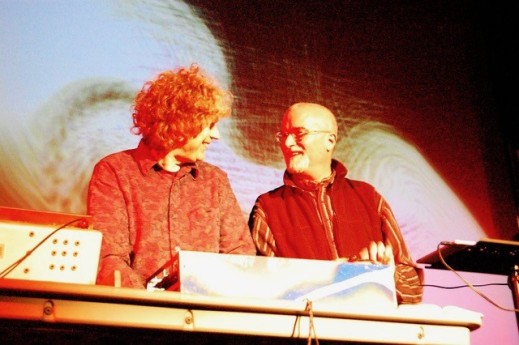
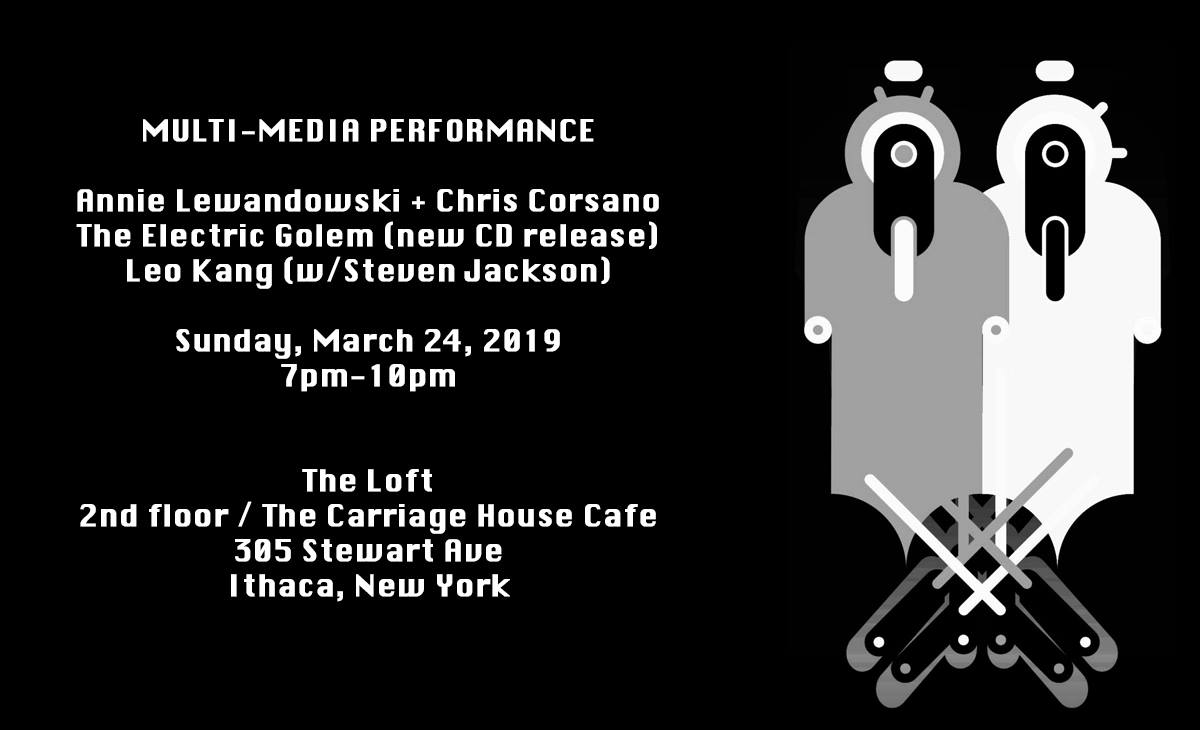
On March 24th, 2019 the record release party for The Electric Golem’s 6th CD Golemology was held at the Loft in Ithaca, New York. The Electric Golem is an avant-garde synthesizer duo featuring Trevor Pinch and James Spitznagel, that has been in existence for about ten years.
Trevor Pinch is a local sound artist and professor at Cornell University. He is an STS (Science and Technology Studies) and Sound Studies scholar. As a key thinker of STS, Trevor is the coproducer of theories about Sociology of Scientific Knowledge, Social Construction of Technology (SCOT), and the role of users in technological history and innovation. However, Trevor’s interest in dates back much farther; he built his first modular synthesizer when he was a physics student in London in the 1970s.
The other half of The Electric Golem, James Spitznagel, is a multi-media artist who uses the iPad as a musical instrument and to create digital paintings. While he has played many roles in the music and culture industries—guitarist in a rock band, record store owner, art gallery and guitar shop investor, and even business manager for the Andy Warhol Museum—he moved to Ithaca to focus on producing abstract art: digital paintings and experimental, improvisational music. Being an energetic and enthusiastic person who has unrestrained fantasies, James finds that everything around him can be his inspiration.
Pinch and Spitznagel formed the group after Spitznagel read Analog Days: The Invention and Impact of the Moog Synthesizer (by Trevor Pinch and Frank Trocco) and realized Pinch also lived in Ithaca. Spitznagel simply looked his name up in the phone book and called him up: “I go, ‘is this Trevor Pinch?’ He said, ‘yes.’ I said, ‘well, you don’t know me, but I just read your book and I love it.’” And then they got together for a beer and have been best friends and collaborators ever since. Once Spitznagel heard about Pinch’s homemade synthesizer, he asked Trevor to try to make something together and it turned out to be a fascinating mixture of analog–Trevor’s synth, Moog Prodigy, and a Minimoog–and James’s digital instruments.
Building from this first moment of discovery, The Electric Golem’s music is electronic, experimental, and totally improvised. Typically, the pieces of music last twenty minutes to half an hour and expresses their interaction with the machines and with each other in the studio. James is much more controlling of the tone and rhythm, and patches the sound as he goes along, whereas Trevor is much more about making spontaneous weird sounds. They complement each other and the creation process is usually by random and spontaneous, as Spitznagel describes: “I didn’t tell Trevor what to do or what to play, but I said, here’s the piece of music I’ve written. He just instinctively knew what add to it.” Reciprocally, “he might just play something that I go, oh, I can weave in and out of the ambient sound he’s putting there.”
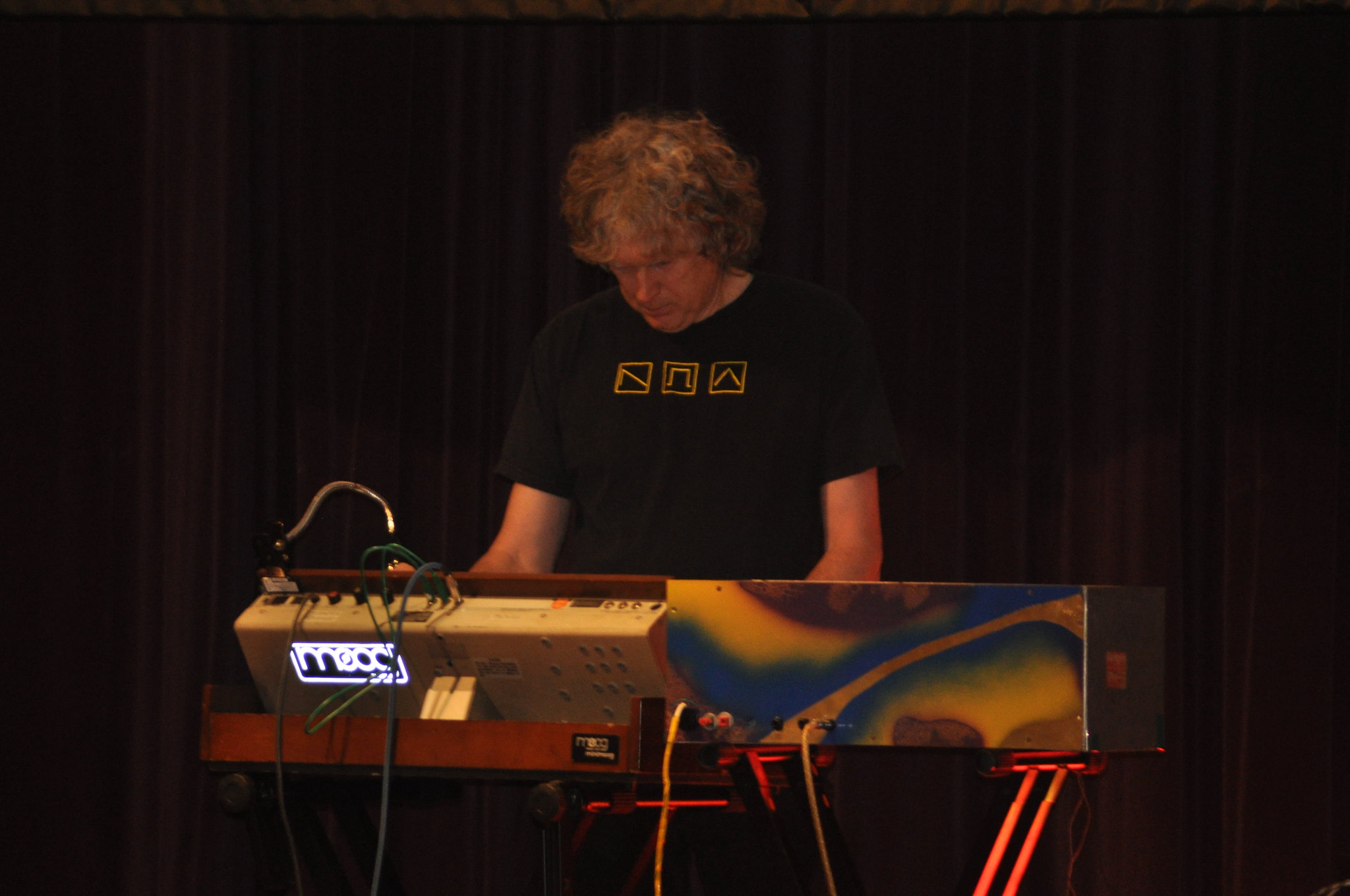
Trevor Pinch, Electric Golem at Elmira College, 2012
For the duo, the process of producing music becomes a shared experience with their listeners. The music is ever changing and evolving. In addition, unexpected drama adds vitality to the palette. “The iPad might freeze up or synthesizer might break somehow,” Spitznagel notes, “that’s happened to us, but we carry on. Like Trevor looks at me and says, it’s not working there. Or, I look at him and go, I have to reboot my computer, it’s not working. But, those times actually inspire us to try new things and go beyond what we are doing.” James explained. Their inspiration comes from the unknown, which just emerges from their practice. “Generally, this sort of music is completely unique to Electric Golem.” Trevor concluded.
The name “Electric Golem” comes from a series of books with Golem in the titles that Trevor collaborated on with his mentor Harry Collins. “The golem is a creature of Jewish mythology,” Pinch and Collins wrote in The Golem, What You Should Know about Science, “it is a humanoid made by man with clay and water, with incantations and spells. It is powerful, it grows a little more powerful every day. It will follow orders, do your work, and protect you from the ever threatening enemy. But it is clumsy and dangerous. Without control, a golem may destroy its masters with its flailing vigour” (1). Noting Trevor’s association with the concept of the Golem, Spitznagel added the “Electric” twist not just as a metaphor for their sound but also because “it’s kind of like a retro name.” The Electric Golem mushroomed from there, and in the past decade they have had many invitations and bookings to play out, receiving the first recording contract from the Ricochet Dream label, and have played with a bunch of notable musicians, such as Malcolm Cecil of Tonto’s Expanding Head Band, Simeon of Silver Apples, and “Future Man” (aka Roy Wooten), and they haven’t stopped there.
According to Pinch, the key feature of The Electric Golem’s music is its ability to encompass different moods. “I think Electric Golem has become good at one thing: its changing and transitioning from one sort of mood of music to another. And we have become quite good at those transitions. I think people would say that’s what they kind of like about us.” These sorts of slow transitions construct a unique texture of sound that can be quite cinematic, so much so that in 2012, the Electric Golem performed the accompaniment to the silent movie A Trip to the Moon, a special Cornell cinema event. Overall, as improvised experimental music, it is sometimes challenging to listen to, with no regular rhythm or reliable melody. Trevor produces warm, rich drones from the analog side that contrast with the sharper digital rhythms that James programs. In short, the Electric Golem varies between these two affects but the music goes far beyond the representation of emotional states; sometimes it conjures up the feeling of the vastness of space and time.
Experimental music, is a collaboration and negotiation process between instruments and their users. No matter if analog or digital, instruments have autonomy; they are non-human actors with their own agency to some extent. As Trevor Pinch intimates, “I understand the general sort of sound that can be produced, but the particular details of how it will work out, you don’t really know, that’s much more spontaneous, you have to react to that.” Instruments can often be uncontrollable–making their own sounds—so that Electric Golem must respond in kind. “So, it’s sort of like higher level meta-control versus actually doing what you’re doing in response to the instrument that combines together,” Trevor describes, “which I think is the secret to controlling these sorts of instruments.” It is incredible that Pinch and Spitznagel know each other so well—and each know their instruments so well–that they can improvise for long periods with no trouble. Trevor says: “Follow the use of these instruments! Follow the instruments! They are not essentialized. They are just stabilized temporarily.”
On the whole, The Electric Golem shows an artistic form which breaks the traditional paradigm, deconstructs and then reconstructs it, seeking to free sound from the instruments. Their music is beyond pure melody and rhythm, beyond the expression of existence, expressing more of an aesthetic state of transcendence. They challenge what music is, and what musical instruments are; they challenge divisions between the identities of engineer and musician. Electric Golem’s music co-constructs art and technology and binds them together; art, for them, is a mode of presenting technology, and vice versa, technology is a pathway through which art can flourish.
My favorite Electric Golem piece is called “Heart of the Golem.” What is the heart of the Golem? According to Pinch, “It is a mystery, a process of unfolding and discovery. It is somewhere where analog and digital sound meet, and an improvisation.” What the magic is remains unknown and unlimited, just like the future of the Electric Golem.
—
Featured Image: Courtesy of The Electric Golem
—
Qiushi Xu is a PhD candidate in the subject of Philosophy of Science and Technology in Tsinghua University, Beijing and in a joint PhD program in the Department of Science and Technology Studies in Cornell University, working with Prof. Trevor Pinch. Her research areas are Sound Studies, STS, Cultural Studies and Gender Studies. Her current research focuses on the sociology of piano sound and the negotiation and construction of piano sound in the recording studio (PhD dissertation), gender issues in recording industry, experimental music, auscultation and sound therapy. She holds an MA in Cultural and Creative Industries from King’s College London; a BA in Recording Arts and a BA in Journalism and Communication from the University of China, Beijing. She is also an amateur pianist, writer, and traditional Chinese painter. As a multiculturalist, she is am fascinated by different forms of art and culture in different cultural contexts.
Share this:


Current Top Posts





April 2021

January 2020

November 2019

October 2019

August 2019

April 2014

November 2017

March 2015

December 2017

October 2015
 Sounding Out!
Recent Comments