
Sounding Out! Podcast #40: Linguicide, Indigenous Community and the Search for Lost Sounds

CLICK HERE TO DOWNLOAD: Linguicide, Indigenous Communities and the Search for Lost Sounds
SUBSCRIBE TO THE SERIES VIA ITUNES
ADD OUR PODCASTS TO YOUR STITCHER FAVORITES PLAYLIST
This podcast is an effort to understand the cultural practices which surround the recovery of “lost sounds.” These are early linguistic sounds that have been forgotten after years of cultural and martial violence toward indigenous communities in America.
From the very beginning of the invasion of the Americas that began in 1492, Eurocentric ideologies overwhelmingly failed to recognize the strengths of American Indian cultures. Evaluating Native people as “savage,” efforts to westernize the tribes alternated between genocide and acts of removal. Government supported education, amongst other things, became the primary means to accomplish the forced eradication of Indian language. The loss of language as a component of ongoing colonization is what Hawaiian scholar Noenoe K. Silva has called “linguicide.” The results of “linguicide,” as the suppression of indigenous languages and cultures in the United States, has been catastrophic for American Indian and Alaska Native peoples.
For Indigenous people, the spoken language is a cherished intellectual treasure. Each sound captures how we see the world. Native American languages are oral, but some of them have been written in the last three centuries. There are over two hundred different North American languages still spoken by peoples of the United States and Canada. That is, of the over three hundred pre-contact languages originally spoken, only two hundred languages still remain. Fortunately, Native communities are fighting hard to keep these languages alive through sustainability efforts and revitalization projects.
I wonder about the relationship between “lost sounds,” indigenous language, and personal experience. How did we come to lose the language in our own homes? How does this loss continue today? What is being done to “find lost sounds”? How are we, as Native people, searching for the sounds, and what does that process mean to us? The conversation in this podcast is not about the science of linguists, it is not about history or the methods of linguistic preservation. Instead, it is a conversation about the experience of listening and trying to hear how we once were.
–
Marcella Ernest is a Native American (Ojibwe) interdisciplinary video artist and scholar. Her work combines electronic media with sound design with film and photography in a variety of formats; using multi-media installations incorporating large-scale projections and experimental film aesthetics. Currently living in California, Marcella is completing an interdisciplinary Ph.D. in American Studies at the University of New Mexico. Drawing upon a Critical Indigenous Studies framework to explore how “Indianness” and Indigenity are represented in studies of American and Indigenous visual and popular culture, her primary research is an engagement with contemporary Native art to understand how members of colonized groups use a re-mix of experimental video and sound design as a means for cultural and political expressions of resistance.
—
 REWIND! . . .If you liked this post, you may also dig:
Sounds of Science: The Mystique of Sonification – Margaret Anne Schedel
Radio and the Voice of the Aymara People – Karl Swinehart
The “Tribal Drum” of Radio: Gathering Together the Archive of American indian Radio – Josh Garrett-Davis
Share this:

Sounding Out! Podcast #38: Radio Frequencies, Radio Forms LIVE


.
CLICK HERE TO DOWNLOAD: Radio Frequencies, Radio Forms LIVE
SUBSCRIBE TO THE SERIES VIA ITUNES
ADD OUR PODCASTS TO YOUR STITCHER FAVORITES PLAYLIST
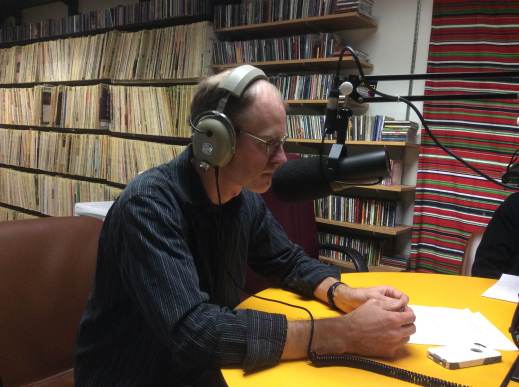
Today’s podcast is an archival recording of “Radio Frequencies, Radio Forms LIVE,” a special program on WHRW, Binghamton University’s free-format radio station, broadcast on December 15, 2014 from 6:00-7:30. Part original radio art broadcast and part “Behind the Artists’ Studio” conversation, “Radio Frequencies” represents the culmination of a semester-long experimental collaboration between Professor Jennifer Stoever (BU English) and Filmmaker, Sound Artist and Professor Monteith McCollum (BU Cinema) and the students of their advanced transdisciplinary seminar “Resonant Frequencies: Exploring Radio Forms.”
Over the course of the Fall 2014 semester, students learned the fundamentals of recording and editing while discussing radio history, sound production, sound art history, and theories of sound and listening to copious (and diverse) radio pieces ranging from Aimee Temple McPherson sermons to Norman Corwin’s We Hold These Truths, the Suspense episode “Sorry, Wrong Number” to Delia Derbyshire’s “The Dreams.” McCollum and Stoever’s students were creative, interested, driven and exceptionally talented; two from the course, Tara Jackson and Aleks Rikterman, went on to have some of their semester’s work featured in the 2014 Mix for Wavefarm’s annual 60 X 60 competition, the only two students alongside seasoned arts professionals, professors, radio producers, and Prix Italia Winners.
The WHRW broadcast features well-crafted recordings of the course’s capstone project—4 collaboratively developed original 8-10 minute radio pieces—alongside fascinating live discussions between Monteith, Jennifer, and their students about radio as medium, broadcast vs. performance aesthetics, the process of recording, manipulating, and editing sounds, the students’ radio influences, the role of the listener, the value of radio’s past and their forecasts about its future. This podcast is a must listen for anyone interested in radio production and history, creative pedagogy, conversations about sound art, or just interesting and unexpected listening!
Credits:
- “Amarilli,” a suspenseful radio drama scripted, performed, recorded, edited, and mixed by Maggie Leung, Hyucksang Sun, and Daniel Hong.
- “The Parlor City,” interwoven radio-verite stories about Binghamton, NY conceived, recorded, edited, and mixed by Yang Gao, Daniel Santos, and Ashley Verbert.
- “Untranslatable” an artistic sono-montage piece about language conceived, recorded, performed, edited, and mixed by Tara Jackson, Anna Li, and Michael Ederer.
- “Pura Vida: Solo Travel” a documentary interview montage conceived, recorded, scored, edited, and mixed by Aleksandr Rikterman and Garrett Bean.
Hosts and Executive Producers: Monteith McCollum and Jennifer Stoever
Opening Interview: Daniel Santos
WHRW Engineer: Tara Jackson
WHRW Program Manager: Daniel Kadyrov
McCollum and Stoever’s course was made possible by a generous transdisciplinary team-teaching grant from the Provost’s Office at Binghamton University, with thanks to Provost Don Neiman and Don Loewen, Vice Provost for Undergraduate Education
–
Monteith McCollum, Assistant Professor of Cinema at Binghamton University, is an inter-media artist working in film, sound, and sculpture. His films have screened at Festivals and Museums including The Museum of Modern Art, Hirshhorn, Wexner Center for the Arts and Festivals including SXSW, Slamdance, Hot Docs, Amsterdam & Osnabruck European Media Arts Festival. His films have garnered dozens of festival awards including an IFP Truer than Fiction Spirit Award. You can learn more about his work at monteithmcollum.com.
Jennifer Stoever is co-founder and Editor-in-Chief of Sounding Out! She is also Associate Professor of English at Binghamton University and a recipient of the 2014 SUNY Chancellor’s Award in Teaching.
—
REWIND! . . .If you liked this post, you may also dig:
SO! Reads: Susan Schmidt Horning’s Chasing Sound: Technology, Culture, and the Art of Studio Recording From Edison to the LP – Enongo Lumumba-Kasongo
Sounding Out! Podcast #34: Sonia Li’s “Whale” – Sonia Li
Sounding Out! Podcast #10: Interview with Theremin Master Eric Ross – Aaron Trammell
Share this:


Current Top Posts





April 2021

January 2020

November 2019

October 2019

August 2019

April 2014

November 2017

March 2015

December 2017

October 2015
 Sounding Out!
Recent Comments