
Listening to the A. D. White House: Cornell’s Society for the Humanities’ Year in Review
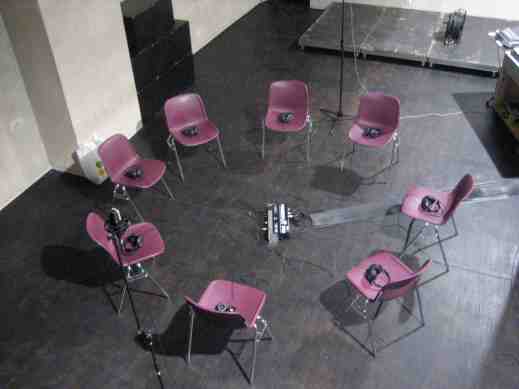
Today, Society for the Humanities Director Timothy Murray sings us back home with a meditation on the soundscapes of study at the A.D. White House this year, closing out our spring “Live from the SHC” series covering new research on “Sound: Culture, Theory, Practice, Politics.” The 2011-2012 Fellows have got to say goodbye for the summer–and sadly beyond–but we all hope that next years’ Fellows (2012-2013 Theme: Risk @ Humanities) enjoy all the good vibrations we will leave behind, and that you, Dear SO! readers, have enjoyed our broadcast! Our summer series, “Tuning In the Past,” on radio and legacy of broadcaster Norman Corwin, featuring Neil Verma, Shawn VanCour, and Alex Russo begins at the end of June. And, of course, every Monday in between and beyond, we’ll keep giving you something you can feel. –JSA, Editor in Chief (and 2011-2012 SHC Fellow)
—
Many thanks to Jennifer Stoever-Ackerman for hosting “Live from the SHC” on Sounding Out! What a fantastic experience it’s been to have Jennifer screening and tweaking Sounding Out! from her garret office overlooking the gardens behind the A.D. White House, the Cornell home of the Cornell’s Society for the Humanities. Readers of “Live from the SHC” have read various strains of this year’s focal theme, “Sound: Culture, Theory, Practice, Politics.” The aim of this year’s residential research project was to contemplate and analyze the resonance of historical and contemporary representations, movements, ideas, and negations of sound.
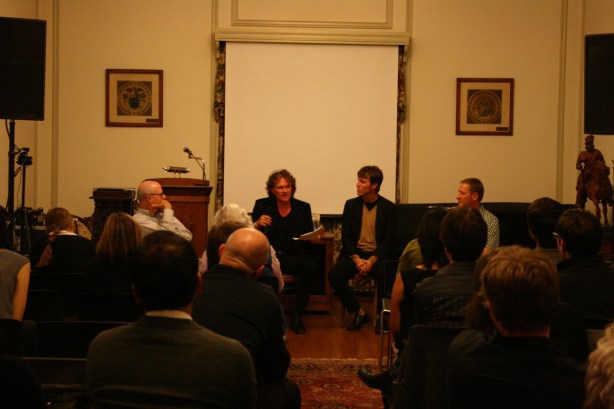
From Left: Tim Murray, Eric Lott, Tom McEnaney, and Marcus Boon, Image by Renate Ferro
Open to study of the broadest cross-cultural range of contexts and media that cross the boundaries of time and space–from East and West/South and North–the Fellows’ research delved into the complex ways that sound abounds in visual, textual, and aural realms. From “voicing” to “listening,” sound shaped the framework of our critical and philosophical analyses of the body, affect, and social publics. Sound came to be appreciated for its shaping of the parameters of psycho-cultural imaginaries, social practice, religious ritual, and political regulation throughout history and across the globe. Just as sound differs in the global context of capitalism and cosmopolitanism, not to mention the specificities of ethnic difference and cultural diversity, “voice,” “hearing,” and “listening” frame the humanities disciplines in relation to their aesthetic properties and political ramifications.

From Left: Eric Lott and Jennifer Stoever-Ackerman, Image by Jeanette Jouili
The Fellows found themselves reflecting on several key issues. Which criteria differentiates natural from artificial sounds? Does sound challenge disciplinary distinctions between the visual and the oral/aural/tactile? Can the loud noises of industrial culture be distinguished from the synthetic sounds of electronic music, the stammerings of performance and the vibrations of philosophical manifestos? It should come as no surprise to followers of Sounding Out! that sound marks the passage of time, the correlation of the aural to the movement of the body in dance and performance, the sonic promise of cartographic projects of social movements and migrations, and the cultural and ethnic specificities of acoustic fields and rhythms in the age of sampling and mixing, not to mention the gender, racial, and ethnic import of voice and spoken narrative.
Adding vibrant texture to our year-long discussions were the three weeks spent in extended dialogue with the Society’s Senior Invited Fellows. Emily Thompson (The Soundscape of Modernity) charted the histories of the architectonic sounds of cinema houses as well as the untraceable wealth of the historical sounds of New York City as its peripheries morphed from country estate to urban zone. Brandon LaBelle came from Norway to take us on a journey of artistic imagination and phenomenological hopefulness as he cruised his writings on Acoustic Territories and Site Specific Sound while sampling the background noises of his multimedia installations. Then Norie Neumark, fresh off the release of VOICE: Vocal Aesthetics in Digital Arts and Media (co-edited with Ross Gibson and Theo Van Leewen), arrived from Australia to follow up on our 2003 online seminar on Sound Cultures. She reminded us of the deep history of sound studies down under, while focusing our attention on voicings and her own multimedia art practice that blends spoken narrative, synthetic noise, mouthed breath, and shocks in the ear. [The “Live From the SHC” logo is a piece from Neumark and Maria Miranda’s “Shock in the Ear”–ED].
.
Various other visitors throughout the year included multimedia artists Mendi and Keith Obadike whose “not” Afrofuturism walked us through their exciting series of performance works,“Four Electric Ghosts,” Caitlin Marshall from Berkeley who brought cyborg speech to life with her prosthetic soundings, and renowned choreographer William Forsythe, whose four-hour choreography piece “Nowhere and Everywhere at the Same Time“–performed amidst amidst over 150 hanging pendulums–combined dance and environment as a means of physically manifesting the process of thought. Marjorie Garber from Harvard rode our acoustic wave to reflect on the future of the humanities while Norma Coates came down from Western Ontario to sensitize us to the mixes of pop sound and culture.

Brock Labrenz performs William Forsythe’s “Nowhere and Everywhere at the Same Time” at Cornell University’s Rand Hall on March 3, 2012. Image by William Staffeld / AAP
In listening back to the echoes of the year past, rather than here retracing the specific projects of our Fellows (you can consult the critical tales already Sound[ed] Out! by Damien Keane, Tom McEnaney, Nina Sun Eidsheim, Jonathan Skinner, Eric Lott, Jennifer Stoever-Ackerman, and Jeanette Jouili), I find myself sampling the sounds, noises, and glitches that provided unexpected reverbs for the academic writing happening behind closed office doors throughout the A. D. White House.
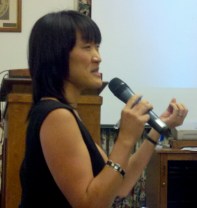
Nina Sun Eidsheim, Image by Renate Ferro
Sounds of glee, delight, and play first arrived on the scene at the end of August with gaggles of laughing and screaming kids running wild and climbing trees in the gardens, surrounded by bemused adults and envious dogs. Accompanying partners brought to the mix the diverse soundings of African film, suspicious packages, software beats, performance art, critical geography, and real estate hawking. No wonder the assembled Fellows strayed so readily, if not unconventionally, from the promised strictures of already exceptional research projects that brought to our weekly seminar table the street sounds of Egypt, Turkey, Korea, early modern Germany, contemporary Islam, American hip hop, contemporary art, circuit bending, gaming, German, Irish, U.S. and Latin American radio, voices of performers, animals, and posthumans, urban soundscapes, and, here making a loud call out to one Stoever-Ackerman, sonic color-lines.

Marcus Boon Rocks the Spring Workshop After Party–Image by JSA
Resounding throughout the year to give cadence and timbre to our serious ponderings were the spontaneous soundings that seemed always to give ample depth to the provocative interstices of intellectual life. There were the noises of glitch, circuit-bending, and Guitar Hero that stretched and extended the purpose of music and machinics. There were spontaneous voice lessons that turned anxious performers into wild choreographic objects. Singing above in the hidden alcoves–when not streaming through the high Victorian ceilings of the A. D. White House–were our flying mammal friends whose echolocation extended beyond the reach of our mere human ears. Then were the sudden noisy reminders of the vulnerability of our corporeal organs. Who could forget the reported imaginary of the crunch of human leg against car as two of our Fellows found themselves under assault from a crazed pizza delivery guy – luckily no lasting damage?
Our fellows will carry away the subliminal lacings of the lighter sounds of improvisation and camaraderie. There were the poundings of feet and slappings of bodies dancing late into the night after hours of laborious conferencing to the beats of DJs Marcus Boon, Art Jones, and Earmuffs.
.
At the end of the year, Fellows grooved to the beat of Tom McEnaney playing bass with The Vix Krater out at the Rongo in Trumansburg, NY (down the road from the home of Moog), before retreating to the bowels of the A. D. White House basement for another dusty, late night jam session with drums, synthesizer, guitars, bass, and various acoustics, led by the ultimate sound blogger herself, the guitar heroesse, Jenny S-A. [Well, I’m learning. So far I know E-Minor. It was Trevor that really broke my strings in! –ED].
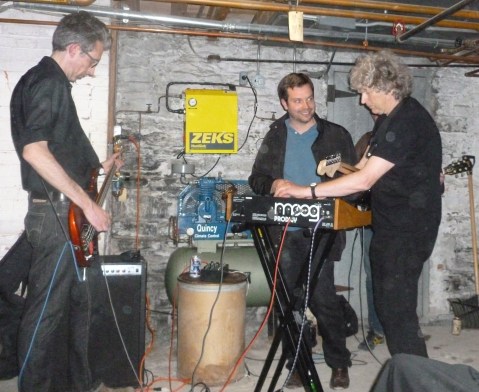
(From left) Damien Keane on bass, Michael Jonik, Trevor Pinch on Guitar and Moog, Image by JSA
And, yes, there was always the accompaniment of the clinks of glasses and bottles bearing the liquid life blood of any noisy crew.
The French philososopher, Jean-Luc Nancy, reminds us in Listening (2007) that the shared space of noise and sound entails “a totality of referrals: from a sign to a thing, from a state of things to a quality, from a subject to another subject or to itself, all simultaneously. Sound is also made of referrals: it spreads in space, where it resounds while still resounding ‘in me'” (7). What resounded and referred this year at the Society for the Humanities was the very immaterial and inchoate touch of sound, which is a-live in intensity and force. But who would have imagined the intensity of the noise of referral that remained so constant throughout the year to envelop the solid academic work of our Fellows in the wilding vibrations of jouissance? Indeed, perhaps the best lesson of the year, at a moment when the humanities finds itself threatened and in transition by the supposed certainty of metric and assessment, is that the Society’s scholarship in sound was driven by the relentless noise of referral and the unpredictable delight of the commune.

From Left: Renate Ferro, Ladi Dell’aira, Sarah Ensor, Jeanette Jouili, Nina Sun Eidsheim, Brian Hanrahan, and Norie Neumark, Image by JSA
—
Featured Image Credit: Brandon La Belle, Duck Duck Goose Installation, Ausland, Berlin
—
Timothy Murray is Professor of Comparative Literature and English and Curator of the Rose Goldsen Archive of New Media Art. He is the Cornell Principal Investigator of the Central Humanities Corridor, generously supported by a grant from the Andrew W. Mellon Foundation, and he sits on the International Advisory Board of the Consortium of the Humanities Centers and Institutes (CHCI) and the Steering Committee of the Humanities, Arts, Science, and Technology Advanced Collaboratory (HASTAC). He is Co-Moderator of the –empyre- new media listserv and the author of Digital Baroque: New Media Art and Cinematic Folds (Minnesota 2008); Zonas de Contacto: el arte en CD-ROM (Centro de la imagen, 1999); Drama Trauma: Specters of Race and Sexuality in Performance, Video, Art (Routledge, 1997); Like a Film: Ideological Fantasy on Screen, Camera, and Canvas (Routledge, 1993); Theatrical Legitimation: Allegories of Genius in XVIIth-Century England and France (Oxford, 1987). He is editor of Mimesis, Masochism & Mime: The Politics of Theatricality in Contemporary French Thought (Michigan, 1997) and, with Alan Smith, Repossessions: Psychoanalysis and the Phantasms of Early-Modern Culture (Minnesota, 1997). His curatorial projects include CTHEORY MULTIMEDIA and Contact Zones: The Art of the CD-Rom.
Share this:

DIANE… The Personal Voice Recorder in Twin Peaks

READERS. 9:00 a.m. April 2nd. Entering the next installment of SO!’s spring series, Live from the SHC, where we bring you the latest from the 2011-2012 Fellows of Cornell’s Society for the Humanities, who are ensconced in the Twin Peaks-esque A.D. White House to study “Sound: Culture, Theory, Practice, Politics.” Enjoy today’s offering from Tom McEnaney, and look for more from the Fellows throughout the spring. For the full series, click here. For cherry pie and coffee, you’re unfortunately on your own. –JSA, Editor in Chief
“I hear things. People call me a director, but I really think of myself as a sound-man.”
—David Lynch
From March 6-April 14 of this year, David Lynch is presenting a series of recent paintings, photographs, sculpture, and film at the Tilton Gallery in New York City. The event marks an epochal moment: the last time Lynch exhibited work in the city was in 1989, just before the first season of his collaboration with Mark Frost on the ABC television series Twin Peaks. At least one painting from the exhibit, Bob’s Second Dream, harkens back to that program’s infamous evil spirit, BOB, and continues Lynch’s ongoing re-imagination of the Twin Peaks world, a project whose most well known product has been the still controversial and polarizing prequel film Twin Peaks: Fire Walk With Me.
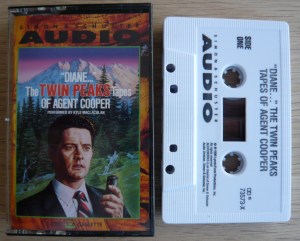
photo by Flickr user svennevenn
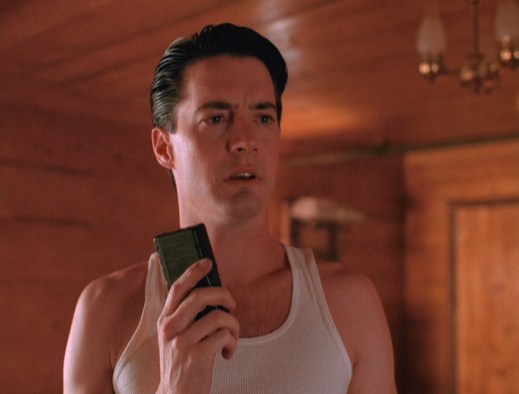
These forays into the extra-televisual possibilities of Twin Peaks began with the audiobook Diane…The Twin Peaks Tapes of Agent Cooper (1990). An example of what the new media scholar Henry Jenkins and others have labeled “transmedia storytelling,” the Diane tape provided marketers with another way to cash in on the Twin Peaks craze, and fans of the show a means to feed their appetite for FBI Special Agent Dale Cooper, aka Kyle Maclachlan’s Grammy nominated voice praising the virtues of the Double R Diner’s cherry pie.
Based on the reminders Cooper recorded into his “Micro-Mac pocket tape recorder” on the show, the cassette tape featured 38 reports of various lengths that warned listeners about the fishy taste of coffee and wondered “what really went on between Marilyn Monroe and the Kennedys.” As on the program, each audio note was addressed to Diane, whose off-screen and silent identity remained ambiguous. For the film and audio critic Michel Chion, Diane is an abstraction, or the Roman goddess of the moon. Others claim “Diane” is Cooper’s pet name for his recorder. The producers delivered their official line in the 1991 book The Autobiography of Special Agent Dale Cooper: My Life, My Tapes, “as heard by Scott Frost,” (the brother of Lynch’s co-creator), where Cooper says, “I have been assigned a secretary. Her name is Diane. I believe her experience will be of great help.”
Whatever her identity, on the show Diane became the motive for Cooper’s voice recordings, and these scenes laid the groundwork for the audiobook. However, unlike the traditional audiobook, which reads a written text in its entirety, Cooper’s audio diary cuts away parts of the story, and includes additional notes and sounds not heard on the show.
The result is something like a voiceover version of Twin Peaks. And without the camera following the lives of the other characters, listeners can only experience the world of Twin Peaks as Diane would: through the recordings alone. Strangely, the inability to hear anything more than Cooper’s recordings opens up a new dimension: even as eavesdroppers we come closer to understanding Diane’s point of audition, the point towards which Cooper speaks in the first place.
Back on the show, Cooper’s notes to Diane track his movements as he tries to solve the mystery of who killed the Twin Peak’s prom queen Laura Palmer. Strangely—and not much isn’t strange in Lynch’s work— in some sense this mystery has already been solved by the show’s second episode, where Laura whispers the name of her killer to Cooper in a dream.
.
.
However, Laura’s whisper remains inaudible to the audience, and Cooper forgets what she said when he wakes up in the next episode. Much of the remainder of the program, full of Cooper’s reports to Diane, was spent trying to hear Laura’s voice. Thus, Diane, the off-screen and silent listener, became the narrative opposite to Laura, whose prom queen photograph closed each episode, and whose voice became the show’s central fetish object. Moreover, this silent relationship changes how the audience hears Cooper’s voice. Rather than a chance to relish in its sound, Cooper makes his recordings because of Laura’s voice from the grave, and directs them to Diane’s ears alone. In other words, Cooper and his recordings become a conduit to Laura/Diane rather than a solipsistic memoir about his time in Twin Peaks.

This triangulation becomes more obvious, if no less complicated in a typically labyrinthine Lynchian plot twist. As I mentioned, the Diane tape makes Cooper’s reports into a kind of voiceover. Critics have interpreted them as a parody of film noir, a genre whose history Ted Martin argues in his dissertation is defined by the relationship between voiceover and death: “Noir’s speaking voice moves from being on the verge of death to being in denial of death to emanating immediately, as it were, from the world of the dead itself.” Fascinated by this history, Lynch tweaks it through the introduction of a mina bird, famed for its capacity to mimic human voices. Discovered in a cabin at the end of episode 7, season 1, the police find the bird’s name—Waldo—in the records of the Twin Peaks veterinarian, Lydecker. The combined names—Waldo Lydecker—happen to identify the attempted murderer of Laura Hunter responsible for the voiceover in Otto Preminger’s classic noir film Laura (1944). On Twin Peaks, Cooper’s voice-activated dictaphone records Waldo the bird’s imitation of Laura Palmer’s last known words, which also happen to be Waldo’s last words, as he is shot by one of the suspects in Laura’s death.
If we follow this convoluted path of listening, we can trace a mediated circuit—from Laura to Waldo to Cooper’s voice recorder—which locates the voice of the (doubled) dead in the Dictaphone, thereby returning that voice to its noir origins in another classic of the genre: Double Indemnity (1944) (see SO! Editor’s J. Stoever-Ackerman’s take on the Dictaphone in this film here). More than a mere game of allusions, this scene substitutes Cooper’s voice with the imitation of Laura’s voice, inverting the noir tradition by putting the victim’s testimony on tape. And yet, while Waldo tantalizes the audience with an imitation of the sound of Laura’s voice, it ultimately only reminds the listener of the silent voice: Laura’s voice in Cooper’s dream.
The longer this voice remained out of range of the audience’s ears, the more it produced other voices—from Cooper’s recordings to Waldo to the dwarf in the Red Room.
Eventually, however, the trail of tape and sound it left behind ended with the amplification of Laura’s whisper, which became as much the “voice of the people” as Laura’s voice. After all, ABC instructed Lynch and Frost to answer the show’s instrumental mystery (“Who killed Laura Palmer?”) because of worries about the program’s declining ratings 14 episodes after Laura’s first inaudible whisper. The audience’s entrance into the show through the mediation of marketers mimicked the idea behind the Dianetape, but with a crucial difference: now the audience tuned in to hear their own collective voice, rather than to hear what and how Diane heard. Laura’s audible voice was audience feedback. It was the voice they called for through the Nielsen ratings. The image of her voice, on the other hand, was an invitation to listen. And Cooper’s voice-activated recorder, left on his bedside, placed in front of Waldo, or spoken into throughout the show remained an open ear, a gateway to an inaudible world called Diane. Although critics and Lynch himself have compared the elusive director to Cooper, perhaps its Diane who comes closest to representing Lynch as a “sound-man.”

David Lynch, August 10, 2008 by Flickr User titi
—
Tom McEnaney is an Assistant Professor of Comparative Literature at Cornell University. His work focuses on the connections between the novel and various sound recording and transmission technologies in Argentina, Cuba, and the United States. He is currently at work on a manuscript tentatively titled “Acoustic Properties: Radio, Narrative, and the New Neighborhood of the Americas.”
Share this:


Current Top Posts





April 2021

January 2020

November 2019

October 2019

August 2019

April 2014

November 2017

March 2015

December 2017

October 2015
 Sounding Out!
Recent Comments