
Listen to the Sound of My Voice

Betrayal
I first realized there was a problem with my voice on the first day of tenth grade English class. The teacher, Mrs. C, had a formidable reputation of strictness and high standards. She had us sit in alphabetical order row after row, and then insisted on calling roll aloud while she sat at her desk. Each name emerged as both a command and a threat in her firm voice.
“Kelly Barfield?”
“Here,” I mumbled quietly. I was a Honor Roll student with consistent good grades, all A’s and one B on each report card, yet I was shy and softspoken in classes. This was an excellent way to make teachers amiable but largely go unnoticed. The softness of my voice made me less visible and less recognizable.
Mrs. C repeated my name. Caught off guard, I repeated “here” a little more loudly. She rose to her feet to get a better look at me. I knew what she saw: a petite girl with long ash blonde hair, big brown eyes, and overalls embroidered with white daisies on the bib. When her gaze finally met mine, Mrs. C frowned at me and cleared her throat loudly. I curled into my desk, hoping to disappear.

“Lincoln High School 9-16-2007 008” by Flickr user Paul Horst, CC BY-NC 2.0
“Miss Barfield, did you hear me call your name twice? In this class, when I call roll, you respond.” I gave a quick nod, but Mrs. C wasn’t finished: “We use our strong voices in here, not our girly, breathy ones.” My cheeks flushed red while Mrs. C droned on about confidence and classroom expectations.
“Do you understand me?”
I stammered a “yes.” Mrs. C turned her attention back to the roll call. Her harsh words rang in my ears. I sank low in my chair, humiliated and angry. I couldn’t help that I sounded girly: I was, in fact, a girl. This was the way my voice sounded. It was not an attempt to sound like the dumb blonde she appeared to think I was.
That day I decided that I would never speak up in her class. Forget the Honor Roll. If the sound of my voice was such a problem, then my mouth would remain firmly shut in this class and all of my others. I would never speak up again.

“Listen” by Flickr user lambda_x, CC BY-ND 2.0
My vow to stop speaking lived a short life. I enjoyed Mrs. C’s serious fixation on diagramming sentences and her attempts to show sophomores that literature offered ideas and worlds we didn’t quite know. At first, I spoke up with hesitation and fear of the inevitable dismissal, but I continued to speak. Becoming louder became my method to seem confident, even when I felt anything but.
Throughout high school, my voice emerged again and again as a problem. Despite the increased volume, my voice still sounded tremulous, squeaky, hesitant, and shrill to my own ears. Other girls had these steady, warm voices that encouraged others to listen to them. Some had higher voices that were melodic and lovely. I craved a lower, more resonant voice, but I was stuck with what I had. In drama club, our director scolded me with increasing frustration about my tendency to end my lines in the form of a question. My nerves materialized as upspeak. The more he yelled at me, the more pronounced the habit became. He eventually gave up, disgusted by my inability to control my vocal patterns.

By Dvortygirl, Mysid [GFDL (http://www.gnu.org/copyleft/fdl.html) or CC-BY-SA-3.0 (http://creativecommons.org/licenses/by-sa/3.0/)%5D, via Wikimedia Commons
Meanwhile, at a big state university in my native Florida, I learned quickly that a Southern accent marks you as a dumb redneck from some rural town that no one had heard of. Students in my classes asked me to say particular words and then giggled at my pronunciations. “You sound like a Southern belle,” one student noted. This was not really a compliment. According to my peers, Southern belles didn’t have a place in the classroom. Southern belles didn’t easily match up with “college student. As a working-class girl from a trailer park, I learned that I surely didn’t sound like a college student should. I worked desperately to rid myself of any hint of twang. I dropped y’all and reckon.
I listened carefully to how other students talked. I mimicked their speech patterns by being more abrupt and deadpan, slowly killing my drawl. When I finally removed all traces of my hometown from my voice, my friends both from home and from college explained that now I sounded like an extra from Clueless. My voice was all Valley girl. I was smarter, they noted with humor, than I sounded and looked. My voice now alternated between high-pitched and fried. Occasionally, it would squeak or crack. I thought I sounded too feminine and too much like an airhead, even when I avidly tried not to. I began to hate the sound of my voice.
My voice betrayed me because it refused to sound like I thought I needed it to. It refused to sound like anyone but me.
When I started teaching and receiving student evaluations, my voice became the target for students to express their displeasure with the course and me. According to students, my voice was too high and grating. Screechy, even: one student said my voice was at a frequency that only bats could hear. In every set of evaluations, a handful of students declared that I sounded annoying. This experience, however, was not something I alone faced. Women professors and lecturers routinely face gender bias in teaching evaluations. According to the interactive chart, Gender Language in Teaching Evaluations, female professors are more likely to be called “annoying” than their male counterparts in all 25 disciplines evaluated. The sound of my voice was only part of the problem, but I couldn’t help but wonder if how I sounded was an obstacle to what I was teaching them.
Once again, I tried to fix my problematic voice. I lowered it. I listened to NPR hosts in my search for a smooth, accentless, and educated sound, and I attempted to create a sound more like them. I practiced pronouncing words like they did. I modulated my volume. I paid careful attention to the length of my vowels. I avoided my natural drawl. None of my attempts seemed to last. Some days, I dreaded lecturing in my courses. I had to speak, but I didn’t want to. I wondered if my students listened, but I wondered more about what they heard.
Sound
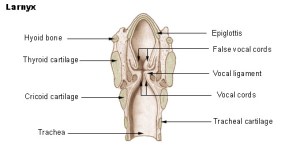
Public Domain, https://commons.wikimedia.org/w/index.php?curid=1393933
The sound of your voice is a distinct trait of each human being, created by your lungs, the length of your vocal cords, and your larnyx. Your lungs provide the air pressure to vibrate your vocal cords. The muscles of your larnyx adjust both the length and the tension of the cords to provide pitch and tone. Your voice is how you sound beyond the resonances that you hear when you speak. It is dependent on both the length and thickness of the vocal cords. Biology determines your pitch and tone. Your pitch is a result of the rate at which your vocal cords vibrate. The faster the rate, the higher your voice. Women tend to have shorter cords than men, which makes our voices higher.
Emotion also alters pitch. Fright, excitement, and nervousness all make your voice sound higher. Nerves would make a teenage girl have an even higher voice than she normally would. Her anxious adult self would too. Her voice would seem tinny because her larnyx clenched her vocal cords tight. Perhaps this is the only sound she can make. Perhaps she is trying to communicate with bats because they at least would attempt to listen.
Biology, the body, gives us the voices we have. Biology doesn’t care if we like the ways in which we sound. Biology might not care, but culture is the real asshole. Culture marks a voice as weak, grating, shrill, or hard to listen to.

“Speak” by Flickr user Megara Tegal, CC BY-NC-ND 2.0
My attempts to change my voice were always destined to fail. I fought against my body and lost. I couldn’t have won even if I tried harder. My vocal cords are determined that my voice would be high, so it is. The culture around me, however, taught me to hate myself for it. Voice and body seem to cast aspersions on intelligence or credentials. It’s the routineness of it all that wears on me. I expect the reactions now.
I wonder if I’m drawn to the quietness of writing because I don’t have to hear myself speak. I crave the silence while simultaneously bristling at it. Why is my voice a problem that I must resolve to placate others? How can I get others to hear me and not the stereotypes that have chased me for years?
Fury
My silence has become fruitful. The words I don’t say appear on the page of an essay, a post, or an article. I type them up. I read aloud what I first refused to say. I wince as I hear my voice reciting my words. I listen carefully to the cadence and tone. This separation of words and voice is why writing appeals to me. I can say what I want to say without the sound of my voice causing things to go awry.
People can read what I write, yet they can’t dismiss my voice by its sound. Instead, they read what I have to say. They imagine my voice; my actual sound can’t bother them. But, they aren’t really hearing me. They just have my words on the page. They don’t know how I wrap the sound around them. They don’t hear me.
Rebecca Solnit, in “Men Explain Things to Me,” writes “Credibility is a basic survival tool.” Solnit continues that to be credible is to be audible. We must be heard to for our credibility to be realized. This right to speak is crucial to Solnit. Too many women have been silenced. Too many men refuse to listen. To speak is essential “to survival, to dignity, and to liberty.”

“Listen” by Flickr user Emily Flores, CC BY-ND 2.0
I agree with her. I underline her words. I say them aloud. The more I engage with her argument, the more I worry. What about our right to be heard? When women speak, do people listen? Women can speak and speak and speak and never be heard. Our words dismissed because of gender and sound. Being able to speak is not enough, we need to be heard.
We get caught up in the power of speaking, but we forget that there’s power in listening too. Listening is political. It is act of compassion and empathy. When we listen, we make space for other people, their stories, their voices. We grant them room to be. We let them inhabit our world, and for a moment, we inhabit theirs. Yes, we need to be able to speak, but the world also needs to be ready to listen us.
We need to be listened to. Will you hear me? Will you hear us? Will you grant us room to be?
When I think of times I’ve been silenced and of the times I haven’t been heard, I feel the sharp pain of exclusion, of realizing that my personhood didn’t matter because of how I sounded. I remember the burning anger because no one would listen. I think of the way that silence and the policing of how I sound made me feel small, unimportant, or disposable. As a teenager, a college student, and a grown woman, I wanted to be heard, but couldn’t figure out exactly how to make that happen. I blamed my voice for a problem that wasn’t its fault. My voice wasn’t the problem at all; the problem was the failure of others to listen.
“listen” by Flickr user Jay Morrison, CC BY-NC-ND 2.0
Loss
While writing this essay on my voice, I almost lost mine, not once but twice. I caught a cold and then the flu. My throat ached, and I found it difficult to swallow. A stuffy nose gave my voice a muted quality, but then, it sounded lower and huskier. I could hear the congestion disrupting the timber of my words. My voice blipped in and out as I were radio finding and losing signal. It hurt to speak, so I was quiet.
“You sound awful,” my husband said in passing. He was right. My voice sounded unfamiliar and monstrous. I tested out this version of my voice. It was rougher and almost masculine. I can’t decide if this is the stronger, more authoritative voice I wanted all along or some crude mockery of what I can never really have. I couldn’t sing along with my favorite songs because my voice breaks at the higher register. I wheezed out words. I croaked my way through conversations. “Are you sick?” my daughter asked, “You don’t sound like you.”
Her passing comment stuck with me. You don’t sound like you. Suddenly, I missed the sound of my voice. I disliked this alien version of it. I craved that problematic voice that I’ve tried to change over the years. I wanted my voice to return.
After twenty years, I decided to acknowledge the sound of me, even if others don’t. I want to be heard, and I’m done trying to make anyone listen.
—
Featured image: “Speak” by Flickr user Ash Zing, CC BY-NC-ND 2.0
—
Kelly Baker is a freelance writer with a religious studies PhD who covers religion, higher education, gender, labor, motherhood, and popular culture. She’s also an essayist, historian, and reporter. You can find her writing at the Chronicle for Higher Education‘s Vitae project, Women in Higher Education, Killing the Buddha, and Sacred Matters. She’s also written for The Atlantic, Bearings, The Rumpus, The Manifest-Station, Religion Dispatches, Christian Century’s Then & Now, Washington Post, and Brain, Child. She’s on Twitter at @kelly_j_baker and at her website.
—
 REWIND!…If you liked this post, you may also dig:
Vocal Gender and the Gendered Soundscape: At the Intersection of Gender Studies and Sound Studies — Christine Ehrick
On Sound and Pleasure: Meditations on the Human Voice– Yvon Bonefant
As Loud As I Want To Be: Gender, Loudness, and Respectability Politics — Liana Silva
Share this:

SO! Reads: Norma Mendoza-Denton’s Homegirls

“When I wear my eyeliner, me siento más macha (I feel more macha) I’m ready to fight” (54)
 Makeup has long been an intentional part of a chola aesthetic: in particular, the skillful sign of bold black eyeliner or a carefully arched, thin, brow. The quote above by Norteña Xótchil, one of author Norma Mendoza-Denton’s interviewees, reminds us that make-up not only creates a sense of empowerment but also evokes the idea of physical strength (“feeling macha”). Norma Mendoza-Denton’s ethnographic study Homegirls: Language and Cultural Practice among Latina Youth Gangs (Wiley-Blackwell, 2008) presents a project of high ambition, and even higher execution, in its carefully crafted discussion of the linguistic and cultural practices of Latina youth gangs at Sor Juana High School in northern California. Homegirls offers much needed insight into the relationship between language style and the cultural, lived experiences of Latina youth gangs. She centers her analysis on the linguistic, the cultural, and the phonetic, and in this way she pushes students of ethnic studies and sound studies to consider how young Latinas craft and articulate their own identity through meaning-making practices that challenge tropes of deviancy that are often unfairly cast on young women of color.
Throughout the book, speaking chola – an urban, gendered variation of Chicana English – becomes an audible badge, a marker of experience rather than a punch line, a culturally appropriated costume, a music video fad, or linguistic variety in need of policing. Recently, celebrity white or non-Latina women, such as Gwen Stefani and Lana Del Rey, have adopted telltale signs of a chola aesthetic – the crisp centered hair part, baggy pants, big hoops and/or only-the-top-buttoned plaid shirt. By focusing on the language styles of cholas, Mendoza-Denton encourages readers to think beyond the stereotypical images and sounds that so often circulate in mainstream media about cholas. Homegirls offers Sound Studies and Chicana/o Studies scholars a notable addition to the growing literature on the intersections of language, race, and sound.

Image by Illusive Photography @Flickr CC BY-NC-ND
“You gotta take pride to do your clothes
you know I have to iron,
when I go out I have to iron my shirt for half an hour
or forty-five minutes, you know,
my pants, you know
they gotta be
cre::ased
you know they gotta-” (56)
 Homegirls joins conversations on Latinas and gang culture (Fregoso 2003; Miranda 2003; Ramírez 2009), which have historically been male-centered. Thelma, one of the Norteña girls, demonstrates in the quotation above her engagement with an aesthetic practice often linked with Latino gang members. Although the topic of language and linguistic identities, specifically bilingualism and translating, are emerging topics within Chicana/o Studies, Mendoza-Denton’s work joins that of a small number of scholars who take on Latina/o language practices and identities as the central focus of their work. She observes, in fact, how identity and meaning-making processes are intertwined to language, as are other social markers of identity such as race, class, gender, ethnicity, and accent. Homegirls joins recent discussions that demonstrate specifically how accents are vocal stand-ins for a person’s racialized, classed, and gendered experience. Where Fregoso and Miranda center their discussion on the cinematic representations of cholas and a historical account of pachucas respectively, Mendoza-Denton’s work is more in line with Miranda’s ethnographic approach to Latina youth gangs. Homegirls listens to the women’s voices and allows them to speak for themselves. This approach yields a work that reminds us how language identities are racialized when conflated with other racial markers, how they negotiate power relations (in/out group dynamics), and how they can also function as political forms of resistance.
“My dad dice que me miro como lesbian (says I look like a lesbian), my mom dice que qué guangajona (complains that it’s baggy). How much you wanna bet that I can go outside like this y no me dicen nada (they won’t say anything)” (151)
Maureen, a 14-year-old participant, speaks above to the code switching that many of the young women in this study practice. Mendoza-Denton re-imagines the chola as an innovator, highlighting the role of language and the body in creating new cultural practices. For example, in Chapter 5, the author heralds an exciting discussion on play and applying makeup as forms of gendered performances expanding on notions of beauty and grooming amongst Latina youth. She writes, “The symbolic and unconventional use of makeup among the girls claiming Norte and Sur at Sor Juana High School literally painted gender and ethnicity on their bodies,” marking a critical intervention in how the chola aesthetic racializes and genders bodies, yet also functions as a self-directed performance (152). In paying close attention to the symbolic meaning of makeup and its application, the ritual of carefully drawing the brow dismantles the mainstream appropriation of this often-criminalized look.
Mendoza-Denton’s close phonetic analysis demonstrates how the visual aesthetic coupled with a sonic aesthetic speaks to the political implications of embodied linguistic and cultural practices. The chola vocal aesthetic challenges traditional notions of femininity, closely associated with politics of respectability through Spanish honorifics like “usted,” within the Chicano family. This idea echoes other studies that show how pachucas, precursors to contemporary homegirls, with their extravagant attire and deviant behavior embody an adolescent rebellion against the patriarchal Chicano family and how pachuquismos forged a stylized linguistic resistance. Such stylized linguistic and embodied resistance can be seen in the excerpt below from T-Rex, one of Mendoza-Denton’s most candid participants in her study.
T-Rex: A girl could be more macha than some guys. For example me.
Norma: You think you’re more macha than guys?
T-Rex: I am more macha.
Norma: What makes you macha?
T-Rex: The way I act. The way I don’t let them step on me. (164)
In this brief excerpt, T-Rex articulates her notions of being ‘macha,’ a prime example of a discursive and material Latina youth practice that transcends the boundaries of normative gendered expressions for Latina youth. We are accustomed to seeing urban cholas with curiosity, envy, or both. Mendoza-Denton allows us to hear them and gain a deeper understanding of their social practices.
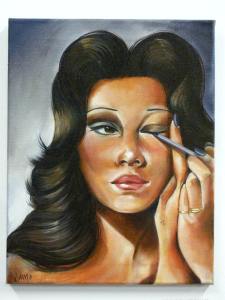
Image by Amor Eterno Arte @Flickr CC BY-NC-ND
In framing the chola aesthetic as a transgressive type of beauty, Mendoza-Denton poses that the cholas in this study act as cultural producers who assign alternative meanings to femininity through their body and speech. Recalling Xóchitl’s remarks about mascara, the eyeliner serves in one form as a tool for a racialized feminine ideal of beauty, while simultaneously a sign for “willingness to fight” for other girls (154). Eyeliner, in this example, very visibly displays the complex interactions and negotiations of gender norms and agency. In this sense, Mendoza-Denton grants the reader a primary example of how cholas participate in a type of feminine gender expression that challenges expected ways of acting, which includes speech.
From Mendoza-Denton’s conversation with T-Rex, we see that speech and accent are just as meaningful in the construction of this alternative aesthetic. T-Rex, explains how the eyeliner is a “power-based interpretation” that when correlated with a tough, or even threatening, manner of walking—the use of the body—cholas command power and respect. Here, her intervention serves not only to gain a deeper understanding of Latina youth practices but also frames the chola as an empowered, vocal (what some would consider, mouthy) woman. Too often cholas receive harsh criticism or complete disregard for their assumed subversive behavior, criminality, and social deviance. In Homegirls, Mendoza-Denton challenges those notions by finding the symbolic capital in how these young women employ discursive, material, and phonetic practices.
The final two chapters of the book focus on the specific linguistic features relevant to studies of language and sound. Mendoza-Denton highlights phonetic variation among the girls speech in how their realization of /I/ demarcates core speakers from members of the group in the periphery yet points to similar speaking characteristics for girls of both gangs. The author’s focus on the stigmatized Th-Pro set (i.e. something, nothing) in the speech of Latina girls demonstrates how it discursively positions theses young women’s interactions and group affiliation due to its frequency and saliency. These later chapters demonstrate one of the author’s most significant contributions: projecting a specific accent is often linked to the creation of an identity. As Mendoza-Denton writes, “How speakers pronounce their words says a lot not only about the identities that they wish to project, but also about the history of the language(s) that they speak” (231). These linguistic variations give readers insight on the importance of how distinctive discourse markers are vital in the creation of stylized identities for young women of color.
Norma Mendoza-Denton has produced a rich account of a community largely ignored and misinterpreted in the conversations on Latina youth culture in the United States. As she reminds readers in her conclusion, Homegirls is one of the only studies of its kind that documents gang dynamics outside of discussions regarding violence, control over territory, or drug trafficking. While this approach provides a much-needed focus on the self-making and cultural processes amongst youth of color, I wonder if some significant discussions might be left out with this approach. Although there is large need for research on this topic that deviates from traditional approaches (such as criminality, violence, drug trafficking) when working with youth, particularly women of color, in her effort to subvert these sociological mainstays Mendoza-Denton avoids certain experiences that leave out pertinent context.

Image by Joey Ortega @Flickr CC BY-ND
For example, in her discussion of the young women’s makeup practices, Mendoza Denton mentions the perceived threat they pose to teachers and police at school but does not go into more detail. These questions are not to discount the contributions of the book but rather to introduce future considerations for work surrounding Latina youth gangs. However, for Mendoza-Denton, the focus on the creativity and agency these young women embody is never lacking:
“So when you walk down the street,
you got the special walk, [begins to walk deliberately, swinging her upper body]
you walk like this,
you walk all slow,
just checking it out.
I look like a dude, ¿que no?
I walk, and then I stop.
I go like this [tilts head back – this is called looking “in”]
I always look in, I always look in,
I never look down.
It’s all about power
You never fucking smile.
Fucking never smile” (155-6)

Image by Amor Eterno Arte @Flickr CC BY-ND
Homegirls is at its finest when the reader is presented with excerpts like the quote above where T-Rex’s assertive physical and mental stance illustrates the linguistic and cultural practices that Mendoza-Denton seeks to highlight in her work. Mendoza-Denton’s contribution to this topic privileges the symbolic capital in linguistic, embodied, and cultural practices which sets up a platform for future work on Latina identities. When we read cholas in popular culture we might think of the aesthetic, the stereotypes, the big hoops, the dark lips, and the mascara. When we read Homegirls, Norma Mendoza-Denton compels us to consider the complex web of how linguistic and cultural practices (through material and vocal embodiments) speaks to the intersections of race, gender, and class amongst Latina youth gangs.
–
Featured image is of Yasmin Ferrada (the author’s sister) as photographed by King Kast. It is used with permission by the author.
–
Juan Sebastian Ferrada is a doctoral candidate in the Department of Chicana and Chicano Studies at the University of California, Santa Barbara. His work investigates the intersections of language and sexuality among LGBTQ Latina/o communities. Specifically, Sebastian explores the politics of Spanglish as a method for articulating ideas of sexuality and family acceptance within an LGBTQ Latina/o community organization. Sebastian earned a B.A. in Global Studies, in addition to a B.A. and M.A. in Chicana and Chicano Studies from the University of California, Santa Barbara.
–
 REWIND! . . .If you liked this post, you may also dig:
“Óyeme Voz: U.S. Latin@ & Immigrant Communities Re-Sound Citizenship and Belonging” – Nancy Morales
Listening to the Border: “’2487’: Giving Voice in Diaspora” and the Sound Art of Luz María Sánchez – Dolores Inés Casillas
Deaf Latin@ Performance: Listening with the Third Ear — Trevor Boffone
Share this:


Current Top Posts





April 2021

January 2020

November 2019

October 2019

August 2019

April 2014

November 2017

March 2015

December 2017

October 2015
 Sounding Out!
Recent Comments