
Hearing Queerly: NBC’s “The Voice”

“Brittany and Santana Lesbian Kissing Scene from Glee” by Flickr user LesMedia available under Creative Commons license 2.0
Tuesday, April 26, 2011 turned out to be a red-letter day for prime time Sapphism. The Fox smash, Glee, continued its hamfisted campaign against teen bullying with a subplot about the label-averse Santana scheming to bring her lesbian (or “Lebanese”) love for Britney to fruition. Airing opposite this “Born This Way”-anchored, supersized Glee, was the debut of the vocal reality competition series, The Voice on NBC. Remarkably, not one, but two out lesbians survived the first elimination round of the show’s blind auditions: Vicci Martinez from Tacoma, WA, and Beverly McClellan from Ft. Lauderdale, FL.
The Voice pitches itself as the democratic alternative to FOX’s American Idol. Whereas Idol’s early audition rounds derive considerable schadenfreude from oddball characters excluded from the expansive realm of what is deemed “pop hot”–remember Kenneth Briggs, the infamous “Bush Baby”?–The Voice eliminates looks altogether from the audition process, including the panel’s ability to look at the singers onstage. Seated in hydraulically-controlled swivel chairs evocative of Dr. Evil’s high-backed perch, the celebrity panel of coaches (not “judges”)–Christina Aguilera, Cee Lo Green, Adam Levine of Maroon 5, and country hunk, Blake Shelton–have their backs to the stage at the beginning of each performance. Only when the singer’s voice sufficiently moves a coach does he or she press a button to swing around and face the talent. If none of the four coaches turns around before the song ends, the singer is eliminated and sent away with only two-and-a-half glorious minutes on national TV as a consolation prize.

Vicci Martinez
While latter-day Idol has increasingly focused on the “total package,” sometimes excusing vocal defects for good looks, performance prowess, and passion (“I had fun with it” is the mantra of anyone who’s suffered a tepid response from the judges, and “you look great tonight” is what a judge says when someone biffs their vocals), The Voice purports to strip away the smoke and mirrors of performance—at least in the live selection process—in order to focus exclusively on vocal talent. Furthermore, as “coaches,” the celebrity panel is meant to cultivate talent rather than simply eviscerate bad performers for the audience’s amusement. As Cee Lo opines in the premiere episode: “it’s not about the judgment; it’s about the journey.” (Has reality competition taken a critical turn from the critical turn? But that’s another topic.) Idol has been explicitly called out on the show, from Adam Levine’s reassurance to dejected contestants that “The people we are not turning our chairs around for could win American Idol,” to the sensational rehashing, ad nauseum, of Frenchie Davis’s disqualification from the Idol competition for nude photos nearly a decade ago.
As the anti or alterna-Idol, The Voice–complete with kitschy, faux Futurist set pieces–would have us believe that truly anyone from anywhere could be a vocal superstar, whether they’re fat, thin, chinless, hirsute, gorgeous, hideous, straight, gay, Mormon, or dykey. The disparate optics offered by Vicci Martinez and Beverly McClellan, the two lesbians who won the celebrity panel over with their raw-throated rock vocals (right in the pocket of what we might call the Etheridgean mode), would seem to affirm the show’s “blind” ethos. Martinez’s audition was shot so that just like the coaches, the TV audience couldn’t see the singer until she was selected. In the package leading up to her performance, we are made privy to her coming out story, offered a glimpse of her skinny jeans and boots, and invited to “listen along with our coaches and see if you would pick Vicci Martinez.”
As it turns out, Martinez is quite a little hottie: a lesbian heartthrob in the making with a cute asymmetrical shag, winning smile and sensibly curated fashion (think PacNorthwest sportif meets urban hipster enclave).
McClellan, meanwhile, offers an “edgier” look that complements her ethos of fighting–in her own words–“against the man.”
TV audiences see McClellan before hearing her, creating some element of narrative suspense: we anxiously await “the reveal” should one of the coaches select McClellan for their team, only to swivel around to confront a bald, bad-ass dyke with ample tattoos, piercings and leather wrist accoutrement, chewing on Janis Joplin’s “Piece of My Heart” with barroom tenacity.
The queer blogosphere has certainly picked up on Martinez and McClellan’s success on the show. (As of this writing, Martinez has already advanced passed the “Battle Rounds” to the live shows where audience members are are allowed to vote). After Ellen and Unicorn Booty posted items immediately, encouraging queer audiences to tune in, while After Ellen followed up with extended interviews, first with Martinez, then with McClellan. Both were asked about whether or not the format of The Voice made it “easier” for queer contestants to succeed without being judged for their appearance. Martinez famously bowed out of the Hollywood rounds of American Idol because producers asked her to buy a new wardrobe (read, “femme up” a bit), so she offered a more affirmative response in line with The Voice’s own rhetoric of leveling the playing field. McLellan, meanwhile, offered a goofy “one love” answer to the question, evoking a universal vibe of human generosity. Different as their public temperaments may be, both have been praised for amplifying lesbian visibility on network television.

Levine listens to McClellan on
Though some robust, “score two for the team” chest-bumping is surely in order after the success of these Sapphic sirens, how might we actually move past the greater frenzy for queer visibility to better grasp how lesbianism fits, or inevitably fails to fit, within the pop landscape? In other words, what would happen if we weren’t so quick to celebrate these “aren’t-we-GLAAD?” moments of prime time visibility, but instead took to heart The Voice’s premise about prioritizing listening?
Throughout the institutional life of queer studies, debates about lesbian visibility have unfurled in elaborate fugue-like variations. Rather than rehash them here, allow me to commit the theoretical heresy of constructing a binary in order to highlight some key positions. In the “real” world of mainstream LGBTQIA organizations and cultural producers, quantifying positive representations of queer folk qualifies as measuring progress. The more gays and lesbians we see on screens big and small, the logic goes, the better the world gets. In the more rarified realms of queer theory (my own habitat), this desire for representation and belonging calls forth the very crisis inherent in politicizing visibility as an end in itself. Film and media scholar, Amy Villarejo, explains this dynamic best when she remarks in Lesbian Rule that “the common sense of visibility is that it does both [parlays representation’s double meaning as ‘portrait’ and ‘proxy]: by appearing, so it would go, we belong…[but]…to present lesbian as image is to arrest the dynamism such a signifier can trigger” (14).
What, then, would be the sonic dynamism of lesbianism? Is it a transformative “grammar” that modifies the terms with which it becomes intimate? (Villarejo explores this possibility in her book.) Is it in the grain of a voice?
Far be it from me to theorize the “butch throat” here, as my dear pal and colleague Elena Glasberg already has with more eloquence and profundity than my mind can muster these days; but even if we hadn’t been primed by the show’s intro packages, might we not have heard the lesbianism in Martinez and McClellan’s throats? In their urgent, tremulous and toothsome strivings through the repertoires of “fierce females” like Adele and Janis Joplin?
There is something marked, and remarkable, in the yearning and temporal drag (see Elizabeth Freeman’s work) modeled by Martinez and McClellan’s respective vocalities, voices that could only break the surface in a format that (at least initially), thwarts the edicts of visibility: of fashion, generic niches, and the avant sensibility demanded by pop. Instead of being one step ahead, Martinez and McClellan constantly pull us back to something we’ve heard before, often in a half-empty bar that reeks of Bud and Marlboros (both Light). And for letting us hear this again, I’m willing to give The Voice the benefit of the doubt, despite its unwieldy format, liberal use of Carson Daly, and trumped up feud between Adam Levine and the real Xtina. Just maybe in this singing competition’s overdetermined relationship to blindness, we will find enough insight to hear queerly.


Share this:

I Hear You, I See You
(The title of this post comes from an episode from Season Two of NBC’s Parenthood; Zeke, the patriarch, learns in marriage counseling that he must listen to his wife and let her know he is listening.)
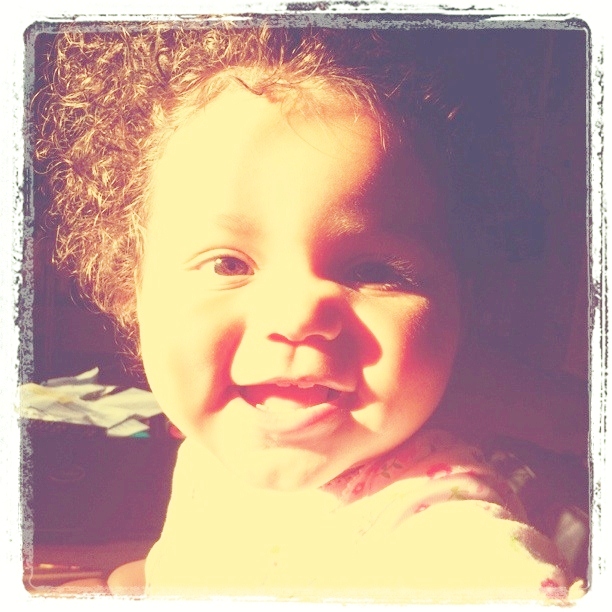 Since she was in the womb I’ve recorded Miss E’s sounds. I’ve posted before about my experience listening to her heartbeat at every obstetrician appointment. Late in my pregnancy I managed to record her heartbeat. I still play it and replay it in amazement; those beats were a sign of the life growing inside of me. I felt like I was eavesdropping on her every time we tuned in. It was sonic peeking. After she was born, I wanted to continue recording the sounds she made because I wanted to have recordings as well as pictures for her when she grew up.
For the past eleven months I’ve recorded my daughter’s sounds at different stages with my iPhone (as I’ve mentioned in my latest KC post, my iPhone is my preferred recording device if only because it is always within reach). I record when I remember, or when she adds a new sound to her repertoire. However, I try to record her once a month. The same way that she has gone from not moving at all to crawling all over our apartment, she has gone from not making any sounds to babbling, squeeling, and laughing. The sounds she makes are an indication of development, but they are also a sign of her awareness of the world around her.
As a first-time mom, I expected a lot of things early on. I didn’t understand why she held her fists closed for the first few weeks or why she didn’t follow me around the room. It almost felt like she was ignoring me. The same thing happened with her sounds. The fact that she didn’t respond to my words with sounds worried me. I always wondered if she was sad! And it’s no wonder: all she would do was cry. Of course, I realized soon after that her crying was her only way of communicating with the world. One of my first recordings of Miss E is of her shrill crying, and it still makes my chest tighten up when I hear it.
My second recording is of her at three months. By this point the cries have morphed into more of a grunt. As I typed this post I listened to my recordings, and it’s remarkable how inarticulate she sounds compared to what she sounds like now. But back then, I was excited that she was making more sounds other than crying. Indeed, the fact that she wasn’t always crying was a relief. These new sounds, to me, were her attempt at trying to communicate, or rather discovering ways to communicate. It’s almost as if she had discovered that she had a voice. The silences talked as much as the sounds, for at this stage she spends more time awake (and more time awake without crying).
As Miss E has grown throughout this first year, her sounds have started to vary. Very much like a language, she has different registers, different sounds depending on what she wants to say. Whereas before she would only give me a smile when she woke up, now she provides me with a running commentary on her dreams and her giraffe while I change her diaper. Even her giggles developed different registers. She had different kinds of giggles! Now she makes sounds on her own, not as a response to something I had done but because there is something she wants to respond to. I read in her babbles the beginning of her path to independence. it’s a long way until she moves out of our household, but the fact that she wants to talk to other people or talk about what she wants, and not in response to what I am saying or doing is amazing. It’s also a little sad, for it’s also an indication of her willingness to move on to other things.
We tend to forget that during that first year babies have little interest in interacting with people outside of their nuclear family. They stare at strangers or shy away. But the moment they start talking to themselves or their toys, you are no longer the center of their world. And it’s a bone-chilling thought.
Recording her sounds is important to me just as much as taking pictures. (I don’t take video of her mostly because we didn’t have any way to do that until recently when I updated my phone to an iPhone 4). I wanted her to have visuals as well as audio, and even though video recordings could do just as well, the effect of just listening to sounds and being able to focus on that is an interesting (if jarring) experience. Those sound recordings trigger memories just as vividly as pictures do, or even more so than pictures. I hope to keep these recordings until she is older so that she can see herself as well as hear herself when she was just a little girl. I want to know that “I hear you, I see you,” that hearing is just as relevant as seeing.
Bonus tracks: Here’s Miss E at several stages in the last year.
Miss E at 3 months (trying to get Mommy’s attention)
Miss E at 10 months (banging and making music)


Share this:


Current Top Posts





April 2021

January 2020

November 2019

October 2019

August 2019

April 2014

November 2017

March 2015

December 2017

October 2015
 Sounding Out!
Recent Comments