
Sounding the Motor City: Chrysler and Detroit’s Legacy
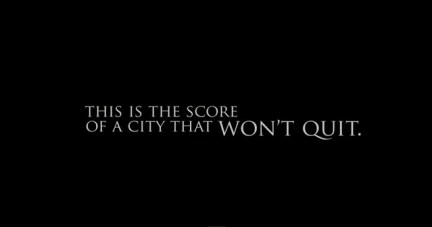
Screen shot from "Selected of God Choir" Chrysler commercial. Selected of God are better known for their appearance in Eminem's Chrysler commercial that aired during the Super Bowl.
Last February, Chrysler premiered during the Super Bowl its “Imported From Detroit” campaign with a stunning 2-minute ad that showcased Detroit to the soundtrack of Eminem’s “Lose Yourself.” Helen Freund and David K. Li at The New York Post called Eminem the star of Super Bowl XLV’s ads. MyFOXDetroit.com mentioned how the people of Detroit showed their love for the ad on social media. Jeff Karoub and Mike Householder from The Associated Press said the ad “sent shivers of pride through the battered city.” Although the ads are, ultimately, about cars, they also sell us stories of the Motor City.
The commercial starts with scenes from a grey day in Detroit. We see streets, factories, and street signs. The voice-over helps weave a story of a working-class city: “What does this city know about luxury? What does a town that’s been to Hell and back know about the finer things in life?” From the vantage point of a Chrysler, we see shots of Detroit as it drives through the city and the suburbs. At the end, Eminem, a Detroit native, parks the Chrysler 200 in front of the Fox Theater and walks in to finda choir singing along to “Lose Yourself.” Ultimately, the video is a declaration of pride in American craftsmanship but also a statement of the strong will of an American city with working-class roots; this is emphasized when Eminem looks straight at the camera and states, “This is the motor city. And this is what we do.”
Although I tend to be critical of the messages advertising sends viewers, this commercial drives chills up my spine every time because it shows pride in an American city. However, what moved me to write this post was one of the most recent ads from the “Imported from Detroit” series. The commercial for the Chrysler 300 (2012 model) uses a sample of Bobby Blue Bland‘s “Ain’t No Love in the Heart of the City” (Dreamer, 1974) from Jay-Z’s 2001 hit “Heart of the City (Ain’t No Love)” (found on his album The Blueprint). The commercial starts with a panoramic view of Detroit, followed by the Chrysler 300 emerging from an underpass. The camera moves on to shots of different areas of Detroit as well as people on the street and street signs (for example, one of the signs we see is the sign for 8 Mile). Also, whereas most car commercials show cars without license plates, this ad proudly display the cars’ Michigan tags.
The music in both of these ads acts as a way of reminding us about Detroit (the first a song by a Detroit native, the second a song that makes us think about cities), but the music also calls into question the luxurious excess of the automobile. The ads try to draw attention away from the automobiles and toward the working-class community that keeps Chrysler running; they emphasize their ties to the Motor City. However, as Angie Schmitt points out in her blog post “The Hypocrisy of Chrysler’s ‘Imported from Detroit’ Campaign,” the ads betray the viewer:
Chrysler is selective about the Detroit it celebrates. Absent is the ruin that now accounts for a large share of the city. Invisible is the crushing poverty, constantly present in the urban landscape. The driver in the most recent installment, traveling out from the center of Detroit to its suburbs, is in control of his fate (thanks to his snappy ride) in a way few in the region really are.
Despite the defiant sentimentality of its ads, Chrysler, as well, is selective about its commitment to the city of Detroit.
Although the ads are visually stunning (but many of the ads produced by Wieden+Kennedy advertising company are–just look at their roster of clients and click on some of the brands), the ads also stage a conflict between race and class through the soundtrack. What is the message these commercials are trying to communicate through their music and their cars? On the one hand, they affirm the presence and reemergence of an American car company, one of the major car companies that was hit hard in the most recent U.S. recession. On the other hand, the ads use a discourse of class (also race) to sell a luxury product. The commercials want to connect Chrysler to Detroit’s working-class identity, and the soundtrack is supposed to act in service of that through the choices of artists and music.
A good example of this is the John Varvatos “Attitude” ad for Chrysler (less popular than the Eminem ad and the more recent Chrysler 300 ad).
Varvatos is a designer from Detroit, located in New York. The commercial shows us Varvatos at the Dope Jams record store in Brooklyn, on his way to his Manhattan studio. The voiceover tells us the key to his success is that he was “surrounded by the perfect combination of rock and roll and heavy industry.” The working-class theme is emphasized in this commercial, especially in the last line uttered by the narrator: “that’s what a blue collar attitude can do in a white collar world.” (It also creates a dichotomy where New York is the “white collar world” to Detroit’s “blue collar attitude.”) Unfortunately, the ads commodify class struggles and class values. The ads use working-class values to appeal to the consumer.
Music is not far removed from the automobile industry in Detroit. The Motor City not only exports cars, but is also an exporter of music. Suzanne Smith, in her book Dancing in the Street: Motown and the Cultural Politics of Detroit (2000), traces the development of Motown within the sociocultural context of Detroit in the 1960s. She explains how the automobile industry in Detroit benefited from African American labor, meanwhile excluding them from “controlling the means of production” (15). On the other hand, Smith also points out that Motown profited from the introduction of the transistor radio in 1953, for drivers could now listen to music in their cars. Motown execs were very aware of the new market that this would provide them. “Both the musical form and the audio fidelity of Motown hits such as ‘My Girl’ and ‘Shop Around’ were well suited and often produced with a car radio audience in mind” (123). The ads remind us how listening to music has become part of the experience of driving–and how that was not coincidental.
Ultimately, these ads remind us of how sound can act as a door into the social and cultural context surrounding the cars. However, I want to leave my readers with a thought: the ads are also about Detroit. If car ads require, in general, remarkably non-specific setting, Chrysler goes in the opposite direction and makes it all about the location. The ads, although problematic, remind us of the power and importance of place, whether in its Detroit ads or in its Portland, Oregon ad or its Los Angeles ad. If Jay-Z and Bobby Blue Bland sing “ain’t no love in the heart of the city,” these Chrysler ads show that the city has plenty of love to give.
–
Liana M. Silva is co-founder and Managing Editor of Sounding Out! She is also a PhD candidate at Binghamton University.
Share this:

Oh Say Can You Hear?: Singing the National Anthem
 In my decade as a play-by-play broadcaster and sports reporter, I’ve covered more than 1,300 games in sports ranging from high school football to Major League Baseball. Every one of those games has been preceded by “The Star-Spangled Banner,” the national anthem of the United States of America. One season, I was responsible for selecting the national anthem singers for all the home games of a minor-league basketball team I worked for. I’m about as familiar with “The Star-Spangled Banner” as someone who’s never performed the song can be. Yet, I wonder why anyone would want to sing “The Star-Spangled Banner” before a sporting event.
For starters, it’s a very difficult song to sing, which isn’t surprising when you consider that “The Star-Spangled Banner” wasn’t originally designed to be sung. What we now know as our national anthem started off as part of a poem written by lawyer and author Francis Scott Key. The poem, titled “Defence of Fort McHenry,” was Key’s thoughts on a battle he witnessed during the War of 1812. [See guest blogger Jeb Middlebrook’s post “Prison Music: Containment, Escape, and the Sound of America” for more on the Star Spangled-Banner as a prison song.–Editor] Key’s brother-in-law noticed that the poem’s words could be set to the music of “The Anacreontic Song“, a popular English drinking song. Within weeks, Key’s words were printed in newspapers throughout the country, the name changed to “The Star-Spangled Banner.” Although all four verses of Key’s poem were converted to song, only the first verse was designated as the official national anthem of the United States of America in 1931.
No one has pinpointed the first sporting event that had “The Star-Spangled Banner” sung before it. However, there’s evidence the song was sung both before and during Major League Baseball games while World War I was going on. During the first game of the 1918 World Series between the visiting Boston Red Sox and the Chicago Cubs at Weeghman Park (known today as Wrigley Field), a band performed “The Star-Spangled Banner” during the seventh-inning stretch (“Take Me Out to the Ball Game” was ten years old in 1918, but the Tin Pan Alley song had yet to become a seventh-inning stretch standard). It wasn’t until World War II when the national anthem was performed before every baseball game, an affirmation of the American spirit during such a difficult time.
It’s fitting that baseball was the first sport whose games were preceded by the national anthem; baseball’s status as America’s national pastime and as one of its defining cultural institutions was undisputed for most of the 20th century. Also, in the 1940s, professional basketball was just getting off the ground, professional football was barely 20 years old, and professional hockey was dominated by Canadians and only played in a handful of American markets. If the tradition of pre-game anthem singing had begun in one of those sports, it would’ve taken much longer to catch on, if it caught on at all. Eventually, all the other professional leagues followed baseball’s example.
When I was an account executive for the Yakima (Washington) Sun Kings of the Continental Basketball Association during their 2002-2003 season, my boss assigned me the responsibility of choosing our pre-game national anthem singers. Fortunately, it proved to be an easy task, since folks who were interested in singing regularly called the team’s offices, and as long as they could hold a tune I booked them. All I could give the singers were tickets to the game at which they were performing, but no one ever bemoaned the lack of compensation.
When I think about all of the games I’ve covered, I honestly can’t remember any vocal renditions of “The Star-Spangled Banner” that stand out because of their greatness. However, I remember all of the terrible singers I’ve heard. There was the raven-haired woman in Keizer, Oregon who got halfway through the song, screwed up the lyrics and started over. There was a middle-aged man in Binghamton, New York who messed up the song’s pitch and pacing so badly, there was a good three seconds of stunned silence when he finished, followed by polite applause. There was the teenager in Kalamazoo, Michigan whose voice cracked every time she hit a high note. And, that’s just the tip of the iceberg. So, you work your butt off to sing an extremely difficult song, you manage not to mess it up, you get some nice applause once you’re done and then you’re forgotten right after the first pitch. Singing the national anthem is a thankless job, yet there’s no shortage of people willing to do it.
When I think about the people who volunteered to sing at Yakima Sun Kings games, I don’t recall anyone who who looked at singing the anthem as a way to honor their country. There was one woman who lived an hour and a half away who volunteered her anthem-singing services to every professional and college team within three or four hours of her home. I asked her why she put in all this effort and she said “I just like to sing.” The one singer I rejected was an eight-year-old girl whose mother bragged over the phone about her daughter being such an outstanding singer that “she brings people to tears.” Her mother seemed to think singing the national anthem before about 3,000 people in the middle of nowhere would lead her daughter to stardom. I was out of the office when a CD arrived with 10 tracks and the young lady’s picture on the cover (her mother called the office twice to make sure her husband had dropped off the CD and that I had received it). I listened to the one track that featured her singing “The Star-Spangled Banner” and I didn’t think it was very good; she had a nice voice but she was trying way too hard. Thankfully, I never heard from her mother again.
Other than that young lady (or, more accurately, her mother), none of the aspiring anthem singers I encountered seemed to be seeking stardom. Perhaps these singers were more patriotic than they – or I – realized. Perhaps they just wanted to cross an item off their bucket list. Or, they were big sports fans and relished an opportunity to go to a game free of charge. Maybe they just thought it would be a cool thing to do and a great way to gain the admiration of their family and friends; many people are petrified of doing anything in front of an audience and those who aren’t are often seen as heroic, even if their anthem singing is immediately forgotten.

Photo: “National Symphony Orchestra violinist plays at Nationals v. Diamondbacks” by Flickr user angela n. under Creative Commons 2.0 License
However, the best way to get your rendition of “The Star-Spangled Banner” to be noticed and remembered is not to sing it but to play it on a musical instrument. Live instrumental performances of the national anthem are rare, so even an average instrumental rendition is more memorable than a great sung rendition. In my stint as national anthem booker for the Yakima Sun Kings, I encountered just one non-singer: a 13-year-old boy who taught himself how to play “The Star-Spangled Banner” on his saxophone. The amount of positive feedback I received from the fans on his rendition was easily double or triple the feedback on all the anthem singers combined; he was one of only two performers I booked for multiple games. When I lived in Binghamton, New York, my favorite national anthem performers were a pair of trumpeters; they played “The Star-Spangled Banner” before a variety of sporting events in the area. I still get chills when I think about the exceptional national anthem rendition performed by trumpeter Jesse McGuire – the former lead trumpeter for the Lincoln Center Jazz Orchestra in New York City – prior to the seventh game of the 2001 World Series in Phoenix, Arizona, the only World Series I’ve covered.
Nowadays, “The Star-Spangled Banner” is far from the only song sung at many American sporting events. In games featuring teams from Canada (the NBA, MLB and NHL all have Canadian franchises), “O Canada”, the Canadian national anthem, is sung pre-game along with “The Star-Spangled Banner.” “O Canada” is a much easier – and shorter – song to sing. Many baseball teams also recruit singers for “Take Me Out to the Ball Game” during the seventh-inning stretch. You don’t even have to sing as much as you have to lead the crowd in singing “Take Me Out to the Ball Game” and being an expert singer isn’t required. However, my guess is more people would rather sing “The Star-Spangled Banner” over anything else at a sporting event. Singers aren’t looking for easy or simple. They’re looking to showcase their talents singing a song we all learned growing up, a song we’ve heard countless others sing on big and small stages and a song that demands the utmost respect and importance requiring both fans and participants alike to stop what they’re doing and to salute the American flag.
—
Robert Ford is currently a reporter and radio pre- and post-game show host covering Major League Baseball’s Kansas City Royals. He has also been a radio play-by-play broadcaster for several minor league baseball, college and high school teams, allowing him to call places like Yakima, WA, Kalamazoo, MI and Binghamton, NY home at various points in his life. Follow him on Twitter: twitter.com/raford3 and read his blog: http://radioguydiaries.wordpress.com/
Share this:


Current Top Posts





April 2021

January 2020

November 2019

October 2019

August 2019

April 2014

November 2017

March 2015

December 2017

October 2015
 Sounding Out!
Recent Comments