
Goalball: Sport, Silence, and Spectatorship
 Editor’s Note: Today, SO! kicks off our summer series on “Sound and Sport,” an interrogation of the roles that sound and listening play in the interconnected aspects of many sports: athletic skill, spectatorial experience, laws of physics challenged and exploited, and politics expressed and created. Often, the true play in sports involves power–and sound is a key venue to help us understand its flows and snags, and parse out the actual winners and losers. And, perhaps more directly than other venues, sports is a heightened arena that helps us understand just how important sound is in our everyday lives, even if (and especially because) we take it for granted.
One of my favorite personal “sports metaphors” for sounds’ unacknowledged centrality involves the precise 3.5 seconds I snowboarded with an iPod before I hit an ice patch full speed and had one of the worst falls I have suffered in my 15+ years of the sport. While I was laying on the hard packed snow gasping for breath and trying to piece together what happened, I realized exactly how much I depended on my listening to provide me with crucial, even-life saving, information. With my ears overwhelmed with treble-y punk, I had charged straight into an icepatch that I would have deftly avoided as soon as I heard the inevitable and unmistakeable scratching sound signalling its location. That kinesthetic lesson has continued to inform my everyday, every day since it happened and has led me to ever deeper understandings about sound’s power and the various forms of power that it clarifies–and are clarified by it in turn. I hope that this series will do the same for you, but without the blood and the bruises, even as some of our writers will remind you about the complex and dubious relationship sports can draw between “pain” and “gain.”
Batting first up on our line-up is Melissa Helquist, who describes how the Paralympic sport Goalball challenges the norms of the spectator/athlete relationship. Look for a post on Muhammad Ali in June (Tara Betts), skateboarding in July (Josh Ottum) and an all-out Olympic extravaganza in August, including a podcast discussing the sonic transformations of Brazil’s favelas in anticipation of the world’s ears in 2016 (Andrea Medrado). This summer, it is Sounding Out! FTW. –-J. Stoever-Ackerman, Editor-in-Chief
—
it’s oh so quiet
it’s oh so still
you’re all alone
and so peaceful until
you ring the bell
bim bam
you shout and yell
hi ho ho
you broke the spell
–Bjork, “It’s Oh So Quiet”
During the London 2012 Olympics, the Copper Box venue, which hosted handball, was dubbed “the box that rocks.” The moniker was also, perhaps, a way to drum up interest in handball, a still obscure sport. And indeed, raucous spectators and the pulse and bounce of balls and shoes created a sonic spectacle.
.
When the Paralympics began a few weeks later, much was made of the transformation of “the box that rocks” into “the box that rocks you to sleep.” The game that supposedly will rock you to sleep is Goalball.
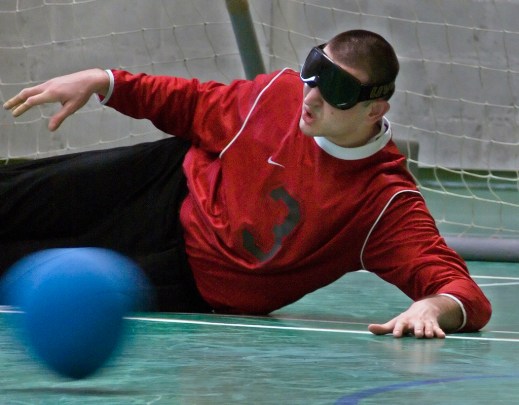
Goalball is a 3-a-side game, played in two 12-minute halves. The offensive team rockets the ball down the court (it must be rolling by mid-court), trying to gain the low and wide net on the other side. As the ball rolls toward the net, the defending players lie on their sides in front of the net, blocking the ball with their bodies. As the ball is pummeled back and forth across the court, it jingles—a simple, clear bell emanating from eight holes in the ball’s surface. In this sport, sound is quite literally a game changer.
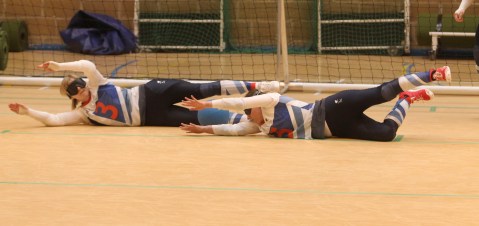
Goalball team practice at the ParalympicsGB Training Camp, Image by Flickr User The Department for Culture, Media and Sport
All goalball players are blind or low vison and wear blackout eyeshades to equalize the playing field and to ensure that any residual vision doesn’t get in the way of the gameplay’s sound. A pre-game equipment check includes referees ensuring that eyeshades don’t let in any light. Penalties include touching one’s eyeshades or making noises that disrupt the other team’s ability to hear the movement of the ball.
Goalball, a game first invented as a way to rehabilitate soldiers blinded in WWII, has been a Paralympic sport since 1976. It is one of the few sports designed specifically for blind athletes, rather than adapted from an existing sport. It is a game of sound and touch, a contrast to the visual perception typically associated with team-based ball games. The game, like many others in the Paralympics, expands the sensory experience of sport. The court’s borders are demarcated with tape-covered twine. Sonically, players orient themselves by calling out the position of the on-coming ball, rapping knuckles on the floor, and of course the jingle of the ball.
“Goalball” Courtesy of Perkins School for the Blind Archives
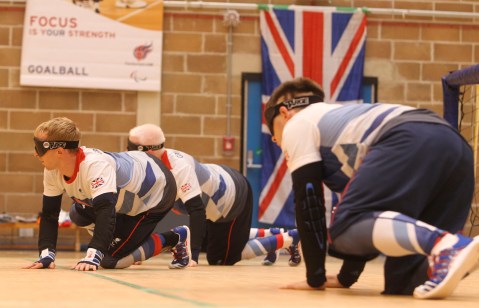
Image by Flickr User The Department for Culture, Media and Sport
The game is high impact; at the Paralympic level, the ball is thrown at speeds up to 60mph. Players launch the ball with high-velocity spins, something like a cross between a discus throw and bowling. Defenders block the ball with their entire bodies—hands, feet, torso. The game is intense, but it is also quiet.
The players’ reliance on sound demands new expectations of the audience. As spectators, we are watchers, but we are also noisemakers—shouters, shriekers, trashtalkers. Goalball spectators can (and do) cheer when a goal is scored, but when gameplay begins, silence is the rule. Before gameplay begins, referees demand, “Quiet Please!”
The Copper Box “was quite specifically designed to achieve a low background noise level so the blind athletes could play” (Soundscape, Issue 3, 38), enabling the venue to be transformed into an atypical space for the sound of sport and spectatorship, a place to challenge our assumptions and expectations.
Goalball? A description? from Daphnee Denis on Vimeo.
Goalball spectatorship doesn’t demand pure silence, but it is not the unfettered cacophony that we often expect in sports spectatorship. At the London 2012 Paralympics, Bjork’s “It’s So Quiet” was played during breaks in gameplay to remind spectators of their obligation. The song’s ebb and flow of silence and exuberance captures the sonic rhythm of Goalball, its pulsing cadence of silent attention and energetic eruption.
.
The nickname, “the box that rocks you to sleep” captures the discomfort spectators may have with Goalball’s soundscape. The silence during play is tense, but the scoring of a goal offers a sudden release. Spectators do not create a persistent cacophony, but rather a pulse, a constant pattern of lull and explosion. The silence of Goalball can feel disconcerting for spectators unfamiliar with the game. The sound of the crowd—the cheers, the clapping, the screams, the groans, the chants–often seem fundamental to the experience of sport.
Silent spectatorship, of course, is an expectation for other sporting events such as golf and tennis. Here, the demand for silence is linked ostensibly to concentration, but also invokes questions of tradition, class, and (in the case of tennis) gender. These sports are individualized demonstrations of skill, and we are admirers, observers.
Team sports invite identification from the crowd. We extend ourselves, making ourselves part of the team, often through sonic exuberance. Speaking about the crowd sounds of the London Olympics, Mike Goldsmith, author of Discord, notes:
Individual athletes commented that the crowd sound was a great source of energy to then, but could also distract. Their comments suggested that some of them used the crowd sound as a resource, that they could tap into or not as the moment demanded (Soundscape, Issue 3, 36).
Sound can feel like participation. Through sound, we make ourselves part of the game, cheering to support our team, hollering to distract a shot. Sound can make sport feel communal, and thus silence can feel like separation, a wall between spectator and team.
But the seeming silence of Goalball spectatorship offers an opportunity to pay attention to the sound of play, sounds that often get subsumed by the roar of the crowd. The meeting of disability and sport offers a “prime space to reread and rewrite culture’s makings” (Tanya Titchkosky, Reading and Writing Disability Differently, 2007), a space to hear sport differently. The culture of sport is rife with ableist assumptions about how we move, how we watch, how we play. Even when sound is part of sport, it is often an afterthought, an addition—sound might be distracting, it may affect play, but the center sensory preoccupation of sport is frequently visual. We watch, we spectate, we keep our eye on the ball. Sport is sight, but it is also sound. Spectatorship is raucous, but it is also silent.
zing boom shhhh.
—
Featured Image, “Goal Ball” by Flickr User BLac
—
Melissa Helquist is an Associate Professor of English at Salt Lake Community College and a PhD Candidate in Technical Communication and Rhetoric at Texas Tech University. Her dissertation research focuses on digital literacy and blindness and explores the use of sound to read, write, and interpret images. She is a 2012-13 HASTAC scholar and the recipient of a 2012-2013 CCCC Research Initiative Grant. She lives in Salt Lake City, where she hikes, camps, and canoes with her husband and daughter.
—
 REWIND! . . .If you liked this post, you may also dig:
Eye Candy: The Absence of the Female Voice in Sports Talk Radio–Liana Silva
The Plasticity of Listening: Deafness and Sound Studies–Steph Ceraso
Taking Me Out of the Ball Game: Advertising’s Acoustic Pitch–Osvaldo Oyola
Share this:

Chicana Radio Activists and the Sounds of Chicana Feminisms

Monica De La Torre interviews J. Kehaulani Kauanui at the Women Who Rock Conference, 2.18.2011, Image by Angelica Macklin
The power of hearing Chicana voices on the air is loud and clear. Indeed, when I heard Chicana feminist scholar Gloria Anzaldúa discussing her theory of hybridity and borderlands on the program The Mexican American Experience (1977) I was not only moved by the sound of Anzaldúa’s voice, but also by my intimate interaction with this influential feminista made possible through analog radio and digital technologies. Such experiences made me want to trace my own genealogy and find other Chicanas involved in radio production. I began to listen for Chicana radio activism on the airwaves, and document when, where and how Chicanas utilize radio not just as a tool for the transmission of sound, but also as a feminist community-building platform.
 My entry into radio came about when I joined Soul Rebel Radio—a radio collective composed of college students, environmentalists, musicians, comics, poets, and community activists in the Los Angeles area. A youth-centered radio program, Soul Rebel Radio airs monthly on KPFK 90.7 FM in Los Angeles and focuses on themes—such as the environment, war, and young women’s issues—and current events through comedy, youth voices, opinion pieces, editorials and interviews. With no prior radio or production experience, I joined the collective in October of 2007 hoping to fulfill my life long ambition of being on the radio. This experience of collective collaboration, which is both inspiring and challenging, became a cornerstone in my thinking about the empowering nature of media making, especially community radio. I cultivated the power of my voice through my participation in Soul Rebel Radio by learning how to write, edit and produce radio segments.
Now, as a Chicana feminist scholar and community radio practitioner, I am interested in collective, community-centered research projects that help transform the neoliberal, corporate institutionalization of media production and higher education. Although the content of my research is rooted in analog technologies, I work to ground the analysis of Chicana/o radio production through a digital Chicana feminista praxis, which includes the use of digital tools such as radio, digital film and open source software. This digital Chicana feminista theory and method may help uncover the ways in which community radio production constitutes an epistemological soundtrack to Chicana feminist activism, asking what are the sounds Chicana feminisms? Who are the Chicana activists of the 1970s and 1980s that utilized radio to build community, while incorporating an important aural element to their activism?
In answering these questions, I explore the ways in which digital tools can be utilized to uncover and reclaim subjugated knowledges. However, I am in no way suggesting that digital technologies should supersede or replace face-to-face community building. In fact, my current project—from which this blog post is drawn—documents and creates an archive of Chicana radio activists, including radio station managers, producers, news directors and on-air hosts. I discuss how community radio production provides Chicanas and other marginalized groups the space to harness digital technologies and engage in the process of producing traveling sounds that speak back to discriminatory and oppressive practices. While my methods include digital film production, online archive building and curation, my writing here focuses on oral history collection, particularly my documentation of Radio KDNA.
Radio KDNA
On December 19, 1979, Radio KDNA (pronounced cadena, meaning chain) transformed the airwaves becoming the first full-time Spanish-language, non-commercial radio station in the United States (Radio Bilingüe KBBF 89.1 FM, in Santa Rosa, founded by farmworkers and Sonoma State undergraduates, was the first bilingual radio station, going on air in 1973). Located in Granger, WA, Radio KDNA’s goal was to utilize the accessibility of radio to build community while serving as a resource for the mostly Mexican and tejano migrant farm workers in the Yakima Valley. The founders of Radio KDNA believed radio was an accessible tool for Mexican and Latino farm worker communities who had little access to other media. Beginning in 1942, Mexican workers entered the United States under the Bracero Program whereby mostly agribusinesses contracted Mexican workers in response to labor shortages of World War II, which in turn caused the lowering of wages. Thus, many Mexican American and tejano farmworkers migrated to places such as Idaho, Oregon and Washington. With a growing population of a Mexican Spanish-speaking community, Radio KDNA used its Spanish-language radio platform to reflect the sociopolitical needs of this shifting demographic.

The oral history I conducted with Rosa Ramón—the only female co-founder of Radio KDNA who served as the station manager from 1979 to 1984—uncovers the radio station’s historical significance within community radio production, specifically as a site of Chicana feminist activism. Rosa’s testimonio reveals the process by which many Mexican-American, and specifically tejano families migrated from the Southwest to the Northwest in search jobs, many ending up in Washington’s Yakima Valley, an area in need of labor to harvest its crops. The migration of Mexican and tejano families served not only as a vital labor force in Yakima’s fields, it also created a community that needed and greatly benefitted from a radio station that addressed the needs of this community, both in content and language. Although Rosa was born in Arizona, her Mexican mother and tejano father decided to migrate north, stopping in Arizona and California before settling down in Eastern Washington where her family purchased a small farm. As Erasmo Gamboa illustrates in his monograph Mexican Labor and World War II, “After 1948, northwestern farms used fewer braceros as they stepped up the recruitment of Mexican Americans from the Southwest” (123). Rosa’s family is one of many families that migrated to the Northwest, a region that needed and greatly benefited from their labor.

Rosa Ramón, Image by author
Although the small community where Rosa grew up was mostly comprised of Mexican and tejano families, she experienced and witnessed racism and discrimination, especially at school where she was reprimanded for speaking Spanish and mocked for eating tacos instead of bologna sandwiches. Rosa was only one of four Latinos that graduated from Grandview High School. These early experiences of marginalization and her family history served as an impetus for Rosa to work in non-profits that benefitted her community, including Northwest Rural Opportunities, a community based organization set up in 1968 to provide services to seasonal and migrant farm workers in Washington state. Here she met Ricardo Garcia, another co-founder of Radio KDNA.
In an effort to bring Spanish language radio programming to the Pacific Northwest, in particular for the migrant farm workers in Eastern Washington, Rosa and Ricardo, along with Daniel Roble, and Julio Cesar Guerrero, worked tirelessly for five years to obtain a broadcasting license for a community radio station in the Yakima Valley. However, Radio Cadena was producing radio content even before opening the doors of their Granger, Washington studio in 1979. In 1975, Northwest Rural Opportunities began a training program for farm worker youth to learn radio production skills in Linden, Washington. They also began an educational training program for Spanish-speaking individuals who were learning English. In May of 1976, Radio Cadena began broadcasting on a subcarrier signal provided by Seattle-based community radio station KRAB FM, with the assistance of its station manager Chuck Reinsch. The use of this signal meant that listeners could only tune in through a special home receiver, which limited the number of people who could actually tune-in to Radio Cadena’s programming.
Ramón’s oral history reveals the importance and central role women played in the founding and development of this station, particularly in its focus on programming for, by, and about women. Her family’s migratory trajectory is an example of how Mexican and tejano communities who moved to the Yakima valley to work in the fields established a community that needed and benefited from community radio. Radio Cadena is an example of the ways in which the migration of people created the conditions for the founding of a community radio station that traversed sonic borders and infused its airwaves with stories of resistance.
Mujer(es)
As part of its community building activities, Radio KDNA trained women, especially farmworker women, to produce radio content. As Rosa shared with me during her oral history, Radio KDNA and the show Mujer (woman) were instrumental in centering women within the radio production process, by playing music by women like Mercedes Sosa and Lydia Mendoza, interviewing local women, creating news content, and training women to actually produce radio programs. Indeed, this model of Chicana radio production was instrumental in the founding and day-to-day activity of Radio KDNA, and it represents a vital technological component of the Chicano Movement era. Chicanas such as station manager Ramón, producer Estella del Villar, and news director Berenice Zuniga, not only held positions of power at KDNA, but they also produced Mujer, which aired weekly and whose goal was to provided farm worker women with news stories, music and other informative pieces addressing their distinct subjectivities. These female producers and their audience demonstrate the transformative power of community radio production and the role of women in a movement that often downplays their contributions.

Yakima Herald Republic, 17 December 1984. From “Radio KDNA: The Voice of the Farmworker, 1975-1985” by Oscar Rosales Castañeda
By deploying Chicana historian Emma Pérez’s concept of the decolonial imaginary within Radio and Sound Studies to uncover the hidden voices of Chicanas within radio production, I document stories that compel scholars to conceive of a new framework that listens to the sound migrations of Chicana media activism, the third spaces and technological tools of the Chicano Movement not just in the Pacific Northwest, but throughout the country. The historical significance of Radio KDNA as the first full-time, Spanish language non-commercial radio station in the United States recasts Chicana/os as technologically adept and as active participants in the development of community radio. Moreover, Rosa Ramón’s oral history provides another example of the ways in which Chicana feminist activism emerged in conjunction with other social justice movements, further challenging the idea that Chicanas came to feminism after their white or African American counterparts. My historical analysis of Chicana radio production contextualizes current participation in media making, as radio can provide women of color and other marginalized groups the space to harness digital technologies to speak back and broadcast their concerns. When remixed with other components of Chicana feminisms, the sounds of Chicana radio activism constitute yet another track of resistance to the narratives that seek to silence these movements..
—
Featured Image by Angelica Macklin: Monica De La Torre interviews J. Kehaulani Kauanui at the radio kiosk, No. 2, Women Who Rock 2011 conference, Seattle University Pigott Building, February 18, 2011, From the Women Who Rock Collection, University of Washington Libraries, Special Collections Division, University of Washington Digital Libraries.
—
Monica De La Torre is a doctoral student in the Department of Gender, Women and Sexuality Studies at the University of Washington. Her scholarship bridges New Media and Sound Studies by analyzing the development of Chicana feminist epistemologies in radio and digital media production. A member of Soul Rebel Radio, a community radio collective based in Los Angeles, Monica is specifically interested in the ways in which radio and digital media production function as tools for community engagement. She is an active member of the UW Women of Color Collective and the Women Who Rock Collective. Monica earned a B.A. in Psychology and Chicana/o Studies from University of California, Davis and an M.A.in Chicana/o Studies from California State University, Northridge; her master’s thesis was entitled “Emerging Feminisms: El Teatro de las Chicanas and Chicana Feminist Identity Development.” Monica received a 2012 Ford Foundation Predoctoral Fellowship, which recognizes superior academic achievement, sustained engagement with communities that are underrepresented in the academy, and the potential to enhance the educational opportunities for diverse students.
—
REWIND! . . .If you liked this post, you may also dig:
Eye Candy: The Absence of the Female Voice in Sports Talk Radio–Liana Silva
Listening to the Border: “’2487’: Giving Voice in Diaspora” and the Sound Art of Luz María Sánchez–Dolores Inés Casillas
Yellow Rain and The Sound of the Matter: Kalia Yang’s Sonorous Objection to Radiolab–Justin Eckstein
Share this:


Current Top Posts





April 2021

January 2020

November 2019

October 2019

August 2019

April 2014

November 2017

March 2015

December 2017

October 2015
 Sounding Out!
Recent Comments