
Fiddling With Freedom: Solomon Northup’s Musical Trade in 12 Years a Slave

 Editor’s Note: Sound Studies is often accused of being a presentist enterprise, too fascinated with digital technologies and altogether too wed to the history of sound recording. Sounding Out!‘s last forum of 2013, “Sound in the Nineteenth Century,” addresses this critique by showcasing the cutting edge work of three scholars whose diverse, interdisciplinary research is located soundly in the era just before the advent of sound recording: Mary Caton Lingold (Duke), Caitlin Marshall (Berkeley), and Daniel Cavicchi (Rhode Island School of Design). In examining nineteenth century America’s musical practices, listening habits, and auditory desires through SO!‘s digital platform, Lingold, Marshall, and Cavicchi perform the rare task of showcasing how history’s sonics had a striking resonance long past their contemporary vibrations while performing the power of the digital medium as a tool through which to, as Early Modern scholar Bruce R. Smith dubs it, “unair” past auditory phenomena –all the while sharing unique methodologies that neither rely on recording nor bemoan their lack. Today, the series kicks off with Mary Caton Lingold‘s exploration of the materialities of Solomon Northup’s fiddling as represented through sheet music embedded in his 1853 narrative, amplifying a sound that was key to both his freedom and his enslavement.—Jennifer Stoever-Ackerman, Editor-in-Chief
—
Steve McQueen’s recent film Twelve Years a Slave has renewed interest in the original 1853 narrative, which has long been a valued resource for historians of nineteenth-century slavery, literature, and music. Because Solomon Northup was a highly-skilled fiddler and a keen observer of plantation culture, his autobiography is one of the most substantive accounts of musical life during slavery and, to my knowledge, the only slave narrative that includes sheet music in its text. As such, it preserves in audible form a precious record of Northup’s musical artistry and facilitates a sound-based study of nineteenth-century black fiddling, a tradition that was flourishing during Northup’s lifetime.
Uncovering the sounds of vernacular music of the pre-recorded era can be incredibly challenging. For this reason, Northup’s descriptions, when coupled with musical notation, make it possible for us to hear something historically significant. Although “slave music” was all the rage in the 1850s due to the widespread popularity of blackface minstrelsy, print-based compositions by enslaved (or free) musicians are difficult to come by and even more challenging to verify. The tune presented in Northup’s memoir has its own complex relationship to the minstrelsy genre, but it remains a unique sample of African-American music that warrants close-listening.

“Roaring River.” In Twelve Years a Slave: Narrative of Solomon Northup, by Solomon Northup, 322. Auburn, NY: Miller, Orton & Mulligan, 1854. Courtesy of the David M. Rubenstein Rare Book & Manuscript Library, Duke University
I use performance as a research method for exploring historical vernacular music, offering here my interpretation of “Roaring River: A Refrain of the Red River Plantation.” As I discuss in an essay titled “Listening to the Past,” the process of performance illuminates the subtleties of musical expression. (Do I play it like this or like that? At what tempo?) The aim of such exercises is not historical accuracy, but rather, an attunement to the sonic possibilities of a given piece. These possibilities cannot tell me how Northup would have played the song or what it meant to him, but they allow me to consider the kinds of choices that he would have had to make as a performer, thus illustrating the intellectual and sensorial richness of his music-making. Rather than simply presenting and describing the sheet music, I aim to make it possible for people to hear what would otherwise sit silently on the page.
In the first recording I play Northup’s melody solo to give you a sense of the tune.
In the second, I am joined by guitar.
The use of guitar accompaniment would have been highly unlikely during the period, but it helps to support my amateur playing by providing a livelier, fuller feeling. Northup connected with banjoists, percussionists and dancers as an enslaved and free musician and it’s interesting to imagine how a single song like this would have been transformed according to the talents, desires, and constraints of the performers assembled. It is unclear from the narrative whether or not the tune is an original composition or something Northup learned while living along the Red River, where he was enslaved in Louisiana. One also wonders how many nineteenth-century readers would have plucked the melody at a keyboard or bowed it on a family fiddle. What might their motivations have been?
Though Northup does not discuss the fiddle tune in the text, he does describe the lyrics below it, remarking that they were accompanied by a percussion technique called “patting” among his fellow slaves. He describes this widely documented practice as follows: “The patting is performed by striking the hands on the knees, then striking the hands together, then striking the right shoulder with one hand, the left with the other—all the while keeping time with the feet, and singing” (219). According to Northup, the lyrics that accompanied patting were often nonsensical because they were made to conform to the tonal and rhythmic pattern being patted. He offers “Harper’s Creek” as suitable for the practice but it’s worth noting that the lyrics voice a presumably white man’s desires to own a piece of land and a slave. Though presented below the sheet music at the end of the book, the lyrics are ill-fitting for the fiddle tune provided, which seems more likely to have been played without vocal accompaniment. In light of Northup’s descriptions, the sheet music creates an interesting blend of various performance modes, from popular folksy vocal diddy (with possible origins in minstrelsy), to patting, and fiddling. Here you can see a wonderful example of patting accompanying a nineteenth-century fiddle tune as performed by the Carolina Chocolate Drops and guest Danny Barber (Intricate patting begins at 1:22).
In addition to serving as auditory artifact, the presence of sheet music in the narrative relates to the way Northup’s musicality was commodified within the aesthetic economy of slavery during and after his captivity. After regaining freedom, his talents are presented for sale in the book presumably to appeal to the sort of audiences who would also have coveted the sheet music of minstrelsy, which caricatured and lampooned black performances. Popular appetites for representations of plantation culture left an imprint on Northup’s autobiography as well as other abolitionist publications, like Uncle Tom’s Cabin.

“Jumbo Jum,” Courtesy of the Newberry Library, Chicago. J.F. Driscoll Collection of American Sheet Music, Box 307a.
Music-making was both labor and leisure for Solomon Northup and it profoundly influenced his experiences as a slave. His narrative also illuminates the far-reaching impact that he and other black musicians had on their communities as well as nineteenth century music.
Alas! had it not been for my beloved violin, I scarcely can conceive how I could have endured the long years of bondage. It introduced me to great houses —relieved me of many days’ labor in the field—supplied me with conveniences for my cabin—with pipes and tobacco, and extra pairs of shoes, and oftentimes led me away from the presence of a hard master, to witness scenes of jollity and mirth. It was my companion—the friend of my bosom triumphing loudly when I was joyful, and uttering its soft, melodious consolations when I was sad. (217)
Solomon Northup’s biography is highly atypical of slave narratives because he is a free man who is sold into slavery. Some have criticized the popularization of his circumstances, arguing that because he conforms to modes of respectability as a literate, propertied black man, he serves as an ideal hero for white audiences while inadequately representing the experience of slavery. Though many aspects of Northup’s biography are unusual, his status as a highly sought-after musician is emblematic of a legion of black fiddlers who dominated music scenes North and South, from ballrooms to barns, beginning as early as the late seventeenth-century, as Dena Epstein explains in her indispensable study, Sinful Tunes and Spirituals: Black Music to the Civil War (1977).
Prior to enslavement, fiddling, “the passion of [his] youth,” provides Northup with supplemental income that helps to sustain his family during periods of insufficient employment in agriculture and carpentry. Music was an ideal side-career for someone in such circumstances, though, as Northup’s story shows, it did not protect him from the dangers of being black in the United States. He is captured and enslaved while touring as a circus musician. Ferrying South toward the Louisiana plantations that would become his deplorable home, Northup’s freedoms are violently stripped away. But his talent as a first-rate fiddler travels with him, becoming a defining element of his experience of slavery.
Fiddles were extraordinarily popular instruments during the era. Lightweight, portable, and increasing in mass production during the nineteenth-century, a single fiddle could service a large dance if need be. As such, slaves were encouraged (or forced) to take up the instrument and musical ability was considered a highly prized skill. Fiddling granted (primarily male) slaves an unusual degree of mobility as well as opportunities for economic advancement. The fact that numerous runaway slave ads note that the sought-after individuals were fiddlers or had in their possession a violin suggests that the increased mobility and access to income may have facilitated escape for some. For more information about these trends and their eighteenth-century origins, I highly recommend Richard Cullen Rath’s How Early America Sounded (2003), an excellent cultural history of sound.

Etching of Solomon Northup “in his Plantation Suit” accompanying his 1853 Narrative
Just before being sold at market to his first master, Northup encounters an enslaved young man in possession of a fiddle and sizes him up by asking if he could play the “Virginia Reel,” a popular dance. The young man cannot and so Northup takes the instrument from him, boldly showing off his more substantial repertoire and ability, much to the delight of those around him. Though about to be sold into an unknown and terrifying fate, this seemingly mundane interaction underscores how important musicianship is to Northup’s identity and also how significant it was to the societies through which he was forced to move. Whether in New York State, a New Orleans slave market, or a backwoods swamp plantation, fiddling was a thoroughly popular form of entertainment, widely enjoyed by Americans, slave and free, rich and poor, native and immigrant.
Northup expresses pride in the fame he earns in the Red River region, noting that he was known widely as the “Ole Bull of Bayou Boeuf.” Ole Bull was a famous Norwegian violinist, who was one of the first musicians to professionally tour the United States in the 1850s; he became a widely-known celebrity. Because of Northrup’s sought-after talents, his masters hired him out extensively to play at the fashionable balls of nearby plantations as well as the Christmas dances held yearly for slaves. At one ball, he was tipped seventeen dollars, an extraordinary amount that he used to furnish his cabin with bare necessities. In contrast to these more favorable gigs, Northup was also forced to perform during his savage Master Epps’ alcoholic binges. These events were held for hours on end in the middle of the night as Northup’s fellow slaves were commanded to dance. The violent, dreaded affairs interrupted precious sleep and were utterly humiliating for the participants. Depicted memorably in both the memoir and the recent film, the horrifying scenario shows the way slavery degrades Northup’s musicianship and his peers’ dancing, turning these arts into yet one more thing that the master possesses. For Master Epps, Northup is a mere musical device, a kind of proto-phonograph, full of tunes that can be made to play on command. Northup’s “passion” and economic livelihood are thus converted into a mechanized musical labor commodity under slavery.
Through Northup, we can see how before the eras of sound reproduction and broadcast, the circulation of music across North America was greatly facilitated by the forced migration of enslaved people. At the time of Northup’s capture, large numbers of mid-Atlantic slaves were being sold South to the booming plantations along the frontier of Louisiana and Texas. Northup brought a unique repertoire on his journey and he also learned new music that he transported back to the New York publishers of his autobiography. Afro-diasporic musicians began revolutionizing Western music centuries before Northup was born, and as we can see, continued to do so in profoundly significant ways in the Antebellum era both in spite of and due to the harsh conditions of their enslavement.
—
I’d like to thank the students in my course “Sounds of the South” for their lively discussion and excellent essays regarding music in Solomon Northup’s Narrative. I’m also deeply grateful to my musical collaborator, Eric Olsten.
—
Featured Image by Flickr User kubotake
—
Mary Caton Lingold is a doctoral candidate in English at Duke University researching early Afro-Atlantic literature, music, and sound. She leads a collaborative experiment called the Sonic Dictionary at Duke’s Audiovisualities Lab and co-directs Soundbox, a project dedicated to enhancing the practice of using sound in digital scholarship.
—
 REWIND! . . .If you liked this post, you may also dig:
“Como Now?: Marketing ‘Authentic’ Black Music,” –J. Stoever-Ackerman
Hearing the Tenor of the Vendler/Dove Conversation: Race, Listening, and the “Noise” of Texts –Christina Sharpe
How Svengali Lost His Jewish Accent––Gayle Wald
Share this:

Cauldrons of Noise: Stadium Cheers and Boos at the 2012 London Olympics
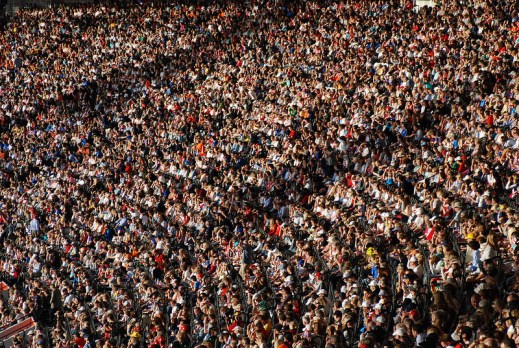
 Welcome to the extra innings of our summer series on “Sound and Sport”! In today’s bonus post, David Hendy discusses his recent Noise broadcast for BBC Radio 4 on the sounds of Olympic crowds. For an instant replay of our summer series click Kariann Goldschmitt’s “The Sounds of Selling Out?: Tom Zé, Coca-Cola, and the Soundtrack to FIFA Brazil 2014” (August), Josh Ottum‘s “Sounding Boards and Sonic Styles: The Music of the Skatepark” (July), Tara Betts‘s “Pretty, Fast, and Loud: The Audible Ali” (June), and Melissa Helquist‘s “Goalball: Sport, Silence, and Spectatorship” (May). Following Hendy’s post on Olympics past, give Andrea Medrado’s podcast a spin for a listen into its future: “The Sounds of Rio’s Favelas: Echoes of Social Inequality in an Olympic City.” And now, David Hendy. Of course, the crowd goes WILD. —J. Stoever-Ackerman, Editor-in-Chief
—
I didn’t get to go to the London 2012 Olympics or Paralympics. Alas, my number didn’t come up in the lottery for seats. So, like millions of others, my family and I watched – and heard – the sporting action on television or, occasionally, on our smart phones. A pretty good experience it was, too: the BBC for instance gave British viewers 24 live streams of high-definition coverage for the Olympics; Channel 4’s approach to the Paralympics was smaller-scale but packed a similar punch in terms of imagery. A key part of the “enhanced experience,” however, was the acoustic quality of the broadcasts. When the Olympics had last been staged in London, during the post-war austerity of 1948, television footage sounded like this:
“1948 Olympics Clip” courtesy of Peregrine Andrews and Alan Hall, Falling Tree Productions Limited
Just about the only things viewers would’ve heard were the voices of the commentators and the distant, muted sounds of the crowd.
That evocative archive recording was used in a recent radio documentary by the British sound designer Peregrine Andrews. The programme explored just how much had changed in location recording techniques by 2012. This time around, Peregrine pointed out, some 4,000 microphones were in position at the various venues: not just suspended in the air above or placed on the trackside, but bonded directly onto the beams in the gymnastic hall, say, or attached to the targets used in archery. Competitors everywhere were heard in extreme close-up – every shift of a hand or foot, every creak of wood, every grunt or groan made audible to the viewer at home.
This wasn’t just hyperbole. Newspapers quickly latched on to the phenomenon, dispatching reporters to measure decibel levels and offer their readers guides to the “best” venues for hearing the sound of the crowd. They pointed out that an airplane taking off produces about “140 decibels of noise”– and that the cheers echoing around the soaring curves and low ceilings of the Olympic Velodrome reached very nearly the same level.

Panorama of the London Olympic Velodrome, Image courtesy of Flickr User Jack999

Olympic Velodrome Image courtesy of Flickr User adambowie
“The roar was thrilling, to the point of pain,” claimed one reporter from the Toronto Globe and Mail. “If I had endured another minute, I am sure we’d all have gone deaf.” Zaha Hadid’s gloriously sweeping Aquatics Centre provided perhaps the most intense acoustics of all. Whenever the 17,500 fans inside cheered, the “guttural roar” was simply “ear-drum shattering,” declared the London Evening Standard. The main Olympic stadium was open air, of course, making the sound less intense. But even here the Globe and Mail journalist wrote of a “tsunami of noise” building in waves; another of the stadium’s “sonic boom”; yet another of how Usain Bolt’s 100 metres final produced a roar from the crowd which, measured at 107 decibels, beat that of your average pneumatic drill.

Olympic Stadium 2012, Image by Flickr User tom_bennett
Perhaps it wasn’t surprising that London 2012 was dubbed the loudest ever Olympics. For the main stadium’s designer Rod Sheard had always conceived it with acoustics firmly in mind. He’s quoted in a piece in It’s Nice That: “The athletes are so focused, it’s very easy for them not to hear the crowd. . .we’ve got to make it really loud for them to get any benefit from it.” And so the 80,000 people inside were packed as closely together as possible with the roof shaped to rebound their roar back into the heart of the space, generating maximum volume.
As my producer Matt Thompson and I discovered when making our recent BBC radio series Noise: a Human History (available on iTunes), this contemporary attempt to revel in the roar of the spectators throws up some striking – and very ancient – parallels. The most obvious is that of the Colosseum in Rome, which, some 2000 years ago, provided what Keith Hopkins and Mary Beard have described as “a brilliantly constructed and enclosed world, which packed emperor, elite and subjects together, like sardines in a tin.”
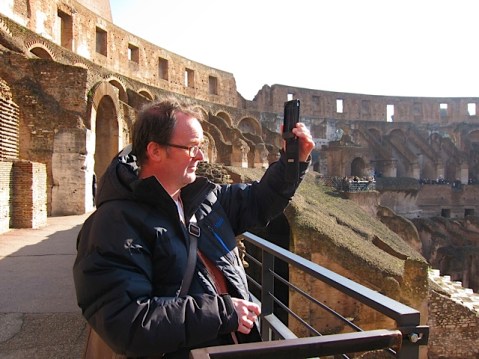
David Hendy at Colosseum, Image by MattThompson/Rockethouse Productions
The acoustic qualities of ancient amphitheaters like this – their ability to amplify the slightest sounds – is still pretty unnerving if you get the chance to witness it for yourself, as Matt and I did when recording, at the Colosseum and at the ancient Greek theatre of Epidaurus:
In these cauldrons of concentrated sound, the roar of the spectators took on a collective force of its own – a volatile quality rich with cultural and political repercussions. During plays in Greek theatres, audiences were rarely hushed and reverential. They were talkative and unruly, sometimes showing their disapproval by drumming their heels against the benches, sometimes disrupting the action by shouting and jeering. The chorus below would address spectators directly, as if facing a jury. Audience participation was as much a part of a performance as were the actors in the orchestra or on the stage. And when it came to the Roman Games later held at the Colosseum or in even larger venues such as the nearby Circus Maximus, the barrage of sound could reach intimidating levels of ferocity.

David Hendy Recording at Epidaurus, Image by Matt Thompson/Rockethouse Productions, taken on location
Roman arenas were not just sporting venues, of course. They were designed for political theatre. Vespasian had ordered the Colosseum to be built to help wipe away the memory of his predecessor Nero and his notorious private pleasure palace the Golden House. Now Roman citizens had a pleasure palace all of their own. The ruling elite had also created a place for the ostentatious display of imperial power and generosity, a bribe for the people’s continuing loyalty. Which is why, if the crowds were sometimes a little slow in showing their appreciation, paid stooges dotted about the arena would start applauding – or booing – at all the right moments, while soldiers would strike down any member of the audience who lagged in their cheering. But, as in the Greek theatres, Rome’s audiences were never entirely under the cosh; they could occasionally give voice to underlying discontentment. And when so many people were so tightly packed together, sheer proximity and the contagious quality of sound meant any turn in the mood would have been quick to make itself felt.
One startling example of this came in 55BC when Julius Caesar’s powerful rival Pompey put on a show in the Circus Maximus that featured the slaughter of elephants – something the crowd lapped up until the very moment they heard the poor creatures’ death throes. In episode 9 of Noise: a Human History, I speculated on what it might’ve been like – and recalled the unsettling outcome:
In London in 2012, we had our very own Pompey, in the form of the British Chancellor of the Exchequer, George Osborne. He’d turned up to the Paralympics to award some medals. And as his name was announced the stadium resounded with loud booing for the first time all summer:
Why did 80,000 people all suddenly decide to boo as one? Because, one commentator quipped, there were only 80,000 people in the stadium.
Politicians as a class are inevitably unwelcome in a place of entertainment, their presence too obviously betraying an attempt to siphon off a little of the goodwill. Osborne’s particular problem, though, was that he wasn’t just any old politician. He was from the ruling Conservative party, which, true to its ungenerous instincts, had just cut welfare benefits for Britain’s disabled people. In the circumstances, turning up to the Paralympics seemed an entirely predictable affront to most of those in the stadium – one that Osborne was thick-skinned and numb-skulled enough not to have predicted for himself.
All this might seem, well, unsporting. But booing is part of the civic dialogue. It brings politicians face-to-face with their electorate. It forces them to feel the scorn and anger of those they’ve let down. The moment passes, of course. Clips briefly went viral on YouTube, and were soon forgotten. Osborne himself is still in office, overseeing the ruination of the British economy through his programme of austerity. But for a delicious few seconds we were reminded of the inherently public nature of sound. We heard – we felt – the role of listening to one another, not as a passive thing but as a powerfully collective, inter-subjective, electrifying, communicative act.
—
Featured Image: Crowd: London 2012 Olympic Stadium, Image by Flickr User Flickmor
—
David Hendy is Professor of Media and Communication at the University of Sussex, England. He wrote and presented the recent 30-part BBC radio series Noise: a Human History, which remains available to download on ITunes. The accompanying book, Noise: a Human History of Sound and Listening, will be published in the US in October 2013 by Harper Collins. He’s the author of Radio in the Global Age (2000), Life on Air: a History of Radio Four (2007), and Public Service Broadcasting (2013), and contributes regularly to radio programmes.
—
REWIND! . . .If you liked this post, you may also dig:
“We wanted to tell stories about sound”: Opening Ears Through the “Everything Sounds” Podcast–Craig Shank and George Drake Jr.
Quebec’s #casseroles: on participation, percussion and protest–Jonathan Sterne
Goalball: Sport, Silence, and Spectatorship— Melissa Helquist
Share this:


Current Top Posts





April 2021

January 2020

November 2019

October 2019

August 2019

April 2014

November 2017

March 2015

December 2017

October 2015
 Sounding Out!
Recent Comments