
Easy Listening: Spreading and the Role of the Ear in Debating

Photo courtesy of Sounding Out! intern, Sky Stage. All rights reserved.
As I write, my institution, the University of Denver, is gearing up to host the first of the 2012 Presidential Debates. The debate promises a polite and eloquent exchanging of reasons on matters of public concerns. This image of “the good man [sic] speaking well,” roughly represented by Obama and Romney, pervades popular culture representations of debate. While there are certainly some forms of debate that stress public reason, like Worlds style debate, most other competitive styles of debate, look and sound very different.
American “Policy Debate,” the type of debate I will explore today, is a high school and collegiate competitive activity where two-person teams argue the merits of governmental legislation. In every round there is an affirmative that advocates an action and a negative defending the status quo, or some alternative. The debate prompts, or resolutions, change yearly and produce research collections comparable to a master’s thesis. But, it is not the research that captures newcomers’ attention. No, it is the velocity that information travels. Indeed, highly successful debaters transform their voice into a high-speed information weapon, sometimes speaking up to 400 words per minute (wpm).
Nobody really knows who decided that speaking quicker than her/his opponents would be a viable strategy. Some allege that David Seikel and Mike Miller, a dominant team from the University of Houston in the late 1960s invented the strategy. However, Miller denies this fact, insisting that the practice of speaking quickly, or “spreading,” predated their success by a couple years. While it is difficult to pin down exactly when talking becomes spreading, studies indicate passive comprehension has a threshold of around 210 wpm. Simply put, spreading is a vocal practice that propagates more arguments than an opponent can rebut, forcing the opposing team into a strategic choice of conceding and/or inadequately responding to some positions.

Almost immediately after its introduction, spreading became a polarizing issue. While some alleged that speed undermined communicative argumentation, others applauded its ability to foster critical thinking. Rate of delivery became a site for what Douglas Ehninger called in 1958 the debate about debate: should debate be concerned with public reason or technical proficiency? Spreading figured prominently in these discussions because it circumscribed debate to the technical sphere, the quick pace precluding lay comprehension. As a site for cultivating what argumentation theorists Ron Greene and Darrin Hicks call “the ethical attributes required for democratic citizenship” (101), debate operates as an ideal problem space to inquire about the relationship between listening and judgment that underwrite argumentative exchanges.
Extracting meaning from a spread requires a trained ear that can delineate the nuance of tone, rhythm, code, and breathing, while translating these sounds into symbols that are then recorded onto a “flow” (a document where participants keep notes of the debate). This technical sphere of argumentation, then, requires what cultural historian Jonathan Sterne calls in The Audible Past: Cultural Origins of Sound Reproduction an “audile technique,” or a set of culturally defined listening practices. Here, spreading denotes not just rate of delivery, but encompasses a range of other practices that attend to the debate. Yoking velocity with technical proficiency, spreading requires an audile technique that attunes the ear to speed, while calibrating the viscera to quickly appraise each position espoused. Extending Sterne’s observations into an embodied theory of listening, I argue that spreading entrains visceral judgment that organizes expertise under the banner of “exchange-value,” instead of its veracity. Reflecting what Jodi Dean calls in Blog Theory: Feedback and Capture in the Circuits of Drive capitalism’s communicative style, I contend, audition in this case privileges flow over content.
Today, debaters are much faster than their 1960s counterparts. Take for example the championship round of this year’s (2012) National Debate Tournament (NDT). The 2012 topic debated the merits of the United States’ democracy assistance in the Middle East.
Finals – NDT 2012 Northwestern BK v Georgetown AM – 1AC + CX
In the speech linked to above, dubbed the first affirmative constructive (1AC), the speaker’s first words are easily audible, but as the seconds expire, the affirmative’s words increase in velocity; syllables collide and contort. The speaker pushes through, taking a split second to take a short, fast breath (called a clutch) before he begins his next word. To the seasoned ear, the voice is instructive; a slower, deeper tone signifying an assertion. also known as a “tag,” and a faster tempo indicating evidence. Out of this buzz, debaters’ are able to discern distinct phrases, like “Arab Spring,” “economic down turn,” and “nuclear war.” In 9 minutes the speaker outlined his advocacy, consisting of multiple scenarios for planetary extinction.
During the 1AC, the negative team is carefully listening, gathering the affirmative’s evidence, and translating the speech into symbolic shorthand, termed flowing. In addition to its purely functional use—to keep track of positions—the flow also provides third party adjudicator(s) a document to evaluate the debate.

Image of flow notes taken during a debate
After a period of questioning, the first negative speaker, linked to below, elaborates his positions: a procedural concern that the affirmative is outside the confines of the resolution; two philosophical objections (or critiques); two alternative courses of action that resolve the affirmatives exigencies, while conserving the president’s political capital, so Obama can push for Jackson-Vanik legislation; and finally direct responses to the affirmative position.
Finals – NDT 2012 Northwestern BK v Georgetown AM – 1NC + CX
Coupled with the “burden of rejoinder,” which dictates a conceded argument is a true argument, speed becomes a strategic weapon. The more positions, the more likely one will be missed, granting the other team an advantage. For example, failure to address the negative’s concerns about the Jackson-Vanik legislation means that the affirmative position would result in a US-Russian nuclear war culminating in extinction and probably losing the affirmative the debate. Even less dire claims exert force in the round. For instance, missing the relatively innocuous claim that Obama does not have political capital abrogates the negative’s whole Jackson-Vanik position. After all, what would be the point of Obama conserving capital, if he has none to begin with?
Debating thus requires a refined ear capable of quickly determining a argument’s merit, while allotting the proper amount of attention. If a claim is deemed irrelevant, the debater can focus on a more relevant position, keeping her/his ear piqued for beginning of the next position.

Debate team members listening to the flow at a 2009 Tournament at University of the Pacific; Image by Flickr User Inkyhack
This confluence of speed, evidence, time constraints, and a burden of rejoinder cultivates an instrumental relationship to expertise. Media theorist Jayson Harsin suggests in “The Rumour Bomb: Theorising the Convergence of New and Old Trends in Mediated US Politics” that these “conditions encourage a relationship of viewer to text (slogan, soundbite, fragment) which is essentially fiduciary, based on trust, not critical understanding”(101). Indeed, time constraints coupled with a proliferation of positions, produces a sound to listener relationship, where the veracity is assumed and significance is dictated by strategies, not the least of which is vocal. This is because there is simply not enough time to evaluate the credibility of each piece of evidence read. Patrick Speice and Jim Lyle, two debate coaches, explain that “Debaters have to be focused on the arguments being offered, have to be able to understand them very quickly, and they have to be able to discern which arguments are of the greatest significance for the round.” Evidence, then, is reorganized along a strategic continuum—the more likely an argument may help or hinder a team’s chances of winning, the more important it becomes. This can precipitate a “race to the margins,” where one side tries to find an obscure argument to beat back more probable analysis. This is not to say that one kind of argument is better than the other. But, the rationality used to organize the evidence relegates veracity to the epiphenomenal. This fosters an epistemic leveling, indexing expertise according to its exchange-value.
The repetitive nature of debate inscribes these listening habits into the body, shaping future interaction. Writing on the pious ear, cultural anthropologist Charles Hirschkind explains in The Ethical Soundscape: Cassette Sermons and Islamic Counterpublics, “patterns of sensory attunement configured through continuous practice of such a listening constitute an intensifying perceptual background for […]ethical agency and public reason”(28). Similarly, the practice of listening to debate rounds, along with the movement of the hands, quickness of thought, and so on are burned into an affective substrate, defining the horizons of future action. That is, through the repetition of debates, audile technique is entrained into motor memory, residing just below the conscious register of thought, acting as a potentiality. Most often, this listening technique is activated in the next debate round, the spread’s distinctive sound generating an anamnestic effect, activating the policy debate ear.
In sum, spreading proffers an audile technique concerned with the exchange-value of evidence, where the “best claim” is the one that wins the round. It entrains a technical mode of audition, aiding the debater in making quick decisions. This listening style underwrites a knowledge economy, where expertise becomes just another commodity that is bought, sold, and traded to support pre-formulated opinions. “Under communicative capitalism,” Jodi Dean writes, “an excess of polls, surveys, and assessments circulates, undercutting not only the efficacy of any particular poll or survey but the conditions of possibility for knowledge and credibility as such. There is always another survey, done by another group or association with whatever bias and whatever methodology, displacing whatever information one thought one had” (103).
—
Justin Eckstein is a doctoral candidate and former director of debate at the University of Denver. His work explores the intersection of listening, affect, and argumentation. Justin’s writing has appeared in Argumentation & Advocacy, Relevant Rhetoric, and Argumentation in Context. Currently, he is writing his dissertation on the micropolitics of podcasting in the post-deliberative moment.
Share this:

On the Lower Frequencies: Norman Corwin, Colorblindness, and the “Golden Age” of U.S. Radio
Editor’s Note: This is Liana, Managing Editor for Sounding Out!, introducing you to this special fall installment of our series “Tune Into the Past,” penned by our very own Editor-in-Chief and Guest Posts Editor, Jennifer Stoever-Ackerman. We at SO! have been waiting for months for Jennifer to share with us a brand-spanking new blog post! She’s back in action this month with a post that asks readers to listen to the cultural landscape that foregrounded Norman Corwin’s success as a radio writer and producer, inspired by her research on her book manuscript on the sonic color-line. In particular, Jennifer addresses the notion of colorblindness and its very real repercussions on radio artists and producers of color in the 1940s. Want to catch up on our series on Norman Corwin? Check out this summer’s posts by radio scholars Neil Verma, Shawn VanCour, and Alex Russo. If you’re all caught up, open your ears and your eyes then (to paraphrase Kurt Cobain). —LMS
—
Almost every day, I hear someone on the radio hailing America as the home of democracy. Yet almost every network is guilty of discrimination against the Negro performer. There are a few isolated cases of Negroes in broadcasting, but the lily-white policy is seldom violated.—Lena Horne, Chicago Defender 1940
The fine pieces in the “Tune in to the Past” series have thoughtfully considered the audible legacies of Norman Corwin: the “kaleidosonic” aesthetics that Neil Verma called the “Corwinesque,” the virtually seamless melding of artistic and commercial concerns that Shawn VanCour analyzed, and the echoes of Corwin remixed into WNYC’s Radiolab that Alexander Russo amplified. But the research I performed for my book manuscript, The Sonic Color-line: Race and the Cultural Politics of Listening, about the fraught relationship between race and 1940s radio, left me pondering the gaps and silences of Corwin’s soundscape. Radio’s “Golden Age” was also its most racially segregated: was the philosophy of “colorblindness” that Norman Corwin publicly espoused key to keeping it that way?
It’s not my goal to undermine Corwin’s work, but rather to enhance our understanding of it by embedding his broadcasts in the wider political, historical and sonic fields in which he was enmeshed. Just as Corwin’s sounded legacy left long-lasting traces in our media, so too have the silences and omissions fostered by the media executives, casting directors, union bosses, radio critics, and sonic auteurs of the “Golden Age.” If Corwin’s work is difficult to access save for far-flung archives and spotty collector’s catalogues, the exclusions of African-American producers, performers, and listeners are even harder to hear, in part because of his very insistence that radio’s microphones were colorblind. As the epigraph from Lena Horne testifies, the discourse of democracy is not mutually exclusive with segregation. In what follows, I discuss the intensely segregated history of the “Golden Age of Radio,” arguing that one of Corwin’s most far-reaching legacies may not have been set in motion by his virtuostic broadcasting, but rather by the World War II-era liberalism that shaped it.
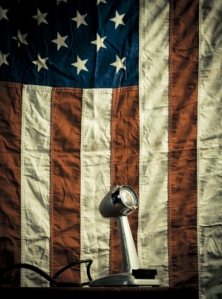 The apex of Corwin’s radio career coincided with a profound shift in America’s dominant racial formation, the beginnings of “colorblindness.” By colorblindness, I mean the belief that if individuals and institutions ignored skin color as a signifier and eliminating race as an official category of identity—particularly within governmental institutions—it would cease to matter in American life and all groups would have equitable access to the privileges, opportunities, and freedoms afforded by citizenship. The shift toward colorblindness—what Michele Hilmes calls America’s “wartime racial realignment” in Radio Voices—was predicated on creating a sense of unity that would inspire men across the color-line to sign up to fight what was dubbed a war to end racism and fascism, even as it raged on in their segregated hometowns. The Pittsburgh Courier’s Double V Campaign—Victory against fascism abroad and Victory against racism at home—addressed these ironies. Barbara Dianne Savage’s Broadcasting Freedom: Radio, War, and the Politics of Race details the suppression of many black newspapers on military bases due to the Double V Campaign, as well as the pressure it put on government radio programs to address race. However, she notes:
if black people had been forced to rely on radio as their primary means of communication about the failings of the federal government, they would have been on an impossible mission, since they were admitted to radio only as entertainers or as briefly invited guests expected to be on their best behavior (94).
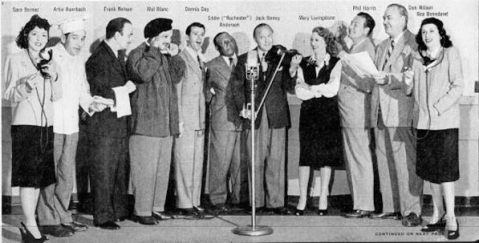
Cast Photo of the Jack Benny Program. Eddie Anderson, who played Benny’s valet, was one of only a handful of steadily working black radio actors in the 1940s
Despite high-profile protests in the black press, mainstream broadcasters constructed radio as an unmediated purveyor of equality and truth with increasing frequency during World War II—its “lofty aerials, symbols of freedom” according to New York Times radio critic Orrin Dunlap. In the case of Norman Corwin, he wrote a symptomatic (and nervy) editorial for Negro Digest in 1945 that depicted U.S. radio as a direct material and technological representation of colorblindness itself.
In “A Microphone. . . is. . . Color Blind”–what revealing ellipses!–Corwin assures black readers that “my feeling about Negroes in radio is that they belong as surely as the microphone.” This strange opening gambit compares black participation in radio to the mute technological presence of the microphone that, while absolutely central to broadcasting, is an object with no inherent agency. Unlike the proprietary, agenda-setting presence of whites in radio, a microphone amplifies the voices of others, while speaking not a word of its own. From his privileged vantage point, Corwin doesn’t quite realize how colorblindness enables him to use black people as tools.
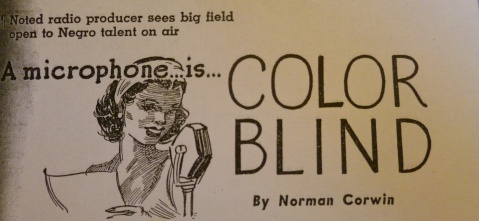
Norman Corwin’s “A Microphone is Color Blind” from Negro Digest (1945), Image by the author
And, while Corwin’s title insists on the microphone’s colorblindness, his article suggests otherwise. Much of his description of what America is missing without black people’s radio presence has to do with aural racial difference: “I have found the same thing that makes Negroes supremely great artists in song makes them great in speech. The color and warmth conveyed in the performance of a Negro artist is directly communicable by air. The microphone is a faithful reporter and says exactly what it hears.” In addition to perpetuating the old stereotype of black people as natural performers, Corwin’s realist depiction of the microphone as a “faithful reporter” that “says exactly what it hears” covers up exactly how much black voices were sculpted for white consumption during this period in radio; as actor Johnny Lee (“Algonquin C. Calhoun” on Amos ‘n’ Andy) told UCLA graduate student researcher Estelle Edmerson in 1954: “I had to learn how to talk as white people believed Negroes talked. Most of the directors take it for granted that if you’re a Negro actor, you’ll do the part of a Negro automatically.”

Johnny Lee as “Algonquin C. Calhoun” on Amos ‘n’ Andy
Whereas radio listeners were able to hear a wide range of white voices in a spectrum of roles—major and minor, comedic, dramatic, musical, informational—the sound and the content of black speech was circumscribed by the sonic color-line that marked it as “automatic,” essential, comedic, and potentially dangerous. Corwin’s use of the word “communicable” rather than “communicated,” for example, is a revealing flourish giving black sound a tinge of contagion and infectiousness. While ostensibly celebrating black voices, this passage simultaneously assures white listeners that they will still be able to unequivocally identify the race of any speaker over the “colorblind” airwaves and that this experience will be a pleasurable one for them. While the microphone may be color blind, it clearly is not color deaf.
That Corwin assumes a white audience becomes more obvious with his assertion a few lines later that “I have found too few Negroes who have taken an interest in radio. I suspect it’s because they don’t know about it.” This statement is fairly incredible, considering that the Research Company of America published a study in the radio industry magazine Sponsor that placed African American radio ownership at 87%, just shy of the national figure of 90% (October 1949, 25). Sponsor dubbed black audiences “The Forgotten 15,000,000.”
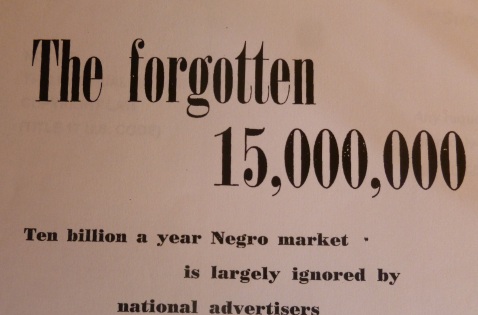
Sponsor, October 1949, Image by author
In addition to being inaccurate, Corwin’s suggestion that African Americans had limited knowledge of radio performs one of the signature moves of colorblindness; it makes institutional barriers to access—lack of training, networks, and mentorship, as well as straight up discriminatory hiring practices—invisible by asserting that black people only need to work harder to succeed in the American media industry. Under colorblindness, the failure to achieve success equitable to white citizens falls squarely on the shoulders of those oppressed. It also willfully mutes the protest of many black actors—such as Butterfly McQueen—who refused to participate in the segregated industry and the agency of all the black listeners who turned the dial on shows distasteful to them, allowing the fantasy of a unified (white) America to remain a powerful referent.
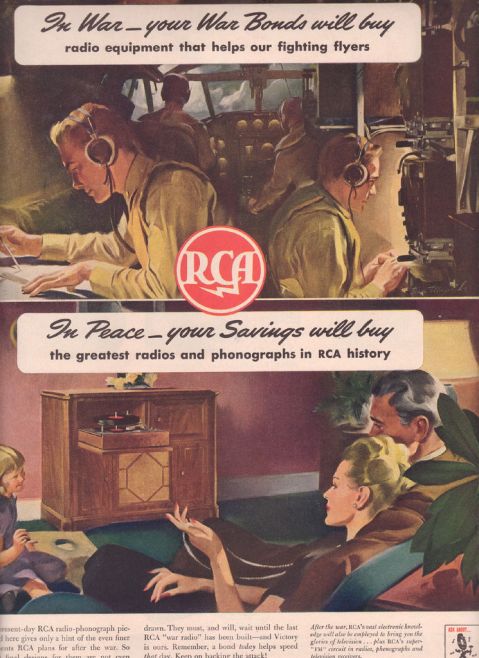
By and large, Corwin’s article paints colorblindness as already achieved. In his estimation, it is up to black people themselves to take advantages of the opportunities he suggests already await them via the colorblind microphone: “My attitude is not unique among radio directors—at least not in the main centers of radio[. . . ],“Corwin insists, “there is less prejudice in this field than in any other. It exists unfortunately, but you can get a hearing.” For someone whose bread and butter was rhetorical flourish, Corwin’s use of passive sentence construction to discuss racial prejudice is significant—he naturalizes it as something that merely “exists,” tooling along without any specific historical agent performing the discriminatory and oppressive actions. Such omission lets the white gatekeepers of the 1940s radio industry off the hook for both the institutional and individual forms of discrimination that kept the industry largely, as Lena Horne phrased it, “lily-white.”
Radio’s profound whiteness was aural as well as visual. In Corwin’s colorblind America, a radio “hearing” comes at a heavy price for African Americans. Without commenting on educational segregation, Corwin proclaimed: “Negro schools should have in their curriculum courses in public speaking, radio, theater. There is no reason why there should not be Negro announcers. It is important to study diction so that distinction in speech cannot be noted.” While Corwin begins “A Microphone. . . is. . .Color blind” by arguing that black voices should continue to retain the racial markings that are legible (and pleasurable) to white listeners, he then suggests they must also simultaneously sound enough like the white voices surrounding them in order to be heard and accepted as fellow American citizens. Radio didn’t just passively reflect the sounds of American citizenship during this period–it actively constructed them on a foundation of exclusion and silencing.
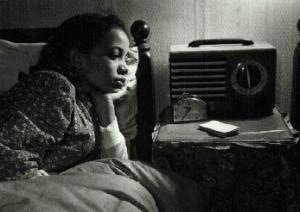 There remains, then, a profound disconnect between the full exercise of American citizenship, the idealized discourse of colorblind equality forwarded by government officials, media critics, and prominent broadcasters exemplified here by Corwin, and the actual representation of African Americans as radio producers, performers, and listeners during and after this period. At the same time as state-sponsored colorblind ideology rose to prominence during the war years, the U.S.’s airwaves became almost exclusively white. There were no black writers regularly employed by any national radio station during the 1940s and there was not a single black member of the Los Angeles Writer’s Guild. While black authors Langston Hughes and Carlton Moss wrote occasional scripts on one-shot contracts, they were about topics deemed of black interest by the networks. Black radio critic Joe Bostic—who would later become one of the nation’s first black radio sportscasters—described the limited openings for black radio performers:
publication last week of the most authoritative and comprehensive of the radio polls showed not a single Negro entertainer placing in the first ten of any branch of radio entertainment. Such a compilation outlines, in bold relief the disturbing fact that the Negro, long a leader in every phase of entertainment, is being excluded in this newest and most lucrative branch (People’s Voice, 1942).
Regular on-site broadcasts from nightspots that featured black performers all but vanished after 1940, meaning that the vast majority of black musical performances broadcast over the American radio networks were conditioned and mediated by white announcers and sponsors as well as the sounds of white-oriented programming that introduced and followed them.
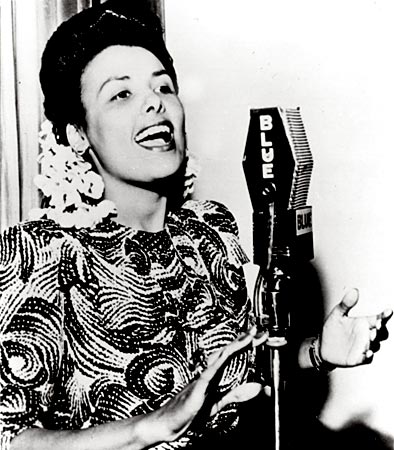
Lena Horne guesting for NBC’s Blue Network
To be clear, I don’t blame Corwin individually for the ideology of colorblindness and the world it has wrought, but I do think it is important to consider his role as a cultural producer in the “Golden Age” of segregated radio, and as a power broker who helped shape the media landscape with which we now contend. While we commemorate his labors as a sonic artist with high journalistic standards who undoubtedly worked to “glorify the ‘common man,'” we also have to consider the institutionalized privilege that enabled him to claim this role as his own, as well as the many people silenced by him doing so, inadvertently or not. Tuning in to the past demands a vigilant ear attentive to the profound silences of exclusion: the traces of words muted, mangled, disciplined and unsaid, as well as the subterranean reverberations ghosting the triumphant tones of the “Golden Age,” a shadow broadcast, on the lower frequencies, of all the sounds that might have been.
—
Jennifer Stoever-Ackerman is co-founder, Editor-in-Chief and Guest Posts Editor for Sounding Out! She is also Assistant Professor of English at Binghamton University and a former Fellow at the Society for the Humanities at Cornell University (2011-2012).
Share this:


Current Top Posts





April 2021

January 2020

November 2019

October 2019

August 2019

April 2014

November 2017

March 2015

December 2017

October 2015
 Sounding Out!
Recent Comments