
Tuning Into the “Happy Am I” Preacher: Researching the Radio Career of Elder Lightfoot Solomon Michaux


Welcome to the second installment of our Thursday series spotlighting endangered radio archives across the United States, promoting the work of the Radio Preservation Task Force (RPTF), which is part of the National Recording Reservation Plan of the Library of Congress. Our series kicked off two weeks ago with this post by Josh Garrett-Davis exploring both the history of Native American radio and new ways of thinking about it, and the series will conclude with a piece next week by the University of Michigan’s Derek Vaillant about radio recordings in immediate need of preservation in Detroit.
Between possible archives and endangered ones, we have an article about an archive that has begun to speak after long years of silence. Below, Professor Suzanne Smith of George Mason University gives us a preview of her research into a radio evangelist who was among the most prominent African Americans of his day, yet has been largely forgotten. Smith’s fascinating work not only revisits Elder Michaux as a historical figure, but also gives us a clear sense of how a project in radio reservation relies not only on institutional resources, but also on personal outreach. As many of us who are part of the preservation project are learning, media history lives on in storage units, basements and lockers, preserved by collectors, churches and communities that only individual connections can truly reach.
— Special Editor Neil Verma
—
In October 1934, the Washington Post published a feature about Elder Lightfoot Solomon Michaux in which it boldly declared that the “radio evangelist extraordinary, is the best known colored man in the United States today.” At the time, Elder Michaux, known as the “Happy Am I” Preacher, had a national radio show on the CBS network that broadcast his ministry of happiness and holiness to over twenty-five million listeners each week.
Like many popular evangelists of his era, Elder Michaux promoted his image as one of God’s prophets, presciently envisioning that radio could revolutionize the purview of modern evangelicalism. Michaux first used portable radio equipment to broadcast his holiness revivals in the mid to late 1920s in his hometown of Newport News and these religious programs were among the first of their kind in the United States. By 1929, Michaux moved to Washington, D.C. in the hopes of expanding his mission.
As an African American, Michaux initially had difficulty convincing local D.C. radio outlets to put him on the air. Eventually, he persuaded James S. Vance, local owner of WJSV, to broadcast his weekly revivals. When the CBS network bought WJSV in 1932, the budding evangelist achieved a national audience in the millions.
 The key to Michaux’s success was his ability to combine his preaching with snappy, upbeat gospel songs that reminded listeners that a holy life leads to a happy life, a message that resonated with Americans navigating the economic trials of the Great Depression. By the late 1930s, the BBC invited Michaux to broadcast his program on its network and listeners around the globe soon began to tune into his WJSV broadcasts in via shortwave hookup. These opportunities allowed the charismatic preacher to reach a vast international radio audience that extended from Europe to Africa, South America, and the Caribbean. That Michaux’s broadcasts, like his story, have disappeared from radio history has impoverished our sense of the role of race in the soundscape of the era.
My current book project examines Michaux’s extraordinary life and career as a radio evangelist. For this post, I want to explain both Michaux’s significance to the history of religious radio as well as African American history; and how my research has led me to join the Radio Preservation Task Force in an effort to preserve the surviving recordings this important figure, but understudied, figure.
In spite of his many accomplishments, Elder Michaux has been largely overlooked in the histories of religious radio and African American religion. Scholarship on religious radio from the 1920s and 1930s tends to focus on figures such as Father Charles Coughlin and Aimee Semple McPherson with only passing mention of African American preachers such as Michaux. In the history of African American religion in the 1930s, Michaux tends to be overshadowed by scholarship on other major figures such as Father Divine and his Peace Mission Movement and Sweet Daddy Grace and his United House of Prayer. Although Michaux’s ministry was often categorized as a religious cult in the popular press of the time, his Gospel Spreading Radio Church of God was firmly a part of the black Holiness movement and continues to have ten active congregations today.
 Throughout his career, which began in the late 1920s and extended until his death in 1968, Elder Michaux defied the odds and challenged boundaries of race, theology and politics to become one of the most successful religious leaders and media celebrities of his time. As early as 1926, Michaux, whose Holiness ministry openly welcomed all races, was arrested for baptizing whites and blacks together. Once established in Washington, D.C., Michaux led annual mass baptisms in the Potomac River and later at Griffith Stadium that drew tens of thousands of followers. At the height of his fame, from the 1930s through the 1950s, Michaux was regularly invited to the White House to consult with Presidents Roosevelt, Truman, and Eisenhower about the racial issues of the day. By the early 1960s, Michaux engaged in public debates with both Martin Luther King Jr. and Elijah Muhammad, leader of the Nation of Islam, about the direction of the civil rights struggle.
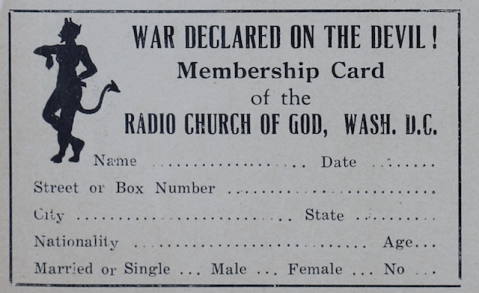
My book argues that Elder Lightfoot Solomon Michaux is critical to our understanding of how religious leaders used the mass medium of radio to literally “sell” evangelical faith movements in modern America. Elder Michaux was the first to fully develop the concept of a “Radio Church,” which offered official membership to followers and created one of the first, if not the first, virtual religious communities in modern America. A true evangelist, Michaux sought to reach believers and potential converts wherever they were and knew that the radio could facilitate his mission in revolutionary ways. In an interview in 1938, Michaux explained, “I wanted to give people religion over the air so they might have it at home. Then they couldn’t have an excuse for not going to church. They couldn’t say that they were tired or didn’t have the right clothes. They could get God and his teachings right in their own parlor.” Most significantly, Michaux’s entrepreneurial skill at marketing his Gospel Spreading Church of God through the radio was simultaneously in service to his race and racially transgressive in ways that complicate our understanding of how modern religious movements navigated Jim Crow segregation.
So how can we actually give an account of Michaux’s contributions? Researching radio programming from the 1920s and 1930s presents a number of challenges for any historian because recordings of broadcasts from this period are rare. Fortunately, Elder Michaux began his career on WJSV, one of the most powerful stations in Washington in the 1930s (which became WTOP, the most popular local news radio station in Washington, D.C. today). The first director of WJSV under CBS ownership was Harry Butcher, who had the foresight in September 1939 to record an entire day of programming, which is remarkable considering this was accomplished without the use of magnetic recording tape. Although this collection does not include Elder Michaux’s program, it is a valuable audio snapshot of the radio era in which he thrived.
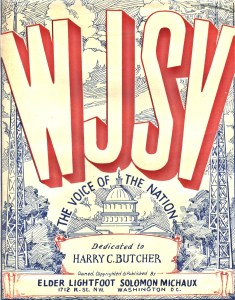 My quest to locate recordings of Elder Michaux’s broadcast has led me to destinations as far away as the BBC archives in London, which houses two recordings of Michaux’s first British broadcasts; and as close as the main branch of the current Gospel Spreading Church of God here in Washington.
In the past two years, I have also developed meaningful relationships with congregants of the church, who have begun to be willing to share their private archive of recordings. During one oral history interview, one church member, who is 92-years old, gave me a reel-to-reel tape from Elder Michaux’s funeral service, which was broadcast in October 1968. Another elder member from Newport News sent me recordings of Michaux preaching at Lorton Prison in Lorton, Virginia in the 1950s. Most significantly, I recently met the current sound engineer at the church, who has been a member since the 1940s and has a large archive of reel-to-reel tapes of Michaux’s radio broadcasts from the 1950s and 1960s. At the height of his fame in the early 1930s, Elder Michaux broadcast his religious services daily and never missed a week of broadcasting until his death in 1968. The church has only kept a fraction of these broadcasts. Nevertheless, a significant number of them exist and are housed in the church’s private storage. I am currently trying to assess the scope of the church’s collection, which has involved reaching out to church members in Philadelphia, New York City, and Newport News, Virginia. I am also trying to investigate grants that might support my efforts to digitize the tapes as soon as possible since they are at risk of deterioration in the church storage facilities.
My research on Elder Lightfoot Solomon Michaux’s career has convinced me that more work needs to be done to pursue the preservation of African American religious radio broadcasts in general. The work of the Radio Preservation Task Force can support this mission, but it will also involve grassroots outreach to established African American churches. Many of these churches regularly broadcast their services and may have their own private archives of recordings that can offer us an invaluable glimpse at the aural history of African American religious practices in the twentieth century.
Moreover, through my ongoing relationships with the congregants of Elder Michaux’s Gospel Spreading Church of God, I have developed a deeper appreciation for the importance of personal outreach to African American religious communities in the service of preserving the history of religious radio. The efforts of the Radio Preservation Task Force are critically important in terms of identifying existing institutional archives, but only through individual connections with these vital, but often overlooked minority communities, will we be able to discover and preserve these treasures of our radio past.
—
Suzanne E. Smith is Professor of History in the Department of History and Art History at George Mason University. She is the author of Dancing in the Street: Motown and the Cultural Politics of Detroit (Harvard University Press, 1999) and To Serve the Living: Funeral Directors and the African American Way of Death (Belknap Press, 2010). She is currently working on her third book, tentatively titled The ‘Happy Am I’ Preacher: The Extraordinary Life and Times of Elder Lightfoot Solomon Michaux.
—
All images courtesy of the author.
—
 REWIND! . . .If you liked this post, you may also dig:
Pentecostal Song, Sound, and Authentic Voices — Ashon Crawley
“I Love to Praise His Name”: Shouting as Feminine Disruption, Public Ecstasy, and Audio-Visual Pleasure — Shakira Holt
Sounding Out! Podcast Episode #5: Sound and Spirit on the Highway — David B. Greenberg
Share this:

SO! Reads: Shana Redmond’s Anthem: Social Movements and the Sound of Solidarity in the African Diaspora
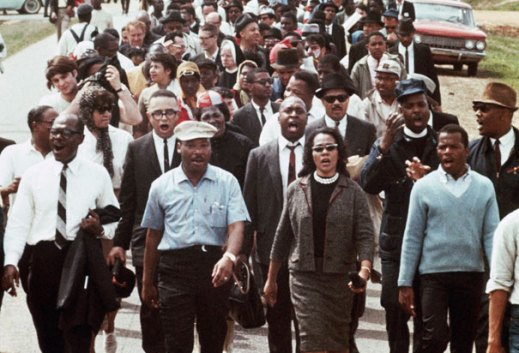
 To follow a song, to trace its roots and genealogy, to consider the context of its emergence as well as its lineage. To consider how sound and song propels political movement. To trace histories and concepts through the enunciative force of sound, of song. This is the work of Shana L. Redmond’s Anthem: Social Movements and the Sound of Solidarity in the African Diaspora (NYU Press, 2014). Redmond is Associate Professor of American Studies and Ethnicity at University of Southern California and the 2014-2015 Ella Baker Visiting Associate Professo of Black Studies at UC Santa Barbara, with research interests in music and popular culture, history and social movements, labor and working-class studies and critical ethnic studies. And this is to say nothing of her interests inAfrican Diaspora and Black political and social life. All these interests are made explicit within Anthem, a book that compels readers and listeners not only to ask questions about bygone eras, but to consider the soundscapes and beat drops of their own milieus. Redmond’s work, in other words, causes readers to consider the efficacy of sound and song making as the vibratory force that inheres in any social mood and movement. Anthem‘s power lies in the attention Redmond gives the circulation of sound and song: how each emerges from specific contexts as well as how songs end up being contested sonic sites wherein an intellectual practice of justice organizing can be articulated and Black sociality and personhood asserted and contended.
 In particular, Redmond utilizes the concept of the Black anthem as a theoretical tool in order to consider the efficacy of organizing and fighting against practices of racism, sexism and imperialism. Redmond documents Black anthems as “sonic productions” that “were not ancillary, background noise” but “were absolutely central to the unfolding politics because they held within them the doctrines and beliefs of the people who participated in their performance” (8). That sounds, that songs, have so much potential to enunciate otherwise modes of living; that sounds, that songs, have within them the capacity to announce otherwise worlds, is something well known to those violently excluded from modernity and its epistemologies of the human, the citizen, the subject. We know this otherwise mode of living, this otherwise modality of world, affectively. And this affectivity is born out in aesthetic practice. Thus, to attend to the organizing of sound – as song – and how such musics made their way from, for example, Harlem to Cuba in the case of the Universal Negro Improvement Association’s “Ethiopia” or from women’s singing in Charleston to international stages, is all within the analysis and the archives offered by Redmond. What pleases is how her historical archival work is inflected by sonic analyses of songs; Redmond discusses the musicality of songs, how chord changes, harmonies, and melodies offer fresh insight into ways to think sonically about the movement of sound and song.
Anthem appeals to those interested in Black social movements of the twentieth-century, to be sure. But the book also makes musicological argumentation central to its thesis. So, for example, readers not only learn about lyrical content and history of brothers James Weldon and John Rosamond Johnsons’ “Lift Ev’ry Voice and Sing,” but they are also compelled to think about the song in its sonic registers, with its musicological features. For example,
The first measure of the vocal line is a half measure and offers a running start to the A-flat major key signature, with the text ‘lift ev’-ry’ notated by three eight notes in the 6/8 time signature. While the song was written in 6/8, its performance follows a 12/8 phrasing, placing it alongside the Black gospel tradition, which…was growing in dynamic ways at this very moment. The quick introduction leads the vocalist to a strong tonic chord on the downbeat of measure 2. The melodic emphasis lands on the word ‘voice’ with ‘and sing’ (measures 10 and 11) following as long notes (72-3).
This so say that Redmond takes seriously the ways songs are constructed as part of the argument she wants to put forward about the efficacy of the Black anthem. Her work models how to attend to the musicological as a fundamental feature of sound and song-making in Black sociality.

In considering the context of emergence for sounds and songs, Redmond produces a text that fits squarely within Black performance theory, since she is less concerned with the rightness or wrongness and much more with the efficacy of performance. The concern and the question of efficacy displaces the necessity for results-driven analyses in Black performance theory, placing emphases on how the production of sound and song proliferates, how it finds life, how it creates – while also being created by – worlds. Impressively, Redmond’s thorough sonic-historical approach to her archive gives her method resonance beyond even its richness. Anthem can be radicalized through generalizing its treatment of to songs as objects that are both part of and propel movements, enabling us to consider the context of emergence for any song and performance. Generalizing Anthem means that readers would take seriously the attempt to move from the specific sonic moment to the general, from various, plural moments of emergence to considering how sounds and songs move, how they create otherwise temporalities and spatial zones. Anthem produces a new theory of thinking relation between specific performances and their history and social movements, both in local and in global diasporic contexts.
In addition, Redmond analyzes how songs–and sounds within such songs–can at times be utilized to further racialist, sexist, imperialist impulses and practices. For example, Redmond analyzes “Ol’ Man River” in multiple forms and contexts, including the performance changes produced by Paul Robeson. Here Redmond begins the tension in the dialect as written by Oscar Hammerstein II and Robeson’s deployment of the song in performance.
The dialect demonstrates a particular version of blackness out of sync with the ‘fine intelligence’ of Robeson, a Phi Beta Kappa scholar at Rutgers University and Columbia Law School graduate. Hammerstein’s dialect not only distinguishes Black from white in the musical but also serves to contain the Black characters in their natural state as uneducated and simple laborers and confidants (105).
Thus, sound and song can also be deployed otherwise, can be used in order to critique, to produce an intervention into such normative conceptions of blackness. And from Redmond’s text, readers learn something of Robeson’s radicalizing, of his deep engagement with thinking global blackness, through the way he changed the lyrical content, and thus the dialect and mood, of “Ol’ Man River.”

Paul Robeson Leading Moore Shipyard Workers in the “Star Spangled Banner,”
Oakland, CA, September 1942, Image courtesy of the National Archives and Records Administration
Still Picture Branch, Record Group 208, National Archives Identifier: 535874
Ultimately, Anthem produced for me the occasion to wonder if we can think the very concept of diaspora otherwise, as a following of vibrational moods and movements, as antiphonal participation in an ongoing call. And as an ongoing call that is resistive in its enunciation, that is ongoing and open-ended. If we did so, perhaps we would also come to understand Black sociality otherwise. In other words, perhaps we can think of it as making a claim on us, a ceaseless and performative ceaseless pulse that beckons and convokes. We are then forced to consider what our response will be to this ongoing call, what reply and resolve we give. In such a response, reply and resolve will have been irreducible, will have had no grounds, will have been constant. Sound and song are resistant to any desire for capture because of the internal disruptive capacities of vibration. Whatever the sound, whatever the song, it has within it vibration, vibration as the materiality that makes anything audible, that gives anything over to its possibly being heard. And if vibration is the grounds from which sound and song emerge, if thoughts of diaspora and blackness and sociality were inflected through such vibration, what we are called to consider is the ongoing sound, the ongoing echo, the ongoing verve and materiality of otherwise modes of living into the world.
As vibrational, Anthem forces readers to think of possibilities for sociality not grounded in categorical distinction as pure or as possibly maintained. “Through anthems,” Redmond argues, “the delineation between art and politics as well as listener and actor is blurred” (2). This blurring can be radicalized as a generalized feature of Black performance as theory and critical intervention into the normative world that depends upon invented–and distinct–categories in order to produce ongoing violence. In their accounting, the sounds, songs, and sonicity of blackness, Black sociality and Black antiphonal force demand a radical rethinking of categorical distinctions of racial classifications, gender binaries, and nation-states. And their vibrations resonate outward. On and on and on and on.
—
Featured Image: American Civil Rights Movement leaders singing on the 1965 March from Selma to Montgomery, Alabama, Photo Credit: Bettman/Corbis
—
Ashon Crawley is Assistant Professor of African American Studies in the Ethnic Studies Department of University of California, Riverside. He earned his doctoral degree from Duke University in the English Department with a certificate in African and African American Studies. Before Duke, he attended the Candler School of Theology at Emory University, earning a Master of Theological Studies degree with a concentration in feminist thought and queer theology. His research and teaching experiences are in the areas of Black Studies, Performance Theory and Sound Studies, Philosophy and Theology, Black Feminist and Queer theories. He has published work in Current Musicology; Souls: A Critical Journal of Black Politics, Culture and Society; The Journal of Theology and Sexuality; Black Theology: An International Journal and in Pneuma: The Journal of the Society for Pentecostal Studies. He is completing my first manuscript, titled Blackpentecostal Breath: The Aesthetics of Possibility, which investigates the relationship of aesthetic productions to modes of collective intellectual practice. this work contributes to interdisciplinary scholarship by engaging queer theory, sound studies, literary theory, theological studies, continental philosophy and visual studies.
—
REWIND! . . .If you liked this post, you may also dig:
SO! Reads: Deborah R. Vargas’s Dissonant Divas in Chicana Music: The Limits of La Onda– Wanda Alarcon
Pentecostal Song, Sound, and Authentic Voices– Ashon Crawley
Quebec’s #casseroles: on participation, percussion and protest– Jonathan Sterne
Share this:


Current Top Posts





April 2021

January 2020

November 2019

October 2019

August 2019

April 2014

November 2017

March 2015

December 2017

October 2015
 Sounding Out!
Recent Comments