
Cauldrons of Noise: Stadium Cheers and Boos at the 2012 London Olympics
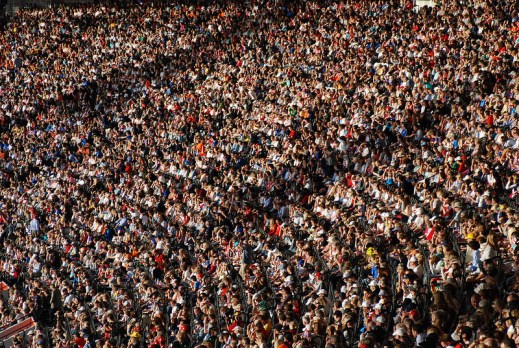
 Welcome to the extra innings of our summer series on “Sound and Sport”! In today’s bonus post, David Hendy discusses his recent Noise broadcast for BBC Radio 4 on the sounds of Olympic crowds. For an instant replay of our summer series click Kariann Goldschmitt’s “The Sounds of Selling Out?: Tom Zé, Coca-Cola, and the Soundtrack to FIFA Brazil 2014” (August), Josh Ottum‘s “Sounding Boards and Sonic Styles: The Music of the Skatepark” (July), Tara Betts‘s “Pretty, Fast, and Loud: The Audible Ali” (June), and Melissa Helquist‘s “Goalball: Sport, Silence, and Spectatorship” (May). Following Hendy’s post on Olympics past, give Andrea Medrado’s podcast a spin for a listen into its future: “The Sounds of Rio’s Favelas: Echoes of Social Inequality in an Olympic City.” And now, David Hendy. Of course, the crowd goes WILD. —J. Stoever-Ackerman, Editor-in-Chief
—
I didn’t get to go to the London 2012 Olympics or Paralympics. Alas, my number didn’t come up in the lottery for seats. So, like millions of others, my family and I watched – and heard – the sporting action on television or, occasionally, on our smart phones. A pretty good experience it was, too: the BBC for instance gave British viewers 24 live streams of high-definition coverage for the Olympics; Channel 4’s approach to the Paralympics was smaller-scale but packed a similar punch in terms of imagery. A key part of the “enhanced experience,” however, was the acoustic quality of the broadcasts. When the Olympics had last been staged in London, during the post-war austerity of 1948, television footage sounded like this:
“1948 Olympics Clip” courtesy of Peregrine Andrews and Alan Hall, Falling Tree Productions Limited
Just about the only things viewers would’ve heard were the voices of the commentators and the distant, muted sounds of the crowd.
That evocative archive recording was used in a recent radio documentary by the British sound designer Peregrine Andrews. The programme explored just how much had changed in location recording techniques by 2012. This time around, Peregrine pointed out, some 4,000 microphones were in position at the various venues: not just suspended in the air above or placed on the trackside, but bonded directly onto the beams in the gymnastic hall, say, or attached to the targets used in archery. Competitors everywhere were heard in extreme close-up – every shift of a hand or foot, every creak of wood, every grunt or groan made audible to the viewer at home.
This wasn’t just hyperbole. Newspapers quickly latched on to the phenomenon, dispatching reporters to measure decibel levels and offer their readers guides to the “best” venues for hearing the sound of the crowd. They pointed out that an airplane taking off produces about “140 decibels of noise”– and that the cheers echoing around the soaring curves and low ceilings of the Olympic Velodrome reached very nearly the same level.

Panorama of the London Olympic Velodrome, Image courtesy of Flickr User Jack999

Olympic Velodrome Image courtesy of Flickr User adambowie
“The roar was thrilling, to the point of pain,” claimed one reporter from the Toronto Globe and Mail. “If I had endured another minute, I am sure we’d all have gone deaf.” Zaha Hadid’s gloriously sweeping Aquatics Centre provided perhaps the most intense acoustics of all. Whenever the 17,500 fans inside cheered, the “guttural roar” was simply “ear-drum shattering,” declared the London Evening Standard. The main Olympic stadium was open air, of course, making the sound less intense. But even here the Globe and Mail journalist wrote of a “tsunami of noise” building in waves; another of the stadium’s “sonic boom”; yet another of how Usain Bolt’s 100 metres final produced a roar from the crowd which, measured at 107 decibels, beat that of your average pneumatic drill.

Olympic Stadium 2012, Image by Flickr User tom_bennett
Perhaps it wasn’t surprising that London 2012 was dubbed the loudest ever Olympics. For the main stadium’s designer Rod Sheard had always conceived it with acoustics firmly in mind. He’s quoted in a piece in It’s Nice That: “The athletes are so focused, it’s very easy for them not to hear the crowd. . .we’ve got to make it really loud for them to get any benefit from it.” And so the 80,000 people inside were packed as closely together as possible with the roof shaped to rebound their roar back into the heart of the space, generating maximum volume.
As my producer Matt Thompson and I discovered when making our recent BBC radio series Noise: a Human History (available on iTunes), this contemporary attempt to revel in the roar of the spectators throws up some striking – and very ancient – parallels. The most obvious is that of the Colosseum in Rome, which, some 2000 years ago, provided what Keith Hopkins and Mary Beard have described as “a brilliantly constructed and enclosed world, which packed emperor, elite and subjects together, like sardines in a tin.”
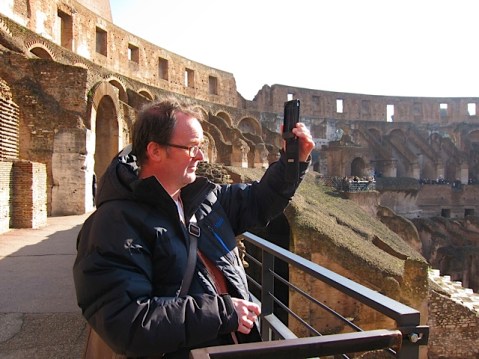
David Hendy at Colosseum, Image by MattThompson/Rockethouse Productions
The acoustic qualities of ancient amphitheaters like this – their ability to amplify the slightest sounds – is still pretty unnerving if you get the chance to witness it for yourself, as Matt and I did when recording, at the Colosseum and at the ancient Greek theatre of Epidaurus:
In these cauldrons of concentrated sound, the roar of the spectators took on a collective force of its own – a volatile quality rich with cultural and political repercussions. During plays in Greek theatres, audiences were rarely hushed and reverential. They were talkative and unruly, sometimes showing their disapproval by drumming their heels against the benches, sometimes disrupting the action by shouting and jeering. The chorus below would address spectators directly, as if facing a jury. Audience participation was as much a part of a performance as were the actors in the orchestra or on the stage. And when it came to the Roman Games later held at the Colosseum or in even larger venues such as the nearby Circus Maximus, the barrage of sound could reach intimidating levels of ferocity.

David Hendy Recording at Epidaurus, Image by Matt Thompson/Rockethouse Productions, taken on location
Roman arenas were not just sporting venues, of course. They were designed for political theatre. Vespasian had ordered the Colosseum to be built to help wipe away the memory of his predecessor Nero and his notorious private pleasure palace the Golden House. Now Roman citizens had a pleasure palace all of their own. The ruling elite had also created a place for the ostentatious display of imperial power and generosity, a bribe for the people’s continuing loyalty. Which is why, if the crowds were sometimes a little slow in showing their appreciation, paid stooges dotted about the arena would start applauding – or booing – at all the right moments, while soldiers would strike down any member of the audience who lagged in their cheering. But, as in the Greek theatres, Rome’s audiences were never entirely under the cosh; they could occasionally give voice to underlying discontentment. And when so many people were so tightly packed together, sheer proximity and the contagious quality of sound meant any turn in the mood would have been quick to make itself felt.
One startling example of this came in 55BC when Julius Caesar’s powerful rival Pompey put on a show in the Circus Maximus that featured the slaughter of elephants – something the crowd lapped up until the very moment they heard the poor creatures’ death throes. In episode 9 of Noise: a Human History, I speculated on what it might’ve been like – and recalled the unsettling outcome:
In London in 2012, we had our very own Pompey, in the form of the British Chancellor of the Exchequer, George Osborne. He’d turned up to the Paralympics to award some medals. And as his name was announced the stadium resounded with loud booing for the first time all summer:
Why did 80,000 people all suddenly decide to boo as one? Because, one commentator quipped, there were only 80,000 people in the stadium.
Politicians as a class are inevitably unwelcome in a place of entertainment, their presence too obviously betraying an attempt to siphon off a little of the goodwill. Osborne’s particular problem, though, was that he wasn’t just any old politician. He was from the ruling Conservative party, which, true to its ungenerous instincts, had just cut welfare benefits for Britain’s disabled people. In the circumstances, turning up to the Paralympics seemed an entirely predictable affront to most of those in the stadium – one that Osborne was thick-skinned and numb-skulled enough not to have predicted for himself.
All this might seem, well, unsporting. But booing is part of the civic dialogue. It brings politicians face-to-face with their electorate. It forces them to feel the scorn and anger of those they’ve let down. The moment passes, of course. Clips briefly went viral on YouTube, and were soon forgotten. Osborne himself is still in office, overseeing the ruination of the British economy through his programme of austerity. But for a delicious few seconds we were reminded of the inherently public nature of sound. We heard – we felt – the role of listening to one another, not as a passive thing but as a powerfully collective, inter-subjective, electrifying, communicative act.
—
Featured Image: Crowd: London 2012 Olympic Stadium, Image by Flickr User Flickmor
—
David Hendy is Professor of Media and Communication at the University of Sussex, England. He wrote and presented the recent 30-part BBC radio series Noise: a Human History, which remains available to download on ITunes. The accompanying book, Noise: a Human History of Sound and Listening, will be published in the US in October 2013 by Harper Collins. He’s the author of Radio in the Global Age (2000), Life on Air: a History of Radio Four (2007), and Public Service Broadcasting (2013), and contributes regularly to radio programmes.
—
 REWIND! . . .If you liked this post, you may also dig:
“We wanted to tell stories about sound”: Opening Ears Through the “Everything Sounds” Podcast–Craig Shank and George Drake Jr.
Quebec’s #casseroles: on participation, percussion and protest–Jonathan Sterne
Goalball: Sport, Silence, and Spectatorship— Melissa Helquist
Share this:

The Sounds of Selling Out?: Tom Zé, Coca-Cola, and the Soundtrack to FIFA Brazil 2014
Welcome back to our summer series on “Sound and Sport.” In today’s post, Kariann Goldschmitt discusses the gamechanging controversy over Brazilian musician Tom Ze’s commercial for Coca-Cola’s FIFA 2014. For an instant replay of July’s post click Josh Ottum‘s “Sounding Boards and Sonic Styles: The Music of the Skatepark” or of June’s post, click Tara Betts‘s “Pretty, Fast, and Loud: The Audible Ali.” For May’s post, click Melissa Helquist‘s “Goalball: Sport, Silence, and Spectatorship.” This Thursday’s grand finale will continue our discussion of Brazil, with a podcast by Andrea Medrado entitled “The Sounds of Rio’s Favelas: Echoes of Social Inequality in an Olympic City” AND keep you on the edge of your seat with a bonus Olympic doubleheader post excerpted from David Hendy‘s recent Noise broadcasts for BBC Radio 4 on the sounds of Olympic crowds. And now. . .the sounds of FIFA’s sponsors. —J. Stoever-Ackerman, Editor-in-Chief
—
Tensions in Brazil have been running high as the the country ramps up preparations for next year’s FIFA World Cup. Brazil’s economy is one of the world’s strongest, but its middle class has suffered as economic growth has stagnated amid rapidly rising costs of living. Yet, FIFA demands that Brazil’s government spend large amounts of money to renovate stadiums and further bolster tourism-based services at the expense of everything else. This last June, news of another hike in transit fees was the final straw for many citizens and they took to the streets to protest corruption and the routing of public funds to tournament preparations while basic services suffered. Protesters argue that the country is burnishing its international brand on the backs of its citizens. It is thus no surprise that much of the Brazilian public is fed up with FIFA and its multinational partners. As a consequence, musicians who participate in World Cup-related ad campaigns risk damaging their relationship with the public.
In Spring 2013, the Facebook page of one of Brazil’s most eccentric musical iconoclasts, Tom Zé, was bombarded by negative comments. Unforgivably to some of his most ardent fans, Zé had lent his vocal talents to a Coca-Cola commercial that sought to connect Brazil’s oft-mythologized cultural diversity to the universals of the World Cup and Coca-Cola’s alleged populism. Zé inflected his delivery of the ad copy with an especially musical speaking cadence and rhythm. It was a peculiar take that drew on his signature vocal eclecticism.
The ad opens with Zé stating,
Muita gente se pergunta como vai ser a copa
A coca-cola vai falar como ela não vai ser
[Many people are asking themselves what this cup will be like
Coca-Cola is going to tell you what it won’t be like]
as the shot features a group of people smoothing out a giant kite with the Brazilian flag. There is a strong syncopated rhythm to Zé’s voice that matches the carnival samba drums (especially the caixa) that accompany the ad throughout. As it continues, the imagery matches what Zé describes, in either stills or brief shots, often recalling the frenzy surrounding world cups of the past. In a rapid cadence, he says:
não vai ser só a copa de vuvuzela, do vidente, da celebridade
da menina bonita, do jogadores com cabelo da moda…”
[it won’t be the Cup of the vuvuzela, the psychic, nor of celebrity
of beautiful women, nor of players with fashionable hair]
The synchronization of Zé’s rapidly rhythmic delivery over archetypal images of Brazil’s tournament excitement is crucial to the ad’s message. This passage mentions two icons of the 2010 tournament, the vuvuzela and the psychic (vidente) octopus, with accompanying images. In under four seconds, the camera jumps from a man holding a celebrity magazine (celebridade), a woman cheering (menina bonita), some player figurines (jogadores) and a boy with an elaborate buzz cut. By aligning himself with an official sponsor of the upcoming tournament through ad copy that valorizes Brazil’s present, Zé also lent the sound of his voice to the sports-industrial complex, thereby opening himself up to accusations that he was a “sell-out” (vendido).
Tom Zé – Todos os Olhos (1973)
Zé is famous for taking part in the tropicália of the late 1960s – a cultural movement that was most effective through popular music. Tropicália musicians bucked Brazilian musical conventions by blending imported rock ‘n’ roll with national music protest songs during a period when musical taste often indicated one’s support or disapproval of the military dictatorship. While most involved in tropicália eventually became Brazilian musical mega-stars (Caetano Veloso, Gilberto Gil, Gal Costa, Os Mutantes, and Mara Bethânia), Zé drifted to obscurity by rejecting many of the machinations of the record industry. He only found an international audience when David Byrne’s Luaka Bop Records released some of his music in the 1990s, the most successful of which was Fabrication Defect [Com Defeito de Fabricação] (1998). Due to his peculiar status, Zé disrupted fan expectations and threatened his brand when he embraced a corporate power so intricately connected to an increasingly unpopular athletic tournament.
The controversy surrounding the Coca-Cola ad took a turn towards farce when, on April 22nd, 2013, Zé released a free 5-song EP on his website titled Tribunal do Feicebuque – a clear play on the way that Brazilians tend to pronounce “Facebook.” Accompanying the songs was a parody of tribunal orders listing the performing and collaboration credits along with lyrics to the songs. Zé’s actions exposed how the incident was a different kind of sonically-driven sports spectacle – this time it was played out over social media, in Brazil’s most influential newspaper, in Tribunal references and fights with fans during his shows at Rio’s famed Circo Voador, and in the ensuing blog reviews of his shows.
The chaotic structure of the EP’s title track, while typical of Zé catalog, disrupts his fans’ claims of “selling out.” He employs a variety of sonically disjunct approaches, opening with the startup sound for Microsoft’s Vista OS before jumping into a psychedelic samba-rock tune with a staccato guitar and a brass section. Zé recorded his vocals over multiple tracks, at times simultaneously sung/spoken at a low pitch and sung at a high pitch. The first half is familiar – the voices trade between Zé and a female companion in something sounding like a duet over a samba-rock beat. The lyrics directly reference infamous moments when Brazilian audiences have turned on their musical icons thought to be too involved in international business influences.
Vendido, vendido, vendido!
A preço de banana
Já não olha mais pro samba
Tá estudando propaganda
[Sell-out, sell-out, sell-out!
The price of a banana
He no longer looks to samba
He’s studying advertising]
At the mid-point, rock gives way to a serious march and more voices enter (including famed São Paulo hip-hop artist Emicida) making the song’s structure more like a trial, complete with competing arguments, before returning to samba-rock under Emicida’s rapping. The song is creative and fun, but it is far from Brazil’s top-40 fare which often favors smoother genre blends and urban pop hits.
Given all of the attention paid to musicians’ efforts to supplement their meager income from digital sales and streaming royalties by forging partnerships with a variety of multinational corporations, it is a little surprising that Tom Zé’s participation in a Coca-Cola commercial would be this controversial. It is difficult to find a musician in Brazil that hasn’t benefitted from some kind of corporate sponsorship. Most artists accept funding from a granting arm of a national corporation (oil company Petrobras, major bank Itaú), license music to national ad campaigns, or embark on a more direct co-branding effort from the likes of mobile phone providers and skin care companies.

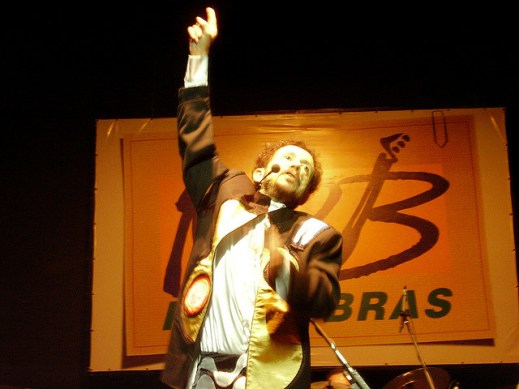
Tom Zé in 2008 performing in front of a Petrobras sign, photo used by CC license, Neto Silveira
One of the hallmarks of the recent changes that have affected the music industry is that musicians rarely refuse opportunities for their music to be used as the soundtrack for mainstream audio/visual entertainment and advertisements. The practice is so common that one of the best-regarded music industry survival books explains possible changes to a musician’s brand when they participate in the advertising of other products. Instead of “don’t license your music,” musicians should license their music in a way that will benefit their brand. It is rare for a song’s success among World Cup spectators to harm musicians; anthems that reflect well on the host nation(s) and express the energy of cheering crowds are a central feature of the tournament. Shakira’s “Waka Waka” actually bolstered her credibility among music fans across the African continent because it sampled Golden Sounds’ hit “Zamina Mina,” a popular song among hip-hop artists in Camaroon and Senegal. In Zé’s case, he misjudged how the tournament and its corporate sponsors were being read by the Brazilian public just weeks before tensions exploded in protest. Indeed, as compared to other Brazilian artists who have recorded potential 2014 World Cup anthems, the reaction to Zé is unique.
As others have noted, television advertising played an important role in the June protest soundtrack. Protesters appropriated the song from a Fiat commercial (released just weeks after Zé’s Facebook episode) that explicitly connects cheering soccer crowds in the street to a new car.
The meaning of “torcer,” a common expression for “cheer” in both advertisements’ copy, is transformed back to its original meaning to wrench or twist thereby exposing the conflicts that have been exacerbated by Brazil’s preparations for the tournament and the sports industrial complex.
These crowds twisted an ad’s soundtrack to challenge the role of multinational agencies and corporations in Brazil’s skewed socio-economic priorities. Indeed, as Leo Cardoso wrote in Sounding Out! a year ago, some of these priorities include regulating sound in Brazil’s largest cities.
For both of these cases involving sonic responses to advertisements that explicitly seek to capitalize on excitement for the soccer tournament, their original intended meaning was twisted and wrenched, forcing musicians to re-evaluate their publics. In the current political climate, Zé found that musical sounds can be aligned with the FIFA World Cup, so long as they are about celebrating sport rather than its multinational sponsors.
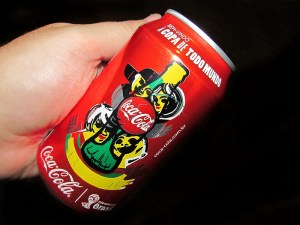
Promotional FIFA 2014 Can, Photo used by CC license, José Roitberg
—
Featured Image: Tom Zé in 2008 performing in front of a Petrobras sign, photo used by CC license, Neto Silveira
—
Kariann Goldschmitt is an Adjunct Assistant Professor at New College of Florida and Ringling College of Art and Design. She holds a Ph.D. in Musicology from UCLA (2009) and was the 2009-2011 Mellon Fellow of Non-Western Music at Colby College in Maine. Her scholarly work focuses on Brazilian music, modes of listening, and sonic branding in the global cultural industries. She has published in The Journal of Popular Music Studies, American Music, Yearbook for Traditional Music, and Luso-Brazilian Review and contributes to the South American cultural magazine, Sounds and Colours.
—
REWIND! . . .If you liked this post, you may also dig:
“Sound-politics in São Paulo, Brazil”–Leonardo Cardoso
Quebec’s #casseroles: on participation, percussion and protest–Jonathan Sterne
Hello, Americans: Orson Welles, Latin America, and the Sounds of the “Good Neighbor”–Tom McEnaney
Share this:


Current Top Posts





April 2021

January 2020

November 2019

October 2019

August 2019

April 2014

November 2017

March 2015

December 2017

October 2015
 Sounding Out!
Recent Comments