
Listening to and as Contemporaries: W.E.B. Du Bois & Sigmund Freud



 Inspired by the recent Black Perspectives “W.E.B. Du Bois @ 150” Online Forum, SO!’s “W.E.B. Du Bois at 150” amplifies the commemoration of the occasion of the 150th anniversary of Du Bois’s birth in 2018 by examining his all-too-often and all-too-long unacknowledged role in developing, furthering, challenging, and shaping what we now know as “sound studies.”
It has been an abundant decade-plus (!!!) since Alexander Weheliye’s Phonographies “link[ed] the formal structure of W.E.B. Du Bois’s The Souls of Black Folk to the contemporary mixing practices of DJs” (13) and we want to know how folks have thought about and listened with Du Bois in their work in the intervening years. How does Du Bois as DJ remix both the historiography and the contemporary praxis of sound studies? How does attention to Du Bois’s theories of race and sound encourage us to challenge the ways in which white supremacy has historically shaped American institutions, sensory orientations, and fields of study? What new futures emerge when we listen to Du Bois as a thinker and agent of sound?
Over the next two months, we will be sharing work that reimagines sound studies with Du Bois at the center. Pieces by Phillip Luke Sinitiere, Kristin Moriah, Aaron Carter-Ényì, Austin Richey, Julie Beth Napolin, and Vanessa Valdés, move us toward a decolonized understanding and history of sound studies, showing us how has Du Bois been urging us to attune ourselves to it. To start the series from the beginning, click here.
Readers, today’s post (the first of an interwoven trilogy of essays) by Julie Beth Napolin explores Du Bois and Freud as lived contemporaries exploring entangled notions of melancholic listening across the Veil.
–Jennifer Lynn Stoever and Liana Silva, Eds.
When W.E.B. Du Bois began the first essay of The Souls of Black Folk (1903) with a bar of melody from “Nobody Knows the Trouble I See,” he paired it with an epigraph taken from a poem by Arthur Symons, “The Crying of Water”:
O water, voice of my heart, crying in the sand,
All night long crying with a mournful cry,
As I lie and listen, and cannot understand
The voice of my heart in my side or the voice of the sea,
O water, crying for rest, is it I, is it I?
All night long the water is crying to me.
A listener, the poem’s speaker can’t be sure of the source of the sound, whether it is inward or outward. Something of its sound is exiled and resonates with Symons’ biographical position as a Welshman writing in English, an imperial tongue. At the heart of the poem is a meditation on language, communication, and listening. Personified, the water longs to be understood and sounds out the listener’s own interiority that struggles to be communicated. The poem’s speaker hears himself in the water, but he is nonetheless divided from it. If he could understand the source of the sound in a suppressed or otherwise unavailable memory, the speaker might be put back together. But listening all night long, that understanding does not come.

Démontée, Image by Flickr User Alain Bachellier
Together, the poem and song serve as a circuitous opening to Du Bois’ “Of Our Spiritual Strivings,” an essay that grounds itself in Du Bois’ training as a sociologist to detail “the color line,” which Du Bois takes to be the defining problem of 20th century America. The color line is not simply a social and economic problem of the failed projects of Emancipation and Reconstruction, but a psychological problem playing out in what Du Bois is quick to name “consciousness.” As the first African American to receive a PhD from Harvard in 1895, Du Bois had studied with psychologist William James, famous for coining the phrase “the stream of thought” in his modernist opus, The Principles of Psychology (1890). In her study of pragmatism and politics in Du Bois, Mary Zamberlin describes how James encouraged his students to listen to lectures in the way that one “receives a song” (qtd. 81). In his techniques of writing, Du Bois adopts and reinforces the paramount place of intuition and receptivity in James’ thought to conjoin otherwise opposed concepts. Demonstrated by the opening epigraphs themselves, Du Bois’ techniques often trade in a lyricism that stimulates the reader’s multiple senses.
I argue that Du Bois surpasses James by thinking through listening consciousness in its relationship to what we now call trauma. While I will remark upon the specific place of the melody in Du Bois’ propositions, I want to focus on the more generalized opening of his book in the sounds of suffering, crying, and what Jeff T. Johnson might call “trouble.” The contemporary understanding of trauma, as a belated series of memories attached to experiences that could not be fully grasped in their first instance, comes to us not from the scientific discipline of psychology, but rather psychoanalysis.
Among the field’s first progenitors, Sigmund Freud, was a contemporary of Du Bois. Though trained as a medical doctor, Freud sought to free the concept of the psyche from its anatomical moorings, focusing in particular on what in the human subject is irrational, unconscious, and least available to intellectual mastery. His thinking of trauma became most pronounced in the years following WWI, when he observed the consequences of shell-shock. Freud discovered a more generalizable tendency in the subject to go over and repeat painful experiences in nightmares. Traumatic repetition, he noted, is a subject struggling to remember and to understand something incredibly difficult to put into words. At the heart of Freud’s methods, of course, was listening and the observations it afforded, grounding his famous notion of the “talking cure.” Because trauma is so often without clear expression, Freud listened to language beyond meaning, beyond what can be offered up for scientific understanding.

Image by Flicker User Khuroshvili Ilya
The beginning of Souls, along with its final chapter on “sorrow songs,” slave song or spirituals, tells us that Du Bois’ project shared that same auditory core. Du Bois was listening to consciousness, that is, developing a theory of a listening (to) consciousness in an attempt to understand the trauma of racism and the long, drawn-out historical repercussions of slavery. Importantly, however, Du Bois’ meditation on trauma precedes Freud’s. But Du Bois’ thinking also surpasses Freud in beginning from the premise that trauma is the sine qua non of theorizing racism, which makes itself felt not only outwardly in social and economic structures, but inwardly in consciousness and memory.
Du Bois claimed that he hadn’t been sufficiently Freudian in diagnosing white racism as a problem of irrationality. He didn’t mean by this that Freud himself made such a diagnosis, but rather that Freud was correct in refusing to underestimate what is least understandable about people. Freud’s thinking, however, remained mired in racist thinking of Africa. Though he claimed to discover a universal subject in the structure of the psyche—no one is free from the unconscious—racist thinking provided the language for the so-called “primitive” part of the human being in drives. This primitivism shaped Freud’s myopic thinking of female sexuality, famously remarking that female sexuality is the “Dark Continent,” i.e. unavailable to theory. Freud drew the phrase from the imperialist travelogues of Henry Morton Stanley in the same moment that Du Bois was turning to Africa to find what he called, both with and against Hegel, a “world-historical people.” As I argue, Du Bois found in the music descended from the slave trade not only a “gift” and “message” to the world, but the ur-site for theorizing trauma.
Ranjana Khanna has shown how colonial thinking was the precondition for Freudian psychoanalysis. Anti-colonial psychiatrist Frantz Fanon, for example, both took up and resisted Freud when he elaborated the effects of racism as the origin of black psychopathology, i.e. feelings of being split or divided. Du Bois, like Fanon after him, was hearing trauma politically as a structural event. The complex intellectual biography of Du Bois, which includes a time of studying (in German) at Berlin’s Humboldt University, mandated that he took from European philosophical interlocutors what he needed, creating a hybrid yet decidedly new theory of listening consciousness. That hybridity is exemplified by the opening of his book, an antiphony between two disparate sources bound to each other across the Atlantic through what I will call hearing without understanding. In this post, I ask what Du Bois can tell us about psychoanalytic listening and its ongoing potential for sound studies and why Freud had difficultly listening for race.
***

“Before the Storm,” Image by Flickr User Marina S.
“Psychoanalysis . . . , more than any twentieth-century movement,” writes Eli Zaretsky in Political Freud, “placed memory at the center of all human strivings toward freedom” (41). He continues, “By memory I mean no so much objective knowledge of the past or history but rather the subjective process of mastering the past so that it becomes part of one’s identity.” In 1919, Freud gave a name to the experience resounding for Du Bois in Symons’ poem “The Crying of Water:” “melancholia.” Unlike mourning after the death of a loved one, whose aching and cries pass with time, melancholia is an ongoing, integral part of subjects who have lost more inchoate things, such as nation or an ideal. This loss, Freud contended, could in fact be constitutive of identity, or the “ego,” Latin for “I” (“is it I? Is it I?” Symons asks). In mourning, one knows what has been lost; in melancholia, one can’t totally circumscribe its contours.
Zaretsky details the way that Freudianism, particularly after its rapid expansion in the US after WWI, became a resource for the transformation of African American political and cultural consciousness, playing a pronounced role in the Harlem Renaissance, the Popular Front, and anti-imperialist struggles. Zaretsky rightly positions Du Bois and his 1903 text as the beginning of a political and cultural transformation, but it is an anachronism to suggest that Freudianism contributed to Du Bois’ early work. Not only does Du Bois’ analysis of “The Crying of Water” predate Freud’s “Mourning and Melancholia” by nearly two decades, the two thinkers were contemporaries. In the years that Freud was writing his letters to Wilhelm Fliess, which became the body of his first book, The Interpretation of Dreams (1900), Du Bois was compiling his previous publications for The Souls of Black Folk, along with writing a new essay to conclude it, “The Sorrow Songs,” a sustained reflection on melancholia and its cultural reverberations in song. 1903 is the year of Souls compilation, not composition.
Du Bois’ thinking of a racialized listening consciousness is not only contemporary to Freud, but also fulfills and outstrips him. To approach Du Bois and Freud as contemporaries involves positioning them as listeners on different, but not opposing sides of what Du Bois calls the “Veil.” It is the psychological barrier traumatically instantiated by racialization, which Du Bois famously describes in the first chapter of Souls. The Veil, Jennifer Stoever describes, is both a visual and auditory figure, the barrier through which one both sees and hears others.
To better define the Veil, Du Bois—like Frederick Douglass before him—returns to a painful childhood scene that inscribed in his memory the violence of racial difference and social hierarchy. Early works of African American literature often turn to memoir, writing their elided subjectivity into history. But we miss something if we don’t recognize there a proto-psychoanalytic gesture. In the middle of a sociological, political essay, Du Bois writes of the painful memory of a little white girl rejecting his card, a gift. In this, we can recognize the essential psychoanalytic gesture of returning to the traumatic past of the individual as a forge for self-actualization in the present.

“Storm Coming Our Way” by Flickr User John
As Paul Gilroy has described, Du Bois’ absorption of Hegel’s thought while at Humboldt cannot be underestimated, particularly in terms of the famous master-slave dialectic. In this dialectic, the slave-consciousness emerges as victorious because the master depends on him for his own identity, a struggle that Hegel described as taking place within consciousness. Like Hegel, Zaretsky notes, Du Bois understood outward political struggle to be bound to “internal struggle against . . . psychic masters” (39). I would state this point differently to note that Du Bois’ traumatic experience as a raced being had already taught him the Hegelian maxim: the smallest unit of being is not one, but two. For Hegel, the slave knows something the master doesn’t: I am only complete to the extent that I recognize the other in myself and that the other recognizes me in herself. That is the essential lesson that an adult Du Bois gleans from the memory of the little girl who will not listen to him. He recognizes that she, too, is incomplete.
The essential difference between psychoanalysis and the Hegelian thrust of Du Bois’ essay, however, is that while a traditional analysand seeks individual re-making of the past—not only childhood, but a historical past that shapes an ongoing political present– Du Bois emphasizes the collective and in ways that cannot be reduced to what Freud later calls the “group ego.” If we restore the place of Du Bois at the beginnings of psychoanalysis and its ways of listening to ego formation, then we find that race, rather than being an addendum to its project, is at its core.
We can begin by turning to a paradigmatic scene for psychoanalytic listening, the one that has most often been taken up by sound studies: the so-called “primal scene.” In among the most famous dreams analyzed by Freud, Sergei Pankejeff (a.k.a. the “Wolf Man”) recalls once dreaming that he was lying in bed at night near a window that slowly opened to reveal a tree of white wolves. Silent and staring, they sat with ears “pricked” (aufgestellt). Pricked towards what? The young boy couldn’t hear, but he sensed the wolves must have been responding to some sound in the distance, perhaps a cry.

“The Wolf Man’s Dream” by Sergei Pankejeff, Freud Museum, London
In “The Dream and the Primal Scene” section of “From the History of An Infantile Neurosis” (1914/1918), Freud concluded that the dream was grounded in the young boy’s traumatic experience of witnessing his parents having sex. Calling this the “primal scene,” Freud conjectured that there must have been an event of overhearing sounds the young boy could not understand. In the letters he exchanged with Fliess, Freud had begun to attend to the strange things heard in childhood as the basis for fantasy life and with it, sexuality.
The primal scene is therefore crucial for Mladen Dolar’s theory in A Voice and Nothing More when he pursues the implications of an unclosed gap between hearing and understanding. In the Wolf Man’s case, it is impossible, Freud writes, for “a deferred revision of the impressions…to penetrate the understanding.” In Dolar’s estimation, the deferred relation between hearing and understanding defines sexuality and is the origin of all fantasy life. This gap in impressions cannot be closed or healed, and, for Jacques Lacan it also orients the failure of the symbolic order to bring the imaginary order to language. From this moment forward, psychoanalytic theory argues the subject is “split,” listening in a dual posture for the threat of danger and the promise of pleasure. Following Lacan, Dolar, Michel Chion, and Slavoj Žižek return to the domain of infantile listening—listening that occurs before a person has fully entered into speech and language—to explain the effects of the “acousmatic,” or hearing without seeing.
After Freud, the phrase “primal scene” has taken on larger significance as a traumatic event that, while difficult to compass, nonetheless originates a new subject position that makes itself available to a collective identity and identification. The original meaning of hearing sexual and libidinal signals without understanding them, I would suggest, holds sway. Psychoanalytic modes of listening, particularly if restored to its political origins in racism, offer resources for what it means to listen beyond understanding, but such thinking of race immediately folds into intersectional thinking of gender and sexuality. Consider the place of the traumatic memory of the little girl who rejects the card. In The Sovereignty of Quiet, Kevin Quashie returns to Du Bois’ primal scene to note how the scene takes place in silence, for she rejects it, in Du Bois’ terms, “with a glance.” I want to expand upon this point to note that where there is silence, there is nonetheless listening. Du Bois is listening for someone who will not speak to him; he desires to be listened to and the card—a calling card—figures a kind of address.

Vintage Calling Card, Image by Flickr User Suzanne Duda
It has gone largely unnoticed that, to the extent that the scene is structured by the master-slave dialectic, it is also structured by desire. This scene of trauma is shattering for both boy and girl. The desire coursing through the scene is suppressed in Du Bois’ adult memory in favor of its meaning for him as a political subject. What would it mean to recollect, on both sides, the trace of sexual (and interracial) desire? In “Resounding Souls: Du Bois and the African American Literary Tradition,” Cheryl Wall notes the scant place for black women in the political imaginary of this text. This suppression, I would argue, already begins in the memory of the girl who appears under the sign of the feminine more generally. The fact that she is white, however, casts a greater taboo over the scene and therefore allows more for a suppression of sexuality in his memory. Du Bois emerges as a political agent disentangled from black women—with one notable exception, the maternal, and this exception demands that we listen with ears pricked to “The Sorrow Songs,” as Du Bois’ early contribution to the psychoanalytic theory of melancholia.
Next week, part two will further explore The Souls of Black Folk as a “displaced beginning of psychoanalytic modes of listening,” emphasizing the African melodies once sung by his grandfather’s grandmother that Du Bois’s hears as a child, as “a partial memory and a mode of overhearing.”
—
Featured Images: “Nobody Knowns the Trouble I See” from The Souls of Black Folk, Chapter 1, “W.E.B. Du Bois” by Winold Reiss (1925), “Sigmund Freud” by Andy Warhol (1962)
—
Julie Beth Napolin is Assistant Professor of Literary Studies at The New School, a musician, and radio producer. She received a PhD in Rhetoric from the University of California, Berkeley. Her work participates in the fields of sound studies, literary modernism and aesthetic philosophy, asking what practices and philosophies of listening can tell us about the novel as form. She served as Associate Editor of Digital Yoknapatawpha and is writing a book manuscript on listening, race, and memory in the works of Conrad, Du Bois, and Faulkner titled The Fact of Resonance. Her work has appeared in qui parle, Fifty Years After Faulkner (ed. Jay Watson and Ann Abadie), and Vibratory Modernism (ed. Shelley Trower and Anthony Enns).
—
 REWIND! . . .If you liked this post, you may also dig:
“A Sinister Resonance”: Joseph Conrad’s Malay Ear and Auditory Cultural Studies–Julie Beth Napolin
“Scenes of Subjection: Women’s Voices Narrating Black Death“–Julie Beth Napolin
Unsettled Listening: Integrating Film and Place — Randolph Jordan
Share this:

Poptimism and Popular Feminism

Almost 20 years ago, 2 Many DJs and Freelance Hellraiser each released too-clever mashups that laid R&B pop diva vocals over indie rock instrumentals, revealing that the paired songs had exactly the same compositional structure. The former’s “Smells Like Booty” put Destiny’s Child together with Nirvana, and the latter’s “A Stroke of Genius” combined Christina Aguilera with The Strokes. The mashups were clever because they flouted supposedly commonsense views that these these pairings shouldn’t work: how could something as superficial, formulaic, and, frankly, girly as Destiny’s Child and Aguilera have anything in common with something as serious and aggressive as Nirvana and The Strokes? Writing in 2009, Dorian Lynskey explained that “A Stroke of Genius came out when many indie fans still believed that manufactured pop stank of evil and death, and the idea of Christina Aguilera and the Strokes in perfect harmony was strange.” Note Lynskey’s use of the past tense: by 2009, the gatekeepers of elite musical taste generally agreed that commercial, chart-oriented music whose fans were at least thought to be mainly teen girls and/or gay men could be just as artistically valuable as rock and hip hop.
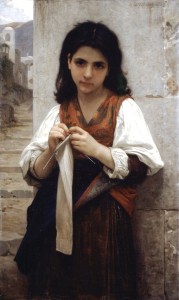
“Tricoteuse” by William-Adolphe Bouguereau (1825-1905), Public Domain
That consensus has a name: poptimism. Poptimism upends the hierarchy between rock (and sometimes hip hop) and pop, which is a contemporary variation on a very old hierarchy that privileged fine art over craft. Back in the 18th century, philosophers like Immanuel Kant invented the idea of “fine art” by distinguishing it from craft: craft is subordinate to utility (you don’t want your coffee mug to leak), but art exists for its own sake (think of how unwearable some high fashion is, or of Rosemarie Trockel’s art sweaters). As many feminist art historians have argued, this art/craft hierarchy conveniently maps onto patriarchal gender hierarchies: art, like men, is autonomous, whereas craft, like women, are subordinate to daily needs; art is productive, craft is reproductive. For example, art historians Roziska Parker and Griselda Pollock have shown that there is an “intersection in the eighteenth and nineteenth centuries of the development of an ideology of femininity…with the emergence of a clearly defined separation of art and craft.” The conceptual and institutional structures that confined women to reproductive labor and craft into the service of life’s reproductive needs were manifestations of the same underlying gender system.

“Jennifer Lopez | Pop Music Festival | 23.06.2012” by Flickr user Ana Carolina Kley Vita, CC BY 2.0. A Google image search of the word “pop music” listed this image as one of the top images.
This same system informs the traditional rock-over-pop hierarchy. In her 2001 article “Feminist Musicology and the Abject Popular,” Susan Cook argues that “‘the popular’…has been so thoroughly feminized” and “carries with it a staggering cultural baggage, a trunk full of social codes that have been historically attached to womankind and underprivileged men.” In the latter half of the twentieth century, the distinction between rock and pop was largely grounded in the same gender system that organized the art/craft hierarchy: rock embodied all the values and characteristics of ideal masculinity, and that’s why it was superior, whereas pop embodied all the values and characteristics of ideal femininity, and that’s why it was inferior. In the early 2000s, poptimism revises this gender script, putting “thoroughly feminized” pop on an equal playing field with rock. However, instead of more-or-less uncritically cheerleading for pop and/or pop stars, we should be thinking about the institutions and conventions that dole out artistic status.

“Rock Hard Open Air 2009” by Flickr user Elena, CC BY-NC-ND 2.0
Kelefa Sanneh’s 2004 article “The Rap Against Rockism” brought the fact of rock-conceived-as-art to the general public’s attention. “Rockism” is the idea that rock music is the only kind of commercial recorded music that has artistic merit. According to Sanneh,
rockism isn’t unrelated to older, more familiar prejudices…The pop star, the disco diva, the lip-syncher, the “awesomely bad” hit maker: could it really be a coincidence that rockist complaints often pit straight white men against the rest of the world? Like the anti-disco backlash of 25 years ago, the current rockist consensus seems to reflect not just an idea of how music should be made but also an idea about who should be making it.
Grounded in the idea that rock is superior because it is both made by and for white dudes and expresses the stereotypical features of elite white masculinity, rockism upgrades the gendered (and raced) logics of the fine art/craft distinction into 20th century terms. Meanwhile, poptimism revalues the aspects of pop music that were traditionally de-valued because of their association with stereotypical (often white) femininity: pop is hugely collaborative and rarely written by lone authors; it prioritizes pleasure over deep meaning, beauty and spectacle over substance; its music and its ideas are supposedly simple rather than complex…you get the idea. (Ethnomusicologist Elizabeth Keenan-Penagos explains the gendered implications of poptimism in more depth in this piece about the role of misogyny in critiques of poptimism.)
Sanneh’s article kicked off this millennial round of poptimism, but poptimism’s basic ideas and values go all the way back to the 19th century (which is much later than Michael Kramer argues here). Friedrich Nietzsche’s critique of German composer Richard Wagner uses the same basic framework we now call poptimism: Wagner, he argued, was too concerned with deep philosophical meaning and not enough with the beauty and pleasure of the sounds. Saying things like “music is a woman” and that Italian opera is superior to German opera because it’s prettier and more fun (see The Gay Science sections 77-80), Nietzsche also recognized the gender and race dynamics of poptimism: by 19th century standards Italians weren’t fully white, so his prioritization of Italian over German opera subordinates white highbrow culture to not-really-white middle-to-lowbrow culture. In Nietzsche Contra Wagner, he makes his preference for light, unserious art over high culture quite clear. There, he contrasts the “hubbub…with which the ‘cultured’ man and the man about town allow themselves to be forced through art, literature, music, and with the help of intoxicating liquor, to ‘intellectual enjoyments’” with the “nimble, volatile, divinely undisturbed, divinely artificial art, which blazes up like pure flame into a cloudless sky” (emphasis mine). This contrast flips fine art/craft hierarchies and argues that things traditionally devalued as feminine, such as superficiality or sensory pleasure, are artistically superior to all the values commonly attributed to fine art, such as intellectual depth. Though he called it “the joyful wisdom” (die frӧliche Wissenschaft, often translated as The Gay Science) instead of “poptimism,” the later Nietzsche’s music aesthetics articulates the same basic theoretical commitments that inform 21st century poptimism.
 The basic idea of poptimism has been around since the late 1880s, but it took more than a century to really take off. In the decade after Sanneh’s article, there was a poptimism bubble: it rose to huge popularity, especially with the publication of Carl Wilson’s 2007 book on fans of cheesy pop music. That bubble started to burst about 9 or 10 years after that book appeared as critics began to sour on poptimism. Though it was initially understood as a radical upheaval of the powers that be, by 2017 poptimism had been co-opted by those powers. Instead of challenging patriarchal gender systems, poptimism reinforced them. Writing in The Quietus, Michael Hann argues that “Poptimism, in practice, has not meant championing those who do not get the acclaim they are due, so much as celebrating the position of artists who don’t need their genius proclaimed” such as Beyonce or Taylor Swift. The oft-noted death of the negative album review suggests that [p]optimism is now the orthodox practice among music critics. (This also coincides with recent trends in academic literary theory, which prize “reparative” readings over critical ones.) Such concerns have led Rob Harvilla to pose the rhetorical question “Have we reached the end of poptimism?” because what began as a feminist revolt now feels like an expectation or obligation to stan for the already powerful, such as corporations and megastars. Hann and Harvilla observe a change in poptimism, at least as it is practiced in the music media and industry: poptimism feels less like rooting for undervalued and underrepresented women and more like cheerleading for The Man. Harvilla speculates about poptimism’s end because this corporate poptimism betrays the movement’s original ideals and values.
Why did the poptimism bubble happen when it did? There were many contributing factors, such as the rise of what sociologists Richard Peterson and Roger Kern call “omnivorous taste,” which is the idea that elites prefer both traditional highbrow culture and a range of lowbrow forms, a.k.a. “I like everything but [usually country or hip hop].” Evolutions in feminist media and activism are another central cause of the poptimist bubble. Because pop is an inherently gendered category defined by its feminization, poptimism’s evolution is closely tied to feminism’s. The poptimism bubble roughly coincides with the period when feminism broke the mainstream and mutated into popular feminism.
This is more than just a correlation or coincidence. “Pop” is a gendered category, so its evolution is inextricably tied to evolving gender norms and politics. Poptimism emerged at the dawn of a broader “woke” turn in popular media and pop culture. The first decades of the 21st century saw the rise of a proliferation of explicitly feminist web publications (Autostraddle, Broadly, Jezebel, etc.) and the circulation of feminist theory outside the academy on social media sites like tumblr. 2014, the year Beyonce brought the big pink “FEMINIST” sign to the VMAs, was the year that feminism broke the mainstream. As media studies scholar Sarah Banet-Wesier argues, around 2014 a variety of white liberal feminism focused primarily on individual economic (and sexual) empowerment; it “became a sort of product” that circulated both as a corporate and individual brand. “Feminism” sold us Tshirts, Spotify playlists, and a couple of Beyonce albums. Banet-Weiser’s term for this feminism as brand or business strategy is “popular feminism.” In 2018, poptimism works more or less like popular feminism: it turns the revaluation of things traditionally devalued because of their femininity into a way to make money.

Screenshot from Beyoncé’s 2014 VMAs performance.
Both popular feminism and corporate poptimism are the result of the same flawed thinking that believes inequality can be fixed just by empowering individuals and not by restructuring the institutions and conventions that structure our relations with one another. This thinking seeks to put formerly low-status things in high status places without reconfiguring the underlying fact that there is a status differential in the first place.
Banet-Weiser warns that popular feminism is only half of a two-sided coin: “popular misogyny…mimics the operation of popular feminism but flips and distorts the politics.” The incel movement is an example of popular misogyny: arguing that women oppress men by refusing to have sex with them, it takes the language of oppression developed by feminism and uses it to justify the idea of patriarchal sex-right. Similarly, the classical music blog “Slipped Disc” has been described as the “Breitbart of classical music” because its championing of the orthodox Western art music canon is “openly sexist, racist, and LGBT-phobic.” The 2018 Grammy Awards show presented both sides of this coin in stark clarity: as Maura Johnston noted, though the ceremony prominently featured a #MeToo performance from Kesha and other women artists, almost all the awards went exclusively to men.

Screenshot of Kesha’s performance of “Praying” at the 2018 Grammys.
Viewed in Banet-Weiser’s terms, the RIAA seems to be leveraging both sides of this coin to maximize its profits, practicing popular feminism in the streets but popular misogyny on the ballot. Like popular feminism, the RIAA’s poptimism values superficial markers of feminist progress because they obscure patriarchy’s retrenchment. For example, the two most definitive or canonical poptimist texts (the Sanneh article and Wilson book) are authored by cis men, so it may appear that poptimism hasn’t changed those institutions and conventions so much as conformed to them.
I agree with Banet-Weiser that though Feminism™ is certainly limited and insufficient, it can be a helpful gateway for beginners. Poptimism™ is similarly limited and insufficient, but we should think about how we can lead fans brimming with that kind of poptimism to a deeper engagement with the institutions and conventions that continue to value the same kinds of people and the music they make and like above others.
—
Featured image: “Pop” by Flickr user Andreas Andrews, CC BY-NC-ND 2.0
—
Robin James is Associate Professor of Philosophy at UNC Charlotte. She is author of two books: Resilience & Melancholy: pop music, feminism, and neoliberalism, published by Zer0 books last year, and The Conjectural Body: gender, race and the philosophy of music was published by Lexington Books in 2010. Her work on feminism, race, contemporary continental philosophy, pop music, and sound studies has appeared in The New Inquiry, Hypatia, differences, Contemporary Aesthetics, and the Journal of Popular Music Studies. She is also a digital sound artist and musician. She blogs at its-her-factory.com and is a regular contributor to Cyborgology.
—
 REWIND! . . .If you liked this post, you may also dig:
In Search of Politics Itself, or What We Mean When We Say Music (and Music Writing) is “Too Political”–Elizabeth Newton
Music Meant to Make You Move: Considering the Aural Kinesthetic–Imani Kai Johnson
Pushing Play: What Makes the Portable Cassette Recorder Interesting?–Gus Stadler
Share this:


Current Top Posts





April 2021

January 2020

November 2019

October 2019

August 2019

April 2014

November 2017

March 2015

December 2017

October 2015
 Sounding Out!

Recent Comments