
Twitchy Ears: A Document of Protest Sound at a Distance

“Royal Thai consulate 351 E52 St jeh” on Wikimedia Commons, CC-1.0
“I compare New York to Bangkok all the time,” a young activist told me, just moments before he joined a small, media-ready protest at the Thai consulate in midtown Manhattan. On a pleasant day this past July, along a quiet side street lined with the gold plaques of consulates general, his comparison felt strained—Thailand is currently governed by a free speech-averse military junta that seized power last year, and mourning a deadly terror attack. In Thailand, the tension and fear are acute; in New York, the local delivery driver was whistling.
The young activist, an ocean removed from Bangkok, sought ways of speaking politically, knowing well that he could and would be heard across that ocean When he returns, if he returns, he may be imprisoned, intimidated, or injured. In front of the consulate in New York, those problems were imperceptible to the uninitiated. But they weighed heavily on all of us. Whenever the group chanted or sang, their voices rose through the low ambience like heavy weights, and stopping they fell away without receiving a response. There was a perverse aural disjuncture between the easy rhythms of the day and the harrowing risk that we knew was present in every utterance.
I had come to participate in the event, to speak against the military junta’s recent arrest of fourteen university students for protesting peacefully. I had also come to make a sound recording, and as usual to consider the odd phenomenon of protests staged to create media artifacts rather than to influence people in the flesh. The purpose of the protest was not to negotiate risk but to invite it. It barely mattered that New York City didn’t hear the protest as it occurred. Where it needed to sound potent, it would. Recorded sound surely renders all protest multi-sited; protest sound is a speech-act spatially and temporally deferred.

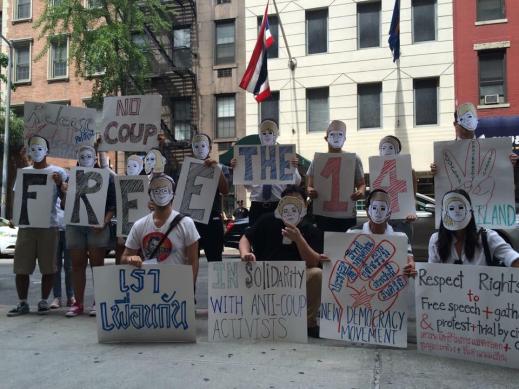
Picture of #FreeThe14 protest in New York City this past July. From Thai Students Center for Democracy (@TSCD_EN) tweet on July 7, 2015.
However, for protests staged at great physical distance from what’s being protested, the specter of comparison and difference between sites and movements can be profound. New York is in certain ways friendly to protest; the city is liberal with permits, and even unpopular opinions are expressible. Relative to most of Thailand, this is a welcome distinction. Of course, such freedom can blunt the acuity of dissenting speech — protests limited to a specific place and time, accompanied by two polite cops indifferent to the issue at hand, are easy to tune out. The United States has its own instruments of containing dissenting speech.
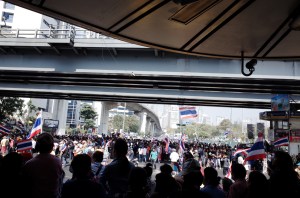
“Protests around Si Lom, Bangkok” by Flickr user
Anton Strogonoff, CC-BY-2.0
Furthermore, as responses to both Occupy Wall Street and the Black Lives Matter movement have shown, organizational structure and subjectivity make some actions more vulnerable to state violence than others. There are moments when a single word can provoke repression here in no less crude a fashion than the Thai junta prefers. But the game has wholly different rules, and these rules engender different strategic responses. Protesting at a distance is both a way of threading multiple sites together and of reflecting on how protesters in different places and movements choose to speak. In the mind of a young activist accustomed to Thailand’s particular labyrinth of political expression, the contrast with his own country can become a source of ideas.
“When I first came here,” the activist continued with a note of awe in his voice, “Occupy Wall Street just started, so it’s like, there is this obvious difference that really intrigued me in how people organize or react to causes. In Thailand we still kind of are using older ways to organize, kind of like really centralized, some figures pretty much
To develop a political movement in the United States is a different challenge than doing the same in Thailand, to put it mildly. In the United States the left risks triviality; in Thailand, it literally risks death. Thai communists were hunted by soldiers in the jungle in the twentieth century, and left-wing political parties are still forbidden today. Republicanism is treason. And with the ascent of the military junta, many trials are now held in secret, and intimidation of political critics is routine. A movement cannot attempt to run headlong toward whatever it wants to topple; circuitous end-runs are necessary. This explains the increased appeal of decentralized protest tactics to Thai activists. The young man I met was far from the first in his country who has espoused such an approach.
***

“Protest Music” by Flickr user killerturnip, CC BY-NC-ND 2.0
The protest began with one woman playing an acoustic guitar, leading the twenty of us assembled in a folk-style singalong. The sincere, uneven rendition of “Song of the Common Man,” currently popular among anti-junta protesters in Thailand, was followed by nervous laughter, and the honk of a nearby taxi. The lyrics are mild and the structure formulaic, but the song has caught on among the junta’s most outspoken critics – notably, one recording available online was made by a band whose songs are strident enough that they were pursued by the military, and forced to flee to Laos. The song lasted less than two minutes, and an American, who worked for a freedom-of-speech NGO in Southeast Asia, ensured that the group moved on to the next part of the tight half-hour schedule. Every moment was brief but assiduously documented.

Picture of #FreeThe14 protest in New York City this past July. From Thai Students Center for Democracy (@TSCD_EN) tweet on July 7, 2015.
We took selfies wearing masks shaped like the faces of the fourteen students who were set to appear before a military court that day. The Thai consulate employees watched with bemusement, and briefly chatted with us in the low, serious hush filled with polite participles that characterizes formal conversation in Thailand. The event ended, and the quiet side street remained undisturbed.
One moment was particularly chilling. The American was leading the group in a series of “what-do-we-want-when-do-we-want-it” chants, which though adapted to concerns of the anti-junta movement felt pro forma and out of place. That cadence and call-and-response pattern is almost never heard at protests in Thailand, and the protesters were not accustomed to it. When someone suggested chanting in Thai rather than English, the group naturally fell into a different rhythm. The repetition of Prayuth aawk bpai, an insulting demand that coup leader General Prayuth Chan-Ocha go away, was much sharper. The chant hearkened to protests of recent years against illegitimate Thai governments. A recording of it would, without doubt, be very risky once heard by the wrong ears in Thailand. Its potency was not only in its direct semantics, but in the connection it formed between the current protest and protests of the recent past. Protest in an age of ubiquitous media tends to form such links across boundaries of time and space.
But a curious thing happens when protest movements can readily observe one another. Comparisons are made all the time, but so are convergences. Rhetoric and strategy become cosmopolitan, not native to any place, and protests increasingly echo other protests. Contemporary Thai dissidents have been influenced by Argentinian horizontalism, and they swap documentaries about the Arab Spring online, for example. The watertight conditions of a geopolitical place have more leaks than was thought. And as ideas travel, the places themselves can become fertile grounds for the growth of those ideas in practice.

“Thailand” by Flickr user Marko Mikkonen, CC BY 2.0
Sound is vital to this process. Perhaps because it is often regarded as the most visceral expression of the body, sound has a special relationship to protest. Sound and self need not be romanticized as coterminous in order to appreciate that speech acts feel very close to the body. But listen again. Sound can both feel immediate and be radically disembodied. It can be a material for experimentation, for feeling out how to speak in the immediate present, and be by the same stroke a final product to be audited by the twitchy ears of the junta. The July protest was and will be both.
—
Benjamin Tausig is assistant professor of ethnomusicology at Stony Brook University, where he works on sound studies, music, and protest in Bangkok and other urban spaces. He is on Twitter @datageneral
—
Featured image: Picture of #FreeThe14 protest in New York City this past July. From Thai Students Center for Democracy(@TSCD_EN) tweet on July 7, 2015.
—
 REWIND! . . .If you liked this post, you may also dig:
SO! Amplifies: Cities and Memory-Stuart Fowkes
Toward A Civically Engaged Sound Studies, or ReSounding Binghamton–Jennifer Stoever
Share this:

Look Who’s Talking, Y’all: Dr. Phil, Vocal Accent and the Politics of Sounding White
From the first time Phillip C. McGraw, Ph.D.—better known as “Dr. Phil”—appeared on the Oprah Winfrey Show in 1998, dropping lines like, “My dad used to say, boy, don’t let yer alligator mouth overload yer hummin’ bird ass,” I was hooked. That accent! That no-nonsense, Southern sauce! From what fount of otherworldly knowledge did Phil drink? An insecure teen, gnawing and thrashing my way through high school’s convoluted social milieu (not to mention the murky waters of multiraciality), Dr. Phil’s frank, accented approach to life’s difficulties appeared as a god-send. It didn’t matter much what Dr. Phil was actually saying or whether his words when strung together formed logical thoughts, it was more the way he said things that affected me so. His deep, sing-songy lilt—preachy and avuncular—brought to mind a grandpappy smoking a pipe, whose wisdom was drawn from a hard day’s farmin’, not a god-forsaken textbook.
With Oprah’s endorsement, the Cult of Phil grew fast and strong. Dr. Phil became a national figure–the corporate media’s version of a public intellectual and my own personal hero. His daytime talk show provided him with a regular platform from which to dispense more of that golden, “Texan-dipped” advice, as The New York Times put it. Selling over 2 million copies, his 2003 classic Self Matters began the onslaught of McGraw-family oeuvre, including several by his wife, Robin, and son, Jay–the face of Phil’s teen self-help brand. Not just a sage, Dr. Phil’s commitment to the McGraw family brand let us know he walked the walk. As evidenced by Dr. Phil’s opening credits, which feature behind-the-scenes glimpses of Mr. and Mrs. McGraw canoodling and his smiley next of kin, this family was for real. They loved and laughed together while cross-promoting each other’s book projects. Teenage Me wondered, did white people get better than this?

Screen capture from the opening credits to Dr Phil
Today, Dr. Phil’s star, and my admiration for him, have faded significantly, but one thing remains the same. Ever since I can remember, my older sister and I have communicated almost exclusively via over-the-top, celebrity impersonations and Dr. Phil became a particular mainstay; even now, we religiously observe the maintenance of the Phil “voice.” Pre-Phil, I can recall my sister addressing me in a raspy, befuddled tone startlingly akin to the Keanu Reeves of yesteryear. Not soon after Bill and Ted’s Excellent Adventure became a permanent piece of our home VHS library, Reeves’ trademark method of delivering lines amidst staggered, nonsensical pauses became an obsessive, sisterly tick. “Dude, shut the door when you pee” she might say, staring blankly at me and cocking her head abruptly to the side.
The use of certain impersonations shifted with the ebb and flow of popular culture’s somewhat predictable tide, depending on whose video was “TRL’s” most requested or whose face most frequently graced the cover of TV Guide. I rehearsed George Herbert Walker Bush’s famous “thousand points of light” campaign ad in front of the stained glass mirror adjacent to the family room television; after that, it was all about Phil Hartman’s witty and endearing impersonation of Bill Clinton.
https://screen.yahoo.com/clinton-mcdonalds-000000491.html
It went on that way until Dr. Phil’s shit blew up, and everything became solidified–as if, finally, my sister and I had found our one true voice. With age, I came to understand that Phil wasn’t the prophetic genius I’d hoped he was and that our compulsive Phil-talk was an oddity, to say the least. I began to wonder why, even as adults, we continued to embarrass ourselves in public and take such pains to text each other in mock-“Texan” (thank goodness for smart phones’ “add word” function).
It’s actually quite common for people to adopt alternate voices or speech patterns. Take, for example, child-directed speech (“babytalk”) or pet-directed speech. Both are customized forms of vocal communication or “prosodic modification,” which, while differing dramatically from normative adult speech in their intonation and grammatical structure, are considered customary forms of address. In fact, cross-linguistic studies show that babytalk and pet-directed speech are common across other European languages, Japanese and Mandarin Chinese. As such, parents and pet owners can rest well knowing that prosodic modification of the child and dog varieties are nearly universal human ticks. Unfortunately, research into child- and pet-directed speech didn’t provide much insight into the unique phenomenon of “Phil-talk.” I had hoped to find other accounts in the literature, a history of similar episodes that might lift the shroud of tomfoolery, explain it away as all too common or evidence of psychological disorder x, y or z, something treatable with an esoteric name.
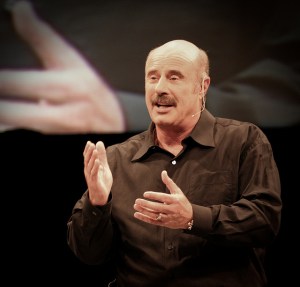
“Dr. Phil in Jacksonville” by Flickr user Craig ONeal, CC BY-NC-ND 2.0
While at this point in my life Phil-talk is more or less an asinine charade, it continues to function as a key component of our familiar vernacular. Interestingly, when re-visiting the many impersonations that have come to define our adolescent years (the Keanu years, the Bush Sr. years, the Phil years), one thing becomes clear: all the voices we’ve adopted have been those of white, male, cultural standard-bearers (Ironically, Keanu Reeves also happens to be Hapa, though I never knew as much. His breakout role as “Ted” helped to popularize the “California dude” archetype). Additionally, I should note, that at no time did any female impersonations enter my repertoire. If you’re going to gain a voice, better make it a male one, no? The racial and gender dissonance that Phil-talk begets drives the urge to perform it.

The author’s mother, with the author’s sister and the author. Picture is property of the author.
From an early age, my mother would tell me tales of her sacrifice—how hard she worked when she came to this country and how difficult life could be in 1960s post-war South Korea—all in a voice with barely a shred of mispronunciation or foreign intonation. My father, a second-generation Swiss-Italian American, scrupulously corrected her syntactical missteps and any other vocal nuances that sounded un-American. It was important to my mother to succeed as an American, and most importantly, that her children succeed too. The pressure I felt to make her content was borderline unbearable. When I started doing the voices, it made my mother happy. She sometimes tried joining in, attempting to mimic key Phil phrases like, “You have gawt to get reee-al,” but to no avail. “You do it better than me,” she’d say, “…my accent.”
When I was young, people looked at me and asked, “what are you?” OR “where are you from?” “America,” I would say. “I’m an American.” These questions were provoked by the racial ambiguity of my mixed-race heritage–the hint of Asianness that marked me as something else. I could not change the shape of my eyes, the contour of my cheeks or the fact that my mother was Korean. But, I could try my hardest to act and sound like an American. Phil-talk became a way to obscure the Asianness, to prove beyond a shadow of a doubt that I did, in fact, belong.
Rather than being merely a childhood performance of celebrity impersonations, I have come to think these various chapters were actually an attempt to perform sonic whiteness. Whether it was Keanu’s California dude cadence, George Bush Senior’s waspy nasality, or Phil’s prolonged Texan twang, I tried to perform in what Aja Martinez defines as “white voice” in her article “‘The American Way’: Resisting the Empire of Force and Color-Blind Racism” (593). She talks about Latino/a students using a “white voice” at school because they equate it with the voice of higher education, but I am really using it here as an explicit racial performance. As a a half Korean, half Euro-American teen girl (now woman) who decides to very literally adopt the voice of a White, 50-something, Texan, TV psychologist, “white voice” was the name of the game, and people loved it–especially my Korean immigrant mother.
For Asian Americans in particular, a people whose national belonging has been culturally questioned and legally denied, accents substantiate and make audible what the eye sees as un-American. In Shilpa Dave’s recently published Indian Accents: Brown Voice and Racial Performance in American Television and Film, she explores accents as they relate to cultural citizenship, national belonging and “the allocation of power.” Someone with an accent is “designated as an outsider to the dominant culture,” writes Dave. In contradistinction to “foreign” sounding accents, Southern accents are a classic symbol of American cultural belonging, like apple pie for the ears.
Would Phil’s wisdom sound as powerful or palatable without the accent? His appeal stems not only from his sometimes entertaining “Phil-isms” (e.g. “You can’t hide the sunrise from a rooster”), but from all that he and his voice signify. A white, male doctor giving advice on TV is hardly noteworthy, but Phil’s recognizably Southern accent separates him from the pack and softens the blow of his often severe advice.
![Angela George [CC-BY-SA-3.0 (http://creativecommons.org/licenses/by-sa/3.0)], via Wikimedia Commons](https://soundstudiesblog.com/wp-content/uploads/2014/11/philmcgrawhwofmay2013.jpg?w=300&h=243)
Angela George [CC-BY-SA-3.0 (http://creativecommons.org/licenses/by-sa/3.0)%5D, via Wikimedia Commons
Constantly searching for ways to be seen, heard, and accepted within an American system of racial binarism that privileges whiteness, denigrates blackness, and locates yellowness somewhere in a No Man’s Land of racial categorization, sound’s flexibility has always seemed to me like a means to belonging. Furthermore, as a multiracial, Korean/White woman, even no man’s land can seem out of reach. As Michael Omi notes in the Introduction to The Sum of Our Parts: Mixed-Heritage Asian Americans, within the historical and political context of the United States, (the “one-drop rule,” eugenic fears of racial intermixing, anti-miscegenation laws, etc.) multiracial identities have consistently been “contained, disregarded, [and] denied.” Multiraciality disorients and confuses insofar as it can discredit entrenched signifiers which make race perceptible to the eye and ear.
Previously on Sounding Out!, I discussed my identification with Nas and the rap world as both a move towards color and the formation of an authentic, multiracial self. A move in the opposite direction, experimenting with “white voice,” functions as another attempt to navigate America’s system of racial identification, albeit in a much more problematic vein. After years of Phil-talk and vocal impersonations of the white male variety, I am finally putting a stop to the charade. However earnest (or subconscious) an attempt to belong, the loss of time spent mimicking Phil represents an era of racial silencing that is somewhat difficult to stomach. Despite the amusement it has brought to friends and family, I am putting the voice to rest in service of getting real.
—
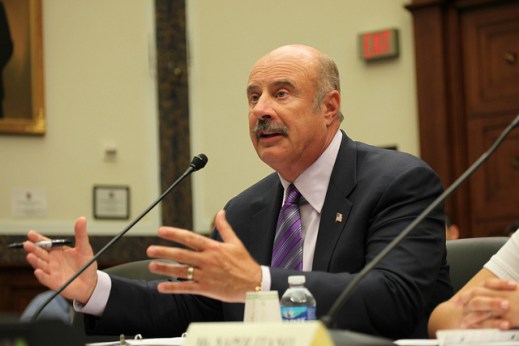
Featured image: “Dr. Phil” by Flickr user House Committee on Education and the Workforce Democrats, CC BY-NC-ND 2.0.
—
Christie Zwahlen is the Assistant Director at Binghamton University’s Center for Civic Engagement, where she has worked for four years to develop, expand and promote community engagement opportunities for students, faculty and staff. Previously, Christie worked for two years as an AmeriCorps VISTA, designing Service-Learning courses in conjunction with faculty at Thiel College and as the Coordinator of the Bridging the Digital Divide Program at Binghamton University. Christie earned her Master’s Degree in English and a Graduate Certificate in Asian & Asian American Studies from Binghamton University in 2009. She is currently enrolled in the English PhD program at Binghamton University.
Share this:


Current Top Posts





April 2021

January 2020

November 2019

October 2019

August 2019

April 2014

November 2017

March 2015

December 2017

October 2015
 Sounding Out!
Recent Comments