
Listening to MAGA Politics within US/Mexico’s Lucha Libre


This series listens to the political, gendered, queer(ed), racial engagements and class entanglements involved in proclaiming out loud: La-TIN-x. ChI-ca-NA. La-TI-ne. ChI-ca-n-@. Xi-can-x. Funded by an Andrew W. Mellon Foundation as part of the Crossing Latinidades Humanities Research Initiative, the Latinx Sound Cultures Studies Working Group critically considers the role of sound and listening in our formation as political subjects. Through both a comparative and cross-regional lens, we invite Latinx Sound Scholars to join us as we dialogue about our place within the larger fields of Chicanx/Latinx Studies and Sound Studies. We are delighted to publish our initial musings with Sounding Out!, a forum that has long prioritized sound from a queered, racial, working-class and “always-from-below” epistemological standpoint. —Ed. Dolores Inés Casillas
—
This post is co -authored by Esther Díaz Martín and Rebeca Rivas
DOI: https://doi.org/10.59350/9w0h7-6cy40
—
“Lucharaaaaaán a dos a tres caídas sin limite de tiempoooo!“
[“They will fight two out of three falls, with no time limit!”]
Announcer at Lucha Libre, El Paso, Texas
“This ain’t no sideshow.”
George Lipsitz on the role of popular culture
The announcer’s piercing “lucharaaaaaán” cries from the middle of the ring proclaims the constitutional two-out-of-three-falls rule of lucha libre. But before the famous cry rings out to set the stage for the spectacularized acrobatic combat between costumed warriors, their theatrical entrances set the all-important emotional stakes of the battle. The entrances are loud, campy, interactive exchanges between luchadores and spectators. An entrance song itself cues the luchador’s persona: a cumbia could signal a técnico (a good guy); a heavy metal song more than likely indicates a rudo (a bad guy) typically donning black, death-themed getups. Luchadores saunter into the arena, stopping to pose, high five their fans, and verbally heckle their opponents. The storylines of good versus evil, betrayal and revenge, or humility versus arrogance are some of the more standard plots that motivate spectators to adamantly cheer for the favorite and jeer for the foe.
The sonic exchanges between luchadores’ and spectators before, during, and after the fight positions lucha libre as much more than a sport. And while the term spectators, suggests the privileged act of watching or viewing; here, we expand spectators within lucha libre arena to mean “a call to witness” (á la Chela Sandoval). Put simply, lucha libre is a cultural phenomenon where contemporary cultural, social, and political anxieties are often tapped as fodder for theatrical plots. In the U.S./Mexico’s sister cities of El Paso, Texas and Ciudad Juarez, Chihuahua, the political realities of border enforcement, immigration politics, and racial tensions are loudly heard and placed on display. As part of Rebeca Riva’s ongoing research about the history of lucha libre at the border—which too often gets skipped over for Mexico City as the epicenter of the sport—we listen for the exchanges between luchadores and spectators as resonant participants in the ritual of this sport. Specifically, we tune into lucha libre and its accompanying mega-spectacle to analyze how fans scoff at lucha libre’s MAGA-spectacles. In Time Passages, George Lipsitz (2001) reminded scholars of popular culture decades ago that “this ain’t no sideshow.” In a similar vein, lucha libre directly engages in the larger social and political arena that contextualizes the sport.
In lucha libre, spectators are resonant participants in the construction of an essential “hi-fi” sonic ambiente. Like in football, as Kaj Ahisved notes, the “noise of the crowd” (building on Les Back’s concept) are essential to a “hi-fi” sound where a high degree of information exchange occurs between listeners and the sound environment.Or, as David Hendy describes Olympic arenas, “cauldrons of concentrated sound, [where] the roar of the spectators took on a collective force of its own – a volatile quality rich with cultural and political repercussions.” The crowd’s response, experienced by athletes as ambient noise, bolsters athlete’s spirits and develops an emotional plot for the contest. In certain cases, for instance in Algeria as Stephen Wilford documents, it is a venue for social critique; football stadiums served as “safe zones” where fans could dissent the Abdelaziz Bouteflika dictatorship through chanting political slogans and songs as an anonymous crowd (139).
By listening to lucha libre, we gain a deeper understanding of the embodied components of fan activism, collective identity, and political action. Visual spectacle, bodily gestures, and musical choices, coupled with verbal taunts and visceral grunts serve as interactive storytelling tools. Yet, the crowd’s noise and, importantly, the sonic memories evoked by visual parafenalia amplify a shared political consciousness and prompts the expression of their allegiance with and opposition to the symbolic representations staged.

* * *
The following audio was captured in November 2023 at a parking lot across from El Paso City Hall during a children’s fundraiser. We hear Chris Watson, a previous college wrestler from Oklahoma, make his debut appearance in lucha libre as a white supremacist character. Wearing a clichéd U.S. flag-themed bandana and waving a Trump 2024 campaign flag, he points towards the crowd and makes swimming motions with his arms to communicate the pejorative “wetback.”
Aligning these symbols of MAGA ideologies with Watson’s role as a rudo in the match positions him as a willing vessel for the scorn of the mostly Mexican American spectators. His red-white-and-blue echoes Trump’s xenophobic statements burned into Latinx consciousness: “they’re all rapists,” “bad hombres,” from “shithole countries” as well as renewed promises to “build a great wall… and Mexico will pay” and enact the largest deportation effort in U.S. history since Eisenhower’s “Operation Wetback.”
The reactions from spectators are visceral and cathartic, eliciting camaraderie, anger, or empowerment. They retaliate strongly: “Fuck you! Fuck Donald Trump!”‘ and “Fuera!”, a seemingly hateful exchange interjected with cheering and laughter. Spectators are amused by the insults and retaliations. Watson’s staged “gimmick” prompts spectators to playfully rage against the violence he embodies. Their taunting in Spanish represents both resistance as cultural pride and insider knowledge. The joke is on Watson, who (presumably) does not understand the double entendres hurled at him.
A MAGA luchador evokes the memory of violence carried out against Mexicans and African Americans in Texas since at least the mid 1800s by white enslavers, colonial settlers, Texas Rangers, border patrol, and the modern police force. White supremacist violence is not mere political rhetoric but an ongoing contemporary reality. On August 3rd, 2019 a white man motivated by the “Great Replacement” theory popular in MAGA circles, drove 9 hours from his home in Allen, Texas to a Walmart in El Paso, a majority Latino city, to carry out a mass shooting with the intent of discouraging immigration. He killed 23 people and left 22 injured. Listening and yelling at Watson and his MAGA symbols at the US/Mexico border vocalizes the cultural, political and humanitarian crisis propelled by neoliberalism, the militarized police, and the exploitation of White supremacist sentiments by a wannabe fascist dictator.

Watson comes from a line of “gringo” white supremacist luchadores such as Sam Adonis (Sam Polinsky) who sprays himself orange and waves a US flag stamped with a Trump portrait. El Migra (Gonzalo Garcia), a U.S.-born Mexican American border enforcer performed during the Bush/Clinton era, who threw tortillas while taunting “traguense estas tortillas frijoleros nopaleros” (“choke on these you cactus-eating beaners”) and growled the U.S. national anthem into the mic. Spectators jeered and threw their drink cups at him; an opportunity to retort white supremacist rhetoric.
In another instance from the 1990s, a major showdown between Love Machine (a gringo wrestler turned técnico) and Blue Panther (a tejana wearing feline-themed rudo) the crowd favor turned against the yankee when his neck-breaking illegal move prompted fans to reconsider their alliances in the context of massive Mexican emigration prompted by the devastating yoke of the country’s debt to the IMF and subsequent neoliberal economic reforms. Love Machine’s fake benevolence would seem to embody U.S. gleeful exploitation of Mexico’s expatriated campesinos while simultaneously introducing legislation to further marginalize them.

Unlike Karen Yamashita‘s staging of SUPERNAFTA vs. El Gran Mojado in her 1997 novel Tropic of Orange, or the masked Chicano poetry of the Rudo Revolutionary Front, MAGA-spectacles within lucha libre are not intentionally staged to politicize the public but tap into the raw political nerve of the moment. They allow fans to emotionally resolve social and political anxieties when excoriating the “bad guy,” be it an anti-social character or the symbols of the oppressor, even if only for dos de tres caidas.
—
Featured image by Flickr User C-Monster, taken in Ontario, CA (2017) CC BY-NC 2.0
—
Esther Díaz Martín is an assistant professor of Latin American and Latino Studies and Gender and Women’s Studies at the University of Illinois Chicago. Her book, Latina Radiophonic Feminisms: Sounding Gender Politics into the Digital Age, (forthcoming UT Press, Spring 2025) theorizes Chicana feminist listening attending to the political work of Latina voices in contemporary sound media.
Rebeca Rivas is a graphic artist and doctoral student in History at the University of Texas at El Paso. Her research examines the lucha libre and community building in El Paso, Texas and Ciudad Juárez, Chihuahua. She is currently conducting an extensive oral history and archival project documenting this spectacular sport at the border.
—

REWIND!…If you liked this post, you may also dig:
Xicanacimiento, Life-giving Sonics of Critical Consciousness—Esther Díaz Martín and Kristian E. Vasquez
Ronca Realness: Voices that Sound the Sucia Body—Cloe Gentile Reyes
Echoes in Transit: Loudly Waiting at the Paso del Norte Border Region—José Manuel Flores & Dolores Inés Casillas
Share this:

Listening to Digitized “Ratatas” or “No Sabo Kids”
This series listens to the political, gendered, queer(ed), racial engagements and class entanglements involved in proclaiming out loud: La-TIN-x. ChI-ca-NA. La-TI-ne. ChI-ca-n-@. Xi-can-x. Funded by an Andrew W. Mellon Foundation as part of the Crossing Latinidades Humanities Research Initiative, the Latinx Sound Cultures Studies Working Group critically considers the role of sound and listening in our formation as political subjects. Through both a comparative and cross-regional lens, we invite Latinx Sound Scholars to join us as we dialogue about our place within the larger fields of Chicanx/Latinx Studies and Sound Studies. We are delighted to publish our initial musings with Sounding Out!, a forum that has long prioritized sound from a queered, racial, working-class and “always-from-below” epistemological standpoint. —Ed. Dolores Inés Casillas
—
This post is co-authored by Sara Veronica Hinojos and Eliana Buenrostro
DOI: https://doi.org/10.59350/v8fxa-h9j28
Cardi B eloquently reminds us that our español, as US Latinxs, might seem “muy ratata;” an apt phrase, heard lyrically within her music, used here to characterize inventive, communicative Spanglish word play. Yet, the proliferation of hashtags used to shame and silence second and later generations of Latinx kids runs counter to Cardi B’s ratata blessings.
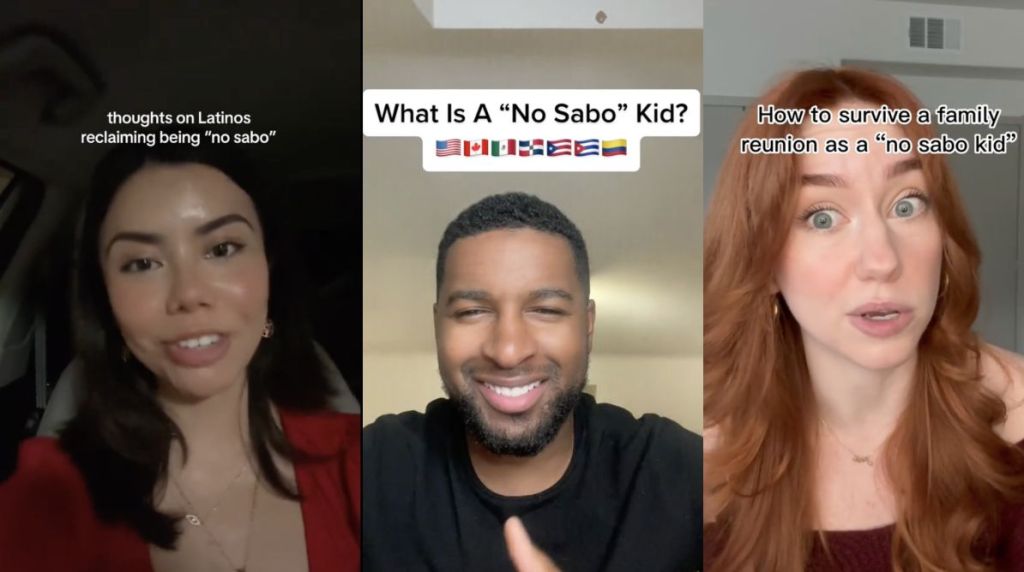
The hashtags #nosabokid #nosabokids #nosabokidsbelike #nosabokidsorry #iamanosabokid represents a collective acknowledgment of Gloria Anzaldúa’s “linguistic terrorism.” Featured on NBC News, Locatora Radio, the Los Angeles Times and, surely, referenced within familial discussions, #nosabo has brought, once again, to the fore the coupling and, we fiercely argue, the need to decouple language (“proficiency”) from that of Latinx identities. The phrase “no sabo” – a non-standard Spanish conjugation of the phrase “no sé” for “I don’t know” – has become a stand-in as both a linguistic (bad) sign of Americanization and/or a (good) marker of ethnic, bicultural pride.
Anzaldúa has long warned us that, “[e]ven our own people, other Spanish speakers nos quieren poner candados en la boca [want to put locks on our mouths]” (1999, 76). In many ways, the “no sabo” label silences or “locks” one’s mouth. The institutional attempts to Americanize Spanish-speaking individuals constitute a form of violence that has led to the erosion of Spanish spoken among Mexican and Latino families in the United States. Today, children of immigrants are ridiculed for speaking “broken” Spanish, yet, for decades Mexicans raised in the United States experienced harsh consequences and blatant discrimination for speaking Spanish in public; this racism continues today.
As scholars of Latinx listening, these social media posts can be incredibly frustrating. They remind us of the sad reality that many Latinx people do not know their own history or better yet futures. Anzaldúa would describe the intraethnic linguistic policing as, “peleando con nuestra propia sombra” (fighting with our own shadow) (1999, 76); it’s both unproductive and self-inflicting. Poet Michele Serros describes her experiences being policed in her 1993 poem “Mi Problema”:
Eyebrows raise
My sincerity isn’t good enough
when I request:
“Hable mas despacio por favor.”
My skin is brown
just like theirs,
but now I’m unworthy of the color
‘cause I don’t speak Spanish
the way I should.
Then they laugh and talk about
mi problema
in the language I stumble over [. . .]
–Opening stanza of “Mi Problema” from Chicana Falsa
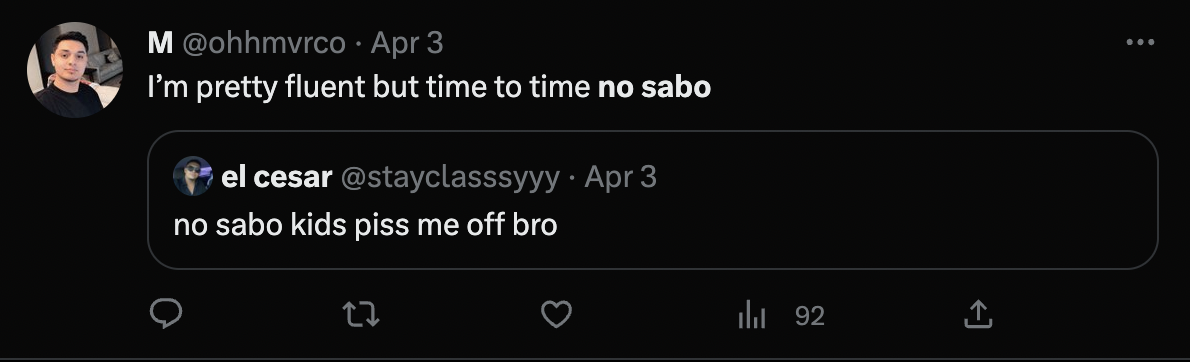
Applied to speakers (mostly kids) whose Spanish is identified as grammatically wrong or heard with an Anglicized accent, “no sabo” hashtags can encourage people to police each other’s tongues. Social media videos even show parents testing their children’s Spanish. When a child cannot remember or (mis)pronounces a Spanish word, or worse, uses a Spanglish iteration, they are disparagingly called “no sabo kids” (Stransky et al. 2023). Other posts reveal Latinx users’ fear of having and raising a “no sabo kid” or not wanting to date a “no sabo kid.”
Lastly, other posts proudly admit to being a “no sabo kid.” The latest series of “no sabo kids” hashtags are also unapologetic declarations that their language does not define the totality of their being or experiences.
Indeed, speaking Anglicized Spanish as Latinx can surface feelings of embarrassment, disappointment, and mockery from presumed “perfect” Spanish speakers or self-appointed “real” Spanish-English bilinguals. Televised instances of Latin Americans chastising the Spanish spoke of Latinx speakers or the public praise thrown at Ben Affleck for his spoken Spanish in comparison to the public side eyes given to wife, Bronx-raised, Jennifer Lopez are both hyper-mediated instances of #nosabokids.
White people might be praised for learning Spanish – no matter how Anglicized their accent – yet Latinx people whose Spanish is detected as Anglicized, are (racially whitewashed) “no sabo kids” (Urciuoli 2013). And yes, the use of the word “kids” alone infantilizes the speaker as some social media posts point to both children and adults as “no sabo.”
Irrespective of the proficiency in English or Spanish, Latinx individuals share experiences of being corrected in educational settings, at home, or online. The misuse of verb conjugation, such as using “sabo” instead of “sé,” is a developmental challenge encountered even by Spanish-speaking children who are learning solely Spanish. In other words, it is not an exclusive practice among Spanish-English bilingual speakers, despite what social media posts insist. The public discourse that some Latinx social media users are battling is what Jonathan Rosa calls “looking like a language” and, in this case, not “sounding like a race” (Rosa 2019).
Speaking, listening, and living “muy ratata” with inventive modes of Spanish and English in the U.S. is clearly heard as threatening. For instance, knowledge of another language has always challenged monolingual conservative speakers. Bilingual speakers and listeners routinely teach us how to resignify language practices and ultimately, the meaning of being a “no sabo kid.” (Or how Nancy Morales argues about Los Jornaleros del Norte and Radio Ambulante in the ways they offer new forms of belonging by understanding themselves and respecting each other.)
Entrepreneurs with Chicana and Latina feminist identities are modeling refashioned ways of belonging. For example, Los Angeles-based brand Hija de tu Madre created t-shirts and crewneck sweatshirts with the words “no sabo” to counter the ridicule heard and circulated within social media and to loudly claim a racial, linguistic identity that has nothing to do with shame. Similarly, the card game “Yo Sabo,” founded by a first generation college student of Mexican descent, Carlos Torres, looks for ways to improve his Spanish and simultaneously creates another way to connect with immigrant family members. Labels like “no sabo ” that are intended to categorize people in harmful ways are being repurposed to build community.
The podcast Locatora Radio: A Radiophonic Novela released an episode on April 12, 2023, Capítulo 160: No Sabo Kids, detailing historical reasons why Latinx ethnicities have structurally been banned from learning and speaking Spanish. Perhaps most importantly, Locatora Radio shares with listeners lengthy listener-recorded testimonios.
They provide diverse personal reasons for identifying as a “no sabo kid.” One listener, Paula, is a transracial adoptee whose first language was Spanish. However, because of forced family separation and the foster care system in Virginia, she “lost” her Spanish. Paula was enrolled in Spanish language classes throughout her formal schooling and accepts that her reclaiming of culture and language is a lifelong process. The use of verbal testimonios, a format that makes it possible for podcast listeners to listen to fellow listeners, moves away from posts above that wag their digital finger at “no sabo kids” and instead gives them a space to speak for themselves.
The intense personal and communal fear of losing aspects of culture or language makes it difficult to understand how shifts in language practices and accents are important new forms of belonging as Latinx in the U.S. If we cannot accept our own linguistic diversity, how do we expect others to listen to us?
—
Featured Image: A selection of TikTok #nosabo memes from @marlene.ramir, @yospanishofficial, and @saianana
—
Sara Veronica Hinojos is an Assistant Professor of Media Studies at Queens College, CUNY. Her research focuses on representation of Chicanx and Latinx within popular film and television with an emphasis on gender, race, language politics, and humor studies. She is currently working on a book manuscript that investigates the racial function of linguistic “accents” within media, called: GWAT?!: Chicanx Mediated Race, Gender, and “Accents” in the US.
Eliana Buenrostro is a Ph.D. student at the University of California, Riverside in the Department of Ethnic Studies. She received her master’s in Latin American and Latino Studies from the University of Illinois at Chicago. Her research examines the criminalization, immigration, and deportation of Chicanes and Latines through the lens of music and other forms of cultural production. She is a recipient of the Crossing Latinidades Mellon Fellowship.
—
—
REWIND!…If you liked this post, you may also dig:
Ronca Realness: Voices that Sound the Sucia Body—Cloe Gentile Reyes
From Spanish to English to Spanish: How Shakira’s VMA Performance Showcases the New Moment in Latin Music “Crossover”—Petra Rivera-Rideau and Vanessa Díaz
Echoes in Transit: Loudly Waiting at the Paso del Norte Border Region—José Manuel Flores & Dolores Inés Casillas
Xicanacimiento, Life-giving Sonics of Critical Consciousness—Esther Díaz Martín and Kristian E. Vasquez
“Don’t Be Self-Conchas”: Listening to Mexican Styled Phonetics in Popular Culture*–Sara Hinijos and Inés Casillas
Share this:




Current Top Posts





April 2021

January 2020

November 2019

October 2019

August 2019

April 2014

November 2017

March 2015

December 2017

October 2015
 Sounding Out!
Recent Comments