
Sonic Lessons of the Covid-19 Soundscape

It’s understandable to resist reading or thinking about Covid in late-2021, even as the Delta variant’s new surges are making headlines around the world. Covid has surrounded and overwhelmed us for over a year, and many people’s reluctance to engage meaningfully with it at this time is fueled by feelings of fatigue, mental exhaustion, and frustration. However, I urge in this post that we have a continued responsibility to sustain our sonic engagement and listen to what the Covid-19 soundscape teaches us.
Covid-19, as most of us now know now, is a virus caused by the coronavirus strain SARS-CoV-2. While the symptoms of Covid-19 are many and varied, one symptom seemed most vital and censorious—a nagging and persistent dry cough that became referred to as the “Covid cough” in everyday vernacular. The Covid cough became an intrusive and yet all too familiar presence in the Covid soundscape—an isolated acoustic environment that allows us to study its characteristics. For instance, investigations within the Covid soundscape have studied the noise annoyances of traffic, neighbors, and personal dwellings; have recorded the quieting of the usually bustling streets of New York City; have researched whale stress hormones linked to less noise pollution in our ocean waters; and have analyzed the reception and aural imagery of sirens. I seek to add to this research by bringing the sounds of the Covid body (or a body perceived to have Covid) into the larger soundscape conversation.
It is of vital importance to attend to the Covid soundscape while we are still in it because the Covid soundscape is bound by time and place and is ever-changing. Once Covid is eradicated, our access to the sounds surrounding it disappear as well. So, I dwell in the soundscape where the Covid cough is still an everyday reality. With the Covid cough present in approximately sixty percent of Covid cases according to WebMD, the cough quickly became the virus’s warning bell, identifying who might be infected with the virus. In the early days of the viruses’ rapid spread in the United States, coughing became an acoustic red flag—a sign that danger could be near. So much about the virus and its spread was unknown, and the uncertainty heightened desires for control and reassurance. Because of this, we attended to coughing in ourselves and others, consciously and unconsciously, in ways we probably never had before.
All of this auditory attention focused on coughing is a process of listening. Different from hearing—perceiving sounds—listening requires attentiveness and consideration. Listening to sounds, as Ceraso states, “influences our feelings and behaviors as we move through the world” (176). I, like Eckstein and other sound scholars, insist that sound is an argument and that sounds have persuasive power. Sounds can evoke different responses from different people—perhaps your favorite song elicits painful memories for someone else. Listening then, can be personal. However, sound studies scholars know, and Covid-19 has amplified, that listening is also shaped by social and cultural contexts (Rice, “Listening”). During the pandemic, people listened to bodies in ways that were shaped by the news, the medical community, the culture, and the environment. While listening as a medical practice is used to diagnose and treat, the listening I refer to here is not one of compassionate care, but rather a practice of fear, surveillance, and othering.
For many people—in the United States, particularly white, hetero, cis-gendered, able-bodied, people—their bodily sounds came under social and cultural scrutiny for the first time——bringing up issues of autonomy and self-control. “It’s just allergies,” folks muttered while passing someone in the grocery store, just as a cough that could no longer be suppressed escaped their lips. Suddenly, as suspicious eyes were cast every which way, people felt compelled to disclose their medical histories to complete strangers in order to have their coughs—their bodily sounds—be deemed socially acceptable and their public presence allowable. Shildrick reminds us that bodies are leaky, but Western medicine and practice reinforce European-descended cultural teachings that our bodily boundaries should be secure (i.e. not leaky) and that otherness should be excluded. The “Covid cough” taught many of us for the first time that our bodies are leaky, noisy, and permeable, and they are not always under our command. Listening to our bodies took on an all-new meaning as we attended to our bodily sounds in hyper-vigilant ways.
Attending to the leaky, noisy nature of bodies, however, was certainly not new to everyone. Stoever’s The Sonic Color Line details the hypervigilance and rigid compliance long demanded of Black and brown bodies—often violently—by the white listening ear’s norms regarding “propriety” and personhood. Ehrick’s concept of the “gendered soundscape” thinks through surveillance in regard to female-presenting bodies and vocal gender. Casillas’s notion of “listening loud(ly)” while Chicanx, Martin’s Black feminist soundwalk methodology , and Blake’s discussion of the “gas station voice” many trans people take on to protect themselves from attack reminds us that the stakes for surveillance are higher at the intersection of race, gender, class, sexuality, accent, and citizenship status, but that resistance can also be also quite powerful.
For individuals with health conditions, impairments, or disabilities, too, concerns about control and disclosure are not recent issues, as their bodies have long been listened to in ways non-disabled bodies simply have not. For example, for a time after my mother had emergency surgery for colon cancer, her body required the use of a colostomy bag. One day she and I were shopping in a department store when a sales clerk heard my mother’s body leak (i.e. make sounds that we’ve been taught to believe are only acceptable in private spaces and bathrooms). The sales associate listened to my mother’s body in a way that bordered on disgust and looked at her in a way that beckoned my mom to justify her leaky, fallible body.
This kind of listening—the surveillance of others’ bodies—is used to regulate and control bodies, and is a long-standing tradition in disability history. For instance, St. Pierre highlights the embodied act of stuttered speech that is not only constructed by cultural norms but that challenges our cultural fantasy of the body as an invisible channel for communication and disrupts the disabled/able-bodied binary. Mills’s research on deafness and hearing technologies explores the irony and paradox that hearing aids and cochlear implants were invented to “treat” the invisible disability of deafness, but yet visibly mark their wearers. And while not explicitly writing of disabled bodies, Booth and Spencer contend that non-vocal bodily sounds are rhetorical and therefore create rhetorical challenges and provoke us into attempted management of the sounds our body produces. Individuals with impairments, diseases, and disabilities have long been listened to, scrutinized, and surveilled in these ways. Such listening is culturally bound and rooted in the ableist myth that bodies should be self-contained and controlled at all times.
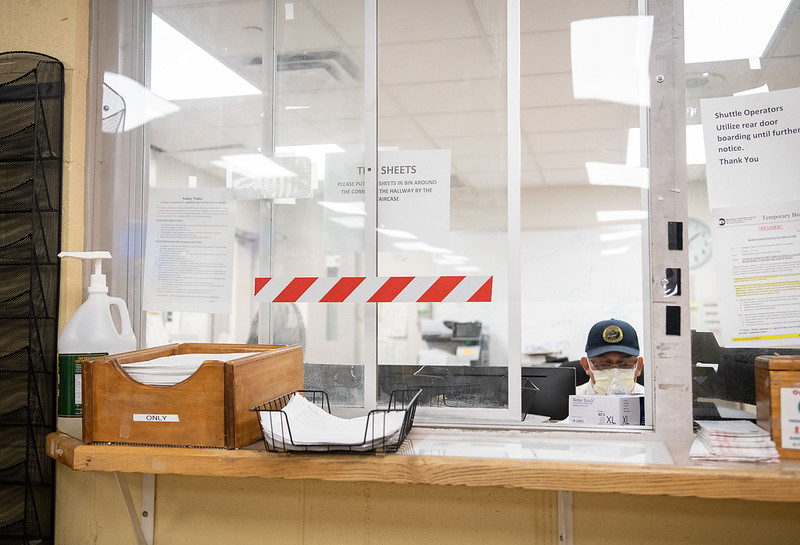
As the Covid-landscape meant that our ability to visually surveil bodies was diminished due to masks, barriers, and plexiglass partitions, our impulse to sonically surveil became heightened. Thus, many of us listened differently. Our fears of being surveilled were heightened by the fear of the Other—in this case, the fear of being othered as unwell. Our anxiety about the Covid cough was attached to ableism and the horror of being perceived as sick because, as Davis states, the “nightmare of the body is one that is deformed, maimed, mutilated, broken, diseased” (Normalcy: Link 7). The Covid cough reminded all of us that we are not as self-controlled and autonomous as we would like to think, and that we are all capable of being–or of becoming–a dissed (diseased or disabled), othered body, if we are not already.
But what if we could revisit the Covid cough and consciously listen to it in other, less fear-driven ways? If we move from listening to the cough as a surveillance practice and situate our listening as a critical rhetorical practice–a practice that examines the relationship of discourse and power and advocates for social change–then we can begin to think about what the Covid cough can teach us. Novak and Sakakeeny claim that sound only becomes known through its materiality. The Covid cough is indelibly material and embodied; it requires lungs and airways, breath and mucus. The Covid cough, distinguishable from other coughs, was described similarly by medical professionals around the world, reminding us that while listening is a highly cultured act, our sound bodies are comprised of blood, bones, and organs—substance that tethers our listening practices to a material body. We are, as Eidsheim claims in Sensing Sound, interconnected in material terms: “we cannot exist merely as singular individuals” (20). The stuff and guts of our material bodies reminds us of our connectivity, of our shared humanity, of our oneness.
The sound of the Covid cough, then, assures us of our vulnerability—a vulnerability precipitated by our lived, material body. It is important to note that not all individuals have been equally vulnerable. Individuals who are immunocompromised and essential workers, for instance, were much more susceptible to being exposed to the Covid-19 virus, as was anyone unable to work to home and many Black and brown Americans made more vulnerable by years of racist neglect by the nation’s health care system. But, still, no one is invincible. The sounds of the Covid-19 soundscape reify this truth and reinforce that through our material bodies, we are interconnected; we are all sound, and sounding, bodies.

Covid-19 brought, and is still bringing, daily horrors. The sounds of the Covid-19 soundscape are not yet absent from our consciousness or our communities. My hope is that by re-immersing ourselves into its soundscape, we can continue to remember that our fight against Covid-19 is a collective one and that we all have a shared responsibility toward our fellow humans. It is also important for sound studies to think critically and rhetorically about normalized listening practices and how those practices shape cultural understandings of what it means to be sick or disabled. Listening is not only an embodied practice; it also has bodily implications. While the Covid-19 soundscape heightened our awareness of our own vulnerability and, for some, their fears of “the other”—and (hopefully) some reflexivity on how one’s own listening can drive practices of othering—it also reassured many of our connectivity, for better or worse.
We remember those whose lives were lost to Covid-19. We listen to honor them and we listen to learn. . .and hopefully we can listen to one another with renewed empathy to build new collectivities that will forever change the Covid soundscape, along with the many other intersecting inequities that collectively brought us here too.
—
Featured Image: Coronavirus, Playground on Lockdown, Sheffield, UK, Image by Tim Dennell (CC BY-NC 2.0)
—
Sarah Mayberry Scott (Ph.D., University of Memphis) is Assistant Professor of Communication Studies at Arkansas State University in Jonesboro, Arkansas. Her research centers on representations and rhetorics of deafness. Scott is particularly interested in how sound impacts the Deaf community and how multi-modal literacies can be of particular interest and utility. She explores these issues in her works, “Re-Orienting Sound Studies’ Aural Fixation: Christine Sun Kim’s ‘Subjective Loudness,’” (2017), “Disability Gets Dissed: How Listening Rhetorically with Cultural Humility Amplifies the Concerns of Disability Culture,” (2021), and “Toward a More Just Rhetorical Criticism Through Situated Listening” (in press).
—

REWIND! . . .If you liked this post, you may also dig:
my mother’s voice, my father’s eye, and my other body: the sound of deaf photographs— Cara Cardinale
SO! Reads: Steph Ceraso’s Sounding Composition: Multimodal Pedagogies for Embodied Listening--Airek Beauchamp
SO! Podcast #79: Behind the Podcast: deconstructing scenes from AFRI0550, African American Health Activism – Nic John Ramos and Laura Garbes
Queer Timbres, Queered Elegy: Diamanda Galás’s The Plague Mass and the First Wave of the AIDS Crisis– Airek Beauchamp
Share this:

Youth, Reverberations, and Detroit’s Most Charismatic Rapper
“Type in Sada Baby on the computer and let them hear the difference.”
Devante gives me this advice in the midst of an escalating back-and-forth among his peers about the difference between singing and rapping. Eighteen middle schoolers lounge around two picnic tables inside our local community center for this six-week summer program. We’re still in the first week, and each day they’ve name-checked Sada Baby, a charismatic rapper from the eastside of Detroit. I’m too occupied at the moment—trying to keep the conversation from spilling into an argument—to heed Devante’s advice, so he takes matters into his own voice.
“Rapping is like this,” he tells the group while starting to nod his head to an ear-magined beat. “Oh boy, I ain’t playing no games!” Devante raps the first half-bar of “Oh Boy,” Sada Baby’s 2017 track that narrates his street exploits and threatens his rivals — often with violence to the women they might or might not love. Devante not only raps this opening line but approximates the grain of Sada Baby’s voice, at least as much as he can since his adolescent tone hasn’t yet caught up to his linebacker build. My own ear—from over 20 years as hip-hop DJ, turntablist, and vinyl enthusiast—is more Sadat X than Sada Baby. But Sada’s playful allure is audible even to me, like while bending his cadence into indecipherable sounds over the track’s intro. And he covered “Return of the Mack” into a shirtless gunplay revenge track. So there’s that, too. I can understand the affective draw he has on the young people in the room. And even if couldn’t, this wouldn’t be the last I would hear of him in Yaktown Sounds that summer.
Yaktown Sounds is an emergent space of sound making I curate in and around Pontiac, Michigan. (Pon-ti-Yak = Yaktown, get it?) A postindustrial city halfway between Detroit and Flint, Pontiac is the home of jazz drummer Elvin Jones, hip-hop group Binary Star, and perhaps the most respected battle rapper on the national scene today: JC. Since 2015, I’ve organized an evolving network of artists—usually DJs and beat makers—to make space for youth and community members to play with sound. Of course, play and sound go well together. In Yaktown Sounds, sometimes it’s elementary-age youth at the public library hitting pads and twisting knobs on MIDI controllers until they like what they hear. Other times it’s daddies and daughters scratching a record under the needle to see what comes out. The summer of 2017, I lined up a different musical artist each week from Pontiac and Detroit to visit and share their skills.

Photo at Yaktown Sounds by James Easterly
My curatory approach to this space takes inspiration from Saving Our Lives Hear Our Truths (SOLHOT), a creative, visionary, performative Black girlhood practice. In part, SOLHOT generates from a particular stance on Black girlhood sound. In Hear Our Truths (2013), SOLHOT visionary Ruth Nicole Brown theorizes Black girlhood sound and the ways it resists and improvises around neoliberal youth programming constraints that are intended to “fix” youth. Riffing off Tricia Rose in Black Noise, Brown theorizes Black girlhood as a sound nobody can organize. It bounces off adult listenings that would compress it into binary identity positions like sass/silence or into white mainstream notions of politeness and civility. What follows from this stance are not constrained, prescribed “learning environments” for youth but open, performative, imaginative spaces not always under adults’ control. This is the type of environment I try to facilitate in Yaktown Sounds.
This stance toward space and environment means vulnerability to reverberations and their affects. Reverberation, of course, is a phenomenon and technique that plays a prominent role in Black diasporic sonic expression. As Michael E. Veal writes, its affect/effect is most pronounced through Jamaican dub music: the collisions among sounds through echo, delay, and reverb. Veal’s engagement with dub and reverberation is also conceptual. In Dub (2013), he considers its echoes and ruptures “a sonic metaphor for the condition of diaspora” (197). In Sound Curriculum (2018), Walter Gershon thinks with sound to make a similar argument for reverberation and other physical, metaphysical, and aural phenomena: “Because sounds are already in motion, they are always reverberating, bouncing off of objects from sinus cavities to walls to coral to brush to air to water to stone” (56). In these instances, Veal and Gershon take up reverberation in both aural and environmental settings. Yet these ideas also apply to the spaces where youth and adults co-create together. What collides, bounces, and stays in motion? What counts as a reverberation?
In that summer of Yaktown Sounds, I understand Sada Baby’s aural presence as a kind of reverberation. He stayed in motion, colliding with youth judgments about what counted as rap, how a rapper’s voice should sound, and even my own aspirations for the space. These collisions were most apparent while preparing each week for our visiting artist.
Before a visit from Mahogany Jones, we watched the video for her song “Blue Collar Logic.” Landon was the first to respond while leaning back against the table, feet kicked out in front of him, and retwisting his short bronze locks:
“Can we see another one? That one wasn’t good. I didn’t think it was good. Not as good as I thought it would be. It was too much of that, uh, old time. I just think she didn’t rap enough.”
For Landon, the standard for rapping enough and not sounding “old time” was—you guessed it—Sada Baby. “He actually raps,” Landon noted while explaining. If we consider music and song not only as art but as different organizations of sound (another point from Gershon), Landon has a point. To get specific, some of Sada Baby’s songs are continuous bars of rapping — no hooks, no chorus, no rest. In “Oh Boy,” Sada Baby raps for two minutes and 20 seconds of the song, and guest artist FMB DZ raps a 40 second verse. Straight bars over a trap beat. By comparison, “Blue Collar Logic” is also roughly 3-minutes long but has a fuller song structure. Mahogany Jones raps for 1 minute and 20 seconds across two verses. In the golden era template of DJ Premier, cuts from DJ Los make up the 30-second intro, the two choruses, and the instrumental outro that lasts approximately one minute. If we do the math, Sada Baby’s track has more than double the rapping compared to Mahogany’s.
My point here isn’t to judge which organization of sound is better; there is no wrong way to organize sound. Rather, these details illustrate two very different organizations and how Sada Baby’s made up the basis for Landon’s judgment.
If Landon’s directness that “she didn’t rap enough” rings a bit harsh to our polite adult listenings, then hear Kareem slice through the group conversation after listening to hometown artist Kodac aka M80, who had just returned from a European tour:
“He don’t know how to rap.”
Kareem’s judgment was based upon what he heard as singing and rapping happening in the same song, an organization of sound he classified as “old.” When I asked Kareem what Kodac needed to do to be a better rapper — “in your opinion,” the recommendation was equally direct: “Be more like Sada Baby.”
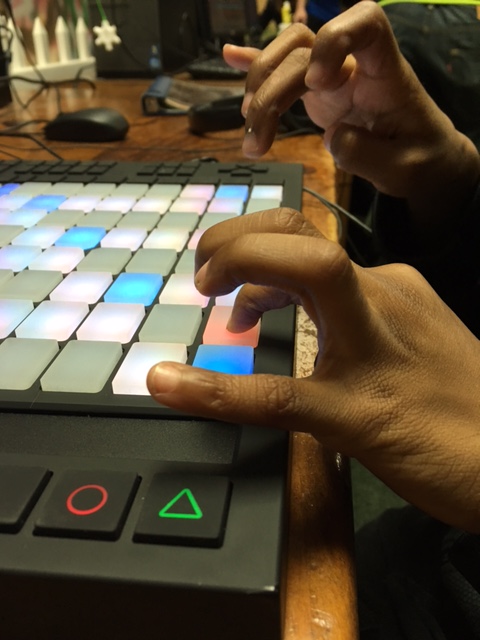
Photo at Yaktown Sounds by Emery Petchauer
These responses from Landon and Kareem show us something else about the movement of reverberations through this space. Sada Baby’s aural presence not only collided with youth preferences and claims about rap. As a reverberation, he was used to berate other artists whose sounds and configurations of sound were heard as “old” through youths’ generationally tuned ears.
Despite the youth-centric stance I take on spaces like Yaktown Sounds, I’m not gonna lie: the strikes and blows of these reverberations hit me too because of the relational ties I hold with these artists. They are part of my own creative community. I’ve DJed on stage for Kodac. I go to all of Mahogany’s shows. As a result, I remain vulnerable to the force of these reverberations. Owning up to that point, I am reminded of what Shakira Holt teaches us about adults and how we listen, particularly in education settings: sometimes we are not as open-eared to youth as we imagine ourselves to be — especially given the ways we have been socialized to censor and silence Black youth, even ones who live through our own cities, schools, and community centers. Though I’m two years removed from this particular iteration of Yaktown Sounds, Sada Baby continues to reverberate with/against me. He stays in motion even now, echoing through my writing as I toggle over to his Soundcloud page, press play on his songs, and wonder if I will hear something that makes me tune in differently to the young people around me.
—
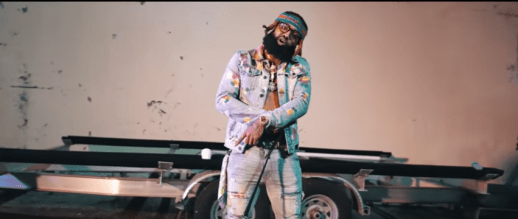
Featured image: Screenshot from “Sada Baby–On Gang”
—
Emery Marc Petchauer makes beats and DJs with kids in and around Pontiac, MI. A former high school English teacher, he works as an associate professor of English and Teacher Education at Michigan State University. His scholarship has addressed the aesthetic practices of hip-hop culture and their connections to teaching, learning, and living. He also studies the high stakes test educators must pass to become certified teachers. He is online at empetch.com and on Twitter at @emerypetchauer.
—
 REWIND! . . .If you liked this post, you may also dig:
Deep Listening as Philogynoir: Playlists, Black Girl Idiom, and Love–Shakira Holt
The Sounds of Anti-Anti-Essentialism: Listening to Black Consciousness in the Classroom–Carter Mathes
Can’t Nobody Tell Me Nothin: Respectability and The Produced Voice in Lil Nas X’s “Old Town Road”–Justin Burton
Share this:


Current Top Posts





April 2021

January 2020

November 2019

October 2019

August 2019

April 2014

November 2017

March 2015

December 2017

October 2015
 Sounding Out!
Recent Comments