
#TigerBlood: Charlie Sheen and Affective Listening

DOI: https://doi.org/10.59350/4atnk-5zx51
What is going on with Charlie Sheen? Banking almost 1.5 million dollars per episode of Two and a Half Men, there seems to be very little reason for Sheen to say things like: “I am on a drug. It’s called Charlie Sheen. It’s not available. If you try it once, you will die. Your face will melt off and your children will weep over your exploded body,” to 20/20. If extreme quotations like that were not enough, you can connect to the Charlie Sheen Twitter feed for round the clock updates on his inanities. Considering this statement, the key question is not who is listening but instead, who does Charlie think his listeners are? Are these tweets a candid rehearsal of Sheen’s innermost thoughts, or considering Andreas Duus Pape’s recent post, is there a strategic construction of audience within Sheen’s Twitter-mediated performances?
To this question, I shall argue that there definitely is a strategy. Sheen knows that he is being watched, and he knows exactly which of his quotes have the potential to go viral. As Radar Online has noted, Sheen has hired a TweetMaster to manage his Twitter account. The TweetMaster adds hashtags (# symbols which link tweets through keywords) to Sheen’s most potent memes. #TigerBlood, #Winning, #earnyourself and #teamsheen, all brand a series of tweets to Sheen in this cross-platform #twitterwar. If Sheen was as slaphappy as some of his quotes evince, he would not have hired a TweetMaster to manage his tweets nor would it be important to aggregate these points via hashtag in Tweetspace. Charlie Sheen’s recent actions exploit a strategy of spectacle in this notable propaganda campaign.
Building on my previous post regarding the politics of the interior, Sheen’s media blitz works to amplify his voice within the interior space of Twitter. In keeping with the politics of interiority and even a so-called ideology of immanence, Sheen’s quotes can be read as exemplifying the production of positive affect. When Sheen tweets: “fastball. the trolls are foaming from their toothless holes. rumor mill abundant with evil gossip. mainstream heretics smirking,” (3/7/11) he draws on the extreme and fantastic to paint what is ultimately a comical picture. Contrasting the fantastic troll to a space-less rumor mill and also making reference to a nebulous mainstream, Sheen leaves attentive followers confused and bemused. Some might chuckle, connecting the troll/hole reference to a musical skit from an episode of It’s Always Sunny in Philadelphia. Because Sheen relies on such extreme and fantastic images while striking a somewhat fanatical tone, he makes people laugh. Sheen’s humor here can be understood as the production of positive affect in a diffuse and decentralized audience. Sheen’s craft has become so slick that it even made headlines in the news this week.

Sheen’s ability to produce positive affect through talk-radio and Twitter quotes yields a positive strategic position. Because Sheen commands the production of a widespread and diffuse affect, he improves on his own “brand.” Further, as a successful producer of affect Sheen transforms himself into a commodity bar-none. Though he may no longer benefit from his meaty Two and a Half Men revenue stream, he becomes available for countless high paying, low-stress cameos seeking to cash in on Sheen the commodity. Sheen exploits what is common in all audiences, the production of sadness and joy, in doing so he transforms and rebrands himself as celebrity commodity. Ultimately, Sheen’s recent statements are highly strategic, because of them he stands to gain work. Cleverly, he imagines an audience of the common, one that will perceive him as either comic or tragic, joyful or sad. Either way, he wins.
This victory comes at a cost, as audiences laugh at and about Sheen, stereotypes of drug abuse and mental illness stand to replicate along with Sheen’s haphazard quotations. Within this sea of affect, monstrous cultural trends will surely endure. Such is the nature of tigerblood, it is contagious.
—
Aaron Trammell
Share this:

Genre in the Age of Convergence: Mario Paint Composer
DOI: https://doi.org/10.59350/rg065-mge82
It’s no secret that over the course of the twentieth century, aesthetic productions have drawn increasingly on recycled and re-appropriated materials. Perhaps, for this reason, the above video – a rendition of Michael Jackson’s Thriller on the newly minted Mario Paint Composer – sounds absolutely mundane. Nothing new, just another curiosity born out of the collective consciousness we cannily refer to as the Internets, which we understand jokingly as a series of tubes, notably Youtubes. Laffs aside, this phenomena complicates many traditional modes of interpretation.How do we hear the music of a convergence era when within it lies a devious set of connotations, each serving to reorient the listener to its own particular theme? What tactics do listeners take when interpreting this semiotic collision of sound, icon and song? These questions complicate the topic of genre, where a social consensus traditionally guides the collective organization of a medium. What social and sonic forms shape our understanding of Thriller as it was reproduced by Mario Paint Composer on Youtube in 2008?
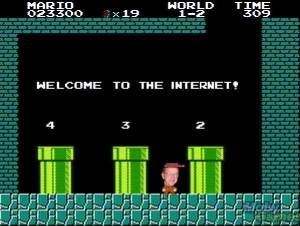
Before delving too deeply into a discussion of genre, it is important to situate the phenomena of convergence in a pre-digital context. Although the user-centric nature of web 2.0 has certainly helped to accelerate this process, one needs to look no further than Dick Hebdige’s “The Meaning of Mod,” in the anthology Resistance Through Rituals, to sense an earlier precedent to the mash-up culture we observe today. Drawn to the adventure of a dangerous soHo night-life culture, “The mod dealt his blows by inverting and distorting the images (of neatness, of short hair) so cherished by his employers and parents, to create a style, which while being overtly close to the straight world was nonetheless incomprehensible to it.” Although Hebdige is writing in 1974, long before computers would become mainstream, he makes a worthy point here about the appropriation of fashion. Constructing it as an act of distortion,Hebdige argues that early 1960s mods (understood here as a working class youth movement), through their stylistic appropriations were able to undermine the fabric of British society. By acting as criminals, but lauding the style of white collar workers – suits, short hair – mods help to show that semiotic convergence is not something new, instead it can be read as a stance of resistance.
In the case of Thriller, resistance is too strong a word. I prefer distortion, it is value neutral, although it can easily be understood in the context of resistance. Thriller on Mario Paint Composer distorts Thriller by Michael Jackson. By simplifying the song to a series of 16-bit samples, the song’s transcriber geoffnet1, translates it all to the symbolic language of Mario Paint – where mushrooms sound like drums, hearts are bass notes, ships are cymbals, flowers are horns, cars are synth pads and game-boys sound like blips. geoffnet1’s Thriller is a distortion of the Mario Paint Composer sound as well; originally a part of the 1992 Super Nintendo cartridge, Mario Paint, Mario Paint Composer is now a fan-modded update of its original form. Unlike the original Mario Paint Composer has been designed with functionality taking a precedent over accessibility. Originally marketed as an intuitive music scripting software, the following limitations were part and parcel of the platform (These restrictions have been copied from Tombobbuilder’s page, a musician who works with the limits of Mario Paint Composer as it was originally distributed.):
1. Only 24 measures are available.
2. No more than three notes at a time.
3. You can not double notes on the same line or space.
4. Tempo is restricted.
5. There is no fluctuation in dynamics (volume).
6. No sharps or flats are available.
7. Can only compose using the “white keys” from the piano.
8. Only two of each letter name are available (except A, where there is only one).
9. C major and A natural minor are the only keys to compose in.
Of these restrictions, Thriller only conforms to the third: “You can not double notes on the same line or space,” in this regard it distorts what most people understand as the Mario Paint sound as well. By no means am I calling this work inauthentic, instead I am calling attention to the stability of sonic tropes in our cultural memory. The sound of Mario Paint is not remembered for the limitations described above, instead, there is a stable and distinct sonic fingerprint which is derived from the alchemy of icon, sound and song though which genre can be constructed and maintained.
Thriller is 8-bit music, even though there is nothing 8-bit about it. Similar to the way in which mods subverted the British status-quo, Thriller puts the idea of genre into crisis. This is not a crisis that works to undermine the existence of genre as a phenomenon, it is instead a crisis of interpretation, where the traditional means through which a genre can be identified are called into question. No longer can the easy answers be found at Allmusic or Wikipedia, some sounds have become more epistemically ellusive. Ultimately, this is a good thing, as it encourages listeners to take a critical ear to what they are listening to – and how they come to understand it.
Aaron Trammell
—
Share this:




Current Top Posts





April 2021

January 2020

November 2019

October 2019

August 2019

April 2014

November 2017

March 2015

December 2017

October 2015
 Sounding Out!
Recent Comments