
Listening to Robots Sing: GarageBand on the iPad

DOI: https://doi.org/10.59350/7g546-ctw32
I recently had the opportunity to fool around with the iPad2’s new GarageBand suite. Enticed by the intuitive touch interface I soon found myself lost within the device’s labyrinthine architecture. Every poke, prod and press brought me to a new screen with a bevy of exciting options. A touch to create a drum loop, a tickle to evoke some reverb, and a brush to strum a guitar. I was one with the machine; it was a truly cybernetic, kinesthetic moment. This may sound naïve, but I had never realized how many tools were available to electronic musicians, or how intuitive using these tools could be. As digital tools to create music become more accessible and more intuitive, what is the role of the human in understanding their use? Further, what strategies can we adopt when listening to these creations?
This question may seem a bit outdated to those who have been researching post-humanist phenomena since the digital boom in the mid-nineties. Often conflicting perspectives regarding the negotiation of the human and the digital have been considered in the last decade or so. Some like Donna Haraway, Pierre Lévy, and even Ray Kurzweil offer particularly optimistic readings of the post-human (although for radically different reasons). While scholars like Nancy Baym and Jaron Lanier have offered decisively more sober readings of the problematic. They argue that splits between the human and post-human, or analog and digital are false dichotomies. Truth be told, none of the theorists above adequately address my feelings on this topic. Producing music with a digital audio suite makes me defensive of my humanism and it is by its very nature a project of preservation.
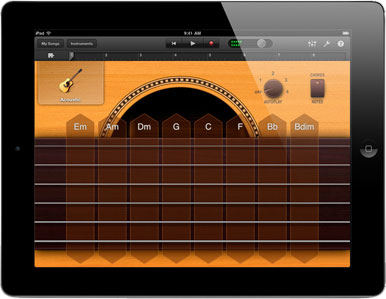
The algorithmic tools packaged within digital audio suites encourage a sense of aesthetic preservation. Tools like GarageBand’s Smart Guitar, Smart Drums, Smart Bass, various arpeggiators and Appleloops encourage the user to program music on a high level where the nuance of serendipity and improvisation play second fiddle to the overall sonic contours of a piece. Although the user is provided the tools to intervene and program music in a very specific way, it is by default a distinctly different experience than that of playing a guitar or piano. The ghost of the algorithm haunts such performances; reminding the user that these acts of spontaneous creation are no longer the default but deliberate…. This sense of deliberate improvisation forces me into a reflexive space where I am acutely aware of the mediations occurring within my performance. Succinctly, I must defend a sense of self within my creation. If I yield to the algorithms that seek to help me compose, I destroy all sense of the human within my work. Simply turning on robots and watching them sing.
For this reason, I propose an aesthetic of preservation as a way to understand the ways in which we listen to works created by digital audio suites. As algorithmic aids become more advanced and commonplace in music, the human becomes a less essential aspect of the form. Understanding what has been deliberately included in spite the seductive algorithmic environment is ultimately a project that seeks to recover the human in the machine; perhaps even, a project doomed from the start, as we grow ever closer to the means of our artistic production.
—
Aaron Trammell
Magnasanti – Check out the results of my collaboration with Colin Germain on GarageBand!
—
Share this:

What Are You Listening to When youarelistening.to/losangeles ?

Earlier last week I came across this post by GOOD regarding a new site called youarelisteningtolosangeles.com. Eric Eberhardt’s (http://twitter.com/url2la) web creation uses an LAPD radio feed and plays Creative Commons-licensed music in the background. (According to Olsen Bright at NBC Los Angeles, the URL was registered only last week, but since it went live it has gone viral. As of this post, it has links for New York, Chicago, San Francisco, and Montreal). The site that has gotten more news coverage has been, by far, the Los Angeles site. Nicola Twilley from GOOD calls it “hypnotic, beautiful, and utterly compelling.” When I first tuned in, I couldn’t stop listening. It is certainly haunting and leaves behind a feeling of uncanniness: the disembodied voices of police dispatchers far away mesh with the soothing sounds of ambiance music.
What caught my eye about the article was Twilley’s description of what it was like to listen to LAPD’s radiofeed:
“To listen to it is to be plugged into the pulse of the city; lost in fragments of someone else’s story. Urgency alternates with frustration and low-level routine; some incidents are reported while others are resolved; and jaywalking tickets are issued in the same breath as lives are lost.”
I like her idea that the site allows you to tune into “the pulse of the city.” The feed is a sonic representation of what is happening on LA’s streets. I had the feeling that I was listening to some subversive channel of LA life, narrated by a police dispatcher. However, there are two things that come to mind: a) the sounds of urban life are being filtered through the police department, and b) what are the sounds we hear on the feed telling us about the sonic dimensions of cities?
This online radio station of sorts mashes up city sounds with background music, but once you pause the music what we get are conversations between police officers. The result is that those sounds (voices, codes, numbers, addresses) filter the soundtrack of the city. When we click on youarelisteningtolos angeles.com we are actually listening to the keepers of peace and order on the city streets. The city has already been distilled for us through a radio dispatcher and officers.
The sounds are haunting. Interestingly, what attracts some listeners is the fact that they can eavesdrop on the police feeds, like we’re tuning into what our neighbors are doing. Others point out how soothing the sounds meshed with the dispatcher feed can be. However, the site serves as an example of how city sounds are filtered to us. We don’t hear the actual people who the dispatchers talk about, but the stories of their actions. In that sense, what we hear about them is really a narrative of order, chaos, authority, and traffic violations. Who is stepping outside of the lines?
But…can we ever really listen to The City? This is why audio projects such as soundwalks are important, because they make that aural experience multisonoral. The same way we must reject single stories (like Chimamanda Ngozi Adichie pointed out in her TED talk) we must also bring to light different soundtracks of the city around us, lest the radio feed of a police dispatcher become the one that stands out.
This brings me to my second concern: what are we actually listening to? What was initially problematic for me was that we don’t actually hear urban sounds. We hear voices talking about citizen activity on the streets. Once you mute the music, what you get are voices narrating what is happening on the street level. But then I realized that I was be limiting what sounds are classified as city sounds. In that sense, youarelistening.to is opening up what it means to listen to cities. The citizens also make sounds; their voices are part of the soundscape of the city.
I’d love to hear from our readers from these different cities, see what their reaction to listening to the transmission is.
By the way: can we get a youarelistening.to/kansascity?
Bonus tracks:
Here is Soul Coughing’s “Screenwriter’s Blues,” whose line “You are listening to Los Angeles” provided inspiration for the title. (via laist.com)
—
Liana Silva
—
Share this:




Current Top Posts





April 2021

January 2020

November 2019

October 2019

August 2019

April 2014

November 2017

March 2015

December 2017

October 2015
 Sounding Out!
Recent Comments