
A Brief Review of Australian Radio Art

Welcome to the second part of Radio Art Reflections, a series on radio art that brings together the thoughts of three practitioners who have been researching the field from Canada, Australia and the UK.
In the first part Canadian sound and radio artist Anna Friz discussed how transmission art has shaped her practice and how it has become an important current within the expanded territory of radio art. Following this, musician and sound artist Colin Black reflects on the particularities of Australia’s radio art history, analyzing the effects of ongoing cutbacks at the Australian Broadcasting Corporation. Black fears a distinctive Australian soundscape-based radio art is in danger of being lost, while identifying a current renaissance in narrative based radio features which currently shape ABC radio output, and considers the potential of ABC’s new Creative Audio Unit.
– Guest Editor Magz Hall
—
As an artist growing up in rural Australia, I was hugely influenced by how state-owned radio engaged with sound-based practitioners. For decades, radio not only gave voice to some of the more exploratory artists and their works, it allowed artists and audiences from all over this vast continent to find a space in which experimental works could, with financial support, gestate, be realized and propelled onto a world stage, often receiving international acclaim for their distinctive perspective.
In recent years I have come back to those works as a PhD researcher, interviewing thirty five international practitioners, theorists and producers on Australian radio art thereby gaining a new appreciation of its particular aesthetic practices and approaches. This article draws on some of these interviews to highlight national and international perceptions about where Australian radio art has been, while also demonstrating its potential to influence a new generation of artists to explore beyond mainstream media formats.

Murray Higgins, ABC Adelaide Drama supervising engineer recording various armaments on the deck of a Royal Australian Navy ship. This actuality was used for a live broadcast of a radio play scheduled for broadcast on the same day of recording. (Photo taken April 8, 1945 by an unknown photographer)
THE LISTENING ROOM
While there are a few early examples of Australian radio art, consistant programming and commissioning of radio art effectively commenced in the 1980s with the formation of the ABC Arts Unit during 1984-85 and the acoustic arts programme The Listening Room, which aired from 1988 to 2003. Although long-decommissioned, The Listening Room was still one of a very few signposts that my interviewees cited when trying to understand the properties of Australian radio art. The Listening Room’s founding executive producer Andrew McLennan, who expanded the boundaries of ABC radio from 1976 onwards, had a clear take on the aesthetic framework of the show, stating in one internal ABC report (c1990) that the programme was a:
… venue for the exploration, the cross-pollination of radio forms. … you can hear new radio plays, audio essays, acoustic features, sound documentaries, new music, sound-scapes and sculptures, audio installations, acoustic art forms …
This approach was broader than that of other international radio art programs. Here is a quote from the formative executive producer of Deutschlandradio Kultur, Götz Naleppa, who took a much more “aesthetic” approach for his well-known Klangkunst programmes in Germany:
The difference to other radio-art-forms like radio-play is simple: sound-composition [a term Naleppa prefers to radio art] shares with them the same elements: sound, text (voice) and music. But in radio-play text (dialogue) is in the foreground and the other elements SERVE it (often in an illustrative way). And in (radio)sound-composition we have the same elements – but they are EQUAL, they are simply MATERIAL in the hands of the composer [Götz Naleppa, e-mail message to author July 28, 2005].
Of the two, The Listening Room clearly had a wider scope. Thus a number of ABC works, like On the Raft, All at Sea (by Robyn Ravlich and Russell Stapleton), placed the text in the foreground as the narrative is primarily driven by the use of spoken dialogue and the other elements are used to serve the text in a chiefly illustrative fashion. By definition Naleppa would call this a “radio-play” and not necessarily neues hörspiel or radio art, and definitely not a radio “sound-composition.”
.
Extract from On the Raft, All at Sea (2002) by Robyn Ravlich and Russell Stapleton (courtesy Robyn Ravlich and ABC Radio)

Figure Two: The Listening Room, program logo postcard designed by Antart (c 1990).
“AUSTRALIAN” RADIO ART
Alongside this inclusiveness of a wide scope of work, my research uncovered a range of other ideas about the identifiable properties of Australian radio art. Austrian Elisabeth Zimmerman claims that with Australian work there is “a certain tradition” that favours the “use of environmental sounds … but in a very composed way.” Andrew McLennan supports Zimmerman’s viewpoint and states: “it’s always hard to say and it is probably a bit of a cliché … [however he] often think[s] of it as quite environmentally driven.” Douglas Kahn, an American, is more skeptical, observing that “The Australian stuff was much broader range … I don’t think you can say that there was an Australian aesthetic because there were so many different artists that were brought in to do things.” Although later Kahn does state that a common thread heard in Australian work was its “really high quality production values … really nice complex mixes … people playing the mixing board like it was a piano in a really sophisticated way.” Kaye Mortley from her Australian French background describes Australian work as “radiophonic art, of various sorts, more experimental in nature, some produced by composers.” While not a composer, Australian Virginia Madsen supports Mortley’s viewpoint when she describes her own work as “experimental … it combines music, theatre performance, and documentary really.” The common theme that emerges from my research is the openness and commitment to experimentation that exists alongside a highly professional approach to the art form within Australian radio art culture.
My interviews also indicated that radio art plays a role in the perceived amorphous and multi-faceted notion of national identity, while confirming Kahn and Nicholas Zurbrugg’s earlier observations that radio art has critically contributed to the overall arts ecology in Australia. As a practitioner, I would also describe my own work as having an experimental approach that is influenced by the high quality production levels of programs like The Listening Room. While much of my work is environmentally driven, my artistic focus is to create multi-faceted, intimate aural geographies in which human imprint is present.
.
Extract from Alien In The Landscape (2007) by Colin Black (courtesy DeutschlandRadio Kultur). This extract features synchronous field recordings made by a Rodes NT4, X-Y configured stereo microphone and Fender Stratocaster with additional strings attached as pictured below.

Figure Three: The author conducting field recordings at the edge of the Great Sandy Desert in Australia, 2006.
THE CREATIVE AUDIO UNIT AND AUSTRALIAN RADIO TODAY
When The Listening Room was decommissioned in 2003, explorative radio was forced in two directions: ABC Radio National programmed some word-based works, while ABC Classic FM aired another set of works that Kate Dundas (Director of ABC Radio) has called “Shorter-form pieces, maybe perhaps down the sound-based acoustic end or radiophonic end of the spectrum.”Budgets were dramatically reduced and diverted, resulting in the effective abandonment of regular commissions and airtime for long-form sound-based works. In 2012 ABC management decommissioned book readings and Creative Instinct (a “feature program that reflects and explores the creative world”) and The Night Air (described as “aural equivalents of the avant-garde cut-up: a montage of interviews, location sound, music and found audio”). Moreover management oversaw the dismantling of the Airplay programme, which included “hour-long dramatic fictions [sic] experiment with form” effectively ending an 80-year tradition of Australian radio drama. In replacing these programmes, the Creative Audio Unit (CAU) was planned and American-style low budget radio production techniques for dramatic short stories (as championed at the 2012 ABC run Radio Beyond Radio conference) were put on the table as the future of radio.
In 2013 the ABC recruited a whole new team (who collectively had very little direct engagement with prior radio drama and The Listening Room production budgets and procedures), to setup, oversee and run the CAU. This transition was so atypical of past ABC changes that it raises questions as to whether this was an orchestrated act of cultural amnesia. It is perhaps not surprising that one of the major challenges this new team faces is the lack of resources, which impedes the magnitude of new works commissioned. This also raises questions as to how the previous budgets from Airplay, The Night Air and Creative Instinct have been reassigned. Another challenge is this unit’s extremely wide area of responsibility (that was previously spread across a number of ABC Units) ranging from radio drama and essays on the Radiotonic programme (effectively replacing the entire radio drama department) to what it claims to be a “portal into radio art, performance, soundscapes and composed audio features” on its Soundproof programme.
While Soundproof makes gestures to re-stimulate radio art activities in Australia, in sampling its first twenty episodes it becomes apparent that a very large percentage of airtime is heavily driven by the spoken dialogue narrative, more in line with radio drama or documentary. Furthermore, the episodes that contain the more interesting sound works seem to be frequently interrupted by extended contextual dialogue and therefore, for the most part, present only extracts or shorter form radio art works. Therefore, as a practitioner who runs the risk of being excluded from future CAU activities, I would nevertheless argue that for the most part, the CAU is doubling up on its focus on radio drama and documentary style productions and has not to date reached its goal of fully exploring and presenting sound rich radio art features, as it claims (please see Soundproof episode mp3 downloads dated between 11 May to 21 September 2014). Moreover, Soundproof is much more constrained, even backward-looking, when compared to its predecessors and is therefore aiming to attract a much less adventurous radio audience. More glaringly, the first twenty episodes lack a strong presence for new Australian works when compared to The Listening Room that broadcast sixty-four Australian works with a total duration of fifty hours in its first year of operation. As an inquisitive listener it seems that, to date, Soundproof has forgotten its own lineage without offering anything new or innovative and in doing so, has also forgotten audience members like myself in Australia and throughout the world.
I sometimes wonder what the conclusions from my research study would be if it were only focused on current practice. Would today’s Australian radio art still play a role in the perceived multi-faceted notion of Australian national identity? Would it still be perceived to have an experimental approach with high quality production levels that favour the use of environmental sounds? Is it still a critical contributor to the overall arts ecology in Australia? Audience members who have little prior knowledge of Australian radio art, may think so or may not conceive of its potential to do so. However, given sustained support, the space for experimentation and a clear inventive vision for the future, building on the legacy of past achievements, Australian radio art clearly has the potential to regain its status on a world stage.
—
Featured Image: Beastman mural on Brisbane Radio by Flickr User JAM Project
—
Dr Colin Black is an internationally acclaimed composer/sound artist having won the 2003 Prix Italia Award and achieving the final round selection in the 2010 and 2011 Prix Phonurgia Nova for his creative feature length works. As a result of this acclaim, Black has received multiple national and international commissions to create innovative long-form works for broadcast across major Australian and European networks. Black’s curator credits include, international festival/showcases of award winning Australian acoustic art and radio art at London’s Resonance104.4fm, Kunstradio (ÖRF, Austria) and Toronto’s New Adventures In Sound Art. In 2013 he also curated the Australian Broadcasting Corporation’s Sound Fix: Your Weekly Dose of Transmitted Audible Art series. He is a PhD graduate of the Sydney Conservatorium of Music where he was a recipient of the University of Sydney Postgraduate Awards Scholarship. More recently Black has been engaged as an academic lecturing at the University Technology, Sydney; moreover he has authored a number of conference papers and peer reviewed journal articles including “An Overview of Spatialised Broadcasting Experiments With a Focus on Radio Art Practices” in Organised Sound. Black is also the founding member of The International Radio Art (and Creative Audio for Trans-media) Research Group. For more information see: www.colinblack.com.au
—

REWIND! . . .If you liked this post, you may also dig:
Unsettled Listening — Randolph Jordan
Radio Ambulante: A Radio that Listens — Carolina Guerrero
Everything Sounds Podcast — Craig Shank
Share this:

The Musical Flow of Shane Carruth’s Upstream Color
Welcome back to Sculpting the Film Soundtrack, SO!‘s new series on changing notions about how sound works in recent film and in recent film theory, edited by Katherine Spring.
Two weeks ago, Benjamin Wright started things off with a fascinating study of Hans Zimmer, a highly influential composer whose film scoring borders on engineering — or whose engineering borders on music — in many major Hollywood releases. This week we turn to the opposite end of the spectrum to a seemingly smaller film, Shane Carruth’s Upstream Color (2013), which has made quite a few waves among sound studies scholars and fans of sound design, even earning a Special Jury Prize for sound at Sundance.
To unpack the many mysteries of the film and explore its place in the field of contemporary filmmaking, we are happy to welcome musicologist and film scholar Danijela Kulezic-Wilson of University College Cork. Listen to Upstream Color through her ears (it’s currently available to stream on Netflix) and perhaps you’ll get a sense of why you’ll have to listen to it two or three more times. At least.
–nv
—
When Shane Carruth’s film Upstream Color was released in 2013, critics described it in various ways—as a body horror film, a sci-fi thriller, a love story, and an art-house head-scratcher—but they all agreed that it was a film “not quite like any other”. And while the film’s cryptic imagery and non-linear editing account for most of the “what the hell?” reactions (see here for example), I argue that the reason for its distinctively hypnotic effect is Carruth’s musical approach to the film’s form: he organizes the images and sounds according to principles of music, including the use of repetition, rhythmic structuring, and antiphony.
The resulting musicality of Upstream Color may not be surprising given that Carruth composed most of the score, and also, as Jonathan Romney has noted in Sight & Sound, Carruth has said on many occasions that he was hoping “people would watch this film repeatedly, as they might listen to a favourite album” (52). In this sense, Carruth (whose DIY toolkit also includes writing, directing, acting, producing, cinematography, and editing) joins the ranks of filmmakers such as Darren Aronofsky and Joe Wright who recognize that, despite our culture’s obsession with the cinematic and narrative aspects of “visual” media, music governs film’s deepest foundations.
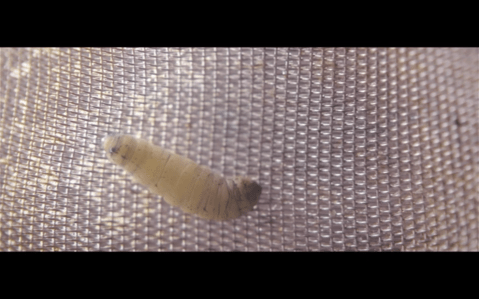
Upstream Color is a story about a woman, Kris, who is kidnapped by a drug manufacturer (referred to in the credits as Thief) and contaminated with a worm that keeps her in a trance-like state during which the Thief strips her of all her savings. Kris is subsequently dewormed by a character known as the Sampler, who transfers the parasite into a pig that maintains a physical and/or metaphorical connection to Kris. Kris later meets and falls in love with Jeff who, we eventually discover, has been a victim of the same ordeal. Although the bizarreness of the plot has encouraged numerous interpretations, the film’s unconventional audio-visual language suggests that its story of two people who share supressed memories of the same traumatic experience shouldn’t be taken at face value, but rather serves as a metaphor for existential anxiety resulting from being influenced by unknown forces.
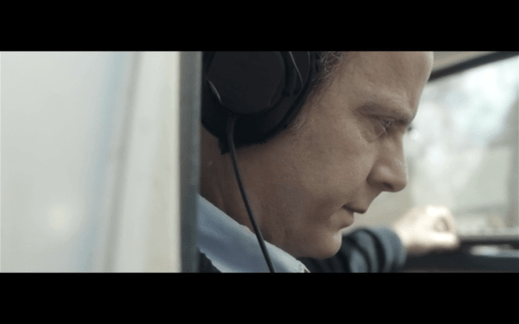
Such an interpretation owes as much to the film’s disregard for the rules of classical storytelling as it does to a formally innovative soundtrack, one that uses musicality as an overarching organizing principle. The fact that Carruth wrote the score and script simultaneously (discussed in the video below) indicates the extent to which music was from the beginning considered an integral part of the film’s expressive language. More importantly, as the scenes discussed in this post suggest, the musical logic of the film is even more pervasive than the style, role, and placement of the actual score.
Whereas feature films traditionally assign a central role to speech, allowing music and sound effects supporting roles only, Upstream Color breaks down the conventional soundtrack hierarchy, often reversing the roles of each constitutive element. For example, hardly any information in the film that could be considered vital to understanding the story is communicated through speech. Instead, images, sound, music, and editing–for which Carruth shares the credit with fellow indie director David Lowery–are the principal elements that create the atmosphere, convey the sense of the protagonists’ brokenness, and reveal the connection between the characters. At the same time, characters’ conversations are either muted or their speech is blended with music in such a way that we’re encouraged to focus on body language or mise-en-scène rather than trying to discern every spoken word. For example, Jeff and Kris’s flirting with one another during their initial meetings (at roughly 0.44.20-0.47.00 of the film) is conveyed primarily through gestures, glances, and fragmentary editing rather than speech, which would be more typical for this sort of narrative situation.
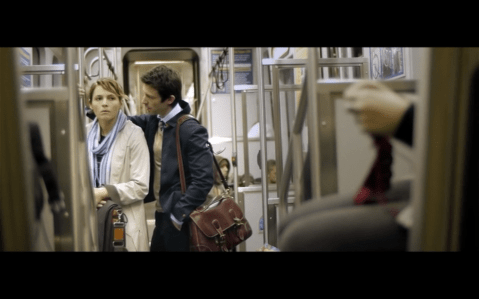
Further undercutting the significance of speech across the film is how the film has been edited to resemble the flow of music. For example, non-linear jumps in the narrative are often arranged in such a way as to create syncopated audio-visual rhymes. This technique is particularly obvious in the montage sequence in which Kris and Jeff argue over the ownership of their memories, whose similarities suggest that they were implanted during the characters’ kidnappings. In this sequence, both the passing of time and the recurrence of the characters’ argument is conveyed through the repetition of images that become visual refrains: Kris and Jeff lying on a bed, watching birds flying above trees, touching each other. Some of these can be seen in the film’s official trailer:
The scene’s images and sounds are fragmented into a non-linear assembly of pieces of the same conversation the characters had at different times and places, like the verses and the choruses of a song. Importantly, the assemblage is also patterned, with phrases like “we should go on a trip” and “where should we go?” heard in refrain. The first time we hear Jeff say “we should go on a trip” and suggesting that they go “somewhere bright”, his words are played in sync with the image of him and Kris lying on the bed. The following few shots, accompanied only by music, symbolize the “honeymoon” phase of their relationship: the couple kiss, hold hands, and walk with their hands around each other’s waists. A shift in mood is marked by the repetition of the dialogue, with Jeff again saying “we should go on a trip” – only this time, the phrase plays asynchronously over a shot of Jeff and Kris pushing a table into the house that they have moved into together. Finally, the frustration that starts infiltrating the characters’ increasingly heated arguments is alleviated by the repetition of the sentence “They could be starlings.” As it is spoken three times by both characters in an antiphonic exchange, the phrase emphasizes the underlying strength of their connection and gives the scene a rhythmic balance. Across this sequence, the musical organization of audio-visual refrains prompts us to recognize the psychic connection between Kris and Jeff, and even to begin to guess the sinister reason for it.
While speech in Upstream Color is often stripped of its traditional role as a principal source of information, sound and music are given important narrative functions, illuminating hidden connections between the characters. In one of the most memorable scenes, the Sampler is revealed to be not only a pig farmer but also a field recordist and sound artist who symbolizes the hidden source of everything that affects Kris and Jeff from afar. As we hear the sounds of the Sampler’s outdoor recordings merge with and emulate the sounds made and heard by Kris and Jeff at home and at work, the soundtrack eloquently establishes the connection between all three characters while also giving us a look “behind the scenes” of Kris’s and Jeff’s lives and suggesting how they are influenced from a distance.
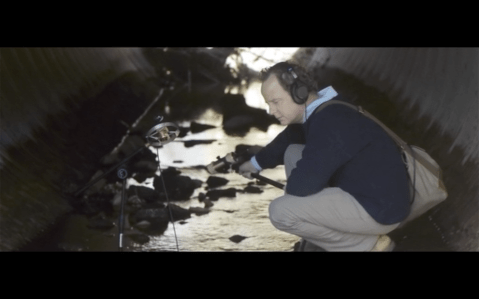
In one sense, by calling attention to the very act of recording sound, the scene exposes how films are constructed, offering a reflexive glimpse into usually hidden processes of production. The implied idea here–that the visible and audible are products of not-so-obvious processes of formation–refers not only to the medium of film but also to the complexity of the inner workings of someone’s mind. Thus the Sampler’s role, his actions, and his relationship to Kris, Jeff, and other infected victims can be interpreted as a metaphor for the subconscious programming – all the familial, social and cultural influences – that all of us are exposed to from an early age. The Sampler is portrayed symbolically as the Creator, a force whose actions affect the protagonists’ lives without them knowing it. The fact that he is simultaneously represented as a sound artist establishes sound-making and musicality as the film’s primary creative principles.
Considering Carruth’s very deliberate departure from the conventions of even what David Bordwell calls “intensified” storytelling, it is fair to say that Upstream Color is a film that weakens the strong narrative role traditionally given to oral language. What is intensified here are the musical and sensuous qualities of the audio-visual material and a mode of perception that encourages absorption of the subtext (in other words, the metaphorical meaning of the film) as well as the text.
The musical organization of film form and soundtrack is no longer limited to independent projects such as Carruth’s Upstream Color. As I have shown elsewhere, musicality has become an extremely influential principle in contemporary cinema, acting as an inspiration and model for editing, camera movement, movement within a scene and sound design. Some of the most interesting results of a musical approach to film include Aronofsky’s “hip hop montage” in Pi (1998) and Requiem for a Dream (2000), Jim Jarmusch’s rhythmically structured film poems (The Limits of Control, 2009; Only Lovers Left Alive, 2013), the interchangeable use of musique concrète and environmental sound in Gus Van Sant’s Death Trilogy and films by Peter Strickland (Katalin Varga, 2009; Berberian Sound Studio, 2012); the choreographed mise-en-scène in Joe Wright’s Anna Karenina (2012); the musicalization of language in Harmony Korine’s Spring Breakers (2012); and the foregrounding of musical material over intelligible speech in Drake Doremus’s Breathe In (2013). Given the breadth of these examples, it’s no exaggeration to say that filmmakers’ growing affinity for a musical approach to film is changing the landscape of contemporary cinema.
—
Danijela Kulezic-Wilson teaches film music, film sound, and comparative arts at University College Cork. Her research interests include approaches to film that emphasize its inherent musical properties, the use of musique concrète and silence in film, the musicality of sound design, and musical aspects of the plays of Samuel Beckett. Danijela’s publications include essays on film rhythm, musical and film time, the musical use of silence in film, Darren Aronofsky’s Pi, P.T. Anderson’s Magnolia, Peter Strickland’s Katalin Varga, Gus Van Sant’s Death Trilogy, Prokofiev’s music for Eisenstein’s films, and Jim Jarmusch’s Dead Man. She has also worked as a music editor on documentaries, short films, and television.
—
All images taken from the film.
—
 REWIND! . . .If you liked this post, you may also dig:
Sound Designing Motherhood: Irene Lusztig & Maile Colbert Open The Motherhood Archives— Maile Colbert
Play it Again (and Again), Sam: The Tape Recorder in Film (Part One on Noir)— Jennifer Stoever
Animal Renderings: The Library of Natural Sounds— Jonathan Skinner
Share this:


Current Top Posts





April 2021

January 2020

November 2019

October 2019

August 2019

April 2014

November 2017

March 2015

December 2017

October 2015
 Sounding Out!
Recent Comments