
Deep Listening as Philogynoir: Playlists, Black Girl Idiom, and Love


DOI: https://doi.org/10.59350/wf650-nn952
Here at Sounding Out! we like to celebrate World Listening Day (July 18) with a blog series. This year, we bring your attention to the role of listening when it comes to the sounds of the K-12 classroom, and by extension, the school.
Any day in a K-12 school involves movement and sounds day in and day out: the shuffling of desks, the conversations among classmates, the fire drill alarm, the pencils on paper, the picking up of trays of food. However, in many conversations about schools, teaching, and learning, sound is absent.
This month’s series will have readers thinking about the sounds in classrooms in different ways. They will consider race, class, and gender, and how those aspects intersect how we listen to the classrooms of our past and our present. More importantly, the posts will all include assignments that educators at all stages can use in their classrooms.
Time’s up, pencils down, and let’s listen to Shakira Holt‘s playlists, compiled by three of her high school graduates. –Liana Silva, Managing Editor
—
This past school year, in my roles as a high school teacher who likes what music can do for the classroom environment and as a Link Crew Coordinator who oversees student leaders as they host a mixture of freshman-only and schoolwide events, I frequently found myself sternly censoring black female student contributions to musical playlists. Although I emphasized the criterion of “clean” with increasing exasperation, my students just did not seem to get it. Strangely overlooking “ni**a,” “f***,” and “s**t,” they brought me songs, which, if played, would have gotten me called into the principal’s office, literally. When they triumphantly approached me with “clean” versions, they typically cast not a moment’s thought towards the lyrical content of drugging, drinking, fighting, and sexing, topics no less hazardous for campus play. Clearly, my students and I were working from battling notions of “clean.”

For them, “clean” was a concept fully bound up in and therefore fully resolved by language alone; in their view of things, to excise the problematic language was to expel the problem. For me, however, “clean” also included ideas such as “not sipping, smoking, popping, or shooting anything,” “not beating, kicking, hitting, shooting, or stabbing anyone,” as well as “not offering a play-by-play of actual or desired intimate activity.” Then there were some of the songs’ seemingly innocuous but just as troubling projections of sad, turbulent, co-dependent visions of love which often turn on the most toxic, tired iterations of normative gender expectations and almost always wound me up to deliver long, moralistic speeches on relationships.
Feeling every bit the forty-year old school marm that I am, I remain abundantly clear on my objections to these songs for general classroom and campus use. However, I confess that my effectual silencing of these young women never sat quite right with me. It nagged me with worries over what I was really refusing to hear, to make space for by shutting off the voices of these young black women in this way.
However outré, daring, or trouble-making I may fancy myself as a scholar and thinker, when placed within the K-12 context, I am, it turns out, your average, workaday campus censor. I hypocritically feign alarm at cussing. I fake-clear my throat with loud ahems whenever that blue talk ventures into the X-rated. While I fully respect the creativity and naughtiness of student-to-student speech and spend a good bit of time pretending not to hear what is meant to be conversation among peers, there is a limit I feel compelled to enforce. Whenever the volume grows too loud for me to pretend not to have heard or when the word choice becomes spectacularly adventurous, the expectations of the classroom/campus setting demand my intervention. Dutifully, I step in as judge and censor.
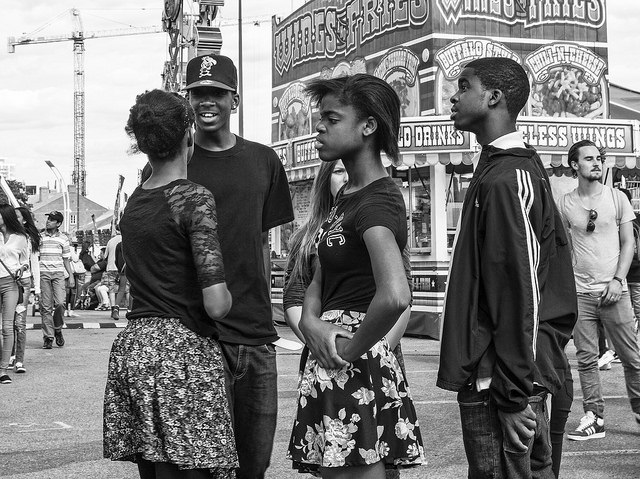
Nor is this a singular feature of schools. Places and spaces of all kinds depend heavily upon the extent to which both occupants and itinerants adhere to place-based expected modes of behavior and speech. It is important to note that even when enforced and observed by people of color, these behavior and speech norms remain overwhelmingly middle-class and white in origin and character, which can lead to interesting, sometimes alarming, and even deadly implications for people of color who enter “allegedly public” spaces without observing these norms, as Jennifer Lynn Stoever points out. In the Introduction to The Sonic Color Line: Race & the Cultural Politics of Listening, Stoever argues that in failing to act or speak in ways that reflect the place-based expected modes of behavior and speech governing such spaces, people of color frequently run the risk of falling prey to what she calls “white Americans’…implicit, sometimes violent, control over…an ostensibly ‘free,’ ‘open,’ and ‘public’ space” (2). This risk, as Stoever illustrates, often exposes non-compliant people of color to condemnation, confrontation, and even bodily harm.

The collision of place/space, race, and gender is a natural element of life in the U.S. and has become a regular and needful facet of contemporary national discourse. In a brilliant analysis of this collision as it took place in the 2013 George Zimmerman trial, Regina Bradley explores how the presence of Rachel Jeantel laid bare the way in which enforcement of place-based norms is often racialized and gendered. Rachel Jeantel is the young black woman whose body, comportment, and speech set off waves of derision and controversy as she testified in court regarding the last living moments of her close friend, Trayvon Martin. Bradley recalls how critics ignored Jeantel’s anguish, her grief, and her trauma in order to train excessive focus on her “refusal and inability to conform to expected cultural and aural scripts of black womanhood within the confines of the courtroom.” The courtroom’s “cultural and aural scripts of black womanhood” demand overt demonstrations of respect, if not outright intimidation, passivity, and general humility in tone and demeanor which would typically compensate for any deviations from Standard American English speech norms. Jeantel’s speech played only by the rules of what Brittney Cooper has called “her own particular, idiosyncratic black girl idiom” as created by her “Haitian and Dominican working-class background, her U.S. Southern upbringing, and the three languages—Haitian Kreyol…Spanish, and English—that she speaks,” and not by the rules of SAE. Thus lacking both the gentle mien expected of black women in court and an acceptable mainstream speech pattern, Jeantel suffered a broad range of brutal racist, classist, and sizeist critiques centering not only on her attitude and her speech, but also on her weight, her skin tone, her hair, and her general unfitness for public consumption.
Like the courtroom, the K-12 classroom and campus are place-based contexts that possess their own “expected cultural and aural scripts.” These scripts prescribe and police such speech elements as volume, tone, syntax, diction, and content. Like courtrooms and other spaces, the K-12 classroom and campus can easily become oppositional, and sometimes downright antagonistic, towards the young black female people who occupy these spaces while speaking their “own particular, idiosyncratic black girl idiom[s].” The idiosyncrasies of their idioms can so completely transgress the K-12 cultural and aural script that these young black female people often lose the right of being heard altogether, of achieving any attention at all beyond opprobrium for their transgressiveness. Bradley writes pointedly of Jeantel, “Her emotionally charged question ‘are you listening?’ jolted not only [George Zimmerman’s attorney, Don] West but those watching the trial. Were we listening? What were we listening for?” I find overwhelming resonance here because when I reframe my students’ playlists and song choices as alternative types of “idiosyncratic black girl idiom,” I must also reframe myself as an agent of what Bradley calls “hyper-respectability,” a source of censure and scorn. I must then answer Jeantel and Bradley’s questions honestly: For most of the year, I was not listening to my black female students. Too preoccupied with listening for speech that matched the cultural and aural scripts of the K-12 classroom and campus, I repeatedly silenced idiosyncratic black girl idiom, enacting an all too-frequent response to black female voices.

This sin against my students becomes even clearer when I consider it in the context of terms set forth by Robin James in “How not to listen to Lemonade: music criticism and epistemic violence.” James discusses at length how music criticism can inflict great violence upon “black women’s cultural and creative work” by “recentering [white] men as authorities and experts.” When white men are recentered as omniscient, innately generic, and consummately universal arbiters of culture and artistry, cultural and creative work emerging from outside of their personal and cultural frames of reference become subjected to filters, demands, and expectations often inapplicable or inappropriate to the work but especially to the black female experiences and vantage points from which that work arises. Hence the “epistemic violence” of which James’ title speaks. Without difficulty, I can replace James’ “black women’s cultural and creative work” with Cooper’s “idiosyncratic black girl idiom,” or even have my own go at it with “black female vision and voice.” I can then also substitute James’ “recenter[ed white] men with “recentered elder/teacher/agent of hyper-respectability.” Having done so, I arrive once again at the epistemic and ontological violence I enacted upon my students—for good reason, of course, but to the same unfortunate end.
My intention is not to intimate that I should have green lighted their every choice and let their music go blaring from the loud speaker at lunch while high school kids enjoyed our classic recess days, during which big kids actually had fun at lunch, dancing and tossing the football (girls, too!) and jumping double-dutch. In retrospect, I see now that there was a way to keep that aural space PG-13 AND to listen deeply to the songs that mattered most to these young women, to hear not only what the songs were saying to them but more importantly to hear what they were saying through the songs. I am saddened that I could have been generating ways throughout the year to center and amplify the very black female student voices I stifled and silenced far too often, for far too long.
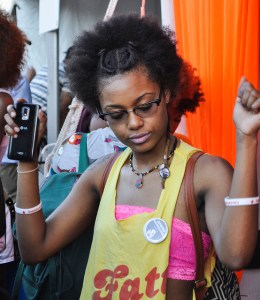
This post is an attempt at redemption for all my huffy exasperation and my quickness to relieve them of the aux cord this school year. Enlisting the help of the three seniors (now graduates) who bore the brunt of all my aux cord snatching, I have set about putting things right. I asked them to compile playlists of their top five songs, along with the lyrics. I then asked these young women either to come in and speak with me about their songs or to submit written commentary about the music they chose. I took off all restrictions and encouraged them to select whatever songs their hearts desired.
When I first imagined the critical value of engaging in this project, I figured that I might be able to mine their playlists and commentaries for some Patricia Hill Collins-esque crystallization of black female thought as it exists at this moment, late in the second decade of the new millennium, among high school seniors on the cusp of black womanhood in a country which remains steadfastly anti-woman, anti-black, and anti-black woman. That is indeed a worthy project and one which deserves completion. For this post, however, I simply want to listen to my students at long last. I want to listen closely, and I want to listen deeply. I want others to listen to them, too.
Attending fully to the thoughts and words and feelings of black female people, is but one means of expressing a form of love I call philogynoir. Clearly, this term plays with and off of Moya Bailey’s misogynoir, which she defined upon its 2010 inception as a “the particular brand of hatred directed at black women in American visual & popular culture.” Philogynoir is my attempt to rise to the challenge of naming, which Bailey identified as essential to addressing social ills. She told Mic.com last year, “I think we have to refine language in a lot of different ways so we can actually come up with solutions that help the communities we want to address,” she said. “When you use language that’s generic or unspecific you can get at some of the problem, but not all of it.”
If misogynoir calls out racist-sexist hatred aimed squarely at black women so that that hatred can be challenged and ultimately eliminated, then the concept of philogynoir provides a name for conscious gestures of love towards those same people—words, acts, and artifacts of acknowledgement, admiration, and adoration which have the potential to neutralize and ultimately undo the effects of the hatred. Deep listening, as I imagine it, in its potential to affirm, to humanize, to dignify, and to amplify, can be activated as a powerful form of philogynoir.
Other than the chance to redress my teacherly wrongs, the greatest honor I experienced in this philogynoir project was the opportunity to attend to the hurts of my students by listening to their distress, their agony. To be sure, their playlists and commentaries demonstrate that the idiosyncratic black girl idiom is highly equipped to express a full range of feelings, thoughts, experiences, and yearnings, so I hesitate to make any move which might define and confine the black female experience or its idiosyncratic idiom only in terms of pain and trauma, especially when there is such little space for black girl pain beyond its most fetishized pop culture iterations. The pain and the trauma are there, however, and deserve witness and respect.

I call attention to the pain and the trauma in my students’ idiosyncratic black girl idiom because it is precious. These are sacred hurts, holy injuries—not because they were inflicted by a deity, but because where they touched the lives of these young women, they became creative forces, shaping the signs and symbols by which these young women will know and be known, by which they will call and be called. There is tragedy here, yes, and terrible misery—but there is also mystery and great, thrilling, healing power, as well. My fervent wish for these young women is that with time, they will come to embrace the mystery and to know healing in every hurting place. My prayer is that they will each, in time, wield that creative force of their own accord to make something beautiful and lasting in the genius of their own idiosyncratic black girl idiom.
What follows are the playlists, with commentary, of these three young black women (whose names I have changed), both bespeaking and spoken in the “idiosyncratic black girl idiom” of each individual young woman, articulating each unique voice and vision and innately honoring the experiences that have shaped them. I have included no critiques of the songs or even of their commentaries. For the time being, these playlists represent a sacred line in the sand across which I will not venture with critique.
I am simply listening now. I’m listening to them, and I’m listening for them…in solidarity and in love.
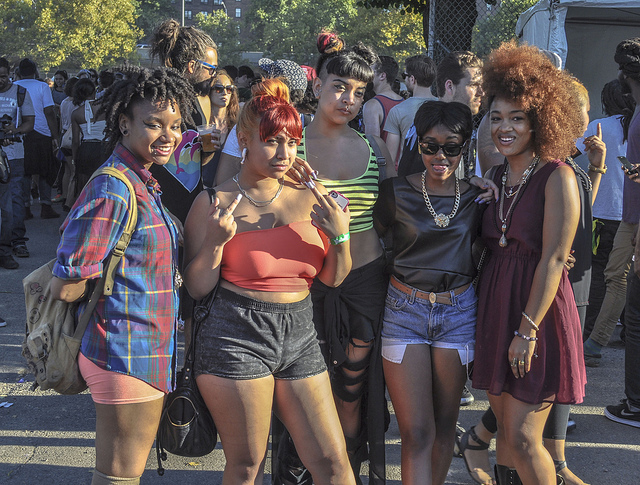
Amani’s List
- Long Song Away by Kevin Ross
This whole song is jazzy, especially the intro. It’s about a girl in the rush of it all. I connected to it because I had so many responsibilities at home. I never had time for fun. My life was joyless. I was like a robot. I finally had to have a conversation with my mom and let her know that she would have to let me live a little and be young. There had to be some kind of fun in my life. This song is about slowing down and just letting the record play.
- Confidently Lost by Sabrina Claudio
This song speaks to me. I’ve been lost before and I got to a place where I was comfortable with my lostness. I love the part about “I don’t need you to find me cuz I’m not hiding anything.” This is a good soul/R&B song about how hard it is to figure out what will bring you fulfillment but that’s not a bad place to be. Being lost is not necessarily anything negative. It means you’re going somewhere.
- Redbone by Childish Gambino
This song makes me want to put on some skates and roll-bounce to it. A lot of people like the groove on this song, but they miss the deeper meaning. It’s telling people to wake up and be known for who you are. It has a lot of references to the Black Lives Matter Movement and the dangers involved in being black. When he says “scandalous” and “creep up on you,” he’s talking about police brutality and racism, especially with the president we have now, and when he says “greenlight,” that’s a code for “wake up” as in “be woke.”
- Location by Khalid
This one is about early teenage love and it’s talking about how we are all too attached to our electronics, so when he says “send me your location,” he’s talking about using the electronics as a way to get to face-to-face communication.
- Put It On Me by Jah Rule feat. Lil Mo & Vita
I like this song maybe because I was born in them days. It’s about a thug and his ride-or-die chick. I like the part when he says, “Every thug needs a lady.” But this song actually means more to me than just the song. In my family, I have many family members who have ties to gangs. I’m looking out for my little brother and doing everything I can to keep him from that life. One of the things we do is perform in the house. We always do this song, like we act it out and everything. So I always think of my brother when I hear this song, especially the part where he says, “Where would I be without you?” I’m that person for my brother. If I wasn’t there for him, he’d be in a gang. I also have a close friend who used to be affiliated, but she’s not anymore. I think about her on the part where it says, “A tear for a tear,” because when she cries, I cry.
Rikki’s List
- Coming Out Strong by Future & The Weekend
I chose this song because it reminds me that no matter what, I can never give up on myself even if I’m in a bad position in life.
- Do For Love by TuPac
I like this song because it tells a story and the way TuPac loves the girl and never gave up on her….I wish someone could do the same for me.
- Confidently Lost & Much Too Late by Sabrina Claudio
I chose these two songs by this particular singer because she talks about love in a different aspect compared to everyone else these days. Her take on love is different, like it’s more thoughtful and more mature. It’s not just sex and drama.
- Candy by Cameo
I chose this song because I just have to have some funk in my life. LOL
- Ride of Your Life by Tinashe
I like the beat of this song and it’s kind of catchy in a way.
- Habits (Stay High) by Tove Lo
I chose this song because after my first love broke my heart, I developed bad habits because my heart was traumatized.
- Kiss It Better by Rihanna
I wish someone could kiss my heart better, but it seems like everyone is the same.
- Party Monster by The Weekend
After my bad habits formed like having sex with no love interest hoping it would make me feel better some type of way….This song talks about sex, drugs, and waking up next to someone and not really knowing them.
Zora’s List
- The Letter by Kehlani
“‘The Letter’ by Kehlani is featured on her album You Should Be Here. It was released in April of 2015. The song speaks on a loved one who abandoned Kehlani at a young age. She references her mother, and it goes through the motions of abandonment and feeling unwanted. In the song, she says,
And if you weren’t gonna guide me
Why bring me into the light?
Must have done something
To make you want to run and hide
Why oh why didn’t you just live your life?
And every girl needs a mother, and dammit, I needed you.
I chose this song because it was the first time I felt like I could personally and truly relate to art. My mother left my life when I was 15. Similar to Kehlani in the song, I had so many things going on in my head for years. But then I heard the song…and it said everything I didn’t know how to say at the time. I blamed myself like she did for a while, and I questioned her motives every day. My mother left during a crucial stage of my childhood, and it’s something I still don’t know how to recover from. The experience in this song plays a role in my story because it showed me that I’m not the only one, and that I had a choice to let the loss make me or break me. I chose for it to make me stronger.”
- Keep Ya Head Up by Tupac
“Keep Ya Head Up” by Tupac was featured on his album Strictly for My N.I.G.G.A.Z. which debuted in February of 1993. This song talks about a lot of issues in today’s society but particularly women’s roles. He speaks on rape culture and women’s rights.
I wonder why we take from our women
Why we rape our women — do we hate our women?
I think it’s time to kill for our women
Time to heal our women, be real to our womenAnd since a man can’t make one
He has no right to tell a woman when and where to create one
So will the real men get up?
I know you’re fed up, ladies, but keep ya head up
I chose this song because it relates to my womanhood. Tupac speaks on our lesser value in today’s society and our mistreatment. Women are allowed to be raped without any repercussions and we are constantly STILL fighting for our own rights, even today.
- 1st of Tha Month by Bone Thugs-n-Harmony
“1st of Tha Month” by Bone Thugs-N-Harmony is featured on their 1999 Eternal album. The song centers around receiving welfare checks in lower income areas and how the community rejoices.
Wake up, wake up, wake up
It’s the 1st of the month
So get up, get up, get up
So cash your checks and come up
I chose this song because I know that feeling, of not having much to eat all month. Sometimes you could feel that emptiness and you resort to doing things you wouldn’t normally do if you weren’t put in that situation. Getting those checks brought solace to my household. That economic struggle made me who I am, and made me appreciate so much. But the 1st of the month… The whole hood would feel that deposit.
- Weary Blues by Louis Armstrong
“Weary Blues” by Louis Armstrong was released in the year of 1925 and is featured on his Jazz Collected album, collaborating with Hot Five and Hot Seven. The song feels like soul. With the rhythm, all the way to the emotion, you can feel celebration. I chose this song because it reminds me of Louisiana itself. It reminds me of Mardi Gras, the crawfish, the Southern lingo. It reminds me of my Southern culture which plays a huge role in my life.
- Wishing by Edo G feat. Masta Ace
“Wishing” by Edo G and Masta Ace is featured on Edo G’s album, My Own Worst Enemy, which released in 2004. The song speaks about problems reflected in the system, that need to be addressed. Being lied to by presidents, lack of healthcare, blacks being murdered, drugs, and many other issues. In the first verse Masta Ace says,
I wish the president would stop lying
Black babies would stop crying
And young brothers would stop dying
I wish the police would stop killing
Politicians stop stealing and acting like they not dealing
When they know they got bricks in the street
I’ve chosen this song, because it speaks about problems that often are ignored that go on within my community. It also speaks about political corruption, which is something I care about. These issues affect me as an American because they are American issues. Being black and low income, you are subjected to a lot of different deprivations. This song highlights them and throws up a red flag. For change.
—
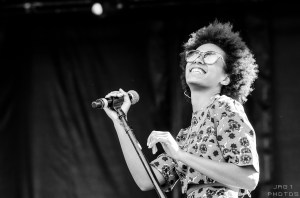
Featured image: “Afro Punk Fest 2013” by Flickr user J-No, CC BY-NC-ND 2.0
—
Shakira Holt is a lifelong Los Angeles resident and teaches literature on the secondary level. She earned a doctorate degree in English from the University of Southern California and works primarily in the area of black women’s literature and culture. o
—

REWIND! . . .If you liked this post, you may also dig:
What Feels Good to Me: Extra-Verbal Vocal Sounds and Sonic Pleasure in Black Femme Pop Music-Robin James
This is What It Sounds Like . . . . . . . . On Prince (1958-2016) and Interpretive Freedom-Ben Tausig
A Listening Mind: Sound Learning in a Literature Classroom–Nicole Furlonge
—
Share this:

Unlearning Black Sound in Black Artistry: Examining the Quiet in Solange’s A Seat At the Table

Editors’ note: As an interdisciplinary field, sound studies is unique in its scope—under its purview we find the science of acoustics, cultural representation through the auditory, and, to perhaps mis-paraphrase Donna Haraway, emergent ontologies. Not only are we able to see how sound impacts the physical world, but how that impact plays out in bodies and cultural tropes. Most importantly, we are able to imagine new ways of describing, adapting, and revising the aural into aspirant, liberatory ontologies. The essays in this series all aim to push what we know a bit, to question our own knowledges and see where we might be headed. In this series, co-edited by Airek Beauchamp and Jennifer Stoever you will find new takes on sound and embodiment, cultural expression, and what it means to hear. –AB
—
DOI: https://doi.org/10.59350/1m8hp-chf19
On May 18th, 2017, Solange Knowles took viewers on an expedition as she glided, danced and “agonized” in a “joyful praise break” on the floor of New York City’s Guggenheim museum. Drawing from the museum’s narrative of introspection and multi-sensory connection, Solange’s performance of “An Ode To. . .” prompted viewers to relearn and reorient the melodies of A Seat at the Table (2016). Solange’s performance in this setting hearkened listeners to new concepts and emotions in the record they didn’t catch before as they consumed it. This begs the question– what other sonic elements have we neglected to identify in A Seat at the Table? And why?
A Seat at the Table integrates topics like race, depression, and empowerment. Although the younger sister of powerhouse Beyoncé Knowles, Solange has managed to carve out her own legion of dedicated listeners from her infusion of Minnie Ripperton-esque vocals, hip-hop production and Gil Scott-Heron storytelling. Thematically, the album incorporates issues of Black Lives Matter and cultural self-preservation. However, Solange weaves personal elements such as vulnerability, futurism and paternity throughout the record as well, which buoy the album to praise but are hardly discussed in the album’s many reviews. Instead, writers and listeners have largely focused on resistance, anger and reactionary concepts.
Because Solange is a black women, historical signifiers of black embodiment influence both the listeners’ senses and consumption of her album. Solange’s intimate moments and reveals are shrouded by the limitation of black sound to the disruptive, angry or depressive. Such masking demands a listening praxis akin to what sound artist Christine Sun Kim describes as “unlearning.” “I’m trying to unlearn what I’ve been taught by others,” she said in an interview about her work, “and trying to find my own definition of both sound and silence.” This unlearning and re-imagination of sound is a difficult transformation considering how sound is influenced by our racialized, gendered, and religious histories.
Consider the contemporary rhetoric of black sound. Black outcry and screaming is a banal American, banal soundscape. Blackness is grieving. Blackness tiptoes near death. Captivity is a breath away. Black Lives Matter leans on the Civil Rights Movement often sonically. Dr. J Marion Sims, both his medical torture of enslaved women and the widespread belief that black people are inured to pain, still haunts our research methodologies, medical practice and our daily lives. This ushering of strife consumes black life into a sound that bleeds—an aural transfer both material and metaphoric—black sound is never personal, individualized or singular, and such historical misperceptions influences black sound studies. The Western artistic critique of black sound and black artistry overwhelmingly focuses on the reaction of whiteness, black resistance, and little else—because supposedly—there is nothing notable about blackness in and of itself.
For example, revisit the 1968 Olympic photo of Tommie Smith, John Carlos and Peter Norman as they stand on the platform with their medals. What do you see in this photo? Perhaps nationalism, masculinity, aggression, or anger from their bodily gesture to the Black Panther Party Movement? What do you hear in the photo—what is its decibel? An outcry? A rebellious yell? desperate scream?

But what other nuances are in the photo? What other critiques are masked by this proscribed sound? In The Sovereignty of Quiet (2012), Kevin Quashie invites us to:
Look again, closely, at the pictures from that day and you can see something more than the certainty of public assertiveness. See, for example, how the severity of Smith’s salute is balanced by the yielding of Carlos’s raised arm. And then notice how the sharpness of their gesture is complemented by one telling detail: that their heads are bowed as if in prayer, that Smith, in fact, has his eyes closed. The effect of their bowed heads is to suggest intimacy…How is it that they are largely icons of resistance, and that vulnerability and interiority are not among all things we are encouraged to read on their image? (Quashie 2-3).
Because of racialized history, we have limited our conceptualization of blackness in literature, film and other mediums. We only hear blackness as it pertains to resistance, grief, and anger—the reaction to whiteness. Black people are verbs instead of nouns. The ’68 Olympic photo is particularly special as it captures the steadfast Western influence that infects our synesthesia because of political and social histories. Moreover, such defects are even internalized in the black artist. As an identity, Quashie argues that “blackness is always supposed to tell us something about race or racism, or about America, or violence, struggle and triumph or poverty and hopefulness (4). Sonically this means blackness in contemporary discourse is critiqued by its decibel of resistance. We cannot read or hear blackness without integrating white pain.
Much like typical readings of the ’68 olympic photo, Solange’s album cover might elicit themes of self-esteem, black-nationalism or even aggression. However, Solange quietly sounds her life transition and personal vulnerability, via her photo, if we would hear it.

But confining view of blackness as pain and resistance prevents us—including those who are black-identifying—from noticing and celebrating vulnerability, grace, and the interiority. Quashie describes interiority as the “inner reservoir of thoughts, feelings, desires, fears, ambitions that shape a human self. . .[it is] expansive, voluptuous, creative; impulsive…more akin to hunger, memory forgetting, the edges of all the humanness one has” (20-21). It’s the tender part of identity shown through subtlety—the desires and dreams spoken through prayer. It’s Martin Luther King Jr. tapping his feet to Coltrane or Tupac Shakur watching dancers to perfect his plié—it’s the soft falsetto Solange uses in her album that bolsters emotional healing and draws avian imagery.
Asking what quiet can bring to our personal, cultural, historical and political understandings of blackness does not signal the imposition of respectability politics or desire for post-racialism. Rather, Quashie’s theory considers how whiteness has constructed and limited our senses as it relates to blackness. Blackness will remain in resistance because of systemic oppression but there is so more to black life. The element of analysis and the sensorium itself needs expansion.
Subsequently, Solange Knowles’ recent album innovatively captures resistance but centers other aspects of black sonic experience: individualization—the nuances of interiority regarding mental health, paternity and forgiveness.
The first track of the song, “Rise,” flutters an anthem of well-being:
Fall in your ways so you can crumble.
Fall in your ways so you can sleep at night.
Fall in your ways so you can wake up and rise
Her tone and pitch is sweet, light and matter-of-fact. The repetition and delivery is similar to a lullaby —reminiscent of Langston Hughes’s poem “Mother to Son”—a soft plea to rest, welcome weariness and any conflict with authenticity but to also travel with a straight back and head looking forward. Fall in your ways… At the 1.11 mark, there is a break of silence in the song; thereafter, the synthesizer yawns into melody with a futuristic twang. This Afrofuturistic moment—the study of blackness as it relates to space, technology, art and futurism— continues later with the production and lyrical content with “Borderline (An Ode To Self Care).” Notably, “Rise” introduces the sonic atmosphere of the record through Solange’s honeyed tonal drops and leaps when she sings “So you can sleep at night.” Her delivery mimics a bird within a thermal lift—her voice calling the plight of the Flying African—the myth that Igbo people escaped slavery by flying back to Africa at night. “Fall in your ways” whispers the discovery and preservation of one’s interiority. Rise emphasizes inner, restorative practice.
Solange also highlights interiority through her album interludes, mostly narrated by Master P, rapper and owner of No Limit Records. This also relates to her inclusion of paternity alongside maternity—a bright distinction considering her identification with black womanhood and the historical racist exclusion of black fathers in the home (e.g. the Moynihan Report and welfare polices). Solange notes the importance of her father and Master P’s presence with an interview with her sister:
I remember reading or hearing things about Master P that reminded me so much of Dad growing up. And I wanted a voice throughout the record that represented empowerment and independence, the voice of someone who never gave in, even when it was easy to lose sight of everything that he built.
Thus the precursor to each song draws from Master P’s embodiment of kinship, lineage and esteem, traits the teenaged-Solange admired and later internalizes into her interiority.
Through these interludes, Solange redresses Master P’s sonic history, particularly his famous rap catch phrase. As he explains in the interlude “Pedestals“:
I never cried or nothing, and that’s where the, ‘Make ’em say uhh uhh,’ that’s like my pain…that’s my battle cry.
Solange spotlights Master P’s quiet–and accompanying tonal signature—while showing its relation to “louder” elements of masculinization and coping. P’s insoluble moan is a staple throughout his songs and a signature in other No Limit artists’s songs as well.
No longer limited to its “loudness” or flattened to party anthem accompaniment—as this song and sound has all too often been characterized—P’s “battle cry” calls out, sounding a communal harkening of empathy and relation.
. . .uhh uhh. . .
In tracks such as Don’t Touch My Hair, Solange makes Black Lives Matter a key sonic element in her album, but as with her rendering of Master P, in a way that “unlearns” previous assumptions and limitations and reveals how the Black Lives Matter Movement and network is pigeon-holed by American racial ideology and its accompanying sonic constriction. While the catalyst for the movement was white supremacy and police brutality, the movement’s guiding principles also highlight interiority-infused concepts of loving engagement, empathy, and restorative justice. Patrisse Cullors, co-founder of the network, has been vocal about the movement’s integration of the arts and the reimagination of blackness. The focus on black outcry and white sirens muffles the movement’s quiet. The consequences of ignoring the interiority dismisses the whole, black self.
Belying a similar dynamic, many listeners have pinned “Don’t Touch My Hair” as a declaration to whiteness, but considering Solange’s point of view, lyrics and gentle sonic value, makes the meaning of the stretch far wider.
As Solange divulges through the sound of the Mardi Gras trumpet that blares throughout the chorus and changes in volume and texture after the quiet interlude ends at 3:34, black hair is spiritual. As the trumpets blasts in hosannas in gospel celebration, the track also sounds honor, adoration, tribute and preservation in the thick of American, racialized fixation.
The unlearning of confined sensory orientation that Solange’s A Seat at The Table and “An Ode To. . .” demands unveils a progression to time travel, what Michelle Commander’s recent book calls Afro-Atlantic Flight. Solange further incorporates such spiritual, diasporic flight with her homage to Parliament-Funkadelic artist Junie Morrison–who passed just a few months after the record came out–in her futuristic track, “Junie,” punctuated with the light, avian melisma, one of her sonic signatures on the record:
Let’s go to moonlight, then they will never find
Let’s go to home, free from the mother mind.Come on along, along, along, along, along, along, along
—
Featured Image of Solange by Flickr User Greg Chow (CC BY-NC-ND 2.0)
—
Kimberly Williams oversees a Black Cultural Center at Virginia Tech where her work includes advocacy, policy, programming and bloodletting. She received her M.F.A. in poetry at Cornell University where she also became a Callaloo Oxford University fellow. Her thesis studied the sonic flight from the Stono Rebellion into contemporary dance and household rhythm. You can find her work in Gulf Coast, Callaloo, Drunken Boat and more. At night, you can catch her watching 90s live performances of Michael Jackson or Nine Inch Nails.
—
REWIND! . . .If you liked this post, you may also dig:
The Listening Body in Death –Denise Gill
Black Mourning, Black Movement(s): Savion Glover’s Dance for Amiri Baraka –Kristin Moriah
Moonlight’s Orchestral Manoeuvers: A duet by Shakira Holt and Christopher Chien
How not to listen to Lemonade: music criticism and epistemic violence–Robin James
Share this:




Current Top Posts





April 2021

January 2020

November 2019

October 2019

August 2019

April 2014

November 2017

March 2015

December 2017

October 2015


Recent Comments