
A Listening Mind: Sound Learning in a Literature Classroom

“Listening is little short of a synonym for learning.”
–Julian Henriques, Sonic Bodies
DOI: https://doi.org/10.59350/th0ht-v6j23
This is the third post in Sounding Out!’s July forum on listening in observation of World Listening Day on July 18th, 2013. World Listening Day is a time to think about the impacts we have on our auditory environments and, in turn, its affects on us. To read last week’s post by Maile Colbert click here and Regina Bradley’s discussion of listening, race, and Rachel Jeantel (and to read more about World Listening Day) click here.
—
How can listening, which I’ve come to understand as an essential way of knowing, enhance the learning experience? My pedagogical challenge over the past few years has been to develop a heightened awareness of the ways our ears are not necessarily, as Robert Frost asserts, “the only true reader and the only true writer,” but certainly an essential mode of reading and writing that is too often underdeveloped. As my high school students read works by Zora Neale Hurston, Ralph Ellison, Michael Ondaatje, Jonathan Safran Foer, James Baldwin, and Lucille Clifton, I want their ears to become increasingly attuned to the sounds, silences, vibrations, and other sonic significance embedded within printed words. I want them to experience how listening enhances their understanding of literature, that listening is learning.
I’ve taught A Listening Mind, a trimester course for high school juniors at Princeton Day School in New Jersey, for two years. Inspired by Toni Morrison’s 1996 National Book Award acceptance speech, “The Dancing Mind,” the course title signals my interest in challenging students to practice writing and reading in ways that are collaborative and cognitively (and otherwise) dissonant with their usual English classroom habits of mind. For my students, at least initially, writing is ruled solely by the mantra “Show. Don’t Tell.” This course, then, creates preconditions for a new kind of learning. It aims to heighten students’ aural attentiveness in general, and particularly in relation to the sonic life that inhabits the lower frequencies of the printed word. In many ways, the class resonates with Liana Silva’s discussion of sound as significant to writing and learning. In this course, we grapple with essential questions such as: How might we read and write with our ears? What happens when we take the risk to do so? As I design assessments and moderate the course, I keep in mind my own essential question as an educator: How can my scholarly interest in listening as a significant mode of cultural and social engagement translate into sound study learning opportunities for my students? The assignments students complete in A Listening Mind, a few of which I share next, are my response to these questions–a response that is in constant development.
CULTIVATING A LISTENING MIND
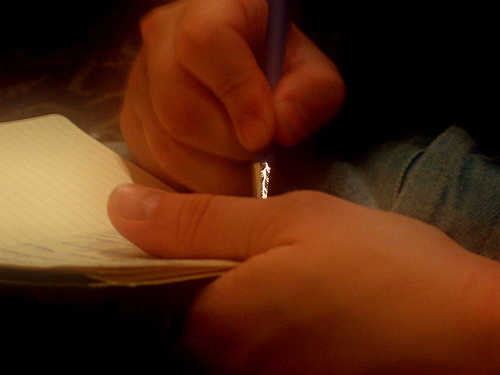
On the first day of class, I play Jason Moran’s “Cradle Song” from his most recent album, Artist in Residence. Moran plays the Carl Maria von Weber-composed lullaby on unaccompanied piano; the urgent scratching of a closely miked pencil on paper writes slightly ahead of the calming melody.
The song, a tribute to Moran’s mother who would stand over his shoulder taking notes as Moran practiced piano as a child, amplifies a sonic life that more often lingers within the printed word. Thus, it allows us to begin exploring the possibilities of listening as an approach to reading and writing.
In the first month of the course, students practice low stakes listening and writing: they go on short listening walks and record by hand what they hear in their sound journals. Rutger Zuydervelt’s Take a Closer Listen, an excerpt from the opening pages of Jonathan Safran Foer’s Extremely Loud and Incredibly Close, and the New York Times Magazine prose and audio essay, “Whisper in the Wind” are our inspirations for this assignment. They visit a space in which they feel most like themselves and tune into the space’s acoustics. They do the same in a space where they are less comfortable. Students also tune their attention to eco-listening – listening with intention to the natural or man-made environments in which we find ourselves. The idea is to notice the sounds our ears have become deaf to as we’ve become accustomed to a space. Their eco-listening results in their creating individual listening booklets that record the sounds we hear and our occasional reflections on them. By listening to various sounds and in various ways during the early weeks of the course, students exercise their ears and, along the way, some even realize that you need more than just ears to listen.
SONIC MATERIAL CULTURE
One of the assignments of the course involves work in what I call “sonic material culture.” According to the University of Delaware’s Center for Material Culture Studies, the study of material cultural objects “promotes the learning from and the teaching about all things people make and the ways people have acted upon the physical and visible world.” But, what about the ways in which material culture impacts the audible world? Sonic material culture looks at how material cultural objects help create cultural meaning through the sounds they make and the ways in which people use those sounds. Students explored an array of “sonic objects” that included, among others, a Tibetan singing bowl, steel drum, Shofar, typewriter, stethoscope, and a boom box. They then chose one of the items – an item that either makes sound (like a steel drum) or allows for access to sound (like a stethoscope), and began their research with a specific focus on how this item holds sonic cultural significance.
To research the stethoscope, for example, one student interviewed a cardiologist and a medical historian. She learned that sounds doctors hear through the stethoscope “comprise a language, spelling out diagnoses and prognoses” and provide “gateways to our understanding of the heart.” Another student chose the Steel Drum, an instrument developed in the 20th century in Trinidad and Tobago, and ended up discussing the innovation involved in reusing oil containers to produce a new cultural sound. Another student’s research on the Tibetan Singing Bowl led him back to a moment in Jonathan Stroud’s The Bartimaeus Trilogy: Book Three, Ptolemy’s Gate when the character Kitty Jones describes the ringing of a Singing Bowl that signals her transport into the world of magical spirits. Listening to the Singing Bowl made this student more attentive to this moment that he initially skimmed. And, one student’s love of all things vintage led her to her father’s manual typewriter and an essay combining family history and larger insights about education, workplaces, and mechanical writing. In each of these cases, the students realized that the sounds cannot be extricated from the material, social, and historical conditions that produce them.
SOUNDING HISTORY
The last time I taught the course, I designed a sound history mini-project. Students read excerpts from the work of Mark A. Smith and my work on historical listening in David Bradley’s The Chaneysville Incident, and considered these question: How might sound function as a way to narrate a specific historical moment? Students needed to choose a historical moment, locate a sound, and then create a museum card that, among others, answered the following key questions: What does this sound bring to our attention that we might not otherwise consider? What questions does this sound raise? What does it leave mute? Since students had watched Django Unchained recently, we discussed sounds of slavery in that film. If you write slavery through the crack of the whip, then your focus might be on violence and torture used during that peculiar past. If you tell slavery, though, from the code-laden singing enslaved persons used to send messages to flee, then you have a different frame, a different sonic way into the historical moment.
One student used the opening sounds from The Wizard of Oz to narrate the Dust Bowl. Another examined news reports and hip hop music to listen back to the Los Angeles Uprisings. One young woman interviewed her mother about her immigration experience from Guatemala; in her project, the sound of a train whistle signaled arrival to the United States and a new life. One of the most striking projects consisted in an inventive student engineering her own sound using a teakettle in order to recreate what she imagined as the sound inside a gas chamber in a concentration camp during World War II. As she explained during her presentation, the screeching teakettle captures for her both the sound of gas and the screaming of those persons trapped within a chamber. What an empathetic choice to make as a listening scholar: to imagine the voice of one in the midst of death.
Students worked on this assignment as part of their culminating assessment for the course. I assigned this work at the end of the course because it gave students an opportunity to delve into the work of a Sound Studies scholar: students drew on their skills as listeners developed over the term; returned to questions we asked regarding listening and interpretation of written and recorded texts; framed their own questions for inquiry; and used sound technologies such as Audacity and GarageBand to amplify their historical sound.
LISTENING BACK
As I tune my ears excitedly towards another World Listening Day (this year on July 18, 2013), I find myself remembering my students’ portfolio reflections of their learning in this course. Students mentioned that their time in the course helped them pay more attention to sounds around them: “my ears have been retrofitted by my experience in this class.” Some students became more in tune with their own sound: “The world is too noisy. I need to focus in, to tune in to myself.” Yet others found themselves “slowly opening [them]selves up to others” and becoming “more engaged with others’ opinions even if they were different from” their own. Even though some students entered the class resistant to, uncertain about, or “unnerved” by the thought of a listening English course, they felt by the end that, in the words of one student, “Now I leave this class with a purpose and clearer understanding of the importance of listening to my own echo.” In short, the two groups of students who have taken this class grow more “in tune” to multiple frequencies of reading, writing, and learning.
Lastly, while I hoped students would grow as listeners, I did not anticipate that their perceptions of themselves as readers and writers would also shift. Students who previously described themselves as “just not an English student” or who began writing and reading assignments with self-defeating “I’m just not good at this” comments, delved more deeply into the writing process and produced strikingly confident, nuanced pieces by term end. They have grown in their sonic literacy. In this, my students remind me of the most essential of questions: How, to borrow Carol Dweck’s language, do we help students develop a growth, rather than a fixed, mindset where learning is concerned? In my view, listening—practiced as a dynamic, tinkering, beta-type approach to the study of literature and writing—provides interesting answers.
—
Featured image photo credit: “Listen, Understand, Act” by Flickr user Steven Shorrock, CC-BY-NC-SA-2.0
—
Nicole Brittingham Furlonge earned her PhD in English from the University of Pennsylvania. Her dissertation, “On the Lower Frequencies: Listening and African American Expressive Culture,” marks the beginnings of her investment in sound studies as the field resonates with issues of race, class, gender and education. Her work has been published in the academic journals Callaloo and Interference, and in the publication St. Andrew’s Today. She also has published a cookbook for young children, Kitchen Passports: Trinidad and Tobago. She has taught in independent high schools and colleges for 16 years, including University of Michigan, UPenn, The Lawrenceville School, Holderness School and St. Andrew’s School in Delaware. She has extensive experience in the classroom and in administrative roles dealing with curriculum development, diversity issues, faculty development and issues regarding education, equity and access.Currently, Nicole chairs the English Department at the Princeton Day School in New Jersey and blogs at the Huffington Post. She lives in the green part of New Jersey with her spouse and their three young children.
—

REWIND! . . .If you liked this post, you may also dig:
“The Sounds of Anti-Anti-Essentialism: Listening to Black Consciousness in the Classroom“–Carter Mathes
“Deejaying her Listening: Learning through Life Stories of Human Rights Violations“–Bronwen Low and Emmanuelle Sonntag
“Audio Culture Studies: Scaffolding a Sequence of Assignments“–-Jentery Sayers
—
Share this:

Deejaying her Listening: Learning through Life Stories of Human Rights Violations

**Co-authored by Emmanuelle Sonntag and Bronwen Low
DOI: https://doi.org/10.59350/306p4-m0596
Are you listening?
Because sound specialist Julian Treasure argues, “We are losing our listening” due to the invention of multiple methods of recording and with the world being “so noisy . . . with this cacophony going on visually and auditorily, it’s just hard to listen, it’s tiring to listen.” In response, Treasure claims that we need to improve our conscious listening skills; he suggests teaching the skill of listening in school.
As co-directors of the “Education and Life Stories” working group of a large oral history project, we have been thinking a good deal about listening and pedagogy. The project is entitled “Life Stories of Montrealers Displaced by War, Genocide, and other Human Rights Violations,” shortened here as “Montreal Life Stories project.” From 2007 to 2012, a team of university and community-based researchers in the frame of the Canadian Community-University Research Alliances (CURA) Program recorded life story interviews with approximately 500 Montrealers who experienced mass violence and displacement. Members of the survivor communities (Tutsi, Haitian, Cambodian, and Holocaust) were key partners in both the research and the diffusion of the project, fundamentally shaping the project’s philosophy, activities and outcomes.
One of the Education Working Group’s principle accomplishments was developing an educational package called We Are Here, containing five Learning and Evaluation Situations (LES), the curricular units in the Quebec Education Program. The units are designed for “cycle two” secondary school, where the students are generally 14 to 16 years old. As of yet, these have not yet been piloted, but we plan to do so.
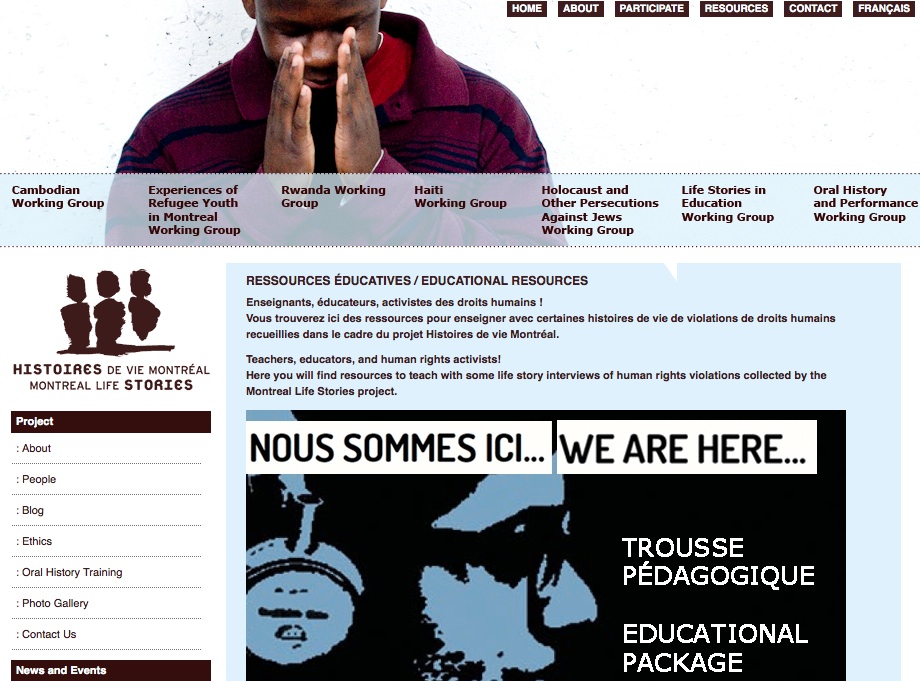
Our goal while designing “We Are Here” was to have teachers and students engage with the life stories of human rights violations, in order to foster a more inclusive cultural memory that would develop “le vivre-ensemble,” our capacity to live well together. Featuring the stories of immigrants and refugees to the province, the curriculum offers students a more complex understanding of human rights violations. First-person accounts bring world history and politics to life, helping us to understand the processes and human costs of violence and war, and expand our awareness of our fellow residents and citizens. At the same time, we recognized that the difficult stories of human rights violations make particular demands upon their listeners. We needed to consider how to ethically support students and teachers in engaging with the stories of people who have survived traumatic experience—while, importantly, respecting the interviewees themselves.
We sensed from the beginning that these goals and commitments would require us to develop our own “pedagogy of listening” to support teaching and learning from the life stories, and we foregrounded listening in all of the materials. For instance, each unit begins with the students listening to one or more project interviews, in the form of digital stories edited collaboratively by the interviewees and the editor. These digital stories tend to be under 10 minutes and bring together video, images, sound, and text (see for example, Bracha Rosenblum’s digital story). They are much more accessible than the original video interviews, which can be many hours long.
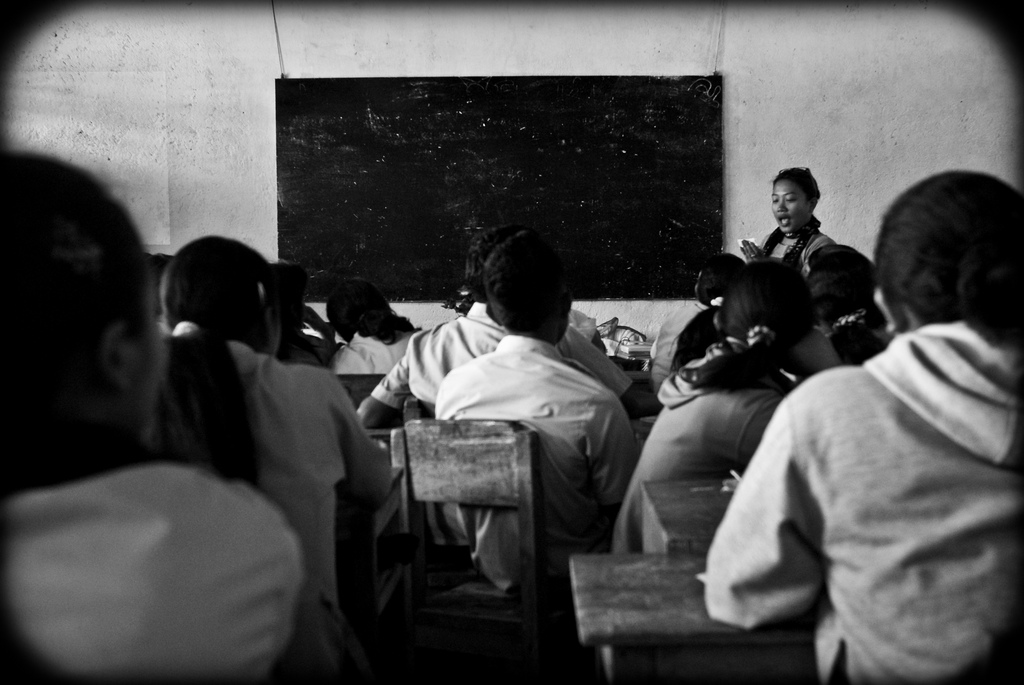
There is an irony in building a case for listening in schools. Students are commanded daily to “be quiet and listen to the teacher.” Despite the long history in educational theory of critiquing this model, the student-who-listens-in-silence versus the teacher-who-speaks-loudly is still regularly invoked in practice as an ideal relation. The demand for silence is in part a pragmatic response to the inherent noisiness of schools filled with people. At the same time, the listening imperative is also a key tool in the establishment of teacher authority and power.
We wanted to rethink the process of listening in our curricular design beyond these traditional power dynamics. Our pedagogy of listening draws on concepts of testimony, communities of memory, dialogue, and the principle of shared authority in oral history, which we describe in detail elsewhere (forthcoming in the Journal of Curriculum Studies). In this blog post, we explore our pedagogy’s indebtedness to philosopher and musicologist Peter Szendy’s work on listening and its potential in the public school classroom.
Listening begins with the desire to be signed and addressed
The address is a central notion in Peter Szendy’s Listen: A History of Our Ears. The early 2000s, as Szendy explains, saw the birth of the peer-to-peer file sharing service Napster (created by Shawn Fanning in 1999), where listeners exchanged and circulated music. Through the lens of file sharing, Szendy began reflecting on the rights of listeners and the nature of musical listening more generally. He argues that sharing shapes the listening act: while listening can be passive–I am listening to you, receiving what you are saying–we also offer up what we are listening to. Rather than envisioning listening as a two-way engagement, Szendy triangulates it, structuring listening around a listening subject, the sonorous object the subject is listening to, and the addressee (le destinataire) of the subject’s listening. In Szendy’s theory of address, as we listen to somebody or something, we also address our listening to an “other” (who might be another beside me, or in myself).
That students would address and engage with “an other” through their listening appeased, in part, our concerns about having students listen to difficult stories of mass violence. If listening is akin to a peer-to-peer sharing system, students were somehow not “alone” anymore in the experience; listening is a building of relation.
Closely related to the concept of listening as address is Szendy’s idea of signature, especially through the digitalization of sound where “listeners become authors” (136) naming, tagging, and classifying the files that they share with others. Szendy describes this process in terms of the singularity of listening:
It is more simply as a listener that I want to sign my listening: I would like to point out, to identify, and to share such-and-such sonorous event that no one besides me, I am certain of it, has ever heard as I have (3).
While all listening necessarily involves an appropriation of what has been listened to, we wanted to amplify the process of students “signing” or marking their listening, and so making it their own. We would deepen students’ engagement with the video interview and the “other” by having them actively edit, rework, even remix, and so adapt the original. We gave students the right to enter into the difficult stories from the survivors interviewed in the Montreal Life Stories project, responding as individuals and as members of a classroom community. While the dynamic of students listening to and making something in response to the life stories takes many forms in our curricular units (including timelines, maps, and audio-tours), we here share the unit which most explicitly embodies the remixing in Szendy’s notion of listening.
What a Story!
What a story!: Life stories and digital storytelling, is designed for senior students in the English Language Arts, and asks students to work in groups to create their own digital story version of a segment from one of the life story interviews.
In the preparation phase, the students listen to a 5 minute digital story of a Holocaust survivor living in Montreal that enables them to discover the multimedia elements and narrative structure of a digital story.
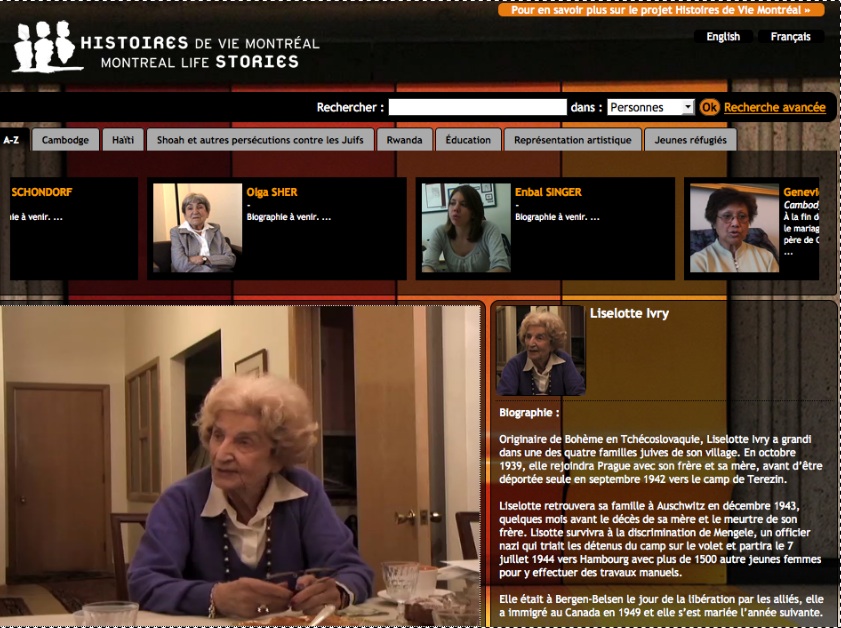
In the production phase, students approach their main task: producing a 5 minute digital story from a 34 minute life story interview with another Holocaust survivor. The phase begins with “deep listening” exercises where students work in groups to summarize the story and decide which parts of the larger interview they would like to keep in their edited versions. In doing this, they reflect on their experience as “listener“ vs. ”reader” and their responsibilities as listeners of difficult stories.
While the expression “deep listening” recalls the work of the composer Pauline Oliveros, in the Montreal Life Stories project the concept stems more directly from the notion of “shared authority,” a phrase coined by oral historian Michael Frisch (1990) to describe the process of co-creating an interview. The community-university model was collaborative at all levels, and researchers and the researched were partners in dialogue. In turn, we frequently used “deep listening” (as in the profound listening between interviewers and interviewees) as an expression during our working sessions. The concept also draws on the work of oral historian Martha Norkunas on interview techniques and deep listening exercices; her visit to the project shaped our curriculum design process, and students are encouraged to engage in dialogue and sharing, and to “Listen with close attention and deeply, in an empathetic and respectful manner.“(13). These appeared, to our eyes, to be consistent with Szendy’s notion of listening as address and signature.
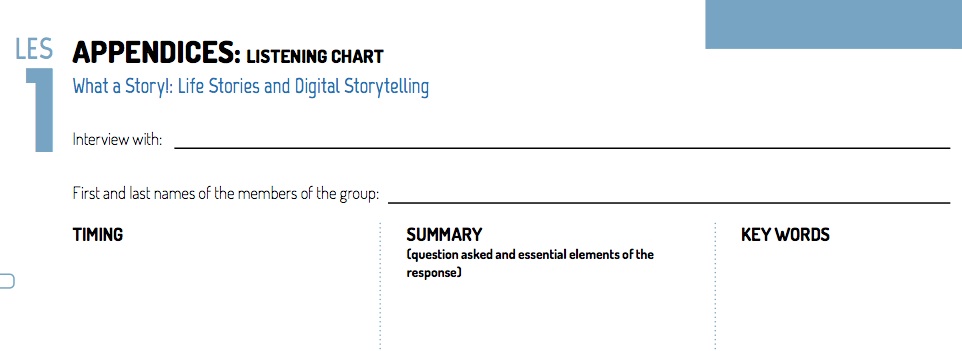
The production phase continues with the creation of the digital story, the editing and the montage. Students then reflect on the ethics of the process of cutting and reworking another’s story, exploring the way narratives can be modified, the meaning built into the digital story vs. the meaning of the interview, and the question of narrative form.
Peter Szendy chooses the deejay, or of the musical arranger, as a figure for the contemporary listener. Indeed, we imagined the students in groups, headphones on, in front of computers, slowing down the cadence, augmenting the sound, rewinding or fast-forwarding, cutting, pasting, annotating. We thought of them as highly skilled listeners, intervening in what they were listening to and interpreting their listening for the “other” ( in the manner of composition theory in which students are asked to write for real audiences for real purposes). As deejays of their listening!
Having students edit the life stories of others, especially stories of violence and war, brings with it risks of misinterpretation and manipulation. However, the unit asks students to think carefully about these risks, and unlike projects which use testimonies in the service of someone else’s argument, this editing assignment has students select from the larger interview in order to craft a narrative that respects the original. As Norkunas says, “When Michael Frisch coined his now famous phrase, “a shared authority,” he wrote of the shared responsibility of listener and narrator for creating the interview document, for interpreting it and for sharing the knowledge created.”(2) If editing and interpreting are critical to the process, adds Norkunas, “the first moment of creation takes place in the interview, in the act of listening.” Hence, the ethical issues raised by the editing assignment–and more generally by having students and teachers engage with personal stories of human rights violation–are addressed by considerable attention to the act of listening (13), and by the cultivation of trust, dialogue and sharing. In short, an attention to the “other.”
Rather than deciding that this content is too challenging for students or reproducing a passive listening dynamic in which students listen to the interviews in reverential silence, we work to support student engagement — as both an attention and response — with these stories as part of a community of listeners. And while listening to these stories can be difficult work, we hope that through our pedagogy of listening, students will gain a greater awareness of the lives of those Quebecois who are not often part of the national narrative, and grapple with some of the difficult knowledge of human pain and survival.
—
Bronwen Low is an Associate Professor in the Department of Integrated Studies in Education at McGill University. She researches the implications of popular culture for education, curriculum theory, and adolescent (multi)literacy practices. Areas of interest include hip-hop and spoken word culture; informal, arts-based and participatory education with youth; and community media and participatory video programs.
Emmanuelle Sonntag defines herself as a “knowledge organizer.” She offers consultancy services in communication, education, curriculum design, information management and knowledge mobilization while pursuing her PhD in Sociology on… Listening at Université du Québec à Montréal. She tweets on listening, sounds, stories and other noises @lvrdg.
—
REWIND! . . .If you liked this post, you may also dig:
Audio Culture Studies: Scaffolding a Sequence of Assignments–Jentery Sayers
The Sounds of Writing and Learning— Liana Silva
Listening to #Occupy in the Classroom–– Travers Scott
—
Share this:




Current Top Posts





April 2021

January 2020

November 2019

October 2019

August 2019

April 2014

November 2017

March 2015

December 2017

October 2015
 Sounding Out!
Recent Comments