
The Love Below (the Mason Dixon Line): OutKast’s Rejection at the 1995 Source Awards

DOI: https://doi.org/10.59350/nm2e2-a4458
During his acceptance speech at 2017’s Golden Globe awards, actor and rapper Donald “Childish Gambino” Glover thanked the black people of the city of Atlanta for “being alive,” and the Atlanta trap rap group Migos for their single “Bad and Boujee.” As the camera panned out into the crowd, it showed dominantly white faces full of confusion and polite yet uncomfortable laughter. These audience members seemed unfamiliar with Migos and with categorizing a “black” Atlanta (and South) separate from the pop culture hub we know as Atlanta today. Glover’s speech re-affirmed the sentiments of Outkast’s Andre “3000” Benjamin over twenty years’ prior at the 1995 Source Awards, that the (black) South got something to say.
As I’ve argued previously, Andre and Big Boi’s acceptance speech at the Source Awards was the springboard for what I call the “hip hop south,” the social-cultural experiences that frame southern blackness after the Civil Rights Movement. The declaration “the South got something to say”—and the booing that ensued—is important to engaging how southerners see and hear themselves in a contemporary landscape. The Source Award’s dominantly New York audience booing both jolts the ear and affirms hip hop’s hyper-regional focus in the early to mid 1990s. The booing crowd identifies hip hop as northeastern, urban, and rigidly masculine, an aesthetic that was a daunting task for non-northeastern performers to try and break through. Even celebrated west coast artists like Snoop Dogg, who menacingly and repeatedly asked the crowd “you don’t love us?” during the show, struggled with the challenge of being recognized – and respected – by northeast hip hop enthusiasts.

The 1995 Source Awards proved to be the climax of the beef instigated by both West Coast Death Row Records and East Coast Bad Boy Records, the bitter lyrical and personal battle between Tupac Shakur and Notorious B.I.G., and OutKast, a Southern act, chosen as “Best New Rap Group.” The crowd’s increasingly despondent sonic rejection of hip hop outside of New York foregrounds my reading of OutKast’s acceptance speech as blatant and unforgiving southern black protest, a rallying cry that carves a space for the hip hop south to come into existence.
A recap of that night, in which Christopher “Kid” Reid and Salt-N-Pepa presented OutKast their award. Upbeat and playful, Kid says “ladies help me out” to announce the winner, but there is a distinctive drop in their enthusiasm when naming OutKast the winner of the category. The inflection in their voices signifies shock and even disappointment, with Kid quickly trying to be diplomatic by shouting out OutKast’s frequent collaborators and label mates Goodie Mob. The negative reaction from the crowd was immediate, with sharp and continuous booing.
Big Boi starts his acceptance speech, dropping a few colloquial words immediately recognizable as proper hip hop – “word” and “what’s up?” Over a growingly irritated crowd, Big Boi acknowledges that he is in New York, “y’alls city,” and tries to show respect to the New York rappers by crediting them as “original emcees.” Big Boi recognizes he is an outsider, his southern drawl long and clear in his pronunciation of “south” as “souf,” yet attempts to be diplomatic and respectful of New York. There is also a recognition that where he is from, Atlanta, is also a city: his statement, “y’alls city,” is not only a recognition of his being an outsider but a proclamation that he, too, comes from a city—except it’s a different city.
Big Boi’s embrace of Atlanta as urban challenges previous cultural narratives of southerners as incapable of maneuvering within an urban setting. Because of a long-standing and comfortable assumption that the American south was incapable of anything urban (i.e. mass transit, tall buildings, bustling neighborhoods and other forms of communities), beliefs about southerners’ perspectives remained aligned with rural – read ‘country’ and ‘backward’ – sensibilities incapable of functioning within an urban cultural setting. These sensibilities often played out in longhand form via literature or in popular black music, with focus on dialect and language standing in as a signifier of regional and cultural distinction.

Consider Rudolph Fisher’s southern protagonist King Solomon Gillis from the short story “City of Refuge” (1925). Fisher’s characterization of Gillis, a black man from rural North Carolina, is one of naiveté and awe for not only New York and its sounds, but the premise of city life in general. In the opening of the story Fisher describes Gillis’s ride on the subway as “terrifying,” with “strange and terrible sounds.” References to the bang and clank of the subway doors and the close proximity of each train as “distant thunder” is particularly striking, a subtle sonic nod to Gillis’ rural southernness and his inability to articulate the subway system outside of his limited southern experiences. The references to “heat,” “oppression,” and “suffocation” also lend premise to southern weather, a well as the belief of the American south as an unending repetition of slavery and its effects.
It is important to point out that Gillis certainly isn’t a fearful man in the literal sense: his reason for migrating to Harlem was out of necessity and desperation after shooting a white man back home to avoid being lynched. Yet Fisher’s attention to sound presents Gillis as an outsider. Further, Fisher describes Gillis as “Jonah emerging from the whale,” both a biblical allusion to triumph over a difficult situation as well as a rebirth, the possibility of a new life and new purpose. This can be connected to the biblical reckoning of southern black folks migrating out of the south for social-economic change and advancement.
Still, southern black folks emerging in the city is not an easy transition, with Gillis’ train ride and his discomfort with the sounds it produces symbolizing the move from one difficult landscape to another. Although Gillis ultimately is confronted with the brutality he was trying to avoid in North Carolina, his repetitive proclamation, “they even got cullud policemans!” amplified his southernness and naiveté. Fisher’s intentional use of written dialect enhances the repetitiveness of the impact of seeing black police officers, which blots out the characteristic of region but not white supremacy as a whole. Gillis’s acceptance of black police officers blurred the binaries of the Great Migration as a testament to black folks not only looking for social-economic change outside of the American South, a terroristic space for blacks, but the unfortunate anxiety of those deciding to remain in the south, complacent in the lack of social equality.
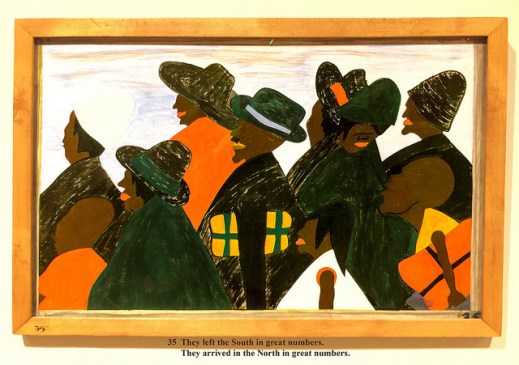
Seventy years later Big Boi, a Georgian, returns to New York with the confidence of both rural and southern sensibilities outside of the immediately recognizable urban trope embodied by New York. Big Boi’s full embrace of being “cullud,” in both the linguistic and cultural elements that Fisher’s long-hand dialect represented as authentic southernness, is jarring because his intentional embrace of southern blackness as othered anchors his approach to rap music. Big Boi does not posture the south as a space or place in need of escape or reposturing. Rather, the hyper-awareness from both Big Boi and Andre in front of the dominantly New York crowd ruptures the accepted narrative of the south as needing saving by non-southern counterparts. Big Boi’s speech forces the audience to de-romanticize their notions of northeastern supremacy and recognize the south as capable of hip hop. Their direct booing is a sonic representation of that discomfort.
From this perspective, André’s now iconic remarks from the acceptance speech further emphasized Big Boi’s departure from reckoning with northeastern hip hop as the standard. He stumbles in his speech, possibly because of nerves or irritation, and, like Big Boi, must talk over the crowd. André speaks about having the “demo tape and don’t nobody wanna hear it,” a double signifier of not only being rejected for his southernness but also the difficulty of breaking into the music industry. André’s frustration with being unheard as a southerner can also be extended into the actual production of the tape by OutKast’s production team Organized Noize, who drew from southern musical influences like funk, blues, and gospel to ground their beats. Andre’s call-to-arms, “the south got something to say,” rallied other southern rappers to self-validate their own music. It is important to note that André’s rally called to the entire south, not just Atlanta. This is significant in thinking about southern experiences as non-monolithic, the aural-cultural possibilities of multiple Souths and their various intersections using hip hop aesthetics.

OutKast moves past their rejection at the Source Awards via their second album ATLiens (Atlanta aliens), which offered an equal rejection of hip hop culture’s binaries. The album’s use of ‘otherworldly’ sonic signifiers i.e. synthesizers and pockets of silence that sounded like space travel – embodied their deliberate isolation from mainstream hip hop culture. Still, OutKast didn’t forget their rejection, sampling their acceptance speech in the final track from their third album Aquemini titled “Chonkyfire.” The brazen and hazy riffs of an electric guitar guide the song, with the recording from the source appearing at the end of the track. There is a deliberate slowing down of the track, with both the accompaniment and the recording becoming increasingly muddled. After André’s declaration “the south got something to say,” the track begins to crawl to its end, a sonic signifier of not only the end of the album but also the end of OutKast’s concern with bi-coastal hip hop expectations. Sampling their denial at the Source Awards was a full-circle moment for their music and identities. It was a reminder that the South was a legitimate hip hop cultural space.
In this contemporary moment, there is less focus and interest in establishing regional identities in hip hop. The dominance of social media collapses a specific need to carve up hip hop spaces per physical parameters. Sonically, there is an intriguing phenomenon occurring where rappers from across the country are borrowing from southern hip hop aesthetics, whether it be the drawl, bass kicks, or lyrical performance. Although our focus on social media has seemingly collapsed the physical need to differentiate region and identity, geographical aesthethics remain central to our listening practices. With this in mind, OutKast’s initial rejection from then mainstream hip hop in favor of sonic and cultural reckonings of southern blackness keep them central to conversations about how the Hip Hop South continues to ebb and weave within and outside the parameters of hip hop culture. Their rejection of hip hop’s stage solidified their place on it.
—
Featured Image “Big Boi I” by Flickr user Matt Perich (CC BY 2.0)
—
Regina N. Bradley, Ph.D is an instructor of English and Interdisciplinary Studies at Kennesaw State University. She earned her Ph.D in African American Literature at Florida State University in 2013. Regina writes about post-Civil Rights African American literature, the contemporary U.S. South, pop culture, race and sound, and Hip Hop. Her current book project explores how critical hip hop (culture) sensibilities can be used to navigate race and identity politics in this supposedly postracial moment of American history. Also known as Red Clay Scholar, a nod to her Georgia upbringing, Regina maintains a blog and personal website and can also be reached on Twitter at @redclayscholar.
—

REWIND! . . .If you liked this post, you may also dig:
Caterpillars and Concrete Roses in a Mad City: Kendrick Lamar’s “Mortal Man” Interview with Tupac Shakur—Regina Bradley
I Been On: BaddieBey and Beyoncé’s Sonic Masculinity — Regina Bradley
The (Magic) Upper Room: Sonic Pleasure Politics in Southern Hip Hop—Regina Bradley
—
Share this:

Me & My Rhythm Box

DOI: https://doi.org/10.59350/dmr4q-e4604
I’m fortunate to have quite a few friends with eclectic musical tastes, who continually expose me some of the best, albeit often obscure, sources for inspiration. They arrive as random selections sent with a simple “you’d appreciate this” note attached. Good friends that they are, they rarely miss the mark. Most intriguing is when a cluster of things from different people carry a similar theme, converging to a need on my part for some sort of musical action.
The Inspiration
A few years back I received a huge dump of gigabytes of audio and video. Within it were some concert footage and performances this friend and I had been discussing; I consumed those quickly in an effort to keep that conversation going. Tucked amidst that dump however, was a copy of the movie Liquid Sky. I asked the friend about it because the description of the plot–“heroin-pushing aliens invade 80’s New York”–led me to believe it wasn’t really my thing (not a big fan of needles). Although my friend insisted I’d enjoy it, it took me several months if not a whole year before I finally pressed play.
Even though Liquid Sky was not my favorite movie by any measure, it was immediately apparent to my ears why my friend insisted I check it out. The film’s score was performed completely on a Fairlight CMI, capturing the synthesized undercurrent of the early 80’s New York music scene, more popularly seen in the cult classic Downtown 81, starring Jean Michel Basquiat. While the performances in that movie are perhaps closer to my tastes, none of them compare to one scene from Liquid Sky that I fell in love with, instantly:
The song grabbed me so much, I quickly churned out a cover version.
While felt good to make, there remained something less than satisfying about it. The cover had captured my sound, but at a moment of transition. More specifically, the means by which I was trying to achieve my sound at the time had shifted from a DAW-in-the-box aesthetic to a live performance feel, one that I had already begun writing about here on Sounding Out! in 2013. Interestingly, the inspiration to cover the song pushed me back to my in-the-box comfort zone.
It was good, but I knew I could do more.
As I said, these inspirations tend to group around a theme. Prior to receiving the Liquid Sky dump, I had received an email out of the blue from Hank Shocklee, producer and member of the Bomb Squad. I’ve been a longtime fan, and we had the opportunity to meet a few years prior. Since then he’s played a bit of a mentoring role for me. In the email he asked if I wanted to join an experimental electronic jazz project he was pulling together as the drummer.
I was taken aback. Hank Shocklee asking me to be his drummer. Honestly, I was shook.
Not that I didn’t know why he might think to ask me, but immediately I started to question whether I was good enough. Rather than dwell on those feelings, though, I started stepping up my game. While the project itself never came to fruition, Shocklee’s email led me to building my drmcrshr set of digital instruments.

A year or so later, I ran into Shocklee again when he was in Philadelphia for King Britt’s Afrofuturism event with mutual friend artist HPrizm. By this time I had already recorded the “Me and My Rhythm Box” cover. Serendipitously, HPrizm ended up dropping a sample from it in the midst of his set that night. A month or so later, HPrizm and I met up in the studio with longtime collaborator Takuma Kanaiwa to record a live set on which I played my drmcrshr instruments.
Not too long after, I received an email from NYC-based electronic musician Elucid, saying he was digging for samples on this awesome soundtrack. . .Liquid Sky.
The final convergence point had been hanging over my head for a while. Having finished the first part of my “Toward a Practical Language series on Live Performance” series, I knew I wanted the next part to focus on electronic instruments, but wasn’t yet sure how to approach it. I had an inkling about a practicum on the actual design and development of an electronic instrument, but I didn’t yet have a project in mind.
As all of these things, people, and sounds came together–Liquid Sky, Shocklee, HPrizm, Elucid–it became clear that I needed to build a rhythm box.
The History
What stands out in Paula Sheppard’s performance from Liquid Sky is the visual itself. She stands in the warehouse performance space surrounded by 80’s scenesters posing with one hand in the air, mic in the other while strapped to her side is her rhythm box, the Roland CR-78, wires dangling from it to connect to the venue’s sound system. She hits play to start the beat launching into the ode for the rhythm machine.
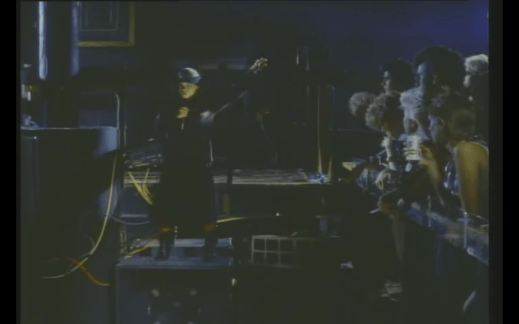
Contextually, it’s far more performance art than music performance. There isn’t much evidence from the clip that the CR-78 is any more than a prop, as the synthesizer lines indicate the use of a backing track. The commentary in the lyrics however, hone in on an intent to present the rhythm box as the perfect musical companion, reminiscent of comments Raymond Scott often made about his desire to make a machine to replace musicians.
My rhythm box is sweet
Never forgets a beat
It does its rule
Do you want to know why?
It is pre-programmed
Rhythm machines such as the CR-78 were originally designed as accompaniment machines, specifically for organ players. They came pre-programmed with a number of traditional rhythm patterns–the standards being rock, swing, waltz and samba–though the CR-78 had many more variations. Such machines were not designed to be instruments themselves, rather musicians would play other instruments to them.

In 1978 when the CR-78 was introduced, rhythm machines were becoming quite sophisticated. The CR-78 included automatic fills that could be set to play at set intervals, providing natural breaks for songs. As with a few other machines, selecting multiple rhythms could combine patterns into new rhythms. The CR-78 also had mute buttons and a small mixer, which allowed slight customization of patterns, but what truly set the CR-78 apart was the fact that users could program their own patterns and even save them.

By the time it appeared in Liquid Sky, the CR-78 had already been succeeded by other CR lines culminating in the CR-8000. Roland also had the TR series including the TR-808 and the TR-909, which was released in 1982, the same year Liquid Sky premiered.
In 1980 however, Roger Linn’s LM-1 premiered. What distinguished the LM-1 from other drum machines was that it used drum samples–rather than analog sounds–giving it more “real” sounding drum rhythms (for the time). The LM-1 and its predecessor, the Linn Drum both had individual drum triggers for its sounds that could be programmed into user sequences or played live. These features in particular marked the shift from rhythm machines to drum machines.
In the post-MIDI decades since, we’ve come to think less and less about rhythm machines. With the rise of in-the-box virtual instruments, the idea of drum programming limitations (such as those found on most rhythm machines) seems absurd or arcane to modern tastes. People love the sounds of these older machines, evidenced by the tons of analog drum samples and virtual and hardware clones/remakes on the market, but they want the level of control modern technologies have grown them accustomed to.
The general assumption is that rhythm machines aren’t traditionally playable, and considering how outdated their rhythms tend to seem, lacking in the modern sensibility. My challenge thus, became clearer: I sought out to build a rhythm machine that would challenge this notion, while retaining the spirit of the traditional rhythm box.
Challenges and Limitations
At the outset, I wanted to base my rhythm machine on analog circuitry. I had previously built a number of digital drum machines–both sample and synthesis-based–for my Heads collection. Working in the analog arena allowed me to approach the design of my instrument in a way that respected the limitations my rhythm machine predecessors worked with and around.
By this time I had spent a couple of years mentoring with Jeff Blenkinsopp at The Analog Lab in New York, a place devoted to helping people from all over the world gain “further understanding the inner workings of their musical equipment.” I had already designed a rather complex analog signal processor, so I felt comfortable in the format. However, I hadn’t truly honed my skills around instrument design. In many ways, I wanted this project to be the testing ground for my own ability to create instruments, but prior experience taught me that going into such a complex project without the proper skills would be self defeating. Even more, my true goal was centered more around functionality rather than details like circuit board designs for individual sounds.
To avoid those rabbit holes–at least temporarily, I’ve since gone full circuit design on my analog sound projects–I chose to use DIY designs from the modular synth community as the basis for my rhythm box. That said, I limited myself to designs that featured analog sound sources, and only allowed myself to use designs that were available as PCB only. I would source all my own parts, solder all of my boards and configure them into the rhythm machine of my dreams.
Features
The wonderful thing about the modular synth community is that there is a lot of stuff out there. The difficult thing about the modular synth community is that there’s a lot of stuff out there. If you’ve got enough rack space, you can pretty much put together a modular that will perform whatever functionality you want. How modules patch together fundamentally defines your instrument, making module selection the most essential process. I was aiming to build a more semi-modular configuration, forgoing the patch cables, but that didn’t make my selection any easier. I wanted to have three sound sources (nominally: kick, snare and hi-hat), a sequencer and some sort of filter, which would all flow into a simple monophonic mixer design of my own.
For the sounds I chose a simple kick module from Barton, and the Jupiter Storm unit from Hex Inverter. The sound of the kick module was rooted enough in the classic analog sound while offering enough modulation points to make it mutable. The triple square wave design of the Jupiter Storm really excited me as It had the range to pull off hi-hat and snare sounds in addition to other percussive and drone sounds, plus it featured two outputs giving me all three of my voices on in two pcb sets.
Filters are often considered the heart of a modular set up, as they way they shape the sound tends to define its character. In choosing one for my rhythm machine the main thing I wanted was control over multiple frequency bands. Because there would be three different sound sources I needed to be able to tailor the filter for a wide spectrum of sounds. As such I chose the AM2140 Resonant Filter.
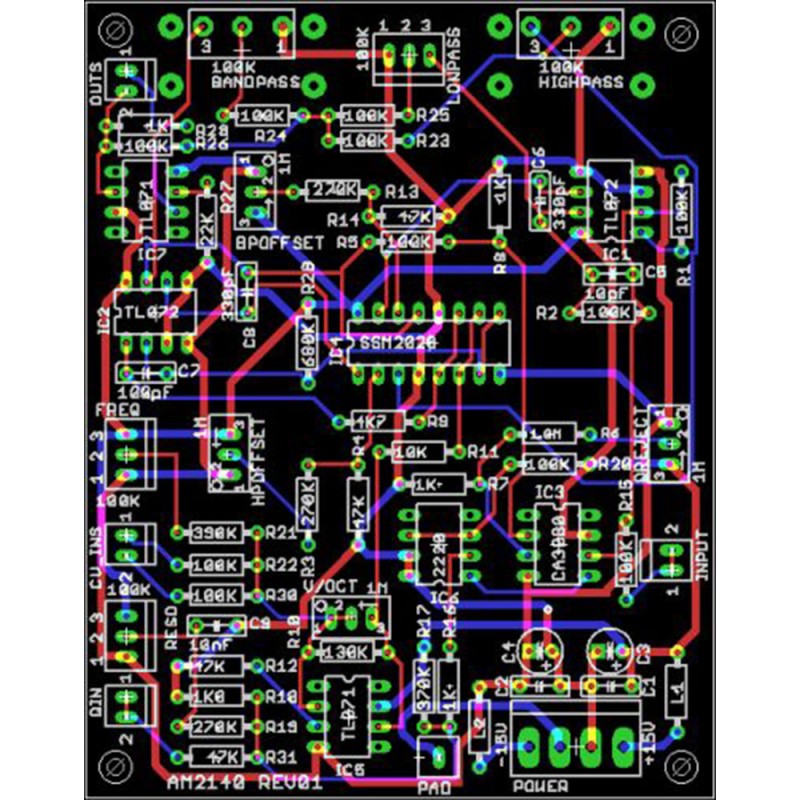
I had no plans to include triggers for the sounds on my rhythm machine so the sequencer was going to be the heart of the performance as it would be responsible for any and all triggering of sounds. Needing to control three sounds simultaneously without any stored memory was quite a tall order, but fortunately I found the perfect solution in the amazing Turing Machine modules. With its expansion board the Turing machine can put out four different patterns based on it’s main pattern creator which can create fully random patterns or patterns that mutate as they progress.
The Results
I spent a couple of weeks after getting all the pcb’s parts and hardware together, wiring and rewiring connections until I got comfortable with how all of these parts were interacting with each other. I was fortunate to happen upon a vintage White Instruments box, which formally housed an attenuation meter, that was perfect for my machine. After testing with cardboard I laid out my own faceplates, which and put everything in the box. As soon as I plugged it in and started playing, I knew I had succeeded.
I call it the RIDM Box (Rhythmically Intelligent Drum Machine Box). I’ve been playing it now for over two years, to the point where today I would say it is my primary instrument. Almost immediately afterward I built a companion piece called the Snare Bender which works both as a standalone and as a controller for the RIDM Box. That one I did from scratch hand wired with no layouts.

While this is by no means a standard approach to modern electronic instrument design (if a standard approach even exists), what I learned through the process is really the value of looking back. With so much of modern technology being future forward in its approach, the assumption is that we’re at better starting positions for innovation than our predecessors. While we have so many more resources at our disposal, I think the limitations of the past were often more conductive to truly innovative approaches. By exploring those limitations with modern eyes a doorway opened up for me, the result of which is an instrument like no other, past or present.
I will probably continue playing the two of these instruments together for a while, but ultimately I’m leaning toward a new original design which takes the learnings from these projects and fully flushes out the performing instrument aspect of analog design. In the meantime, my process would not be complete if I did not return to the original inspiration. So I’ll leave you with the RIDM Box version of “Me & My Rhythm Box”—available on my library sessions release for the instrument.
—
Primus Luta is a husband and father of three. He is a writer and an artist exploring the intersection of technology and art, and their philosophical implications.
—
REWIND!…If you liked this post, you may also dig:
Heads: Reblurring The Lines–Primus Luta
Into the Woods: A Brief History of Wood Paneling on Synthesizers*–Tara Rodgers
Afrofuturism, Public Enemy, and Fear of a Black Planet at 25—andré carrington
—
Share this:




Current Top Posts





April 2021

January 2020

November 2019

October 2019

August 2019

April 2014

November 2017

March 2015

December 2017

October 2015


Recent Comments