
Sounding Out! Podcast Episode #1: “Peter DiCola at River Read Books”

DOI: https://doi.org/10.59350/ccj37-gbd28
As multimedia editor of Sounding Out!, it’s my pleasure to introduce our new podcast series. Starting today, Sounding Out! will challenge and enhance our critique of sound in culture by turning to the production of sound as culture with the first of many occasional podcasts, free and ready to download at your convenience. Itunes users can access our stream here: http://bingweb.binghamton.edu/~apape/subscribeSO.html. For listeners with other podcatchers please use http://feeds.feedburner.com/SoundingOutPodcast.
From the crackle, pop and hiss of a record to the scuffle over Arizona noise ordinances, Sounding Out! remains committed to scratching the surface of your everyday with practices, insights, and theories concerning sound and culture. For your listening pleasure, we will provide extended multimedia for our posts, cultural commentary, serendipitous soundscapes, startling sound art, and mobile mixes as we quest for listeners at all corners of the ‘tubes. These podcasts will show not tell, playing back like a new album at a midnight party. Let us celebrate the archeology of sound, as we follow an episodic guide excavating relics of the unseen. If you’ve got an idea for a future podcast or would like to submit work, please drop me a line at aht@soundstudiesblog.com.
In today’s podcast, SO! guest blogger, law professor, and co-author of Creative License: The Law and Culture of Digital Sampling, Peter DiCola mashes creativity, intellectual property, race and music into a lecture you can’t afford to miss. DiCola addresses the legalities of sampling under the current expansive definitions of copyright and discusses how lawsuits brought an end to the “Golden Age of Sampling” in the early 1990s. Arguing that the current music industry practices constrain musical creativity, DiCola suggests reforms that would make clearing samples much more streamlined. With an introduction and Q and A by SO! Editor-in-Chief Jennifer Stoever SO! regular contributors Andreas Pape and Osvaldo Oyola and economics professor Daniel Henderson. Listen in, and leave some feedback!
Thanks to River Read Books for hosting this event, and to William Huston for the recording.
SoundingOutPodcast1-PeterDiCola-CreativeLicense
—
Aaron Trammell
—
Share this:

Head Games?: The Strategic View of Liveness and Performance
DOI: https://doi.org/10.59350/zc0jb-kgr76
When I tell people that I am an economist and a musician, they usually have one of two reactions. Either they tell me that I must be crazy, or conflicted—that the two things can’t possibly go together—or they immediately start talking about ticket prices, drops in CD sales, 360 deals. I however, refuse both stances. The connection that I see between what I study as an economist and how I perform as a musician is the element of strategy.
Performance, in my view, is the willful construction of a series of events to create a particular mental state for the witnesses. This is the strategic view of performance. I am a game theorist, and game theory is the foundation of the strategic view. Game theory is based on the idea that games are a metaphor for human interaction generally. It is essentially the study of strategy: the chess player imagines different actions he can take, and imagines how his opponent will respond in each case, and uses those forecasts to make his original choice; that’s strategic thinking. In “Singing to my Imagined Listener,” I describe rehearsal as playing to an imagined audience member, judging her response, and adjusting accordingly. That is exactly the strategic view.
I got the opportunity to explore this synergy between live musical performance and economics in an intimate and visceral way a couple of weeks ago—February 9th, 2011, to be exact—when I was asked to speak to a small group of students at Binghamton University who study live performance in an English course called “Representation and Popular Music” taught by Jennifer Stoever. I thought I would reproduce some of that talk here, via video clips, in order to breathe elements of aurality and liveness into the words that follow, which meditate on strategic differences between liveness and recording in the game that we call music.
But first, a song.
In this clip, I play the guitar and harmonica and sing a song of mine called “Sittin’ on the Mailtrain.” I strategically start off with a song that has a jarring chord in each line: my intent is to make the audience feel a bit uncomfortable with this shared live experience, so that they are more inclined to look at it with fresh eyes. At minute 7:45, I point out that I am giving a live performance to those in the room, and recording to those in the future. That’s you. As I say at minute 8:07: “There’s an audience here, in the room, and there is an audience out there in the future, who are experiencing this, but clearly in a different way than you are experiencing it.”
And, I think that you are. Even now. However self-aware and live-esque, this recorded object cannot reproduce the physicalness and immediacy of performance.
Performance is standing in front of people, feeling nervous or confident, holding a guitar, forming words, reading faces, projecting to the back of the room or getting quiet. Performance is hitting taut strings pulled across a wooden box at specific times and with a certain speed, vibrating vocal chords in a certain way, holding ones hands out to make a point, or inhaling a wail out of a blues harp. It is a series of events that are a part of a human life, in the sense that life is a series of physical moments. Agency in that visceral present moment is the essential difference between live performance and recording. Like Kathleen Hanna (frontwoman of Bikini Kill, Julie Ruin, and Le Tigre) wrote in “On Not Playing Dead” in 1999, “[O]ne thing I do as a performer is to stay physically present on stage, and that means being in the now. (Oh my god, I sound like such a hippie.)”
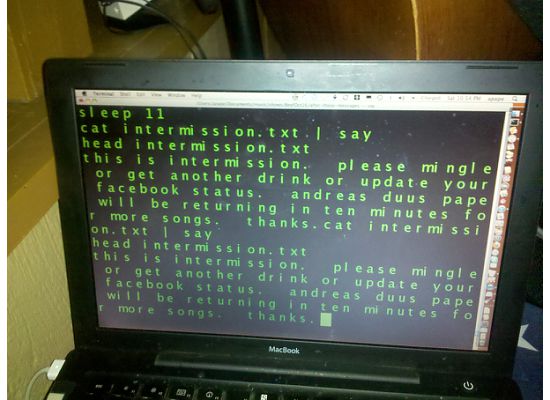
Halfway through my talk, however, my computer interjects with a pre-programmed dialogue that complicates Hanna’s claims. Watch here:
“Excuse me, I’d like to make a point,” my computer says aloud, for all to hear. “I felt it was important to point out that this is not exactly a live event. This is a recording, in some way.”
“Sure,” I reply, according to script.
“You typed this in to simulate this conversation that you’re having right now.”
“Yes,” I reply, “it’s scripted. Did anyone not know this was scripted?” I look questioningly at the students assembled in front of me.
“But this [lecture],” my computer points out, “is basically a recording. It’s an encoding of a particular process. So [the] physical body and mind [of the performer] decodes this script into a process, just like the CD player decodes the CD into a process! So how is this performance not a recording?”
“A recording encodes a performance, and a performance decodes a recording,” I say.
There is a strong way that any “live” performance has a recorded aspect to it and vice versa. The decoding of a CD is a performance, akin to my live performance. My computer worked from a script in the computer science sense—a set of essentially English-language commands that it followed to reconstruct a set of sounds. That is not a traditional recording, in that it is not direct storage of sound waves in magnetic tape or record grooves. However, it is functionally a recording: the user presses a button and a predictable and pre-specified series of sounds emerge.
If we agree that this computer script is a recording in this sense, then we are compelled to accept the next step—that if I, a human, am following a script, that I, too, am simply decoding a recording. That is, I had an idea about how “Sittin’ on the Mailtrain” would go and this idea was necessarily encoded in my mind; then I unpacked this encoding by arranging physical objects, namely my fingers and my voice, to create a song. The song followed an encoding in my head, like when you put a CD in a CD player. The encoding is unpacked, and ultimately results in the same thing: some vibrating object that vibrates the air which then vibrates the audience’s ears in a relentlessly physical way.
The future of performance lies in acknowledging the interrelationship of liveness and recording and further blurring the boundaries between them. The podcasts produced by the lo-fi movement are a key part of this new relationship. I am part of this artistic movement, which asserts the primacy of performance over recordings while also using recording technology to foster and promote liveness. Lo-fi’s hallmarks are: smaller numbers of performers in groups (often solo acts), an emphasis on live recordings complete with audience noise, low production quality (“Background hiss”), and a large number of recordings that often include many versions of the same song. The primacy of performance means the definitive versions of lo-fi songs are not located in recordings that live performances then try (and often fail) to recreate. Rather, the most recently performed version is the “master.” The performance you just watched of the song “Sittin’ on the Mailtrain” for example, was the most definitive version on February 9th. Today just may bring a new definitive version.
In the aesthetics of the lo-fi movement, the life of the performer is treated not as a series of objects, but rather a series of events, which can be attended or subscribed to, like a podcast. No doubt, each episode is recorded, and the audience receives it as a recording. However, these recordings are meant to be listened to once or twice and let go; they are intended to be ephemeral. A podcast, when viewed as a process over time rather than a possession, is no doubt a performance; the audience can respond from one episode to the next via comments, email, Twitter, etc. and the performer can react. What you are reading and viewing here is simultaneously a lo-fi recording event and a lo-fi performance. This. This blogpost, you reading it, the videos you can watch and listen to, my comments on it here, your comments below that you can post, you sharing it on Facebook or Twitter. You can even follow the traces of this performance through my own Twitter feed.
Strategically, I think the podcast model is the next logical step in the Lo-fi aesthetic. Standup comedy (one of my favorite kinds of live performance) is making this transition as we speak. The old model for the young comedian was to develop “an act” that one (hopefully) toured with, perhaps releasing a comedy CD or landing a role on a sitcom. The new model is a couple of comics releasing a conversational podcast once a week, responding to their biggest fans, giving a raw, intimate, unpolished performance of improvisational humor and riffing, and convincing their fans to become members; a membership that occasionally awards the listener with additional content, but more often only a sense of satisfaction that one gets from supporting something one loves. See, for example, the podcast “empire” of Jesse Thorn at maximumfun.org which includes live comedy podcasts, or the political humor of wearecitizenradio.com, which is also member-supported. What’s interesting, here, is that a pure donation podcast model is enough for some comics to make a living. Ironically, using recording to give primacy to performance, serves the artist. Yesterday’s recording can be taken away from the artist, but tomorrow’s performance cannot.
As for my own future? My own “tomorrow’s performance”? On February 25, 2011, at the Eastern Economics Association Meetings, I will perform a similar event, called this time “Rhetoric, Choice Theory, and Performance.” I will perform music and discuss the strategic view. Economists are not used to thinking seriously about performance nor are they used to thinking seriously about sound. I intend to change that, one strategic moment at a time.
Additional footage in which I define strategy and game theory, and discuss what the strategic view of performance has to say about my references to Dylan and Guthrie:
Andreas Duus Pape
—
Share this:




Current Top Posts





April 2021

January 2020

November 2019

October 2019

August 2019

April 2014

November 2017

March 2015

December 2017

October 2015


Recent Comments