
Lokananta: Sounds of Crisis and Recovery from Indonesia’s National Record Company

DOI: https://doi.org/10.59350/9vkr2-1p088
Entering from the front, Lokananta seems quiet. An art-deco façade gives way to a sleepy courtyard with a central fountain—the sound of splashing water mixes with stately gamelan music from a wall-mounted speaker—but there are signs of activity here in Indonesia’s oldest record company. Head right into the duplication room and you hear the hiss-snap of an old tape-splicing machine at work, plus occasional bursts of guitar as a worker in a blue collared shirt tests out punk cassettes. Across the low campus of pastel yellow buildings, an engineer in the company’s cavernous studio listens back to an upbeat shuffle from a recent session.
These sounds take on a special significance at Lokananta, because it is the nation’s state-owned record company—the “Sound of Indonesia”—which after a brush with bankruptcy in the early 2000s, is now making a tentative comeback driven largely by renewed interest in analog music technology. It makes for an interesting scene: tattooed indie rockers and young tape sellers partnering with a company that for decades was part of the authoritarian government’s Department of Information. Crisis and transition have a way of forging unusual partnerships, and Lokananta’s current business configuration is a product of economic crisis.
I learned of Lokananta’s winding path to recovery while doing ethnographic fieldwork in May 2015, when I visited the company, interviewed many of its employees, and met with some of the young musicians and entrepreneurs that are helping to keep it afloat. They helped me piece together this story of Lokananta’s long history and uncertain future, a story that reflects many of the larger social changes unfolding across Indonesia during the company’s sixty years of operation. From the ‘golden years’ to the ‘vacuum,’ crisis to recovery, I found that Lokananta continues to fulfill its mission of disseminating the sounds of the nation, but those sounds are different than before. More specifically, I argue that the fiscal crisis forced Lokananta to open itself to the new sounds and scenes that have emerged in contemporary Indonesia.
An Instrument that Plays Itself
Lokananta takes its name from a mythical gamelan ensemble that according to legend sounded without being struck (perhaps an echo of the long-running association between recorded sound and the supernatural?). When established in the city of Surakarta in 1956, Lokananta’s mandate from the Sukarno government was to establish a national culture through sound, and at the same time mitigate the influence of the international music then dominating the airwaves. In Lokananta’s early years, this meant manufacturing vinyl discs of recordings made throughout the archipelago, and then distributing those records back to the country’s radio stations for broadcasting. Soon enough listeners began asking to buy records themselves, and in 1959 the state-owned company began selling to the general public. Besides recordings of regional songs, or lagu daerah, much of the music bearing Lokananta’s seal was in the classical gamelan tradition of central Java and a style of sentimental song known as kroncong.




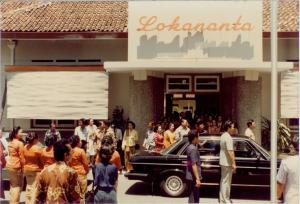
The company’s output during those golden years—basically the 60s-80s—is well documented in a discography compiled by ethnomusicologist Philip Yampolsky; I’m more interested in what has happened since then. By the 1990s, recorded music was neither mysterious nor scarce. Anyone with a tape deck could copy a cassette and pirated music was ubiquitous. Studios were downsizing and going digital, and Lokananta, with its large facility and staff, was struggling to remain viable even with government support. Then came the Asian Financial Crisis and the fall of the ‘New Order’ regime in 1998.
The Department of Information was liquidated during the political transition, meaning Lokananta lost all government funding. Most of the technical staff were shifted to the national radio broadcaster, RRI, while Lokananta shrank to a skeleton crew and for several years stopped almost all production. Employees who were there refer to this time as the “vacuum.” The piano was sold, microphones disappeared, and for a time the record storage shed was rented out for indoor soccer. Lokananta went silent.
With the loss of public support and the traditional music market in decline, Indonesia’s oldest record company needed new sources of revenue. Increasingly, that revenue has come from recording and duplicating albums by indie and underground artists, scenes that have actually blossomed in the aftermath of the repressive New Order regime.
Lokananta Riot
Just days before I arrived at Lokananta, a Balinese Rockabilly band called The Hydrant wrapped up a session there for their new album. The band’s very presence at the studio says a lot about Lokananta’s changing image in the Indonesian music world. When I later met with Adi, The Hydrant’s bass player, he told me that until this year he’d never heard of Lokananta. Even as a lover of vintage recordings, he had no idea that his country boasted an old wood-paneled studio that is reportedly modeled on the famous Abbey Road in London. When he heard about that room from a friend in Jogjakarta, Adi and his band realized it was the perfect place to record an album ‘live in the studio’ just like their idols from the 50s and 60s (some of those idols were even released on the Lokananta label). According to Adi, the studio manager at Lokananta told him that The Hydrant was the first “riot and roll band” to record there, so the album became “Lokananta Riot.”
This trend of young bands recording live at Lokananta got its start in 2012, when Indonesian R&B singer Glenn Fredly and the indie pop group White Shoes and the Couples Company both completed projects there. For these artists, recording in the company’s vintage studio served to emphasize their connection with Indonesia’s national music history, and also to draw attention to Lokananta’s important role in that history. In fact, the album that White Shoes recorded, Menyanyikan Lagu2 Daerah, was entirely based on the style of regional folk songs (lagu daerah) that Lokananta distributed in its early years.
But the big name acts that are drawn to Lokananta’s studio don’t necessarily manufacture their albums there, even though Lokananta was originally and primarily a record factory, not a studio. The 7” vinyl records of Menyanyikan Lagu2 Daerah, for example, had to be pressed overseas because Lokananta’s record fabricating machines—the country’s first—were sold for scrap metal in the 1980s. Cassette production, however, has not stopped, even if it is down from the days when the company could pump out tens of thousands of tapes a month. In those days, neighborhood kids would fly kites with the discarded magnetic tape. And like the recording end of business, Lokananta’s duplication services are now reaching a whole new clientele.
Rather than churn out playful kroncong tapes, today Lokananta acts as more of a boutique producer, specializing in small runs of indie releases by bands with names like Deluded, Homicide, and Working Class Symphony. These bands are not drawn to Lokananta so much by its history and legacy, but for very practical reasons that again can be traced back to the company’s near collapse in the early 2000s.
Many of the new cassettes produced at Lokananta pass through the hands of two local entrepreneurs: Rochmad Indrianto and Tamtomo Widhiandono. Indtrianto, who goes by Anto, is only 25. Over the whir of tape duplicators, he explained to me that unless you want them copied one by one on a home tape deck, Lokanata is the only place to do a short run of cassettes—as few as 20-50 copies. The quality is good, and because Lokananta is right there in Surakarta, the turnaround is fast and the prices low. When Anto and Tamtomo started working with Lokananta in 2014, the company’s only output was re-releases of old recordings. The two young entrepreneurs, and the cassette revival they were part of, could not have come at a better time. That year they placed several duplication orders for their label and online store Alpha Omega Merchandise, and also helped to organize a Record Store Day event at Lokananta with vendors, speakers, and live performances in the studio:

Once word got around the local scene, more tape orders started coming in. Lokananta was not easy to work with directly—it had no online order form or Instagram account—so Anto and Tamtomo became the middlemen. They told me that this year they are handling at least eight to ten orders a month. Thanks to that business, for the first time ever Lokananta now generates more than half of its revenue from tape duplication services. This turn of events feels appropriate in a way: the very independent music scene that both contributed to and benefited from the end of the New Order regime is now helping to prop up an institution left stranded by that government’s collapse.

The Sound of Indonesia
Many people and projects have claimed to capture the sound of a nation. No doubt Lokananta comes up as short as the rest. Yet, I’m struck by the way this one state-owned recording company and its meandering story do reflect so much of the tumult of Indonesia’s last sixty years. Lokananta has always been what the moment called for: a pressing plant for regional folk records, a studio for mass-produced gamelan recordings, an archive, and an indie cassette workshop. In each adaptation you can hear the political, cultural, and technological changes at work. You can sense the shifts in government censorship, which limited the import and reproduction of foreign sounds, and the sounds of critique and dissent that followed. You can see the shift from vinyl—which most Indonesians could only access via radio broadcasts—to the cassette, the medium that finally made recorded music readily available to the general public. And since Lokananta’s crisis at the turn of the millennium, you can hear the sounds of an industry in transition: a growing and uncensored independent music scene, and a renewed search for a national identity in the sounds and technologies of the past.
The ‘Sound of Indonesia’ that Lokananta offers in its current output must be understood as part of the institution’s response to crisis—brought on by both a changing music market and the sudden loss of government support. In this state, Lokananta’s sound cannot be curated by producers or culture ministers; it is dictated by necessity, and in that struggle to survive the company has had to open itself up in new ways. Looking through old photos in Lokananta’s archive, I saw a lot of official state pageantry and choreographed presentations—administrators in suits and workers with ID badges. Right now, however, Lokananta is a place where someone can walk in off the street with a home-recorded cassette and get it duplicated, where an up-and-coming band can book a recording session, where an avant-garde composer can put on a noise concert, or where a few motivated entrepreneurs can find a willing partner. It is a place of nostalgia but also experimentation and DIY networking—all of which are now publicly visible on the company’s facebook page.

Lokananta’s new director has plans to convert the main building into a museum and is already applying for national cultural heritage status. There is also talk of restoring and updating the studio equipment—no word on any new vinyl pressing machines. But whatever it becomes in the future, the present is clearly a special moment in Lokananta’s history. And while many of the company’s employees may consider this to be a rough patch in that history, when I see the words “The Sound of Indonesia” emblazoned on their uniforms, I can’t help but think that they are living up to that motto in ways that their predecessors in the New Order period would have never imagined. They are producing records and finding community partners that previously might have never made it through the company’s pastel-yellow entryway. The political transition, fiscal crisis, and recovery forced that change, and luckily for Lokananta, Indonesia’s burgeoning independent music scene has embraced it.
—
Ian Coss is a graduate student in Ethnomusicology at Boston University, where his work is focused on the uses of radio and recording technologies. Ian has released several albums of original music that draw on everything from gamelan to dub, and continues to perform around New England. He has also worked as a freelance radio producer for Afropop Worldwide and The World. Follow all his projects at iancoss.com.
—
All images are used with permission by the author.
—

REWIND! . . .If you liked this post, you may also dig:
That Infernal Racket: Sound, Anxiety, and the IBM Computer in AMC’s Mad Men — Andrew Salvati
Brasil Ao Vivo!: The Sonic Pleasures of Liveness in Brazilian Popular Culture — Kariann Goldschmitt
Sounding Out! Podcast Episode #6: Spaces of Listening / The Record Shop — Aaron Trammell
—
Share this:

Twitchy Ears: A Document of Protest Sound at a Distance
DOI: https://doi.org/10.59350/hr4b4-k5684

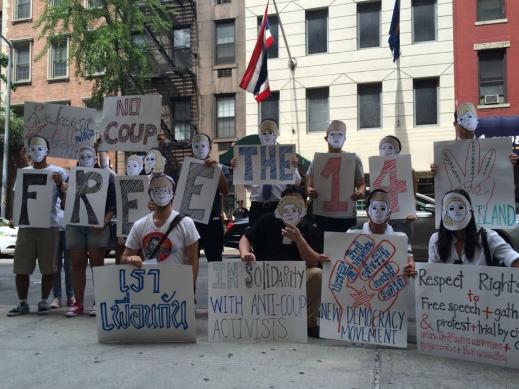
“I compare New York to Bangkok all the time,” a young activist told me, just moments before he joined a small, media-ready protest at the Thai consulate in midtown Manhattan. On a pleasant day this past July, along a quiet side street lined with the gold plaques of consulates general, his comparison felt strained—Thailand is currently governed by a free speech-averse military junta that seized power last year, and mourning a deadly terror attack. In Thailand, the tension and fear are acute; in New York, the local delivery driver was whistling.
The young activist, an ocean removed from Bangkok, sought ways of speaking politically, knowing well that he could and would be heard across that ocean When he returns, if he returns, he may be imprisoned, intimidated, or injured. In front of the consulate in New York, those problems were imperceptible to the uninitiated. But they weighed heavily on all of us. Whenever the group chanted or sang, their voices rose through the low ambience like heavy weights, and stopping they fell away without receiving a response. There was a perverse aural disjuncture between the easy rhythms of the day and the harrowing risk that we knew was present in every utterance.
I had come to participate in the event, to speak against the military junta’s recent arrest of fourteen university students for protesting peacefully. I had also come to make a sound recording, and as usual to consider the odd phenomenon of protests staged to create media artifacts rather than to influence people in the flesh. The purpose of the protest was not to negotiate risk but to invite it. It barely mattered that New York City didn’t hear the protest as it occurred. Where it needed to sound potent, it would. Recorded sound surely renders all protest multi-sited; protest sound is a speech-act spatially and temporally deferred.
However, for protests staged at great physical distance from what’s being protested, the specter of comparison and difference between sites and movements can be profound. New York is in certain ways friendly to protest; the city is liberal with permits, and even unpopular opinions are expressible. Relative to most of Thailand, this is a welcome distinction. Of course, such freedom can blunt the acuity of dissenting speech — protests limited to a specific place and time, accompanied by two polite cops indifferent to the issue at hand, are easy to tune out. The United States has its own instruments of containing dissenting speech.
Anton Strogonoff, CC-BY-2.0
Furthermore, as responses to both Occupy Wall Street and the Black Lives Matter movement have shown, organizational structure and subjectivity make some actions more vulnerable to state violence than others. There are moments when a single word can provoke repression here in no less crude a fashion than the Thai junta prefers. But the game has wholly different rules, and these rules engender different strategic responses. Protesting at a distance is both a way of threading multiple sites together and of reflecting on how protesters in different places and movements choose to speak. In the mind of a young activist accustomed to Thailand’s particular labyrinth of political expression, the contrast with his own country can become a source of ideas.
“When I first came here,” the activist continued with a note of awe in his voice, “Occupy Wall Street just started, so it’s like, there is this obvious difference that really intrigued me in how people organize or react to causes. In Thailand we still kind of are using older ways to organize, kind of like really centralized, some figures pretty much
To develop a political movement in the United States is a different challenge than doing the same in Thailand, to put it mildly. In the United States the left risks triviality; in Thailand, it literally risks death. Thai communists were hunted by soldiers in the jungle in the twentieth century, and left-wing political parties are still forbidden today. Republicanism is treason. And with the ascent of the military junta, many trials are now held in secret, and intimidation of political critics is routine. A movement cannot attempt to run headlong toward whatever it wants to topple; circuitous end-runs are necessary. This explains the increased appeal of decentralized protest tactics to Thai activists. The young man I met was far from the first in his country who has espoused such an approach.
***
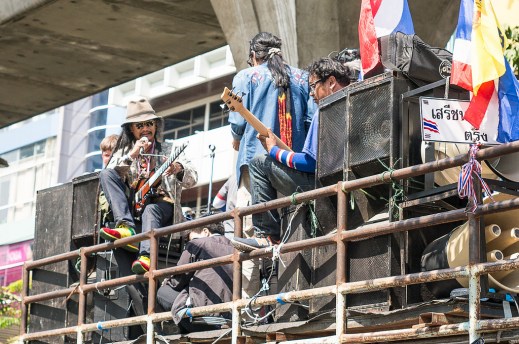
The protest began with one woman playing an acoustic guitar, leading the twenty of us assembled in a folk-style singalong. The sincere, uneven rendition of “Song of the Common Man,” currently popular among anti-junta protesters in Thailand, was followed by nervous laughter, and the honk of a nearby taxi. The lyrics are mild and the structure formulaic, but the song has caught on among the junta’s most outspoken critics – notably, one recording available online was made by a band whose songs are strident enough that they were pursued by the military, and forced to flee to Laos. The song lasted less than two minutes, and an American, who worked for a freedom-of-speech NGO in Southeast Asia, ensured that the group moved on to the next part of the tight half-hour schedule. Every moment was brief but assiduously documented.

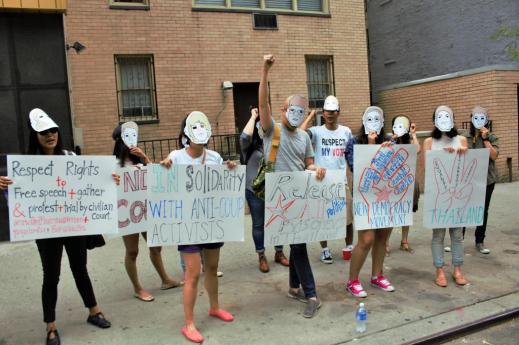
We took selfies wearing masks shaped like the faces of the fourteen students who were set to appear before a military court that day. The Thai consulate employees watched with bemusement, and briefly chatted with us in the low, serious hush filled with polite participles that characterizes formal conversation in Thailand. The event ended, and the quiet side street remained undisturbed.
One moment was particularly chilling. The American was leading the group in a series of “what-do-we-want-when-do-we-want-it” chants, which though adapted to concerns of the anti-junta movement felt pro forma and out of place. That cadence and call-and-response pattern is almost never heard at protests in Thailand, and the protesters were not accustomed to it. When someone suggested chanting in Thai rather than English, the group naturally fell into a different rhythm. The repetition of Prayuth aawk bpai, an insulting demand that coup leader General Prayuth Chan-Ocha go away, was much sharper. The chant hearkened to protests of recent years against illegitimate Thai governments. A recording of it would, without doubt, be very risky once heard by the wrong ears in Thailand. Its potency was not only in its direct semantics, but in the connection it formed between the current protest and protests of the recent past. Protest in an age of ubiquitous media tends to form such links across boundaries of time and space.
But a curious thing happens when protest movements can readily observe one another. Comparisons are made all the time, but so are convergences. Rhetoric and strategy become cosmopolitan, not native to any place, and protests increasingly echo other protests. Contemporary Thai dissidents have been influenced by Argentinian horizontalism, and they swap documentaries about the Arab Spring online, for example. The watertight conditions of a geopolitical place have more leaks than was thought. And as ideas travel, the places themselves can become fertile grounds for the growth of those ideas in practice.
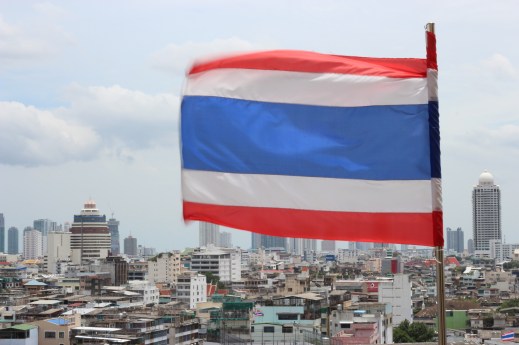
Sound is vital to this process. Perhaps because it is often regarded as the most visceral expression of the body, sound has a special relationship to protest. Sound and self need not be romanticized as coterminous in order to appreciate that speech acts feel very close to the body. But listen again. Sound can both feel immediate and be radically disembodied. It can be a material for experimentation, for feeling out how to speak in the immediate present, and be by the same stroke a final product to be audited by the twitchy ears of the junta. The July protest was and will be both.
—
Benjamin Tausig is assistant professor of ethnomusicology at Stony Brook University, where he works on sound studies, music, and protest in Bangkok and other urban spaces. He is on Twitter @datageneral
—
Featured image: Picture of #FreeThe14 protest in New York City this past July. From Thai Students Center for Democracy(@TSCD_EN) tweet on July 7, 2015.
—

REWIND! . . .If you liked this post, you may also dig:
SO! Amplifies: Cities and Memory-Stuart Fowkes
Toward A Civically Engaged Sound Studies, or ReSounding Binghamton–Jennifer Stoever
—
Share this:




Current Top Posts





April 2021

January 2020

November 2019

October 2019

August 2019

April 2014

November 2017

March 2015

December 2017

October 2015


Recent Comments