
Listening to the Border: “’2487’: Giving Voice in Diaspora” and the Sound Art of Luz María Sánchez

DOI: https://doi.org/10.59350/dabyt-ma826
Statistics of death can startle a reader. As tidy yet powerful numeric representations statistics are often used as tools of persuasion, cited routinely by journalists and politicians alike to strengthen or belittle a political objective. According to professors from Wharton’s School of Business, statistics are also gaining in importance as our society attempts “to make sense of an increasingly large and complex barrage of information.” Many have argued, quite provocatively, of the gendered and racialized nature of statistics as objective, “hard,” facts. In “2487: Giving Voice in Diaspora,” the artist Luz María Sánchez uses sound-based art to trouble a statistic brought on by institutional violence on the U.S./Mexico border.
In 2006 Luz María Sánchez used a lone statistic from 2004 – 2487, the number of bodies found dead throughout the border region of the U.S. and Mexico – to create a sound-based art installation for the San Antonio Artpace (now available as an online exhibit). The museum invited audiences to sit in sparsely furnished rooms with strategically placed speakers in order to experience the exhibition. The online access, however; makes certain the exhibit travels beyond the geographical boundaries of Texas, bellowing from the private devices of laptops. Seemingly simple, the crux of the project involves the artist stating each of the 2487 names. Its complexity, as mentioned below, lies in the actual organization of the names. The voice of Luz María Sánchez within this artistic expression reminds us, as Brandon LaBelle states, that sound “leaves a body and enters others” and is never merely a “private affair.” The use of sound forces spectators to listen closely to a statistic and in doing so, directs attention towards the parts of the sum.
The topic of immigration has become a staple of news network channels. Its somewhat mundane presence has served to lump immigrants together into one sound bite: “them” sapping social services; “them” taking away our jobs; or “them” having those anchor babies. The reporting of immigrants as a block serves to dehumanize and delegitimize intentions of family reunification held by many immigrants. Indirectly, “2487” tackles the verbal “them” head on.
Buried within discussions of immigration policy and arguments for increased border enforcement on the U.S./Mexico border are the statistics of those who have died crossing the treacherous dry desert. A series of shifts in immigration policy and increasingly anti-immigrant public sentiment have produced record setting budgets that intensified efforts to beef up border control. The once urban points of crossing in Tijuana or Juarez are now heavily discouraged; the visual yellow and black warning of a family running an insignia of those times. Many immigrants take greater risks as they walk through the Sonoran desert in southern Arizona, now considered the busiest gateway for immigrants where temperatures easily mount well into the 100s.
Within 2487, it is not merely the statistic that serves to astound, it’s the ingenuous yet powerful act of listening to the full name of each body that can engulf the listener.
José Salomon López
Francisco Torres Santiago
Leticia Torres Solis
Adolfo Sánchez
Enrique Soto Pacheco
Guadalupe Valdez Sandoval
Antonio Sánchez Morales
Juan Antonio Sánchez Reyes
Patricia Trinidad
Narrated by the artist herself, each name is voiced individually with a dignified, strong tenor. The text itself – the names – mark this sound piece as solemn. It’s as if one is listening to an obituary read out loud, a roll call with no response, or – a tradition many Latinos identify with – a rosary in honor of the dead. Despite studies that explain a Latina’s public wail as a sign of pain and grief, this piece in its parallel focus of honoring the dead stands out as the artist’s female voice never quivers, trembles, or abandons its strength. In naming each person, listeners may not necessarily focus on their death – represented numerically in 2487 – but may also find themselves imagining their risk as they hear each name. Under the website’s database tab, lies a detailed chart of each name, the location of their body, presumable age, known origin, and the cause of death. Many of the columns are listed with a tag of “unknown” or left blank except for their names.
It’s a forced, almost-awkward, tension-laden, and heavy listening experience. Sánchez makes certain that any semblance of passive listening is disrupted, disturbed, and therefore nearly impossible since the names voiced do not follow a pattern or rhythm. The eight piece sound compilation offers no sense of monotony since it is played continuously and at random. Pauses are sometimes short, long, pensive, and altogether distressing. Names are voiced either in isolation or in an overlapping manner, said to model the “organic patterns of migration itself”; an audible gesture towards the word “diaspora” itself. Because of the deliberate variation of the names, the listener can make out the names of some yet not detect the names of others.

Even as Sánchez gives voice and dignity to a statistic based on dead bodies, the topic of death certainly is not easy to translate. Regina Marchi’s “Day of the Dead in the USA” argues that the public commemoration of death by Latino communities has slowly begun to transform American Culture’s views of death. According to Marchi, Americans tend to be “removed from death” or lack positive modes of relating to those deceased. A popular case in point is the plethora of euphemisms used to characterized death: moved on, no longer with us, watching over us now, passed away. Día de los Muertos or Day of the Dead (on November 1) has become a multicultural method of publically viewing and even embodying death as different communities construct altars, dress as the dead, and openly pay tribute to those who have died. The use of art galleries, the mass media, and community centers have become public venues for these celebrations since their inception by Chicano artists in 1972.
Despite, or (perhaps more precisely) because, honoring the dead is so frequently a visual custom these sonic remembrances are that much more significant. A politicized eulogy for immigrants who have died while crossing the border merits the weight of listening. The 2487 statistic encompasses two thousand and eighty seven bodies and each, according to Luz María Sánchez, had a name that deserves our listening attention.
—
Dolores Inés Casillas, UCSB
—
Share this:

Becoming a Bad Listener: Labyrinthitis, Vertigo, and “Passing”
DOI: https://doi.org/10.59350/5yxsp-v9f03
For the past three weeks I have been sick with labyrinthitis. It started with a bout of vertigo while picking up some essentials at a local pharmacy and has since recurred in various other locations. In the morning, when I stroll for coffee, it feels like I am walking a tightrope. Shelves after shelves of boxes at a local store have made the world spin. A determined trip to Manhattan (for a friend’s film release) quickly transformed into an incomprehensible blur of light and sound. Because of this lapse in cognition I have found myself listening to the world, and my body, in fascinating (although frustrating) new ways. The most frightening moments of vertigo I experienced have followed moments of both visual and audio overload. When I can no longer understand what I hear, panic is sure to follow. Worst of all, even though negotiating my day-to-day responsibilities has become a trial in patience, to most observers, I seem perfectly fine. I have decided to share these experiences because of how well they inform the ways that sound, specifically the practice of listening, informs the process of “passing” as normal in everyday life.
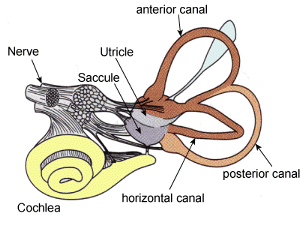
Labyrinthitis is often related to an inner ear infection. When the series of canals within the ear are damaged, a sense of balance is lost. This lack of balance completely skews all visual cues: things look blurry, there is an unsteadiness to things (as if on a boat), bright and flashing lights are extremely distracting . . .imagine being drunk, but with none of the perks. Another symptom of labyrinthitis is an occasional ringing in the ear. For me, this ringing is at its worst when I am trying to focus on a conversation in an environment with lots of ambient noise. For instance, if I try to hold a conversation while walking down the street and several cars pass by, the ringing will begin to overwhelm both the cars and the conversation. It’s like my brain is dialing back the volume of all the sounds around me. As mentioned earlier this is the most terrifying of all the symptoms that I experience – it feels, uncannily, like I am waking from a dream.
One labyrinthitis support site suggested that prolonged coping with the above symptoms in everyday life is, perhaps, the most difficult part of recovery. In an interesting twist they drew on sociologist Erving Goffman’s 1963 work Stigma to support this claim, “An individual carries a stigma if s/he is unable for any reason to fulfil society’s sterotypic criteria for normality – if this deviation is obvious (eg: physical deformity) the person is at once ‘discredited’. Failings that are less obvious or may be concealed (eg: vestibular problems) render the individual ‘discreditable’ in the sense that his/her identity is vulnerable. Whereas a discredited person must adopt a stigmatised identity – a discreditable individual may prefer the effort and risks attached to trying to ‘pass’ as normal to the frank stigma of admitting the attribute.” Has labyrinthitis rendered me discreditable? Although it is tempting to critique the armchair diagnosis above, I believe that it is a valuable basis for theoretical inquiry. What are the risks of acquiring the stigma of vestibular problems? In other words: do I choose to reveal my illness tactically?
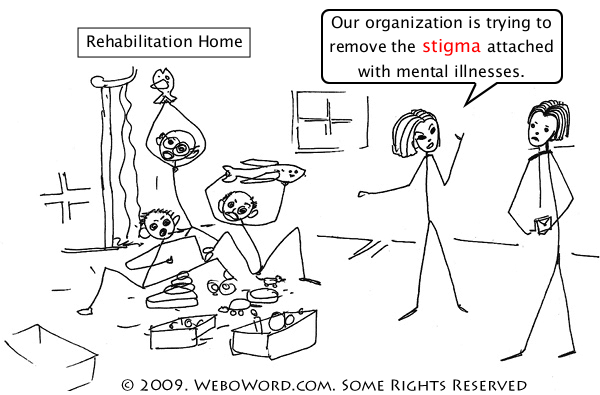
Surely, as this blog post attests, I am not too frightened by the stigma of revealing my illness. It is likely to pass in the next few months and I assume that most of our readers are not particularly judgmental. I am scared, however; when I lose track of conversations. Sometimes even to the point that I choose, as Goffman suggests, to “pass” and keep my lapse of understanding secret. As the ringing in my ear grows: I will often keep quiet, smile, and nod my head. There have been several times in recent memory that I have even forced a chuckle, or a short, daft, answer. Often these replies are deliberately vague, peppered with just enough key words to convince my companion that I was listening. At these times, in my head, I am lost – reeling with confusion. I’m trying to figure out where I am (what street is this, how can I get home quickly?), what has triggered this confusion (is it the noises behind me, or the lights ahead?), and if there is cause to be concerned (is this business as usual, or am I about to faint?). I want, at these moments, to “pass” as normal because I am scared of becoming too much of a burden to those around me. My Achilles’ heel in these situations is contingent on my ability to listen, passing, at least, as a good listener.

The sense of stigma I imagine, as a bad listener, is infinitely worse than the sense of stigma I could accrue as a sick individual. Goffman, in 1963, had been writing in a late Fordist economy. As such, the stigma of illness related more to physical labor than one’s ability to socialize and fit in. In these context of illness could suggest an inability to produce; the diseased body set apart from all others. As immaterial and affective labor become valorized in new ways, stigma comes to relate to the inter-social processes of control that form the new societal knot. Chief among these stigmas, for myself at least, is the inability to listen. Listening cues others in to how well one is able to socialize, participate, and contribute to a tight web of everyday activities. When I cannot listen, yes, I am vulnerable. I am vulnerable, mostly, because I am suddenly and inexplicably alone.
The worst part of becoming a bad listener is recognizing how very little is required in a conversational exchange. As noted earlier, vagaries and key words are, for the most part, sufficient. Is there a final irony here, while my ability to listen to and understand others is diminished has my ability to listen to and understand myself increased? Many have argued that mimesis, or imitation, is, in fact, central to the way people communicate. “The whole of human culture,” according to Anna Gibbs, “then, is, perhaps, predicated on imitation, in which difference and innovation are as central as reproduction and similarity” (p.202). This notion sends eerie chills up my spine. Bad listening, is, from this perspective, simply an alternative mode of identity. Words come in through the ear, rattle around for a bit in the brain, and then come out of the mouth with sparse changes and a different order. Where difference and innovation can be considered the bi-products of good listening, reproduction and similarity stem from bad listening.
Perhaps bad listening is not all that bad. Gibbs also suggests that mimetic communication, “is the cement of parent-child, peer, friendship, and love relations” (p. 202). When “passing” for normal, I shift gears. I use my listening instincts to further a set of affective and emotional bonds which are equally important to my everyday life. Listening is central to “passing,” but there is a fine distinction between modes of listening. Listening analytically is the practice of listening in order to decipher, decrypt, suggest and parse new ideas from a statement or song. Listening affectively is, then, the binary. Not a mode which drives conversations, and/or innovates, but one which actively seeks to create bonds of comfort, compassion, and support. Listening for timbre, tone, and vibe instead of composition, consistency and argument.
—
Aaron Trammell
—
Share this:




Current Top Posts





April 2021

January 2020

November 2019

October 2019

August 2019

April 2014

November 2017

March 2015

December 2017

October 2015


Recent Comments