
El Llanto Against I.C.E.: Toward a Latinx Sonic Phenomenology of the Dignified Cry
DOI: https://doi.org/10.59350/xgm8r-acg57
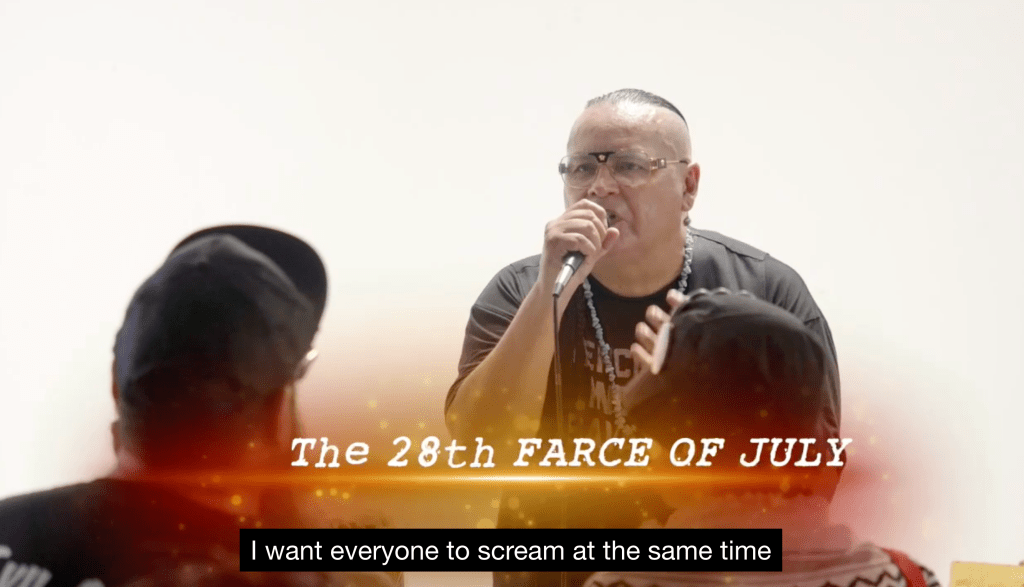
It is July 4, 2025. The air is hot; the sun is beaming on concrete and asphalt. Sweat is accumulating on my cotton Disrupt band t-shirt. My skin is sticky. Inside a suffocating room, the volume penetrating my ears is the racket of voices producing a steady pulsation of disunified sounds. A brown noise. In a studio room in Boyle Heights, the acoustics create a space-time of rebellious gravity. There’s something gestating. We are in that in-between aural space, the time-lag between speaker, musician, or performance. The MC is letting the crowd know what is next. We all desired to know.
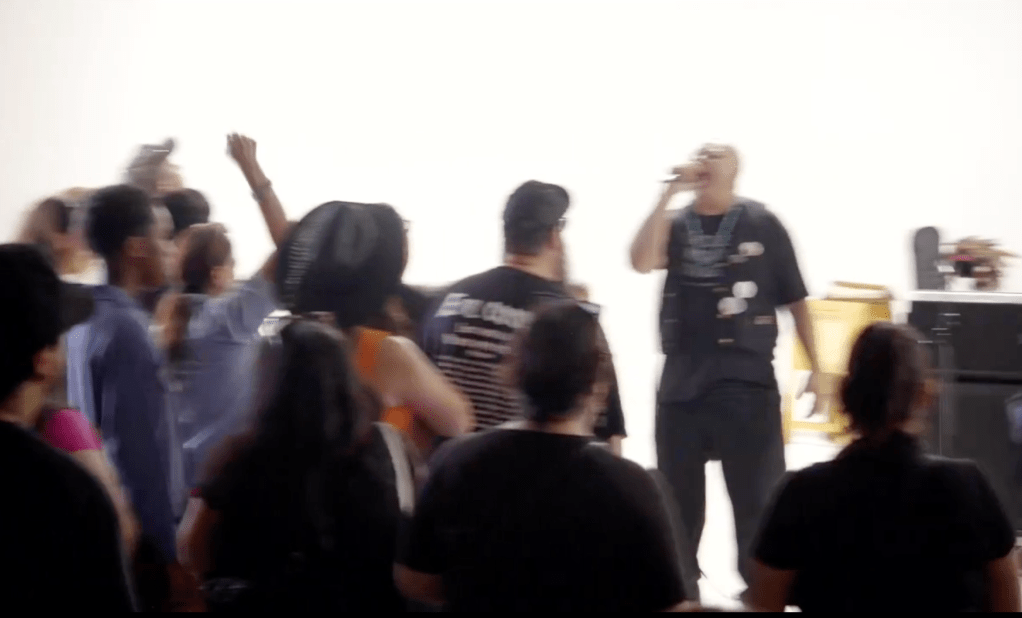
Yaotl—the vocalist of Xicano hip-hop/punk group Aztlán Underground—is the MC. He is speaking to the crowd during that transition to the next set. Doing so, Yaotl used this exact instance to identify the political moment we were all witness to, the historical cause for the event here, and then, surprising everyone, facilitated a collective llanto. He called it “scream therapy.” The dignified cry, as I am calling it, for him, is sticky, piercing, and angry—a sonorous form of dignified rage. We are all here for Xican@ Records and Film annual cultural event, the Farce of July that hosts vendors and musicians. Yaotl readies the crowd, his contagious call for a llanto also fused with the intimate violences of coloniality, what decolonial theorists of modernity, such as semiotician Walter Mignolo, have called its darker side or underside. “I want everyone to scream your fucking rage against all this shit.” He counts to three. One. Two. Three. We scream. We yell. We cry and cry out together. We manifest the sound of el llanto.
Gritos, llantos, sonidos, caos, and roncas are not new in Latinx Sound Studies. Their history, particularly in Latinx cultural studies, is intimate with the genealogy of not only musical or popular cultural forms (think rancheras in Mexico) but ancestral ceremony, rituals, and mythic stories (like La Llorona). From the invasion of Mexico-Tenochtitlan by Cortés in 1519 to the sonic protest of the 2018 Llanto Colectivo against the Otay Mesa Detention Center in San Diego, we can adequately identify the historically loud opposition against racism and coloniality in the United States. I explore the function of el llanto in relationship to a generalized response to the fascist sequences of repression emerging in the United States, showing how llantos orient both the listener and participant toward a discernment of grief and catharsis. This twofold function facilitates an embodied practice of corporeal sound-making and its therapeutic effect, which I ground here as a form of affective suture. Suffering, transmuted into coraje (angry-tinged courage), generates a collective sounding that pulls listeners into the acoustic llanto. In doing so, it transforms the listener into an agent of dignified rage.
Theorizing llantos requires a Latinx sound and listening methodology grounded in sonic phenomenology—drawing from phenomenological and sound studies traditions—that develop an “acoustic perception” sensitive to the “sonic environment.” I contribute to the notes toward a Latinx listening methodology introduced by Wanda Alarcón, Dolores Inés Casillas, Esther Díaz Martín, Sara Veronica Hinojos, and Cloe Gentile Reyes, who affirm faithful listening as, “attuned not only to sound, but to histories, structures, and acts of refusal that resist dehumanization.” Historically, phenomenologists have privileged the visual phenomenal field, the primacy of visuality being the ocular sense to discern or disclose the meaning of consciousness and lived experience. The sonic phenomenologist tunes into the soundscape as the totality of the aural experience.
The sonic phenomenologist of el llanto, or the dignified cry, develops a decolonial listening technique to perceive the aural structure of coloniality, the audition of dispossession mediated by anti-migrant animus, and the desire for emancipation from such sonic hauntings in everyday life. Many who let out a llanto do so in the face of anti-immigrant, anti-Latinx racism. It emerges as a vocal response to coloniality as lived and enforced through everyday regimes of racialized governance, from linguistic profiling and labor precarity to the slow violence of immigration delay and the spectacle of public kidnappings.
The collective llanto in July came at a time when in Los Angeles, California a popular revolt broke out in the early days of June amongst dissenters against I.C.E. raids and the Trump administration’s deployment of the National Guard to the streets. The spectacle, of a Xicano hip-hop/punk ensemble inviting a collective llanto, became much more than the cacophony of discordant screams but the dissensus of an aggrieved community. In their grief, mediated by the capture, detainment, and transport of undocumented migrants to detention centers, the catharsis of a llanto fueled the connection between desire and social movement. The sounds exiting the body, resonating as vibration in a shared room, identified the mutual feelings of others, in the exhalation of a noisy, impulsive breath.
This was not euphoria.
This instance of a rageful cry—loud, infectious, piercing – builds on the “faithful witnessing” articulated by María Lugones and Yomaira Figueroa-Vásquez, disclosing collective anguish fused with a tender fury. The listener must resist the organization of the dignified cry as melodic, rhythmic, or joyful. Rather, the llanto disturbs, ruptures, and erupts as a thunderous dissonance. Its saturation of auditory space interrupts the experience of conviviality or seriality and enchants the temporal form of the ensemble where the participants disappear behind the guttural and raucous sounds.
Faithful listening not only decolonizes racializing sonic structures but amplifies resistance, revolt, and coraje. Llantos are spontaneous, organized, lived. To voice el llanto is to become el llanto; an affective suture where a new auditory imaginary links with the Xicanacimiento of Yaotl’s specificity. Llantos, thus, are particular vocal moments continually shaped and fashioned. For the critical Latinx listener, el llanto offers a few seconds of catharsis and collective grief.
—
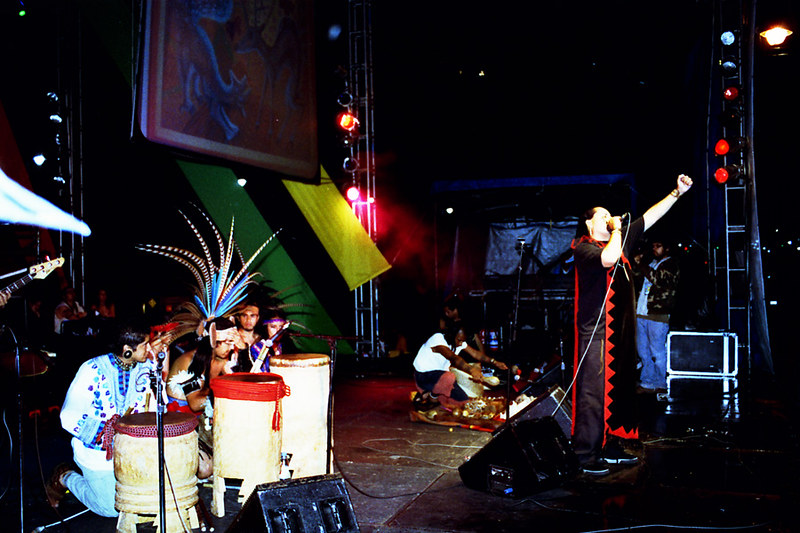
Featured Image: Aztlan Underground en Tenochtitlán by Flickr User Joél Martínez CC BY-NC-SA 2.0
—
Kristian E. Vasquez is a Ph.D. candidate in the Department of Chicana and Chicano Studies at the University of California, Santa Barbara. His research on the affects, performances, sounds, and semiosis of La Xicanada expands the concept of Xicanacimiento, centering the aesthetic force of expressive cultural forms in California.
—
.

REWIND!…If you liked this post, you may also dig:
Boom! Boom! Boom!: Banda, Dissident Vibrations, and Sonic Gentrification in Mazatlán—Kristie Valdez-Guillen
Listening to MAGA Politics within US/Mexico’s Lucha Libre –Esther Díaz Martín and Rebeca Rivas
Ronca Realness: Voices that Sound the Sucia Body—Cloe Gentile Reyes
Echoes in Transit: Loudly Waiting at the Paso del Norte Border Region—José Manuel Flores & Dolores Inés Casillas
Share this:

“Ich kann nicht”: Hearing Racialized Language in Josh Inocéncio’s Purple Eyes (Ojos Violetas)

DOI: https://doi.org/10.59350/4wyc8-g9m61
In Spring 2017, I brought Houston-based playwright/performer Josh Inocéncio to my campus—the University of Houston—to perform his solo show Purple Eyes (for more on the event, see “Campus Organizing, or How I Use Theatre to Resist”). Purple Eyes is what Inocéncio calls an “ancestral auto/biographical” performance piece which explores his upbringing as a closeted gay Chicano living in the midst of the cultural heritage of machismo. Following a legacy of solo performance storytelling aesthetics seen in John Leguizamo’s Freak and Luis Alfaro’s Downtown, Inocéncio plays with memory to understand how the United States and Mexico have influenced his family and his own identity formation. Moreover, Purple Eyes explores the intersections of queerness and Chican@ identity alongside the legacy of machismo in his family (For more on the play, see “Queering Machismo from Michoacán to Montrose”).

During my Intro to LGBT Studies course following the performance, students discussed issues of representation and how many of them had never seen a queer Latin@/x play or performance, with some of them having never seen a live play. Many students picked up on how Purple Eyes foregrounds the intersections of race, ethnicity, gender, and sexuality. While these discussions were indeed fruitful, what struck me most was how both classes harped on Inocéncio’s use of different linguistic registers. Put simply, what stayed with them was how the performance sounded. My students obsessed over the Spanish in the play, leading me to question why this group of students at a Hispanic-Serving Institution in a city that is over 40% Latin@ had so much trouble whenever Inocéncio spoke Spanish, or the sounds of Latinidad.
In what follows, I discuss how my students heard Purple Eyes. While the play is predominately in English, Inocéncio often code-switches into Spanish and German to more accurately embody particular family members. This blog adds to previous research by Dolores Inés Casillas, Sara V. Hinojos, Marci R. McMahon, Liana Silva, and Jennifer Stoever on the relationship between the Spanish language and non-Spanish speaking Americans. Indeed, my students racialized the Spanish in Purple Eyes while completely disregarding the German in the play. Why?
Drawing from sociology, racialization is the process of imposing racial identities to a social practice or group that might not have identified in such a way. Typically, the dominant group racializes the marginalized group; i.e. Latin@s in the U.S. become racialized by the mainstream. Even so, Latin@s are not a race, but are an ethnic group. Yet, I argue that non-Latin@ Americans view Latin@s through a lens of race which often becomes a sonic one, in which language becomes one of the most overt identity markers. In terms of Spanish, while many races and ethnicities speak the language, in the United States it is often viewed as a way to mark Spanish-speaking Latin@s as Other. In this way, language plays a fundamental role in shaping mainstream ideas about race. According to Dolores Inés Casillas, “For unfamiliar ears, the sounds of Spanish, the mariachi ensemble, and/or accented karaoke all work together to signal brownness, working-class,” and as Jennifer Stoever argues, the sounds of Latinidad indicate “illegality” in the U.S.
Drawing from the intersections of race, language, and racism, the relatively new academic field Raciolinguistics has emerged as a means to explain how people use language to shape their identity (For more, see Raciolinguistics: How Language Shapes Our Ideas About Race). Branching off from Raciolinguistics, I am most interested in exploring how the mainstream hears languages and racializes what they are hearing. The result is that Spanish is seen as Other, meaning that monolingual U.S. listeners hear Spanish-speakers as inherently different and a threat to a mainstream United States cultural and, more importantly, national identity.

Reflecting Inocéncio’s cultural multiplicity, Purple Eyes features English, Spanish, and German strategically used at different moments in the play to reflect the temporality, positionality, and relationship to language of each character that Inocéncio inhabits. While the chapter on his father is entirely in English, the final chapter focusing on Josh himself opens with a monologue in Spanish in which the performer narrates the events of the FIFA World Cup before finally announcing to the crowd that the epilogue is Inocéncio’s journey of young love and heartbreak on his journey of queer discovery. This moment features the longest extended use of Spanish in the play. The remaining Spanish is sprinkled in as Josh code-switches between the two languages for added cultural specificity.
While some of my Spanish-speaking students appreciated hearing a play that reflected their linguistic identities, monolingual English speakers in my class claimed that the Spanish confused them and made it difficult for them to follow certain parts of the play. After several students echoed these thoughts, a student from Mexico without full fluency in English comprehension told others about how her experiences were the exact opposite. She had trouble following some of the parts in English since she is still learning the language. I then pivoted the conversation to discuss how my English-dominant students approached the play with the assumption that English is the norm and a performance on a university campus should reflect this. Case in point: several told me that the show should have been subtitled.
But what was most telling was the following exchange. After several expressed confusion over the Spanish, one particularly woke student from Nigeria raised her hand and said: “I haven’t heard anyone say anything about the German in the play and not being able to follow the play during the German part.” She then noted how, in the United States, Spanish is racialized whereas German is not. In fact, most of the students did not even recall German in the play. Admittedly, the play features far more Spanish than German, but the scene in which Inocéncio speaks German occurs while dramatizing his Austrian grandmother’s abortion. As Inocéncio (as Oma) frantically repeated “Ich kann nicht” (I can’t), my students had no trouble; to use some Millennial vernacular, it was with Spanish that they “couldn’t even.” Arguably, this is the most intense scene in the performance and one that my students wanted to discuss. That the majority of them understood this scene without fully registering the German, coupled with their confusion over lines spoken in Spanish, speaks to not only how race and ethnicity impact how languages are heard in the United States. German is viewed as familiar and accessible whereas Spanish is immediately heard as foreign, i.e. undesirable, not welcome here.
As the Latin@ population continues to grow and the Spanish language becomes an increasingly present reality in U.S. everyday life, audiences must consider possibilities not grounded in an English-only narrative. My experiences with Purple Eyes are not unique. I have witnessed and heard many stories about audiences at mainstream theatre companies who have struggled whenever a play included Spanish. While I don’t claim to have the answers to address this across the nation, as an educator, I question what tools I can give my students to help prepare them for sonic experiences outside of their comfort zone and, specifically, how they become aware of subconscious racialization practices. What will they hear? And, more importantly, how will they react?
—
Featured Image: Still from Purple Eyes (Ojos Violetas), with permission from Josh Inocencio who retains copyright.
—
Trevor Boffone is a Houston-based scholar, educator, writer, dramaturg, producer, and the founder of the 50 Playwrights Project. He is a member of the National Steering Committee for the Latinx Theatre Commons and the Café Onda Editorial Board. Trevor has a Ph.D. in Latin@ Theatre and Literature from the Department of Hispanic Studies at the University of Houston where he holds a Graduate Certificate in Women’s, Gender, & Sexuality Studies. He holds an MA in Hispanic Studies from Villanova University and a BA in Spanish from Loyola University New Orleans. Trevor researches the intersections of race, ethnicity, gender, sexuality, and community in Chican@ and Latin@ theater and performance. His first book project, Eastside Latinidad: Josefina López, Community, and Social Change in Los Angeles, examines the textual and performative strategies of contemporary Latin@ theatermakers based in Boyle Heights that use performance as a tool to expand notions of Latinidad and (re)build a community that reflects this diverse and fluid identity. He is co-editing (with Teresa Marrero and Chantal Rodriguez) an anthology of Latinx plays from the Los Angeles Theatre Center’s Encuentro 2014 (under contract with Northwestern University Press).
—

REWIND!…If you liked this post, you may also dig:
“Don’t Be Self-Conchas”: Listening to Mexican Styled Phonetics in Popular Culture*–Sara V. Hinojos and Dolores Inés Casillas
Deaf Latin@ Performance: Listening with the Third Ear–Trevor Boffone
Moonlight’s Orchestral Manoeuvers: A duet by Shakira Holt and Christopher Chien
If La Llorona Was a Punk Rocker: Detonguing The Off-Key Caos and Screams of Alice Bag–Marlen Rios-Hernández
—
Share this:




Current Top Posts





April 2021

January 2020

November 2019

October 2019

August 2019

April 2014

November 2017

March 2015

December 2017

October 2015


Recent Comments