
A Tribe Called Red Remixes Sonic Stereotypes


DOI: https://doi.org/10.59350/2sjwd-72g16
Welcome back to “The Wobble Continuum,” a three part series here on Sounding Out!. When we last left you, Mike D’Errico had brought us to the intersection of patriarchal cultural norms, music production practices and aesthetics, and the Military Entertainment Complex. His particular focus was on the sounds and practices of brostep (be sure to check out D’Errico’s SO! Comment Klatsch from last week on gendered sounds, too), and some of those sounds leak through to today’s post from Christina Giacona. Giacona turns her ear to the group A Tribe Called Red in order to hear how they reappropriate and redress the sounds of colonization and racism.
As the series’ title suggests, her essay entails another journey to the low end, where things will once again get wobbly.
Guest Editor Justin D. Burton
—
Since first contact, Native Americans have consistently needed to combat the European stereotypes that portray them as inferior and uncivilized. Barraged with echoes of the same handful of Native tropes since Buffalo Bill’s Wild West Shows, contemporary American society often treats the stereotypical Native American princess, chief, and savage as historical truths, represented recently in Johnny Depp’s portrayal of Tonto in The Lone Ranger. But it is not just the visual image of the Native American that has been stereotyped, so has their sonic sensibility. As documented in the film Reel Injun, Native languages and musics have consistently been “faked” by Hollywood with tricks like backwards English, pig-Latin, and Westernized imaginings of a ubiquitous Native music based on a pan-Indian society that never actually existed. Hollywood often uses Native American music to show a “primitive” society where music’s sole function is to prepare for war. However, the “Indian” drumbeat that accents the first beat of a group of four cannot be found in any traditional Native American or Aboriginal music.
While Native American-directed motion pictures such as Smoke Signals, Powwow Highway, and Atanarjuat: The Fast Runner finally gave agency to Natives in film, it was the all-Native DJ collective A Tribe Called Red’s self-released album and popularization of the Electric Powwow that directly challenges the perception of Native American music in modern society. In this post, I analyze the sonic composition of ATCR’s song “Braves,” exploring how A Tribe Called Red challenges North American stereotypes of Native Americans through the cultural re-appropriation of racist sounds.
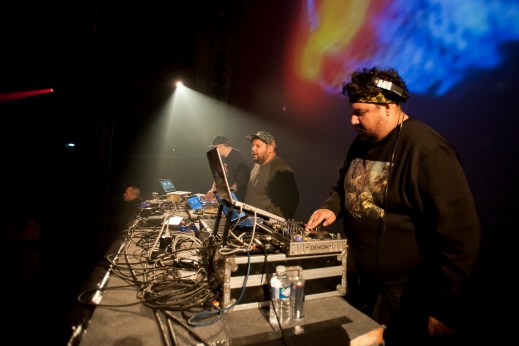
After World War I, intertribal powwow gatherings served as a place to celebrate newfound unity among Native Nations returning home from the war. By the 1950s intertribal powwows had spread throughout North America. With the continued strength and importance of the powwow in contemporary Native society, urban Natives in locations like New York City and Ottawa, Canada, have begun to search for ways to create the same sense of unity in urban venues. In 2008, DJs NDN and Bear Witness formed the DJ collective “A Tribe Called Red” and began curating performances in Ottawa the second Saturday of every month called the Electric Powwow: a “wild party” focused on showcasing native talent and aboriginal culture. ATCR’s website describe the music as “ the soundtrack to the contemporary evolution of the powwow.“ Bear elaborates in an interview with NOW magazine, “[the Electric Powwow] was also about creating a space for our community within the club environment.” Hip-hop DJ and turntable champ DJ Shub was invited to join the group in 2010, and the trio spent the next two years evolving the sound of the Electric Powwow into a mash-up of powwow and First Nations music with contemporary club sounds including hip-hop, dubstep, and dance hall.

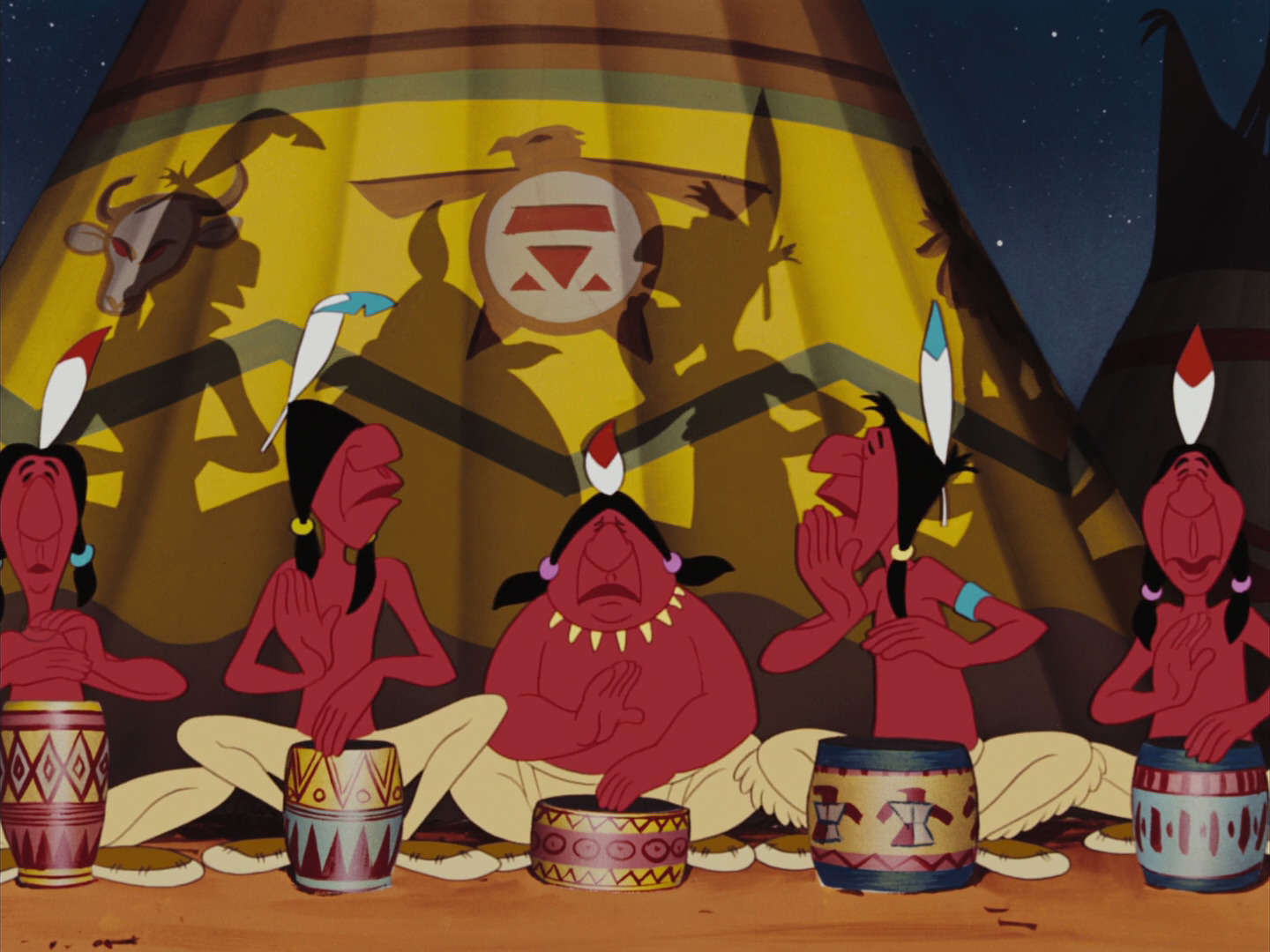
Much like Fela Kuti’s popularization of Afrobeat in the 1970s, made up of a combination of traditional Nigerian Yoruba polyrhythms with a blend of Western jazz and funk, and Reggaeton’s fusion of Caribbean rhythms with the aesthetics of American hip-hop in the 1990s, the Electric Powwow merges a historically traditional and non-syncretic music with popular and cosmopolitan music in a way that both honors cultural heritage and makes it relevant to a new generation. As NDN points out on Noisey, even their name follows this trend, simultaneously referencing the introduction of Nations at powwows and famous Afrocentric hip-hop group A Tribe Called Quest. The Electric Powwow events are not just about the creation of a new genre of music, but they also serve as a site for ATCR to speak publicly about aboriginal issues and represent themselves as a contemporary face for the urban Native youth renaissance. ATCR’s music videos and live-show projections extensively sample racist imagery from movies and cartoons including old westerns, Back to the Future III, Bugs Bunny, and Disney’s Peter Pan. As a result of their audio-visual activism, the group has become the unofficial soundtrack for the Idle No More movement, which is attempting to reassert Indigenous sovereignty rights and previously signed treaties in Canada.
By taking both visual and sonic symbols that depict racist stereotypes out of their cultural contexts, ATCR draws attention to both the specific racism of each individual image and the ubiquity of racist stereotypes. In their track “Braves,” A Tribe Called Red takes on the U.S. baseball team the Atlanta Braves by remixing the baseball organization’s Tomahawk Chop anthem, itself adopted from Florida State University.
ATCR’s version transforms the innocuous-sounding chant by showcasing its core as a Hollywood-esque stereotype of Native American song. By re-contextualizing the anthem, “Braves” prompts listeners to reinterpret this facet of American sports culture as a racist pageantry of “savage violence.”
The association of the “war chant,” the motion of the Tomahawk Chop, and the fact that these actions call for one team to attack all make it clear that American sports culture appropriates Native Culture as an example of “savagery” and “uncivilized” behavior. The Tomahawk Chop also forgoes the use of a language-based text entirely and instead chooses to use vocables that cannot be attributed to any particular Native nation, ceremony, or meaning. Like Hollywood’s use of backwards English and the war drumbeat to represent “Indians,” the Tomahawk Chop bears no resemblance to any real Native Nation’s music, acting as yet another imagined primitive stereotype that marginalizes actual Native American music.
On A Tribe Called Red’s SoundCloud page, “Braves”’s description reads, “We wanted to make a song for all the racist and culturally inappropriate sports teams that are still used today!” The group accomplishes this by creating dissonance between contemporary electronic drumbeats and the “traditional” paramilitary marching band arrangement of the “Tomahawk Chop.” “Braves” utilizes a standard dubstep song structure in 4/4 at 140 beats per minute that includes an intro, two main sections that include melodic materials, a breakdown/buildup section, a vocal “drop” which announces and is followed by the climax of the piece, and an outro that brings the track to a close. However, “Braves” does differ from other dubstep songs in the marked separation and interaction between the Tomahawk Chop samples performed by voices and marching band and the composed elements of the song performed as the Wub—a deep, wobbly synthesized sound—and accompanied by a HiHat cymbal pecking away at syncopated rhythms. Even though all the melodic content of “Braves” is based on variations of the Tomahawk Chop melody, ATCR never fully integrates actual samples of the Tomahawk Chop into the composition. The marching band and chant samples are treated as an unwanted and unexpected visitor to a party; they seem important at the entrance, but they are given an increasingly diminished role until they finally exit with a whimper.
Written as a protest against racist sports organizations to help convince them to stop using characterized ceremonies and mascots, “Braves” contains that struggle within the composition itself: dubstep, sounded as the Wub and HiHat, eventually renders the Tomahawk Chop sonically impotent. The “Tribe” drop, when ATCR marks the song by saying “tribe,” acts as the turning point in “Braves.” After this point the Wub and HiHat consistently overwhelm the sampled material. In a standard dubstep song, the tribe drop would be followed by the climax: the strongest, most complex musical section of the piece. However, the Tomahawk Chop sample that follows this drop is immediately swallowed up by a low-pass filter that rubs out the tune, starting with the highest pitched sounds, over the course of sixteen measures, heightening the lower end of the sonic spectrum. Only then does the true climax occur. The Wub and HiHat appear here for the first time without the sample band or vocalizations. After the “Tribe” drop, the samples of the Tomahawk Chop are either dominated by the Wub or swallowed up by low-pass filters and fades.

In this way, “Braves” acts as a three-minute sonic story of reappropriation. The marching band arrangement and vocables represent the common stereotypes of Native American music perpetuated by Western Culture. The Wub and HiHat act as disapproving commentary on these stereotypes. “Tribe,” the only word used in the entire song, not only sounds ATCR as a group, but also marks the point in the song when ATCR begins to create their own image of Native music while simultaneously disempowering the strength of the marching band.
Just like the rebel American marching band’s reappropriation of the song Yankee Doodle in the Revolutionary War, A Tribe Called Red employs irony: in order to get the song the audience has to understand the racism, and while that sort of understanding seems to represent a steep learning curve for a culture so saturated in racist stereotypes, it is also exactly the sort of understanding a multicultural nation needs in order to thrive. Like Afrobeat, Reggaeton, and the more recent alternative hip-hop group Das Racist, ATCR is an underground voice within American popular culture that speaks with reverence for its own traditions while challenging the popular perception of race relations and breaking new ground in contemporary art. “Braves” proves that the reappropriation of sonic space is a powerful tool in the fight for cultural agency.
—
Featured image: “ATCR 4” by Flickr user MadameChoCho, CC BY-NC-SA 2.0
—
Christina Giacona is the Director of the Los Angeles New Music Ensemble and Instructor of Music at the University of Oklahoma. Dedicated to performing and researching the music of her generation, Christina teaches courses in Native American, World, and Popular Music. Since founding the Los Angeles New Music Ensemble in 2007, Christina has commissioned and premiered over twenty new works for the ensemble; run an international composers competition, recorded three albums, and collaborated with DJs, MCs, animators, choreographers, projectionists, and film producers.
—

REWIND!…If you liked this post, you may also dig:
“One Nation Under a Groove?: Music, Sonic Borders, and the Politics of Vibration”-Marcus Boon
“Live Electronic Performance: Theory and Practice”-Primus Luta
“Remixing Girl Talk: The Poetics and Aesthetics of Mashups”-Aram Sinnreich
—
Share this:

Making Music at Studio X: The Identity Politics of Community Studios

DOI: https://doi.org/10.59350/ptbwv-abm26
What are the social obligations of what I term “community studios”— spaces that exist to provide “at-risk” youth access to free or low-cost music recording equipment, services, and education? This essay reflects the findings of a four month ethnomethodological project, in which I explored the institutional and social affordances of Studio X, a community studio located in a rural college town in upstate New York. Using information from interviews and several hours of observation in the studio, I argue that community studios are subject to unique institutional pressures that emerge from their framing as both professional studios (private enterprises with no restrictions on creative expression) and community centers (shared spaces, which, in this context, are designed to provide oversight and the proper socialization of youth through rules and activities). While tapping into private and philanthropic revenue streams has resulted in the development of some exceptional studio projects, it has also led to a problematic situation where the studio has trouble establishing an independent identity for itself. This essay hopes to offer a critical perspective and, in doing so, offer some suggestions to help community studios deal with these challenges.
Community studios offer a different studio model than the standard professional or DIY models typically discussed in academic literature. While recent work by Eliot Bates and Susan Schmidt Horning has done an excellent job of framing the sociohistorical contexts of commercial music studios, neither adequately addresses the politics of community studios. These politics, however, cannot be taken for granted as they challenge Bates’ contention that studios “isolate studio workers from the outside world, and the world from studio work, while possessing a visual and audible difference from other work environments.” Contentiously, community studios represent a unique set of stakeholders including parents, donors, youth, and community center administrators, amongst others. The community studio is far from isolated, however, and its identity, therefore, is in constant flux.
Studio X was developed in 2006 with funds from a $65,000 grant from the New York State Music Fund, a board created by the Rockefeller Philanthropy Advisors to dispense over $35 million in settlement money from music businesses that profited from “payola” practices. It was conceived as a space where predominantly low-income African American youth would have access to professional recording equipment and training. According to the grant proposal, technical expertise was to be supplemented with classes that contextualized the music within “the socio-political, and social justice significance and origins of hip-hop, reggae, and other forms” in addition to making connections with “jazz, African percussion, and contemporary world music.”

Many of Studio X’s goals had been met. On my first day there, I encountered a local singer who spoke with me for over an hour, praising the studio for giving him the opportunity to use a voice he claims to have wasted in jail. Another respondent explained that the studio helped to shed positive light on an area that is often categorized in negative and judgmental terms. He remarked: “More people should know about [the studio]. Show more appreciation. They should come down and see what we’re about down here. It’s not all negative. Good things happen at [Studio X].”
Not all was well with Studio X, however, as I learned when I encountered an administration struggling to negotiate the studio’s joint identity as both a community center and a professional studio. At the helm was Eric, an audio engineer by training, and the full-time director of Studio X. Since accepting the position in 2012, he had been crafting the space in the likeness of a professional studio. Free music production and engineering classes ceased and he even began offering private sessions with better equipment at the rate of $25 an hour. Eric justified this decision by explaining that the fee helped to ensure that people actually kept their appointments, and the better equipment yielded superior recordings. He also insisted that a large percentage of the funds these sessions earned ultimately supported the community center and studio.
Community response was mixed. Many respondents noted that they trusted Eric, with a few even suggesting that he should charge more. One respondent, a local producer, felt Eric’s pay sessions were a reflection of greater economic trends in cloud music sites, like Soundcloud and Reverbnation, that allow artists to tailor their investment through incrementally priced packages.
A number of community members, however, were deeply disturbed by this change. One local rapper claimed that turning Studio X into a “real studio” had never been a part of its original mission. They were fearful that the space’s shift towards a professional studio in structure implied the troubling imposition of capitalist hierarchies. This contention is echoed by scholars like Louis Meintjes and Tricia Rose, who state that studios and other technologies of musical (re)production are always deeply representative and constitutive of the greater institutional structure of the music industry.
The studio also furthered a number of questionable social policies. Upon the studio entrance was a sign that detailed rules for proper conduct. Not only did the studio maintain a dress code, but it also censored lyrical content. The sign displayed six rules:
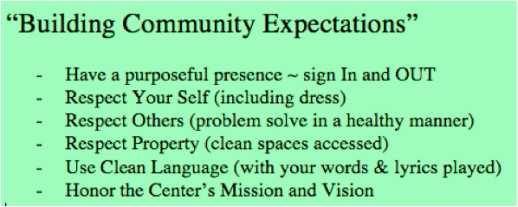
When I asked Eric about these rules he indicated that he’d written these rules to avoid running into trouble with parents and with the Executive Director: “I just don’t want to be known as the guy who lets 14 and 15 year olds come and say whatever they want…Usually kids that age don’t have language like that although a few times I had to tell them to use different language or I had to tell them to leave.” Thus, according to Eric, Studio X’s success as a community center meant the censoring many of its patrons. But how did Eric’s decision affect the narratives of the studio’s constituents?
This research suggests that the administrative politics of community studios has deep implications for inclusion and identity of community members. Although it’s easy to dismiss Eric’s decisions to charge for studio space and censor language as racist, the reality is that many members of the community respected his leadership and felt he was guiding Studio X towards a positive direction. Eric’s vision, in other words, worked to produce a culture of ideological support within the community itself.
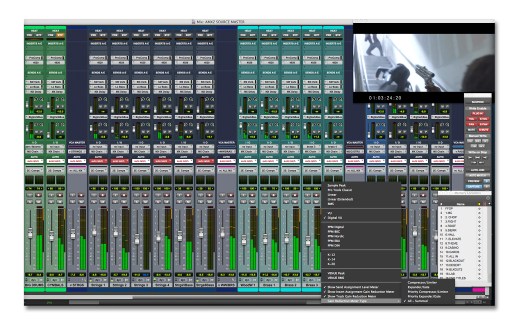
Even though Studio X represents only one community studio, its identity struggles are certainly worth noting as similar institutions crop up around the world. How can community organizers best create a recording space that is safe, professional, and productive for members of low-income populations?
To start, organizers must recognize how the strings attached to philanthropic grants can lead to poor administrative choices. The institutional design of community studios mirrors the demands of broader grant-funding institutions, from which community studios derive their primary income. In order to provide community members with tools to produce work that is “competitive,” at least from an audio engineering perspective, community studios must invest in expensive equipment or risk coming across to both community members and potential investors as a poor alternative to daycare.
To adequately support these spaces, administrators and other stakeholders must insist on finding new and creative ways to raise clean money. Beat Making Lab, a community studio initiative that has connected educators and artists with community centers and schools across the globe since 2012, allows supporters to directly contribute and sponsor the purchase of specific equipment and development of projects. Still, it relies on its grant partnership with PBS to reach a larger audience. Similarly, Notes-for-Notes, an organization founded in 2006 toward the development of positive spaces for youth to learn about, create, and record music, receives private funding and sponsorship from celebrities and music production companies among others; it is also the recipient of funds from a number of philanthropic grant institutions.The alternative to these innovative funding tactics is to imagine, construct, and present a studio that is primarily concerned with “positively” shaping the character of young men and women in an effort to appease questionably minded philanthropists, even though this maneuver often compromises the culture, community, and content of the community which the studio itself exists to support.
—
Enongo Lumumba-Kasongo is a PhD student in the Department of Science and Technology Studies at Cornell University. Since completing a senior thesis on digital music software, tacit knowledge, and gender under the guidance of Trevor Pinch, she has become interested in pursuing research in the emergent field of sound studies. She hopes to combine her passion for music with her academic interests in technological systems, bodies, politics and practices that construct and are constructed by sound. More specifically she would like to examine the politics surrounding low-income community studios, as well as the uses of sound in (or as) electronic games. In her free time she produces hip hop beats and raps under the moniker Sammus (based on the video game character, Samus Aran, from the popular Metroid franchise).
—
REWIND! . . .If you liked this post, you may also dig:
Papa Sangre and the Construction of Immersion in Audio Games— Enongo Lumumba-Kasongo
Yellow Rain and The Sound of Matter: Kalia Yang’s Sonorous Objection to Radiolab— Justin Eckstein
The Noise of SB 1070: or Do I Sound Illegal to You?— Jennifer Stoever
—
Share this:




Current Top Posts





April 2021

January 2020

November 2019

October 2019

August 2019

April 2014

November 2017

March 2015

December 2017

October 2015


Recent Comments