
Cauldrons of Noise: Stadium Cheers and Boos at the 2012 London Olympics


DOI: https://doi.org/10.59350/sa06v-85h38
Welcome to the extra innings of our summer series on “Sound and Sport”! In today’s bonus post, David Hendy discusses his recent Noise broadcast for BBC Radio 4 on the sounds of Olympic crowds. For an instant replay of our summer series click Kariann Goldschmitt’s “The Sounds of Selling Out?: Tom Zé, Coca-Cola, and the Soundtrack to FIFA Brazil 2014” (August), Josh Ottum‘s “Sounding Boards and Sonic Styles: The Music of the Skatepark” (July), Tara Betts‘s “Pretty, Fast, and Loud: The Audible Ali” (June), and Melissa Helquist‘s “Goalball: Sport, Silence, and Spectatorship” (May). Following Hendy’s post on Olympics past, give Andrea Medrado’s podcast a spin for a listen into its future: “The Sounds of Rio’s Favelas: Echoes of Social Inequality in an Olympic City.” And now, David Hendy. Of course, the crowd goes WILD. —J. Stoever, Editor-in-Chief
—
I didn’t get to go to the London 2012 Olympics or Paralympics. Alas, my number didn’t come up in the lottery for seats. So, like millions of others, my family and I watched – and heard – the sporting action on television or, occasionally, on our smart phones. A pretty good experience it was, too: the BBC for instance gave British viewers 24 live streams of high-definition coverage for the Olympics; Channel 4’s approach to the Paralympics was smaller-scale but packed a similar punch in terms of imagery. A key part of the “enhanced experience,” however, was the acoustic quality of the broadcasts. When the Olympics had last been staged in London, during the post-war austerity of 1948, television footage sounded like this:
“1948 Olympics Clip” courtesy of Peregrine Andrews and Alan Hall, Falling Tree Productions Limited
Just about the only things viewers would’ve heard were the voices of the commentators and the distant, muted sounds of the crowd.
That evocative archive recording was used in a recent radio documentary by the British sound designer Peregrine Andrews. The programme explored just how much had changed in location recording techniques by 2012. This time around, Peregrine pointed out, some 4,000 microphones were in position at the various venues: not just suspended in the air above or placed on the trackside, but bonded directly onto the beams in the gymnastic hall, say, or attached to the targets used in archery. Competitors everywhere were heard in extreme close-up – every shift of a hand or foot, every creak of wood, every grunt or groan made audible to the viewer at home.
This wasn’t just hyperbole. Newspapers quickly latched on to the phenomenon, dispatching reporters to measure decibel levels and offer their readers guides to the “best” venues for hearing the sound of the crowd. They pointed out that an airplane taking off produces about “140 decibels of noise”– and that the cheers echoing around the soaring curves and low ceilings of the Olympic Velodrome reached very nearly the same level.

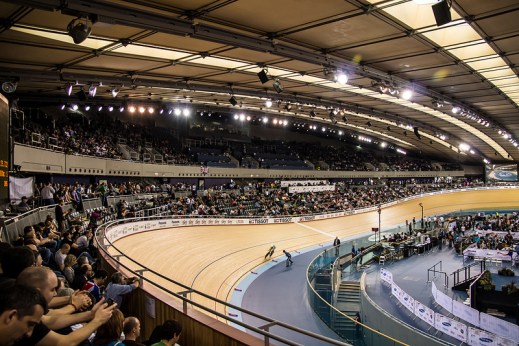
“The roar was thrilling, to the point of pain,” claimed one reporter from the Toronto Globe and Mail. “If I had endured another minute, I am sure we’d all have gone deaf.” Zaha Hadid’s gloriously sweeping Aquatics Centre provided perhaps the most intense acoustics of all. Whenever the 17,500 fans inside cheered, the “guttural roar” was simply “ear-drum shattering,” declared the London Evening Standard. The main Olympic stadium was open air, of course, making the sound less intense. But even here the Globe and Mail journalist wrote of a “tsunami of noise” building in waves; another of the stadium’s “sonic boom”; yet another of how Usain Bolt’s 100 metres final produced a roar from the crowd which, measured at 107 decibels, beat that of your average pneumatic drill.
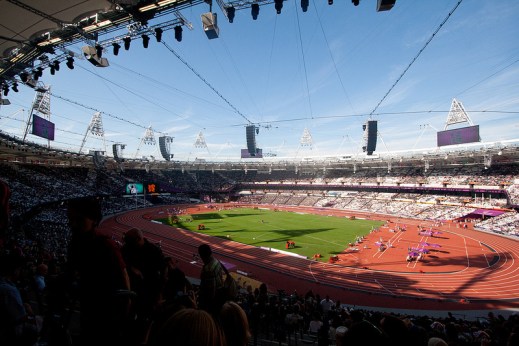
Perhaps it wasn’t surprising that London 2012 was dubbed the loudest ever Olympics. For the main stadium’s designer Rod Sheard had always conceived it with acoustics firmly in mind. He’s quoted in a piece in It’s Nice That: “The athletes are so focused, it’s very easy for them not to hear the crowd. . .we’ve got to make it really loud for them to get any benefit from it.” And so the 80,000 people inside were packed as closely together as possible with the roof shaped to rebound their roar back into the heart of the space, generating maximum volume.
As my producer Matt Thompson and I discovered when making our recent BBC radio series Noise: a Human History (available on iTunes), this contemporary attempt to revel in the roar of the spectators throws up some striking – and very ancient – parallels. The most obvious is that of the Colosseum in Rome, which, some 2000 years ago, provided what Keith Hopkins and Mary Beard have described as “a brilliantly constructed and enclosed world, which packed emperor, elite and subjects together, like sardines in a tin.”
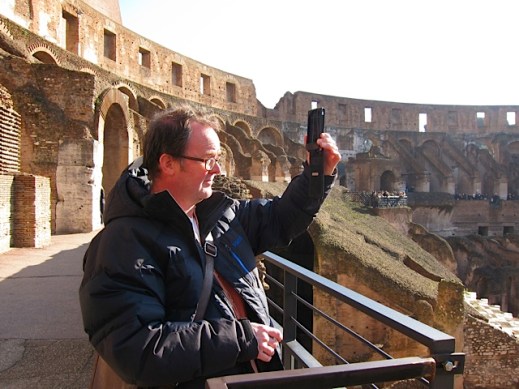
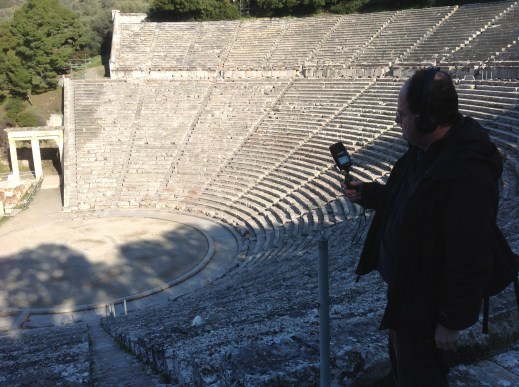
The acoustic qualities of ancient amphitheaters like this – their ability to amplify the slightest sounds – is still pretty unnerving if you get the chance to witness it for yourself, as Matt and I did when recording, at the Colosseum and at the ancient Greek theatre of Epidaurus:
In these cauldrons of concentrated sound, the roar of the spectators took on a collective force of its own – a volatile quality rich with cultural and political repercussions. During plays in Greek theatres, audiences were rarely hushed and reverential. They were talkative and unruly, sometimes showing their disapproval by drumming their heels against the benches, sometimes disrupting the action by shouting and jeering. The chorus below would address spectators directly, as if facing a jury. Audience participation was as much a part of a performance as were the actors in the orchestra or on the stage. And when it came to the Roman Games later held at the Colosseum or in even larger venues such as the nearby Circus Maximus, the barrage of sound could reach intimidating levels of ferocity.
Roman arenas were not just sporting venues, of course. They were designed for political theatre. Vespasian had ordered the Colosseum to be built to help wipe away the memory of his predecessor Nero and his notorious private pleasure palace the Golden House. Now Roman citizens had a pleasure palace all of their own. The ruling elite had also created a place for the ostentatious display of imperial power and generosity, a bribe for the people’s continuing loyalty. Which is why, if the crowds were sometimes a little slow in showing their appreciation, paid stooges dotted about the arena would start applauding – or booing – at all the right moments, while soldiers would strike down any member of the audience who lagged in their cheering. But, as in the Greek theatres, Rome’s audiences were never entirely under the cosh; they could occasionally give voice to underlying discontentment. And when so many people were so tightly packed together, sheer proximity and the contagious quality of sound meant any turn in the mood would have been quick to make itself felt.
One startling example of this came in 55BC when Julius Caesar’s powerful rival Pompey put on a show in the Circus Maximus that featured the slaughter of elephants – something the crowd lapped up until the very moment they heard the poor creatures’ death throes. In episode 9 of Noise: a Human History, I speculated on what it might’ve been like – and recalled the unsettling outcome:
In London in 2012, we had our very own Pompey, in the form of the British Chancellor of the Exchequer, George Osborne. He’d turned up to the Paralympics to award some medals. And as his name was announced the stadium resounded with loud booing for the first time all summer:
Why did 80,000 people all suddenly decide to boo as one? Because, one commentator quipped, there were only 80,000 people in the stadium.
Politicians as a class are inevitably unwelcome in a place of entertainment, their presence too obviously betraying an attempt to siphon off a little of the goodwill. Osborne’s particular problem, though, was that he wasn’t just any old politician. He was from the ruling Conservative party, which, true to its ungenerous instincts, had just cut welfare benefits for Britain’s disabled people. In the circumstances, turning up to the Paralympics seemed an entirely predictable affront to most of those in the stadium – one that Osborne was thick-skinned and numb-skulled enough not to have predicted for himself.
All this might seem, well, unsporting. But booing is part of the civic dialogue. It brings politicians face-to-face with their electorate. It forces them to feel the scorn and anger of those they’ve let down. The moment passes, of course. Clips briefly went viral on YouTube, and were soon forgotten. Osborne himself is still in office, overseeing the ruination of the British economy through his programme of austerity. But for a delicious few seconds we were reminded of the inherently public nature of sound. We heard – we felt – the role of listening to one another, not as a passive thing but as a powerfully collective, inter-subjective, electrifying, communicative act.
—
Featured Image: Crowd: London 2012 Olympic Stadium, Image by Flickr User Flickmor
—
David Hendy is Professor of Media and Communication at the University of Sussex, England. He wrote and presented the recent 30-part BBC radio series Noise: a Human History, which remains available to download on ITunes. The accompanying book, Noise: a Human History of Sound and Listening, will be published in the US in October 2013 by Harper Collins. He’s the author of Radio in the Global Age (2000), Life on Air: a History of Radio Four (2007), and Public Service Broadcasting (2013), and contributes regularly to radio programmes.
—

REWIND! . . .If you liked this post, you may also dig:
“We wanted to tell stories about sound”: Opening Ears Through the “Everything Sounds” Podcast–Craig Shank and George Drake Jr.
Quebec’s #casseroles: on participation, percussion and protest–Jonathan Sterne
Goalball: Sport, Silence, and Spectatorship— Melissa Helquist
—
Share this:

“We wanted to tell stories about sound”: Opening Ears Through the “Everything Sounds” Podcast
DOI: https://doi.org/10.59350/k708m-kk431
This is the fourth and final post in Sounding Out!’s July forum on listening in observation of World Listening Day on July 18th, 2013. World Listening Day is a time to think about the impacts we have on our auditory environments and, in turn, its affects on us. To read last week’s post by Nicole Furlonge, click here, for Maile Colbert‘s piece click here and for Regina Bradley’s post (and to read more about World Listening Day) click here.
This week we have something a little different in store for our readers. The good folks from Everything Sounds, Craig Shank and George Drake Jr., wrote a post for us on the role of listening in their podcast. However, they approached it as a transcript of their podcast. One of the things we like about Everything Sounds is that their approach to discussing sound is like a conversation, and so listeners feel like they are hanging out with the hosts as they go on sonic adventures. Moreover, they have recorded the post as an Everything Sounds podcast episode, so that you can choose how to experience this blog post: either as a written/visual text, audio text, or read along while you listen. Also, feel free to respond in our comments section to the listening challenge they present at the end of the post. We want to hear your stories about sound too!–Liana Silva, Managing Editor
—

Craig Shank (CS): I’m Craig Shank
George Drake Jr. (GDJr): …and I’m George Drake Jr.
CS: This is an Everything Sounds blog post.
GDJr: If you’re not familiar with Everything Sounds, it’s a podcast and public radio show about the ways that sound plays a role in art, science, history, and culture.
CS: Everything Sounds covers stories about instruments made of meteorites, voicemail confessions, microphone museums, and dozens of other topics.
GDJr: Don’t forget about the time that we somehow managed to get on the subject of using music to encourage…you know…tortoise-love.
CS: Obviously, radio shows use sound to tell stories. How else would they do it? However, we wanted to tell stories about sound. The best way to reign in our slightly unwieldy premise was by asking questions. How do artists use sounds? What sounds result from the natural world, daily life, and industry? Why is sound important? What can we learn about our own experience through sound?
GDJr: Sound plays an important role in our lives. It makes sense that it would, right? Sound is everywhere. Complete silence is virtually impossible. There’s always something generating a sound somewhere. That’s good news for us since we’ll always have something to talk about on the show.
CS: When Sounding Out! approached us about contributing to the blog for World Listening Day, we were flattered. Then the reality set in. We’re just two guys that make a podcast. It’s unlikely that anyone would consider us experts. Our education involved studying sound and music, but it was mostly in the context of creating radio.
GDJr: We were initially drawn to radio because of music, but over time we began to appreciate how songs, voices, and sounds were used to share information and tell stories. Radio is a medium that spoke to our curiosity about the world as well as the role that sound plays in it. After spending so much time working with and around sound, you can’t help but notice all of the ways it can influence everyday life.
CS: We aren’t scientists, inventors, acousticians, artists, or anything other than radio producers, but Everything Sounds allows us to speak with experts and creative people that can help us learn about the influence that sound has on us.
GDJr: This may be the exact reason why the show resonates with listeners. In many cases, we’re learning something new right along with you. We’re able to ask questions and make sense of new information. After we gather the information we organize everything to make more sense, find supporting information, check the facts, and try to reassemble all of it in a way that is fun and engaging.
CS: The reaction to the show is humbling and beyond our expectations. When we started producing the show we were unaware that it could have a real-world impact. However, we’ve heard from listeners that thank us for opening up their ears and helping them reconsider the role of sound in their daily lives. We’ve been touched by stories from listeners with vision difficulties that tell us how much they appreciate the show and its treatment of sound.
GDJr: One of our listeners commented that their ability to recognize and classify sounds was well-developed as a result of their condition. They said our show made them want to find ways to record some of their experiences with sound and share it with others. We’re always delighted to hear that the show generates any kind of reaction, but it’s especially meaningful when it makes listeners want to create, investigate, or learn after the show ends.
CS: …and inexplicably, some people actually think we’re funny. I’m not even convinced we’re funny.
GDJr: If we are, it’s probably not intentional. Let’s get back to your point. Making a connection helps to spark an interest in learning about and exploring sound. If people think Everything Sounds is funny, informative, entertaining, or “ear-opening,” then we have managed to get people to think about sound and hearing more deeply. Even if it’s only for a few minutes each week, sound becomes the center of attention. If we make the show enjoyable for listeners, then we open doors to topics that they may not have considered in the past.
CS: The wonderful thing about learning is that you don’t have to be an expert to do it. You just have to be curious. Even the experts use their imagination and curiosity to solve problems and explore unanswered questions. Accessibility is extremely important when it comes to creating an intellectual spark that encourages people to stop , think, pick up a book, or search on the internet for more information. Even though we are sharing information that is new to us, we try to make it entertaining and less intimidating.
GDJr: We don’t want to overstate our contributions to listeners’ lives. We’re fully aware that we’re competing for their time and attention. Everything Sounds has probably become background noise for many hours of laundry folding, dinner preparing, or late-night driving. Despite this, we value all listening and levels of engagement.
CS: By listening to podcasts or radio programs the world can come to you through your headphones or speakers. If someone can’t make a trip, then we can provide the material to construct the scene in ears and minds.
GDJr: So, what are the scenes that we’ve created? Well, in the very beginning, episode 1 in fact, we talked to a sound artist named Jesse Seay. Craig and I had no idea what the show would sound like, how it would be structured, or if anyone would even care. The only thing we knew is that we wanted to do a feature on her “Mechanical Tide” piece. Sculpture is inherently visual art form that sometimes may be difficult to translate on the radio. So, we were interested to learn more about one of many artists that has found a way to incorporate sound elements into their work. A simple interview with Jesse would have probably given us enough to work with, but to bring some life into the story we decided to see the piece in person with her.
CS: At the University of Chicago we were able to capture Jesse interacting with the piece, talk to students, and run into tour groups that reacted to Mechanical Tide. This episode taught us a valuable lesson. Capturing honest, real, and unscripted moments is essential to telling stories about sound.
GDJr: All of the time and writing in the world couldn’t create moments as memorable as when we simply keep the tape rolling and listen for the surprising sounds of the real world. We need some consistency for the sake of telling coherent stories, but including surprising and unexpected audio adds a great deal to our episodes.
CS: In the first episode of our second season we spoke to Nick Zammuto. He’s a musician that has performed with The Books and more recently Zammuto. Over the years, Nick simply kept the tape rolling whenever he could to capture as much of the world around him as possible. Many of these clips ended up being used in his music.
GDJr: Nick said, “It’s an obvious rule of physics that, you know, the more you record, the more you get.” Listening works the same way. The more time you spend listening to the world, the more you get out of it.
CS: A striking example of this involved a trip to the The Aquarium of the Pacific in Long Beach, California. Nick was recording in front of the jellyfish tank and captured part of an unsettling conversation with a father and daughter. This conversation eventually made its way into a song called “Motherless Bastard” by The Books.
GDJr: Nick has a knack for finding ways to use the sounds of everyday life in his musical pieces. The results are sometimes uncomfortable, humorous, confusing, or odd, but taking sound from its original context allows us to reconsider its place in the real world and in art. Although Nick often has a use for his recordings, listening itself often doesn’t need to have a goal to be beneficial.
CS: Being open to those experiences of everyday life is what makes good listeners. Most of us are born with the ability to hear the world around us. However, it takes patience and practice to develop better listening habits. We can learn about other people, the natural world, our surroundings, and the things we care about by taking a closer listen. Everything Sounds isn’t meant to encourage a blanket approach to listening, but we do think it encourages people to consider the way that they listen to the world and what they are neglecting.
GDJr: When was the last time you put away your phone, turned off the TV or radio, and listened to the sounds in your neighborhood? If you’ve been in nature recently, did you take a moment to close your eyes and listen to the birds while the wind rustled the leaves on the trees? Have you thought about how different all of your friends’ laughs sound?
CS: Listening isn’t just about encountering and acknowledging the cacophony of daily life. Listening is about taking the time to notice the role that many different sounds play in a soundscape. Taking the time to process the sounds around you gives you an increased awareness of the world and your place in it. There is a wealth of information carried in sound waves. Neglecting that information would be like eating a wonderful meal and not allowing any of it to touch your taste buds.
GDJr: Deep listening serves practical purposes. It helps us appreciate our favorite music, enjoy the environment, and understand the people we love. Sounds can bring us joy, alert us to danger, keep us connected, and help us navigate our world. Listening closely allows you to hear the subtle details that many others will overlook or ignore. It helps you to become more mindful, in the moment, and intellectually engaged.
CS: So, take a moment now to listen to the sounds that you may have been blocking out while reading this post. Consider other times in your life where you may not be paying attention to the sounds around you. Make an effort to appreciate all that your ears have to offer.
(6-7 second pause)
GDJr: It’s easy to be distracted by bright colors, motion, and other attention-grabbing visual elements in our culture, but if you make the effort to listen, you’ll be able to hear diverse and nuanced examples of sounds that can create just as much excitement everywhere.
CS: In the introductory episode of the show we talked about the way sounds shaped us and led us to create Everything Sounds. In that episode we stated that the goal of the show is not to just share our own experiences with sound. We want the show to encourage listeners to have their own journeys with sound. With this blog post, even if you never listen to the show, we hope that you will recognize your own listening habits and consider ways that you can have a closer relationship with sound.
GDJr: I think that’s pretty much the whole ball of wax.
CS: Thanks for listening…or reading. Whichever one you’re doing.
GDJR: Or Both!
CS: Thanks to Sounding Out! for giving us this platform to share our enthusiasm for sound.
GDJr: We love meeting other audiophiles and geeking out, so feel free to reach out. We’d love to hear from you.
CS: I’m Craig Shank.
GDJr: And I’m George Drake, Jr. Thanks for reading or listening to this Everything Sounds blog post.
—
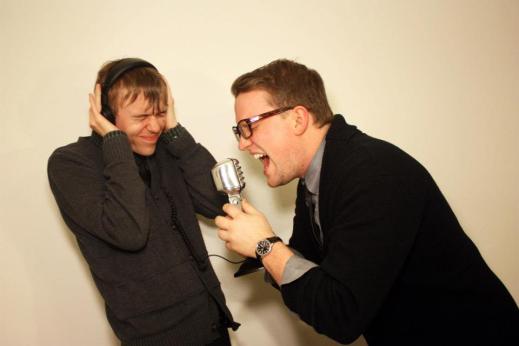
Featured image photo credit: Everything Sounds duo Craig Shank and George Drake, Jr., image courtesy of the authors.
—
The hosts of Everything Sounds:
Craig Shank is an Indiana native that developed a passion for music and broadcasting at an early age. While in college, Craig balanced internships, part-time jobs, and volunteer opportunities that allowed him to spend most of his time outside of the classroom in broadcast facilities. His interest in sound and digital media paired with extensive broadcasting experience led Craig to produce Everything Sounds with his longtime friend and collaborator, George Drake Jr. He is fascinated by the cosmos and begrudgingly acknowledges his lactose intolerance.
George Drake Jr. grew up in Chicago, but spent time in Indiana and London before returning to the Windy City. His passion for music and background in theatre as a teenager made George a perfect fit in the world of radio. Following his involvement at WIUX, WXRT, and WTTS George took his dedication to his craft to the next level when he traveled overseas to pursue his Masters in Radio at Goldsmiths College, U. of London. George has consistently allowed his ears and intuition to find and promote sounds that will have an impact. His favorite band is The Books, he enjoys a spicy Bloody Mary, and finds any excuse to wear a tie.
—
REWIND! . . .If you liked this post, you may also dig:
Sounding Out! Podcast Episode #2: Building Intimate Performance Venues on the Internet—Andreas Pape
The Sound of Radiolab: Exploring the “Corwinesque” in 21st Century Public Radio–Alex Russo
Park Sounds: A Kansas City Soundwalk for Fall—Liana Silva
—
Share this:




Current Top Posts





April 2021

January 2020

November 2019

October 2019

August 2019

April 2014

November 2017

March 2015

December 2017

October 2015


Recent Comments