
Vocal Gender and the Gendered Soundscape: At the Intersection of Gender Studies and Sound Studies

DOI: https://doi.org/10.59350/c66e0-sdz16
Editor’s Note: Welcome to Sounding Out!‘s annual February forum! This month, we’re wondering: what ideas regarding gender and sound do voices call forth? To think through this question, we’ve recruited several great writers who will be covering different aspects of gender and sound. Regular writer Regina Bradley will look at how music is gendered in Shonda Rhimes’ hit show Scandal. A.O. Roberts will discuss synthesized voices and gender. Art Blake will share with us his reflections on how his experience shifting his voice from feminine to masculine as a transgender man intersects with his work on John Cage. Robin James will return to SO! with an analysis of how ideas of what women should sound like have roots in Greek philosophy. Me? I’ll share a personal essay/analysis of what it means to be called a “loud woman.”
Today we start our February forum on gender and sound with Christine Ehrick‘s selections from her forthcoming book Radio and the Gendered Soundscape in Latin America. Below, she introduces us to the idea of the gendered soundscape, which she uses in her analysis on women’s radio speech from the 1930s to the 1950s. She will make you think twice about the voices you hear on the radio, in podcasts, over the phone…
In the meantime, lean in, close your eyes, and let the voices whisk you away.–Liana M. Silva, Managing Editor
—
Several years ago, while aboard a commercial airline awaiting take off, I heard the expected sound of a voice emerging from the cockpit, transmitted via the plane’s P.A. system. The voice gave passengers the usual greeting and general information about weather conditions, flight time, etc. What was unusual, and caught the otherwise distracted passengers’ attention, was the fact that the voice speaking was female. People looked up from their magazines and devices not because of the “message” but because of the “medium”: a voice that deviated from the standard soundscape of commercial aviation, a field comprised mostly of men.
For this historian, interested in vocal gender and the female voice in particular, the incident was a fascinating demonstration of both the voice as performance of the gendered body, and the fact that the human voice can and often does communicate beyond (and sometimes despite) the words being spoken. In this essay I want to briefly discuss some of the ideas I explore more fully in my forthcoming book, a study of women/gender and golden age radio titled Radio and the Gendered Soundscape in Latin America: Women and Broadcasting in Argentina and Uruguay, 1930-1950 (forthcoming, Cambridge 2015). In this book, I use the stories of five women and one radio station to explore the possibilities and limits for women’s radio speech, and to pose some larger questions about vocal gender and the gendered soundscape. For this post, I present the conceptual framework that I use to understand how gender is constructed through the voice.
Gender and sound have both been explored as categories of historical analysis, but largely in isolation from one another. The historiographical impact of gender analysis is almost too obvious to mention; suffice to say that attention to gender has altered the very questions historians ask of the past and the way we understand structures of power and historical change. More recently, historians have begun to incorporate R. Murray Schafer’s concept of the soundscape and what Jonathan Sterne has called “sonic thinking” into their analysis of the past (The Sound Studies Reader, 3). But not enough consideration has been given within the field of history to the ways sound may be gendered and gender sounded.
I bring these three threads together – gender, sound, and history – via the concept of the gendered soundscape. Helmi Järviluoma, Pirkko Moisala and Anni Vilkko introduce the term in their book Gender and Qualitative Methods (2004), which asks readers to contemplate the way gender – and gendered hierarchies – may be projected and/or heard in sound environments. We not only “learn gender through the total sensorium,” as they put it; gender is also represented, contested and reinforced through the aural (85). Thinking historically about gendered soundscapes can help us conceptualize sound as a space where categories of “male” and “female” are constituted within the context of particular events over time, and by extension the ways that power, inequality and agency might be expressed in the sonic realm—in other words, tuning in to sound as a signifier of power. Although many of us have been well-trained to look for gender, I consider what it means to listen for it.
The soundscape, of course, is not only gendered; other aspects of social hierarchy, such as race, class and sexuality, are also performed and perceived in the aural realm. Greg Goodale’s analysis in Sonic Persuasion: Reading Sound in the Recorded Age (2011) of “the race of sound,” which argues that sound constructs rather than simply reiterating race, provides a useful framework for understanding both what we might call the gender of sound and the ways gender and race might intersect in the soundscape (76-105). As we learn to become more “ear-oriented” scholars, in other words, we come to perceive power, oppression, and agency in entirely new ways.
One of the most immediately gendered sound categories is the human voice, a richly historical convergence of human biology, technology and culture. We can and do hear gender in most human vocalizations; linguists seem to agree that, when listening to adult (non-elderly) voices speaking above a whisper “gender determination is usually a simple task” (See, for example, David Puts, Steven Gaulin and Katherine Verdolini in “Dominance and the Evolution of Sexual Dimorphism in Human Voice Pitch” and Michael Jessen in “Speaker Classification in Forensic Phonetics and Acoustics”). When we hear a voice without visual referent, as in the airplane example above or when listening to the radio, we immediately tend to classify the voices as “male” or “female.”
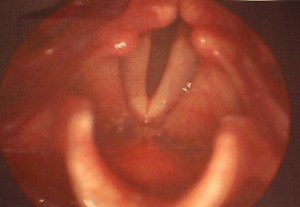
Voice differences have roots in biological sex difference. With the onset of puberty, the larynx is enlarged and vocal folds increase in length and in thickness, resulting in a decrease in frequency (Hz) of vocal fold vibration and thus a lowering of voice pitch. But while bodies classified as biologically female experience about a one-half octave average drop in voice pitch with puberty, biological males tend to experience a full octave average drop in pitch, with the result being that adult male voices tend to operate within a lower frequency range than female voices. However, gendered constructions of the human voice vary widely over time and place.
Biology (body size, hormonal secretions, age, and other physiological factors) is no way destiny when it comes to the human voice. Linguists distinguish between “anatomical voice quality features,” which in essence set the parameters of comfortable pitch range given a person’s vocal anatomy (the range outside of which is difficult to easily maintain one’s speaking voice) and “voice quality settings,” which refers to where someone places their voice within that range (See Monique Adriana Johanna Biemans’ thesis, Gender variation in voice quality.) Bound to some degree by these physiological parameters, humans can and do place their voices in ways that are consistent with the performative aspects of gender, and voice pitch is both highly variable and subject to cultural/historical framing and self-fashioning (For more on this subject, see Anne Karpf, The Human Voice: How this Extraordinary Instrument Reveals Essential Clues About Who We Are, 2006). Thus like other aspects of gender, voice is culturally and historically constructed and performative.
Conceptualizing the voice as a sonic expression of the gendered body requires revisiting both the tendency of feminist scholars to equate “women’s voice” with writing or discourse, and the tendency of some media scholars to refer to voices without immediate visual referent (in film, radio) as “disembodied.” In their Introduction to Embodied Voices: Representing Female Vocality in Western Culture (1997), Leslie C. Dunn and Nancy A. Jones concisely articulate the challenge for scholars interested in the sonic/acoustic dimensions of women’s voices:
Feminists have used the word “voice” to refer to a wide range of aspirations: cultural agency, political enfranchisement, sexual autonomy, and expressive freedom, all of which have been historically denied to women. In this context, “voice” has become a metaphor for textual authority…This metaphor has become so pervasive, so intrinsic to feminist discourse that it makes us too easily forget (or repress) the concrete physical dimensions of the female voice upon which this metaphor was based. (1)
Thinking about voice in terms of vocal gender brings us to the complex relationship between voice and body. The concept of disembodiment conveys the sometimes uncanny effect of hearing (especially female) voices without an immediately discernible source. It also underscores the destabilizing effect of these unseen female voices liberated thus from patriarchy’s specular regime. Yet to refer to voices from an unseen source as “disembodied” is to suggest that the voice is somehow separate from the body, a problematic formulation.
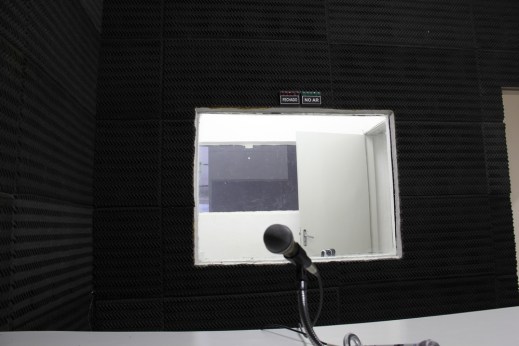
Simply: if the voice is not the body, what is it? Even when it travels over long distances (via telephone or radio, for example) and/or if its source remains out of sight, the body is there, present via the sound vibrations it produces. Stepping away from concepts like disembodiment frees us to explore the nuances of the relationship between the voice and the body, and the presence of gendered bodies in the soundscape, particularly with regard to the vertiginous relationships between bodies and voices that are gendered female.
Gender and history impact how we read the tone, velocity and pitch of the voice, but they also shape parameters of where and when particular voices are invited to speak or expected to remain silent. And here of course we encounter the ways gender hierarchy is expressed and constructed in the acoustic/vocal arena, as well as racial categorization. Kathleen Hall Jamieson puts it succinctly in Eloquence in an Electronic Age: The Transformation of Political Speechmaking (1990): “History has many themes. One of them is that women should be quiet” (67). While by no means absent, women’s voices have remained largely outside of the realm of what Schafer calls “signal”: sounds listened to consciously and that often convey messages and/of authority. Just as other aspects of gender inequality become naturalized, patriarchy tunes our ears to listen to certain voices differently. In these formulations, women’s voices are thus subject to categorization as “noise” or “unwanted sound” (see Mike Goldsmith, Discord: The Story of Noise) and therefore dissonant, disruptive, and potentially dangerous.
The discomfort (or dissonance) with women’s voices, especially women’s voices speaking publicly and/or with authority, carried over into and shaped the history of radio, making early and golden age broadcasting an ideal venue for an historical exploration of gender and voice. What did it mean to hear women’s voices on the radio? How did radio rework the gendered dimensions of public and private space, and by extension the place of the female voice in the public sphere?
The emergence of radio in the early twentieth century was part of a larger revolution in human communication which Walter Ong termed in Orality and Literacy: The Technologizing the Word (1983) a “secondary orality,” an historical moment which reawakened older oral traditions and communal listening in a very different historical and technological context (3). It also reawakened a focus on the human voice, with all of its implications for the gendered soundscape.
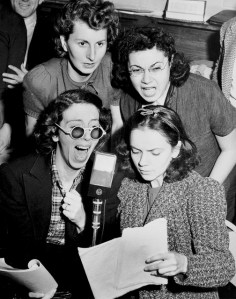
In many parts of the world, the rise of radio also coincided with an upsurge in feminist politics and discourses calling for women’s full citizenship and other related matters. As Kate Lacey notes in Feminine Frequencies: Gender, German Radio and the Public Sphere 1923-1945 (1997), “the arrival of radio heralded the modern era of mass communication, while women’s enfranchisement confirmed the onset of mass politics in the twentieth century.” Researching the history of women and radio – and particularly the sometimes hostile reactions to women’s radio voices – led me to appreciate the ways gender is performed and perceived via the voice, and from there into larger questions about the way social hierarchies – of gender, but also of race/ethnicity, class and sexuality – are reproduced and challenged within the sonic realm.
In this way we can better begin to contemplate the historical significance of women’s radio speech in understanding the sonic construction of gender. Depending on content and context, these voices carried the potential to not only challenge taboos on women’s oratory, but to assert the female body into spaces from which it had previously been excluded—like the cockpits (can’t help but note the name here) of commercial airliners.
–
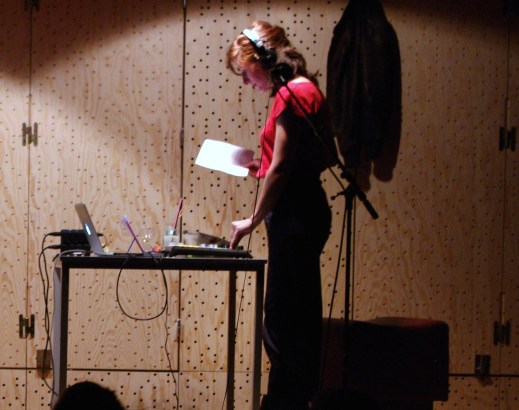
Featured image: “ateliers claus – 140522 – monophonic – Radio Femmes Fatales” by Flickr user fabonthemoon, CC BY-NC-SA 2.0
–
Christine Ehrick is an Associate Professor in the Department of History at the University of Louisville. Her second book, Radio and the Gendered Soundscape in Latin America: Women and Broadcasting in Argentina and Uruguay, 1930-1950 will be published by Cambridge University Press in Fall 2015. This book explores women’s presence and especially their voices – on the airwaves in the two leading South American radio markets of Buenos Aires and Montevideo. Her current work looks at comedy, gender and voice, with a focus on mid-twentieth century Argentine comedians Niní Marshall and Tomás Simari.
Thanks to Cambridge UP for allowing me to use some excerpts from the forthcoming book in this essay.
–

REWIND! . . .If you liked this post, you may also dig:
Look Who’s Talking, Y’all: Dr. Phil, Vocal Accent and the Politics of Sounding White– Christie Zwahlen
On Sound and Pleasure: Meditations on the Human Voice– Yvon Bonefant
Heard Any Good Games Recently?: Listening to the Sportscape–Kaj Ahlsved
—
Share this:

The New Wave: On Radio Arts in the UK

DOI: https://doi.org/10.59350/xap2w-ja998
In the UK there has never been much scope for radio art within the realm of public service broadcasting, leading artists to seek funding for their own independent projects, predominantly from the Arts Council of England (ACE) and other state funding bodies and charitable trusts. In this article, the final in Sounding Out!‘s series Radio Art Reflections, I will consider this recent avenue of practice, because its results – in terms of audience composition, artistic output and the wider cultural context of the form – shed light on both the particular context of radio art practice in the UK, and also have implications for the wider struggle for sustainable independent media networks against the diminished imaginative horizons of a public broadcast culture endlessly inured to ‘unavoidable’ cuts and the free market enclosure of the digital commons.
In the name of ‘austerity’ such cuts have been inflicted upon broadcasters worldwide. The loss of key radio arts programmes like Australia’s Listening Room, as discussed in the last post by Colin Black, is by no means the exception, even in an age of expansion in digital spaces. As De Lys stated way back in 2006 it may be considered “[i]ronic that the ‘rationalization’ of radio arts by public broadcasters occurs at the same time that audio arts activity and the creative use of sound are expanding exponentially in community spaces, in galleries, games, and online.” (De Lys, S and Foley, M; 2006, “The Exchange: A Radio-Web Project for Creative Practitioners and Researchers” Convergence; The International Journal of Research into New Media Technologies, 12; 129, Sage)
Elsewhere, institutional affirmation through public broadcasting connects local, national and international art radio broadcasters, as it also empowers two long running international radio art competitions that continue today: the Prix Italia set up by RAI, in 1948, to engage creatives to work with radio and create new works for the medium; and the The Karl Sczuka Prize for Radio Art, established by SWR in Germany in 1955, notable (sadly) for how so few women artists have ever won the awards. For Kersten Glandien, contributing to the Reinventing The Dial symposium back in 2009, the availability of public radio funding in the 80s and 90s enabled a heyday of commissions and festivals, events and prizes (Glandien, K; 2009. Keynote Paper given at Reinventing the Dial Symposium. Canterbury Christ Church University).

No such radio art competition or open call for new radio art work has ever been run by the BBC, highlighting its resistance to the form. At present the BBC runs just one experimental programme that has been on air for 20 years: Between The Ears on BBC Radio 3, which leans towards more narrative-centered features reflecting Black’s issues with ABC’s Soundproof discussed in the last article.
ART STATIONS AND COMMUNITY RADIO IN THE UK
The first experimental art radio station in the UK went on air in Liverpool for a week in 1995, Hearing is Believing on 105.8FM. As Scanner wrote at the time it offered the chance for listeners to hear “sound works, performance and innovative documentaries that would never receive airplay on even the most ‘progressive’ FM bands. Remember, BBC Radio still has problems playing certain works of Stockhausen because they contain randomly-culled shortwave radio signals.”(The Wire, 1995). That inspired the London Musicians Collective to run its own month long arts station in Resonance 107.3FM in 1998. I was part of its action group and then its steering group as the station went full time in 2002.
Tight regulation across public and commercial radio in the UK also meant that artists were late to explore the medium. Trevor Wishart reminisced with me at Radio Without Boundaries about a radio piece he made with the BBC in mind that took over 28 years to be played on the radio in the UK, being not sufficiently ‘musical’ for a music station and not ‘dramatic’ enough to fulfill the conventions of drama.
In this context, community radio has been an important if limited platform and nurturing site for new radio art. There are now over 200 such stations in the U.K. but only two dedicated to the arts community: Resonance FM and Soundart Radio at 102.5 FM, the latter based in Devon since 2006. Soundart Radio exists on a hand-to-mouth basis via small grants to provide training for disadvantaged groups. Resonance FM, by contrast, has achieved regular funding by walking a line between its community status and its avant garde roots. Its success is due largely to its location and the exceptional work of volunteer artists and musicians who have developed innovative programming without budgets.
Arts Council England increased Resonance’s funding as it became a ‘national portfolio organisation’ in 2012. The station may tower over other most community stations, but its yearly funding is still only comparable with that of many regional arts festivals. Moreover, radio art is only a small part of what Resonance broadcasts, and is mostly scheduled as discrete programmes such as Radia, and as less frequent one-off programming such as Remote Performances a collaboration between London Fieldworks, the Live Art Development Agency and ACE, broadcasting 20 live mostly music based performances for a week from Glen Nevis, Lochaber, Scotland.
FUNDING RADIO ARTISTS
Open funding for artists directly from community radio stations is very limited and ad hoc. The Community Media Association was able to offer small commissions for Modulate, an open call to encourage artists to team up with community stations to encourage more arts diversity and address the fact that around “70 per cent of the community radio sector’s programming is music-based” (CapeUK, 2008, p.08). Meanwhile, Art Transmission was a welcome one-off project early this year run by Francis Knight who commissioned three sound artists including Jane Pitt and Xentos Jones to work with young boxers and steam railway enthusiasts to make radio works for the small community station BRFM on the Isle of Sheppey. A recent CapeUK report concluded that Community radio “offers creative and artistic freedom to their contributors unmediated by the editorial control exercised in commercial or public service broadcasting.” (CapeUK, 2008, p.20).

It would be naive to imagine editorial constraints do not exist in the community radio sector. This is perhaps why several British artists have gone it alone to retain autonomy by running their own short durational arts stations as Restricted Service Licenses for projects which run for up to 28 days and can broadcast up to 25 watts, such as Kaffe Matthews Radio Cycle (2003) and Tom McCarthy and INS Calling All Agents (2004), Celestial Radio (2008), Boat Radio (2012), Writtle Calling (2012), Radio Boredcast (2012) and The Dark Outside (2012-14) all funded by The Arts Council. This marks an increasing trend in the UK of artists-curated FM stations.
Grants for the Arts from ACE offers a way for artists to receive funding to make new work. My own group Radio Arts has, through funding from ACE and Kent County Council, been able to recently commission new radio art works for broadcast from Colin Black (AU), Arturas Bumsteinas (LITH), Iris Garelfs (GER), Anna Friz (CAN), Louise Harris (UK),Olivia Humphreys (UK),Langham Research Centre (UK), GX Jupitter- Larsen (US), Carlo Patrao (PORT), Mikey Weinkove (UK),Joaquim Cofreces (Argentina), Esther Johnson (UK), Michael McHugh (UK), Gregory Whitehead (USA), as well as Radio Arts members Genetic Moo, myself and James Backhouse (UK). Radio Arts ran a series of workshops, a radio art showcase exhibition and will be running a forthcoming live event and online gallery and further workshops next year alongside broadcasts of the new works to be heard on eight partner stations in four countries.
However, such work can only continue with further funding. For me it is important to move away from the current creative commons ethos, where no one is ever paid to participate. We should allow sound and radio artists to gain a fee to produce new radio work, particularly as the Artist Network in the UK is campaigning for artists to be paid in galleries.
MICROBROADCSTING AND ARTS SPACES
Another interesting area which has taken off from Japanese radio artist Tetsuo Kogowa is micro broadcasting, the use of small range transmitters allowing artists to broadcast in a localized space of up to one watt, without the need for a license, either by building the transmitters or buying them readymade. These work well for radio installation and have allowed me to continuously play works as discrete stations and produce surround works allowing a different voice or sound to emanate from each radio in the installation. For eight years, mostly unfunded, I worked on Switch Off a PhD radio art project documented on my blog creating eight different fictional stations as micro broadcast installations each imaging a future use for FM when it has been abandoned in the UK these works explored radio art practice from a post digital perspective.
.
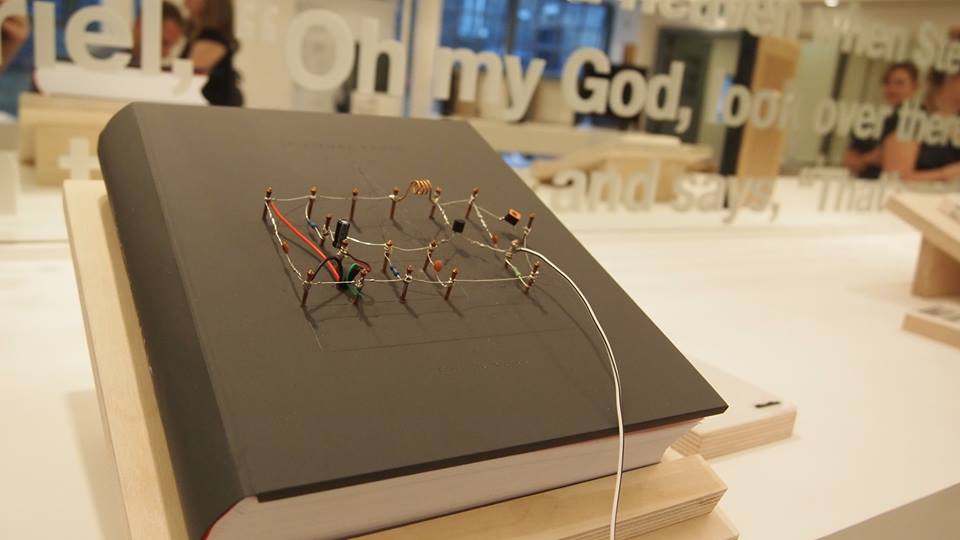
Micro broadcasting these works proved to be a very liberating way of sharing radio art work in galleries and outside of conventional radio broadcasts and allowed me to really experiment without constraint, whilst the web has brought me closer with other international artists and communities to share practice and projects. Having used radios as a readymades for multiple and surround installations my experience has led me to new ways of thinking about installation work such as a bespoke transmitting book Spiritual Radio 2014, which broadcasts itself and awaits the listener to find its frequency.
Following this line, many online arts stations have been set up by galleries and arts spaces, often as temporary projects. Online arts station Basic FM started in 2011, and was a project of Newcastle independent cinema Pixel Palace having hosted Vicki Bennett’s Radio Boredcast at the AV Festival (2012). It “presented an audio gallery that exhibited the work of those making interesting noise: sound collage, found sound, spoken word, discourse, dialogue and discussion, musique concrète or original, remixed and detourned musics” (Basic FM, 2014, website). Run by one part-time member of staff and funded by the Arts Council to run for thirty months until 30th Sept 2014 Basic FM did not carry on due to lack of further funding, a real loss after it steadily building up its reputation as the third full time arts station in the UK.
It seems that in the UK the lack of artistic airspace on public and community radio has been sidestepped by radio artists who have forged their own stations to redefine public space in myriad forms. And there are possibilities in the future. The latest temporary UK arts station call comes from the well regarded CCA Gallery Glasgow Radiophrenia next year, while London’s Tate Britain is currently running a family programme Radiocity and its community programmes have commissioned myself and Jim Backhouse from Radio Arts to run a series of workshops called Reclaim the Waves from the end of February, working with the local Westminster community to document the changing city and produce a participatory radio installation for exhibition.

—
Magz Hall is a sound, radio artist and founder of Radio Arts an artist led group who promote radio art. Her work has been exhibited in the British Museum, the Sainsbury Centre, MACBA Barcelona, Denmark, Italy, Germany, Norway, Morocco, Canada and the USA and broadcast internationally. Her ambisonic soundtrack of Hong Kong Airport at the British Museum was described as “extraordinary and rich.” Radio Mind (2012) an “intriguing and beautiful work” was commissioned by the Lightworks Festival. Her most recent work Spiritual Radio (2014) “looks like a hardback on life support” (TLS) was commissioned for ‘Unbinding the Book’a touring exhibition. A senior lecturer at Canterbury Christ Church University and a founder of London’s arts station Resonance FM, she has just completed a practice based PhD on radio art at CRISAP, LCC, University of the Arts London entitled Radio After Radio: Redefiningradioart in the light of new media technology through expanded practice.
—
Images courtesy of the artist.
—

REWIND! . . .If you liked this post, you may also dig:
Sound and Curation — reina alejandra prado
From Kitschy to Classy: Reviving the TR-808 — Ian Dunham
Revising the Future of Music Technology — Aaron Trammell
—
Share this:




Current Top Posts





April 2021

January 2020

November 2019

October 2019

August 2019

April 2014

November 2017

March 2015

December 2017

October 2015


Recent Comments