
Sound at SCMS 2013

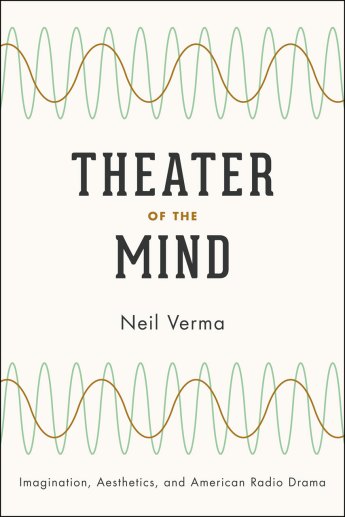
For the 2013 Society for Cinema and Media Studies meeting in Chicago, Sounding Out! enlisted one of our favorite guest writers, radio scholar Neil Verma (whom you’ll remember from our excellent Tune Into the Past series from summer 2012). When we heard the news that his recent book Theater of the Mind: Imagination, Aesthetics and Radio Drama (University of Chicago Press) won this year’s SCMS first book prize we were ecstatic. . .and not surprised in the least. It’s brilliant–for a taste read Neil’s SO! blog post from June 2012, “Radio’s “Oblong Blur”: Notes on the Corwinesque”). So, please join us in congratulating Neil, and then, join Neil for a thoughtful preview of sound studies at SCMS 2013. He’s one of the reasons why it’s such a great year for the field. —Editor-in-Chief, Jennifer Stoever-Ackerman
—
For the Society for Cinema and Media Studies (SCMS), this year may mark the point at which sound studies became – likely temporarily, and perhaps distressingly – normal. That’s something to ponder at this year’s annual conference of the Society, which takes place from March 6th to the 10th at the Drake Hotel in Chicago.
SCMS last came to the Second City in 2007. A glance at the panels from that year highlights how quickly the conference has expanded. If you exclude ads, this year’s program is 80 pages longer than its counterpart six years ago. Back then, SCMS featured 323 panels and workshops. This year there are 456. And sound studies work has grown disproportionately. In 2007, by my count, there were just 13 panels with two or more papers featuring sound as an “analytical point of departure or arrival,” to borrow language that Jonathan Sterne has recently used to characterize the field. This time we have 31 such panels.
That’s a lot of foot traffic. And it’s extremely good news for the field. But if these trends continue, it is also true that visitors focused on sound may only be able to attend a fraction of all panels and papers on the subject. As a result, sound has transformed from one possible pathway through SCMS into a field of many possible itineraries. Not only is the durability of that situation tenuous, but its intellectual ramifications are as unclear as they are promising.
A Conference in Transition
As it grows, the SCMS conference is restructuring. In a move sure to stir controversy, for instance, the Society has taken the experimental step of dramatically scaling back its slate of screenings, citing poor attendance at such events during recent conferences in Boston and New Orleans. Seen in conjunction with other developments – a focus on social media (follow @SCMStudies on Twitter), expanded online video, and a marvelous new podcast sponsored by Cinema Journal – the reduction of screenings represents a small step away from the cinema as a privileged object of study and experience.
That idea is borne out by the offerings. This year’s conference features as much exciting work on Call of Duty as on The Clock, with more papers on Girls than on Godard, along with compelling offerings on topics ranging from Rancière to Revenge, from Warhol to Lego, and home movies to Grindr. The word “television” appears on 58 pages of the current catalog; back in 2007 it appeared on just 14. As Barbara Klinger points out in her introduction to the program, this year truly elevates the “M” for “Media” in “SCMS.”
Skeptics may see a conference drifting from its raison d’être, while optimists will see an increasingly capacious meeting that is willing to undertake the experimentation for which many members have long been calling. As the conference grows, both sides can expect perhaps less intimacy than in previous years, with more of the action localizing around Caucuses and Scholarly Interest Groups (SIGs).
That’s true for sound. This year marks the debut of a new Radio Studies SIG, recognizing an area of scholarship that has been growing steadily for decades. Congratulations to Bill Kirkpatrick and Alex Russo, among others, for bringing this about. Readers interested in the radio SIG should hop over to Antenna to read Kirkpatrick’s terrific piece on the emergence of radio studies at SCMS this year (and be sure to catch his paper on disability and radio on Saturday at 1:00). In conjunction with the Sound Studies SIG, which has been driving a sound agenda since Jay Beck and Tony Grajeda helped form it in 2007, the Radio SIG is sure to be a magnet for future presenters and an advocate within the institutional SCMS structure.
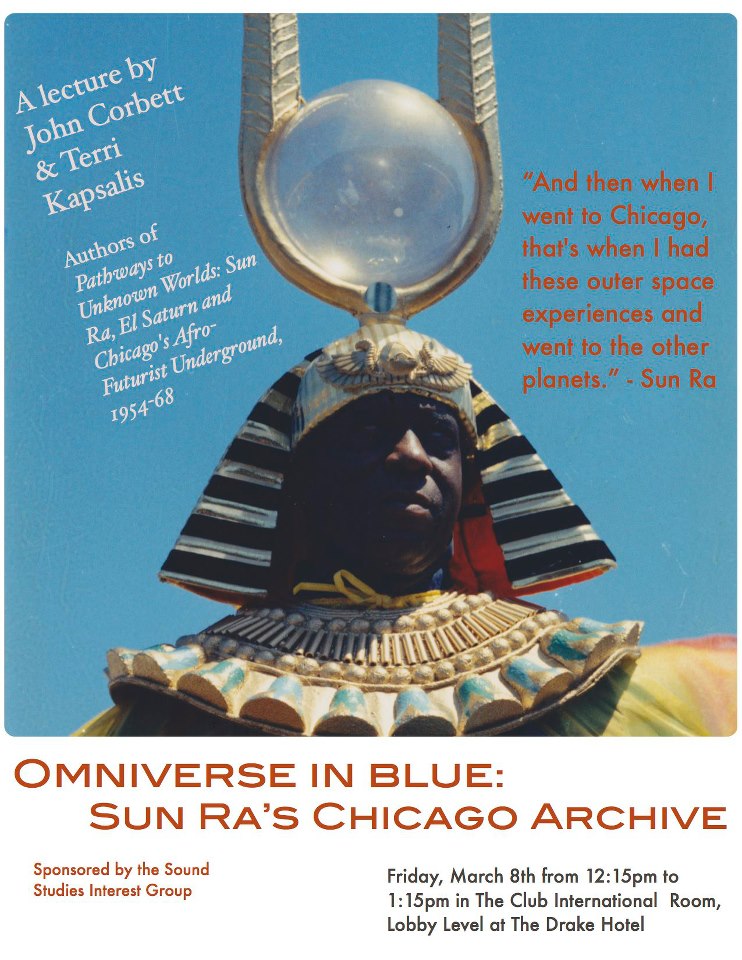
The Radio SIG’s inaugural workshop features leading scholars to explore critical approaches (9:00 – 10:45 on Saturday), and that should be at the top of the agenda for SO! readers. I’m pleased to report that the Radio SIG’s first official meeting (9:00-10:45 on Sunday) will feature special guest Johanna Zorn, founder and Executive Director of the Third Coast International Audio Festival. The Sound SIG, meanwhile, helmed by Norma Coates and Tim Anderson, will hold its annual meeting on Friday (12:15-2:00) with an exciting presentation by John Corbett and Terri Kapsalis, who will speak about Sun Ra and his place in the history of Chicago sound and visual culture. Beyond these marquee events, these two SIGs together will sponsor a total of 13 panels this year.
That’s already quite an itinerary. Now let’s look deeper.
Further Highlights
In her SCMS post last year, Jennifer Stoever-Ackerman called for an effort to reimagine sound studies in the larger architecture of SCMS. She wrote,
Very few panels engage with sound as a primary modality and there are far less individual papers threading sound into panel discussions not explicitly about sound. We need more of both kinds of scholarly engagement […]
Indeed. While many problems persist, including an uneven focus on music – it’s odd to see so little on music in a city rich in its history, from Bronzeville to Bloodshot Records – this year’s offerings also show great progress. Panels that engage sound as a primary modality have fresh takes on established subjects (Hollywood film music, voice narration in documentary, archiving, etc.) but many also raise subjects that SCMS might have been wary of in previous years, such as earth-sensing, sound in film noir and video game sound. And there is tremendous creativity in individual papers, with scholars engaging topics from sound in Yiddish Cinema and Russian pop to the Black audio film archive and player pianos in education, all sprinkled among panels considering other issues. There are not one but two papers about sound in Terrence Malick’s films, in two separate panels, neither of which is about sound.
What other goodies can you find this year? I’m glad you asked. Here are some highlights
- There are a couple of terrific panels on gender and sexuality this year. I’d recommend starting off your visit to SCMS by attending a panel on film music that Norma Coates is hosting on Wednesday (10:00-11:45), and following up with Jennifer Wang’s panel “Gender Trouble across the Dial” on Friday (9:00-10:45).
- On Thursday (from 9:00 to 10:45) I’m pleased to be chairing a panel with Jacob Smith, Mary Ann Watson, Shawn VanCour, and Alex Russo considering radio writer Norman Corwin as a transmedia author, continuing a project that we started on this blog last summer. Those interested in sites of overlap between radio and other media institutions should also check out “Radio in Transition” (Friday, 11:00-12:45), chaired by Cynthia Meyers, and “Economies of Media Industries” (Saturday, 3:00-4:45), featuring Jim Lastra and Douglas Gomery.
- The panel “Earth-Sensing” (Wednesday, 2:00-3:45) looks compelling, with work by Lisa Parks on broadcast infrastructure and Google Earth, as well as a presentation by Janet Walker on audiovisualizations of sea level rise. It might pair well with a panel on deep history later that day (4:00-5:45) which will feature, among other topics, Mack Hagood speaking on the work of Irv Teibel.
- Another great pairing is available on Friday. Try attending “Sounding the Radio Archive” (12:15-2:00), with projects from junior scholars and a response from Debra Rae Cohen. Then check out “Live Sound in Film and Television” (2:15-4:00), featuring exciting work on rockumentary by Michael Baker and sound in situation comedy by Foley artist Vanessa Ament-Gjenvick. Together, these panels should give newcomers a good sense of the future of sound studies.
- One theme that has emerged this year is a renewed interest in processes of adoption and incorporation of sound technology. For that, consider attending “Transitional Soundtracks” on early Hollywood film music (Thursday, 3:00-4:45), “Channeling Stereo Histories” (Saturday, 5:00-6:45), and “Rethinking Technologies of Audiovision” (Sunday, 9:00-10:45).
- There are two panels on sound in the mass media in Japan, each in a different period: “Archeologies of Intermediality in Prewar Japanese Cinema” (Friday, 2:15-4:00) and “Japanese Celebrity Cultures” (Saturday, 5:00-6:45). Only one is sponsored by Sound Studies, so the appearance of both may be a fortuitous coincidence.
- Another cluster of panels forms around issues of voice, talk, and orality. On Wednesday, there’s “Orality and Storytelling” (10:00-11:45), followed by “Speech, Music and the Sound of Film and Media” (12:00-145). On Thursday, there’s “Spectators: Sound and Talk” (1:00-2:45) and “Vocal Projections: The Disembodied Voice in Documentary” (5:00-6:45). Then on Saturday there is “The Actor’s Voice” (1:00-2:45) and “Cinema Sound, Music, and Voice” (3:00-4:45).
- Don’t forget the workshops! There’s great stuff this year on platform studies, spreadable media, and close reading, as well as several meetings on teaching and job searching. Attending these will give you a chance to hear from Mary Ann Doane, Michele Hilmes, Henry Jenkins, Peter Krapp, Jason Loviglio, Jason Mittell, Elena Razlogova and Jonathan Sterne, to name just a few.
That’s a lot of material, and it’s not even everything, which is precisely my point. For maybe the first time, SCMS has far more sound studies material than you can feasibly attend.
So is it time to indulge the pernicious scholarly habit of naming a moment of change and uncertainty as one of emergence? Should we declare that sound has come of age at last, a cliché that, as Michele Hilmes has pointed out, sound studies has been using for a hundred years?
Let’s not and say we did. There’s much more to do in terms of diversifying objects and cultures for sonic exploration. And rather than seeing papers that study sound in new ways, I’d love to see future presenters using sound in innovative ways to think about objects and events well outside the perimeter of sound studies, drawing experimental modes of listening in to the conference experience and challenging how scholarship itself is fashioned and displayed.
As well as being a point of analytical departure and arrival, after all, sound is also a way of traveling between points. Sterne is right when, in the introduction to The Sound Studies Reader, he argues that sound studies should be a place where sonic imaginations are “challenged, nurtured, refreshed and transformed” (10), but sound studies can do that for other kinds of imaginaries, too. Sound is a medium to be studied, but it is also a way of doing media studies, and that is a property that should be highlighted in a scholarly society open to transition.
Or, to put it another way, as sound scholarship worms its way ever further into the mainstream of SCMS, let’s do our best to keep it weird.
—
Note: Below I’ve listed times for panels that I’m guessing will be of most interest to SO! readers, plus special events and a few sessions that touch on professional matters. This year, SCMS has not released the room assignments on the PDF circulated prior to the event, so attendees will have to find that information in the printed catalog. I’m sorry for any errors or omissions. If your panel is missing or I’ve made some other mistake, please email me at nkhverma@gmail.com and I’ll be happy to amend this post.
—
Neil Verma is a Harper-Schmidt Postdoctoral Fellow at the University of Chicago, where he teaches media aesthetics. Verma works on radio and its intersection with other media, and has taught subjects including film studies, sound, art history, literature, critical theory and intellectual history. His book, Theater of the Mind: Imagination, Aesthetics, and American Radio Drama, is published by the University of Chicago Press and is the winner of the 2013 SCMS First Book Prize.
Jump to WEDNESDAY, March 6
Jump to THURSDAY, March 7
Jump to FRIDAY, March 8
Jump to SATURDAY, March 9
Jump to SUNDAY, March 10
WEDNESDAY, MARCH 6
Session A 10:00 – 11:45 a.m.
A19. Film Music: Gender, Sexuality, and Taste Formations
Chair: Norma Coates, UNIVERSITY OF WESTERN ONTARIO
Jack Curtis Dubowsky, ACADEMY OF ART UNIVERSITY, “Louisiana Story, Homoeroticism, Hollywood, and Americana Music”
Landon Palmer, INDIANA UNIVERSITY, BLOOMINGTON, “Pre‐existing Film Music as Traveling Text: The Case of 2001: A Space Odyssey”
Zhichun Lin, OHIO STATE UNIVERSITY, “Presenting Her through Music: The Theme Music of the Chinese Film Version of Letter from an Unknown Woman”
Norma Coates, UNIVERSITY OF WESTERN ONTARIO , “‘5% of It Is Good’: Leonard Bernstein, CBS Reports, and the Cultural Accreditation of Rock Music”
.
A22. Orality and Storytelling
Chair: Sheila Petty, UNIVERSITY OF REGINA
Kester Dyer, CONCORDIA UNIVERSITY, “Storytelling and Testimony: Archiving Melancholia in Alanis Obomsawin’s Kanehsatake: 270 Years of Resistance”
Katherine Brewer Ball, NEW YORK UNIVERSITY, “The ‘Brainwashing’ of Patty Hearst and Sharon Hayes: Forging Alliances and Forgetting the Lines”
Yifen Beus, BRIGHAM YOUNG UNIVERSITY, HAWAII, “Deterritorializing Essentialism: Narrating Place and Space in Filming the South Seas”
Sheila Petty, UNIVERSITY OF REGINA, “Spaces in‐Between: Zahra’s Mother Tongue as Performative Documentary”
.
Session B 12:00 – 1:45 p.m.
B19. Speech, Music, and the Sound of Film and Media
Chair: Heather Warren‐Crow, UNIVERSITY OF WISCONSIN‐MILWAUKEE
Nishant Shahani, WASHINGTON STATE UNIVERSITY, PULLMAN, “‘I Have a Voice’: Speech, Silence, and the Redemption of Empire”
Eric Dienstfrey, UNIVERSITY OF WISCONSIN‐MADISON, “New Methods of Multichannel Surround Sound Analysis and Contemporary Film Aesthetics”
Brian Fauteux, UNIVERSITY OF WISCONSIN‐MADISON, “Satellite Sounds and the Transnational Circulation of Music”
Heather Warren‐Crow, UNIVERSITY OF WISCONSIN‐MILWAUKEE, “The Phonetics of Early Video Art”
.
B21. Workshop on Publishing on Digital Platforms
Chair: Christopher Hanson, SYRACUSE UNIVERSITY
Co‐Chair: Joan Saab, UNIVERSITY OF ROCHESTER
Kim Akass, UNIVERSITY OF HERTFORDSHIRE
Norm Hirschy, OXFORD UNIVERSITY PRESS
Jennifer Porst, UNIVERSITY OF CALIFORNIA, LOS ANGELES
John David Rhodes, UNIVERSITY OF SUSSEX
Andrew Young, UNIVERSITY OF CALIFORNIA, LOS ANGELES
.
Session C 2:00 – 3:45 p.m.
C4. Character and Performance
Chair: Matthew Solomon, UNIVERSITY OF MICHIGAN
Ganga Rudraiah, INDEPENDENT SCHOLAR, “Singing and Dancing like an ‘Aravaani’: Emerging Articulations of Transgender Performances in Contemporary Tamil Cinema”
Kim Wilkins, UNIVERSITY OF SYDNEY, “Cast of Characters: The American Eccentrics and Pure Cinematic Characterization”
Elizabeth Alsop, WESTERN KENTUCKY UNIVERSITY, “The Imaginary Crowd: Neorealism and the Uses of Coralità”
.
C20. Earth‐Sensing: Media Above and Below the Surface
Chair: Nicole Starosielski, NEW YORK UNIVERSITY
Co‐Chair: Janet Walker, UNIVERSITY OF CALIFORNIA, SANTA BARBARA
Janet Walker, UNIVERSITY OF CALIFORNIA, SANTA BARBARA, “Moving to Higher Ground?: Documentary Film and (Other) Scientific Audiovisualizations of Sea Level Rise”
Lisa Parks, UNIVESITY OF CALIFORNIA, SANTA BARBARA, “Signal Territories: Studying US Broadcast Infrastructure Using Google Earth”
Eva Hayward, UNIVERSITY OF NEW MEXICO, “Technologies of Migration: Conservation Science and Whale Media”
Nicole Starosielski, NEW YORK UNIVERSITY, “Sensing the Seafloor: Undersea Observatories and the Contours of Media Distribution”
.
C21.Workshop on Platform Studies: Debating the Future of a Field
Chair: Caetlin Benson‐Allott, GEORGETOWN UNIVERSITY
Ian Bogost, GEORGIA INSTITUTE OF TECHNOLOGY
Jonathan Sterne, MCGILL UNIVERSITY
Steven Jones, LOYOLA UNIVERSITY, CHICAGO
Peter Krapp, UNIVERSITY OF CALIFORNIA, IRVINE
.
Session D 4:00 – 5:45 p.m.
D12. Deep History II Insight from Artifacts
Chair: Mack Hagood, INDIANA UNIVERSITY
Kyle Stine, UNIVERSITY OF IOWA, “Cybernetic Movie Machines: Norbert Wiener’s Cinema Integraph and Richard S. Morse’s Data Soundtracks”
Sindhu Zagoren, UNIVERSITY OF NORTH CAROLINA‐CHAPEL HILL, “We Want the Airwaves: Early Radio and the Struggle for Airspace”
Mack Hagood, INDIANA UNIVERSITY, “Nixon, Mobster, Bigfoot: The Performative Audio Media Forensics of Irv Teibel”
.
WEDNESDAY INDIVIDUAL PAPERS OF INTEREST
A 12. Veronica Zavala, UNIVERSITY OF CALIFORNIA, SANTA BARBARA, “The Role of Spanish Language Radio in the United States”
B7. Brian Gregory, COLUMBIA UNIVERSITY, “Packaging Sound for Schools: Selling the Player‐Piano and the Phonograph to American Education”
C12. Matthew Malsky, CLARK UNIVERSITY, “Early CinemaScope Sound Experiments”
D4. Lauhona Ganguly, AMERICAN UNIVERSITY “Production Cultures and Cultural Re‐Productions in a Global Television Industry: Rethinking Global Cultural Economy with Indian Idol”
D7. David Harvey, UNIVERSITY OF IOWA, “Rethinking Voice in the Essay Film Form”
.
Special Events Wednesday Evening
6:00 – 8:00 pm
Caucus/SIG special event
Remembering the Life & Legacy of Alexander Doty
Grand Ballroom, Lobby Level
.
6:00 – 9:00 pm
Caucus/SIG special event
Public Media 2.0
A Conversation on the Future of Urban Documentary and Social Change
Museum of Contemporary Art, 220 E. Chicago Avenue
THURSDAY, MARCH 7
Session E 9:00 – 10:45 a.m.
E9. Sounds and Silences
Chair: Charles Kronengold, STANFORD UNIVERSITY
Chelsey Crawford, OKLAHOMA STATE UNIVERSITY, “Sound Off: Absolute Cinematic Silence and the Unconscious”
Manuel Garin, UNIVERSITY OF POMPEU FABRA, “Silent Film Gameplay: Keaton, Mario, and the Misadventures of Visual Freedom”
Charles Kronengold, STANFORD UNIVERSITY, “Puzzling Interfacing, Musical Thinking, and Multisensory Experience”
.
E16. Workshop. Scholarly Social Media: Successes, Failures, and Future
Chair: Elizabeth Ellcessor, INDIANA UNIVERSITY
Gina Giotta, CALIFORNIA STATE UNIVERSITY, NORTHRIDGE
Dan Leopard, SAINT MARY’S COLLEGE OF CALIFORNIA
Jamie Poster, IRVINE VALLEY COLLEGE
Andrew Miller, SACRED HEART UNIVERSITY
Leah Shafer, HOBART AND WILLIAM SMITH COLLEGES
.
Session F 11:00 – 12:45 p.m.
F22. Norman Corwin and Transmedia Authorship
Chair: Neil Verma, UNIVERSITY OF CHICAGO
Jacob Smith, NORTHWESTERN UNIVERSITY, “Norman Corwin’s Radio Realism”
Mary Ann Watson, EASTERN MICHIGAN UNIVERSITY, “Norman Corwin and the Big Screen: Artistic Differences”
Shawn VanCour, UNIVERSITY OF SOUTH CAROLINA, “Corwin on Television: A Transmedia Approach to Style Historiography”
Alexander Russo, THE CATHOLIC UNIVERSITY OF AMERICA, “Sonic Legacy: Exploring the ‘Corwinesque’ in Radiolab”
.
Session G 1:00 – 2:45 p.m.
G13. Spectators: Sound and Talk
Chair: CarrieLynn Reinhard, DOMINICAN UNIVERSITY
Leo Rubinkowski, UNIVERSITY OF WISCONSIN‐MADISON, “‘When You Know the Words to Sing . . .’: Sing‐Along Exhibition and Participatory Audiences”
Annie Dell’ Aria, THE GRADUATE CENTER, CUNY, “Doug Aitken’s Song 1: Cinema‐in‐the‐Round”
Carter Moulton, UNIVERSITY OF WISCONSIN‐MILWAUKEE, “Reading Accents: Subtitles and Spectatorship in Multiplex Cinema”
CarrieLynn Reinhard,DOMINICAN UNIVERSITY, “Answering the Whats, Hows, and Whys of Film Spectatorship: An Empirical Investigation and Comparison of Film Reception”
.
Session H 3:00 – 4:45 p.m.
H16. Transitional Soundtracks: The Vicissitudes of Hollywood Film Music, 1927–1933
Chair: Katherine Spring, WILFRID LAURIER UNIVERSITY
Lea Jacobs, UNIVERSITY OF WISCONSIN‐MADISON, “Words and Music: Dialogue Underscoring in the Early Musical”
Michael Slowik, KUTZTOWN UNIVERSITY, “From Presentational Aesthetics to Narrative Absorption: Film Music in Warner Bros. Part‐Talkies, 1927–1929”
Jeff Smith, UNIVERSITY OF WISCONSIN‐MADISON, “What Exactly Is a Partial Cue?: Jurisdictional Conflict in Warner Bros. Films of the Early Sound Era”
Katherine Spring, WILFRID LAURIER UNIVERSITY and Maggie Clark, WILFRID LAURIER UNIVERSITY, “Trading on Songs: The Emergence of the Musical Genre in the Trade Press”
.
H23. Workshop on Spreadable Media: Creating Meaning and Value in a Networked Culture.
Chair: Henry Jenkins, UNIVERSITY OF SOUTHERN CALIFORNIA
Whitney Phillips, NEW YORK UNIVERSITY
Ethan Tussey, GEORGIA STATE UNIVERSITY
Kevin Driscoll, UNIVERSITY OF SOUTHERN CALIFORNIA
Sam Ford, PEPPERCOMM
.
Session I 5:00 – 6:45 p.m.
I7. Vocal Projections The Disembodied Voice in Documentary
Chair: Maria Pramaggiore, NORTH CAROLINA STATE UNIVERSITY
Shilyh Warren, UNIVERSITY OF TEXAS AT DALLAS, “Documentary Attunement and Earthly Crisis”
Maria Pramaggiore, NORTH CAROLINA STATE UNIVERSITY, “‘You’re Gonna Miss Me’: The Disembodied Voice in Rock Documentary”
Jean Walton, UNIVERSITY OF RHODE ISLAND, “Animating Voices, Onscreen and Off, in Kathleen Shannon’s Working Mothers”
Respondent: Jason Middleton, UNIVERSITY OF ROCHESTER
.
I22. Off Beat Music/Film Mismatches
Chair: Krin Gabbard, STONY BROOK UNIVERSITY
Caryl Flinn, UNIVERSITY OF MICHIGAN, “Christopher Plummer Learns to Sing”
Kathryn Kalinak, RHODE ISLAND COLLEGE, “How the West Was Off‐Beat: Howard Hawks, Dimitri Tiomkin, and the Score for The Big Sky”
Krin Gabbard, STONY BROOK UNIVERSITY, “‘What Is This Music?’: Jimmy Knepper with Charles Mingus and Tom Cruise”
Respondent: Kay Dickinson, CONCORDIA UNIVERSITY
.
I23. Workshop on Success and Survival in the 21st Century: Career Strategies for Under‐ or Unrepresented Graduate Students and Early Career Faculty in Film and Media Studies
Chair: Theresa L. Geller GRINNELL COLLEGE
Co‐chair: Jeffrey Masko, PENNSYLVANIA STATE UNIVERSITY
Bambi Haggins, ARIZONA STATE UNIVERSITY
Sarah Projansky, UNIVERSITY OF UTAH
Julie Russo, BROWN UNIVERSITY
Maria San Filippo, WELLESLEY COLLEGE/HARVARD COLLEGE
Rebecca Gordon, FULBRIGHT FELLOW, NICARAGUA
.
THURSDAY INDIVIDUAL PAPERS OF INTEREST
E20. Mark Hain, INDIANA UNIVERSITY, “Visualizing the Great American Songbook: Queer Archiving, Class, and Memory”
F3. Joan McGettigan, TEXAS CHRISTIAN UNIVERSITY, “Play This Movie Loud: Sound and Silence in Terrence Malick Films”
F4. Michelle Cho, BROWN UNIVERSITY, “K‐pop, YouTube and ‘Pop Cosmopolitanism’ in the Digital Age”
F7. Diego Zavala, MONTERREY INSTITUTE OF TECHNOLOGY AND HIGHER EDUCATION, “Voice, Testimony, and Reflexivity in Werner Herzog ́s Documentary Films”
F11. Shannon Mattern, THE NEW SCHOOL, “Echoes and Entanglements: A Sonic Archaeology of the City”
F13. Colleen Montgomery, UNIVERSITY OF TEXAS AT AUSTIN, “Pixarticulation: Vocal Performance in the Toy Story and Monsters Inc. Franchises”
G5. Steven Rybin, GEORGIA GWINNETT COLLEGE, “Beyond the Voice: Patterns of Performance in Terrence Malick’s Films”
G11. Chunfeng Lin, UNIVERSITY OF ILLINOIS, URBANA‐CHAMPAIGN, “Noise in Chinese Neorealist Cinema: A Temporary Reverse Hierarchy (TRH) Model and Political Statements”
G20. Hannah Hamad, KING’S COLLEGE LONDON, “Musical Moments of Women’s Work and Affective Labor on Contemporary British Television”
H4. Regina Arnold, STANFORD UNIVERSITY, “Hardly Strictly Utopia: Race, Space, and the American Rock Festival”
H22. Maura Edmond, UNIVERSITY OF MELBOURNE, “Here We Go Again: Making (and Remaking) Music Videos After YouTube”
I3. Melissa Click, UNIVERSITY OF MISSOURI, “Making Monsters: Lady Gaga, Social Media, and Fan Culture”
I9. Vanessa Chang, STANFORD UNIVERSITY, “Audiovisualizations: Musical Screens and the Sound Image”
I12. Rachel Haidu, UNIVERSITY OF ROCHESTER, “Triangulation and Transmission in the Works of Black Audio Film Collective, James Coleman, and Steve McQueen”
I17. Desiree Garcia, ARIZONA STATE UNIVERSITY, “Everything Old Is New Again: The Sing‐Along Musical Film”
.
Special Events Thursday Evening
5:30 – 7:00 pm
Youth Film Festival—Competition
DePaul University, Downtown Campus, 14 E. Jackson
.
8:00 pm
Remix‐It‐Right
Rediscoveries in the Phil Morton Archive
Gene Siskel Film Center, 164 N. State Street
.
9:00 pm
Chicago Symphonies: Nontheatrical Shorts from the Chicago Film Archives
Cinema Borealis, 1550 N. Milwaukee Avenue, 4th floor
(Please note: there is no elevator)
Seating is extremely limited. (Reservations Martin Johnson (martin.johnson@nyu.edu)
FRIDAY, MARCH 8
Session J 9:00 – 10:45 a.m.
J12. Gender Trouble across the Dial: Disrupting Conventions of Women’s Mediated Representation in Radio and Television, 1930–1960
Chair: Jennifer Wang, INDEPENDENT SCHOLAR
Jennifer Wang, INDEPENDENT SCHOLAR, “‘Recipe for Laughs’: Comedy While Cleaning in Housekeeping Radio Programs”
Kathryn Fuller‐Seeley, GEORGIA STATE UNIVERSITY, “‘What Are You Laughing At, Mary?’: Transgressive Women and Gender Performance on the Jack Benny Radio Program”
Catherine Martin, BOSTON UNIVERSITY, “Adventure’s Fun, but Wouldn’t You Rather Get Married?: Gender Roles and the Office Wife in Radio Detective Dramas”
Joanne Morreale, NORTHEASTERN UNIVERSITY, “Dreams and Disruption: The Fifties Sitcom”
.
J18. Workshop on Surface Tension: The Stakes and Fates of Close Analysis
Chair: Elena Gorfinkel, UNIVERSITY OF WISCONSIN‐MILWAUKEE
Co-chair: Karl Schoonover, UNIVERSITY OF WARWICK
Victor Perkins, UNIVERSITY OF WARWICK
Lesley Stern, UNIVERSITY OF CALIFORNIA, SAN DIEGO
Jean Ma, STANFORD UNIVERSITY
Mary Ann Doane, UNIVERSITY OF CALIFORNIA, BERKELEY
..
J19. Sound in Video Games and Interactive Media
Chair: Lori Landay, BERKLEE COLLEGE OF MUSIC
Chris Russell, NORTHWESTERN UNIVERSITY, “The Atari VCS and the Making of Digital Sound”
Costantino Oliva, UNIVERSITY OF MALTA, “Soundmarks in Digital Games Soundscapes”
Lori Landay, BERKLEE COLLEGE OF MUSIC ,“Sound, Embodiment, and the Experience of Interactivity in Video Games and Virtual Environments”
Respondent: Benjamin Aslinger, BENTLEY UNIVERSITY
.
J23. Workshop on Digital Humanities and Film and Media Studies: Staging an Encounter
Chair: Miriam Posner, UNIVERSITY OF CALIFORNIA, LOS ANGELES
Co-Chair: Jason Mittell, MIDDLEBURY COLLEGE
Hannah Goodwin, UNIVERSITY OF CALIFORNIA, SANTA BARBARA
Jasmijn Van Gorp, UTRECHT UNIVERSITY
Jason Rhody, NATIONAL ENDOWMENT FOR THE HUMANITIES
Eric Faden, BUCKNELL UNIVERSITY
.
Session K 12:15 – 2:00 p.m.
K14. Sounding the Radio Archive
Chair: Ian Whittington, MCGILL UNIVERSITY
Katherine McLeod, UNIVERSITY OF TORONTO, “Acoustic Archives: Listening to the CBC Radio Archives of Anthology”
Melissa Dinsman, UNIVERSITY OF NOTRE DAME, “Clogged Networks: The Theoretical and Practical Difficulties of Radio Archivization”
Ian Whittington, MCGILL UNIVERSITY, “Tracing the Voice: Una Marson and the Ethics of the Radio Archive”
Respondent: Debra Rae Cohen, UNIVERSITY OF SOUTH CAROLINA
.
* Meeting of the Sound Studies Schoarly Interest Group *
12:15 – 2:00 pm
The Club International Room, Lobby Level
.
Session L 2:15 – 4:00 p.m.
L4. Live Sound in Film and Television
Chair Benjamin Wright, UNIVERSITY OF SOUTHERN CALIFORNIA
Co-chair: Randolph Jordan, SIMON FRASER UNIVERSITY
Benjamin Wright, UNIVERSITY OF SOUTHERN CALIFORNIA ,“We’ll Fix it in Post: The Professional and Creative Constraints of Production Sound Mixing”
Vanessa Ament‐Gjenvick, GEORGIA STATE UNIVERSITY, “Mad About You: Production Sound Challenges in the Television Situation Comedy with Live Studio Audience”
Randolph Jordan, SIMON FRASER UNIVERSITY, “Hearing the Cinematic City: Location Film Sound and Soundscape Research in Acoustic Ecology”
Michael Baker, UNIVERSITY OF BRITISH COLUMBIA , “The Sound of Rockumentary: Location Recording and Documentary Sound Practice”
.
L11. Archeologies of Intermediality in Prewar Japanese Cinema
Chair: Michael Raine, UNIVERSITY OF WESTERN ONTARIO
Keiko Sasagawa, KANSAI UNIVERSITY, “Silent Films with Popular Music: The Intermediality of Kouta Films, 1896–1929”
Michael Raine, UNIVERSITY OF WESTERN ONTARIO, “A Revolution in Film Accompaniment: Record Playback Systems in Japanese Silent Cinemas”
Chie Niita, WASEDA UNIVERSITY, “Japanese Cinema and the Radio”
Johan Nordström, WASEDA UNIVERSITY, “Songs that Bind: Connections between the Early Japanese Sound Cinema and the Record Industry”
.
L14. Genre Studies: Variations on the Musical
Chair: Frances Smith, UNIVERSITY OF WARWICK
Paulina Suarez, NEW YORK UNIVERSITY, “Stage, Backstage, Everyday Life: Scenes of Transition in the Cabaret Picture”
Sean Griffin, SOUTHERN METHODIST UNIVERSITY, “‘And Then I Wrote . . .’: Enshrining the American Songbook in the Postwar Musical Biopic”
Amanda McQueen, UNIVERSITY OF WISCONSIN‐MADISON, “Songs and Shadows: The Question of the Classical Film Noir Musical, 1941–1958”
Frances Smith, UNIVERSITY OF WARWICK, “‘(I’ve Had) the Time of My Life’: The Afterlife of Dirty Dancing (Ardolino, 1987) in the Contemporary Romantic Comedy”
.
L16. Workshop on Graduate Education in Film and Media Studies
Chair: Masha Salazkina, CONCORDIA UNIVERSITY
Neepa Majumdar, UNIVERSITY OF PITTSBURGH
Dana Polan, NEW YORK UNIVERSITY
Jennifer Holt, UNIVERSITY OF CALIFORNIA, SANTA BARBARA
Shelley Stamp, UNIVERSITY OF CALIFORNIA, SANTA CRUZ
Masha Salazkina, CONCORDIA UNIVERSITY
.
FRIDAY INDIVIDUAL PAPERS OF INTEREST
J9. Anastasia Saverino, NEW YORK UNIVERSITY, “Liveness Ever After: Popular Music and the Aesthetics of Referentiality”
J14. Richard McCulloch, UNIVERSITY OF EAST ANGLIA, “‘When Camp Goes Mainstream?’: Eurovision Audiences, Ironic Appreciation, and the Production of Comedy”
L5. Martha Shearer, KING’S COLLEGE LONDON, “‘Don’t You Realize a Big City Like this Changes All the Time?’: The Hollywood Musical and the Rise of Cold War New York”
.
Special Events Friday Evening
4:15 – 5:30 pm
Awards Ceremony
Grand Ballroom, Lobby Level
SATURDAY, MARCH 9
Session M 9:00 – 10:45 a.m.
M6. “Hot‐Jazz in Stone”: The Urban Landscapes and Soundscapes of Film Noir
Chair: Richard Ness, WESTERN ILLINOIS UNIVERSITY
Michael Dwyer, ARCADIA UNIVERSITY, “It Takes the Village: The Neighborhood outside Hitchcock’s Rear Window”
Jans Wager, UTAH VALLEY UNIVERSITY, “From Paris to Ishpeming: Miles Davis, Duke Ellington, and the Landscape of Noir”
Richard Ness, WESTERN ILLINOIS UNIVERSITY, “Killer Riffs: Music as Cultural Identifier in Contemporary Neo‐Noir”
Michele Schreiber, EMORY UNIVERSITY, “David Fincher1s San Francisco as Neo‐Noirscape”
.
M17. Workshop on Strategies for the Academic Job Market
Chair: Ashley Elaine, York UNIVERSITY OF ALBERTA
Maruta Vitols, EMERSON COLLEGE
Scott Richmond, WAYNE STATE UNIVERSITY
Homay King, BRYN MAWR COLLEGE
Aaron Baker, ARIZONA STATE UNIVERSITY
.
M23. Workshop on Critical Approaches to Studying the Radio Industries
Chair: Eleanor Patterson, UNIVERSITY OF WISCONSIN‐MADISON
Brian Fauteux, UNIVERSITY OF WISCONSIN‐MADISON
Jason Loviglio, UNIVERSITY OF MARYLAND, BALTIMORE COUNTY
Jeremy Morris, UNIVERSITY OF WISCONSIN‐MADISON
Elena Razlogova, CONCORDIA UNIVERSITY
Alexander Russo, THE CATHOLIC UNIVERSITY OF AMERICA
.
Session N 11:00 – 12:45 p.m.
N1. Networked Media
Chair: Patrick Jagoda, UNIVERSITY OF CHICAGO
Doron Galili, OBERLIN COLLEGE, “Networked Media Fantasies and the Project of Networking the World”
Max Dawson, NORTHWESTERN UNIVERSITY, “‘It’s the Network!’: Broadcasting, Cellular, and the Politics of Networks”
Patrick Jagoda, UNIVERSITY OF CHICAGO, “Between: Network Aesthetics and Networked Games”
Respondent: Wendy Chun, BROWN UNIVERSITY
.
N4. Radio in Transition, Past and Present
Chair: Cynthia Meyers, COLLEGE OF MOUNT SAINT VINCENT
Kyle Barnett, BELLARMINE UNIVERSITY, “Rethinking Radio’s Rise through the Phonograph’s Fall”
Cynthia Meyers, COLLEGE OF MOUNT SAINT VINCENT, “Radio with Pictures: How the Ad Industry in the 1940s Debated the Transition from Radio to TV”
Andrew Bottomley, UNIVERSITY OF WISCONSIN‐MADISON, “The Liveness of Internet Radio: Streaming, Sociability, and the Experience of Radio in the Convergence Era”
.
Session O 1:00 – 2:45 p.m.
O15. The Actor’s Voice
Chair: Katherine Kinney, UNIVERSITY OF CALIFORNIA, RIVERSIDE
Kelly Kirshtner, UNIVERSITY OF WISCONSIN‐MILWAUKEE, “Actor/Microphone: Acoustic Presence in Sound Collection Practices”
Yiman Wang, UNIVERSITY OF CALIFORNIA, SANTA CRUZ, “Speaking in a ‘Forked Tongue’: Anna May Wong’s Linguistic Cosmopolitanism”
Katherine Kinney, UNIVERSITY OF CALIFORNIA, RIVERSIDE, “The Resonance of Brando’s Voice”
Katherine Fusco, UNIVERSITY OF NEVADA, RENO, “Voices from Beyond the Grave: Virtual Tupac’s Live Performance at Coachella”
.
O23. Workshop on Cinema and Media Studies in Higher Education: Perspectives from Administrators
Chair: Ted Hovet, WESTERN KENTUCKY UNIVERSITY
Co-Chair: Charles Wolfe, UNIVERSITY OF CALIFORNIA, SANTA BARBARA
Michele Hilmes, UNIVERSITY OF WISCONSIN‐MADISON
R. Barton Palmer, CLEMSON UNIVERSITY
Murat Akser, KADIR HAS UNIVERSITY
Deniz Bayrakdar, KADIR HAS UNIVERSITY
Mary Desjardins, DARTMOUTH COLLEGE
.
Session P 3:00 – 4:45 p.m.
P11. Cinema Sound, Music, and Voice
Chair: Kate McQuiston, UNIVERSITY OF HAWAII, MANOA
Babak Tabarraee, UNIVERSITY OF BRITISH COLUMBIA “A Pragmatic Approach to the Metaphor of Silence in the Oeuvre of Abbas Kiarostami”
Paula Musegades, BRANDEIS UNIVERSITY, “I Don’t Think We’re in the Nineteenth Century Anymore: Copland’s Establishment of Atmosphere in Golden Age Hollywood Films”
Nilo Couret, UNIVERSITY OF IOWA, “The City Listened: Ethnography, Vernacular Speech, and Niní Marshall’s Vocal Stardom”
Kate McQuiston, UNIVERSITY OF HAWAII, MANOA, “Germanic Yearnings and Musical Dreams: Rehearing Stanley Kubrick”
.
P12. Remixing Hip-Hop Film and Visual Culture
Chair: Michele Prettyman‐Beverly, MIDDLE GEORGIA COLLEGE
Lauren Cramer, GEORGIA STATE UNIVERSITY, “‘What Does Keepin’ It Real Look Like?’: Examining the Visual Language of Hip‐Hop Album Covers”
Charles Linscott, OHIO UNIVERSITY, “DJ Spooky’s Hip‐Hop Time Machine”
Michele Prettyman‐Beverly, MIDDLE GEORGIA COLLEGE, “Beautiful, Dark, and Twisted: Kanye West, Genius, and Madness in Hip‐Hop Film and Visual Culture”
.
P18. Economies of Media Industries
Chair: Brett Gary, NEW YORK UNIVERSITY
Josh Shepperd, UNIVERSITY OF WISCONSIN‐MADISON, “The Emergence of the Non‐Monetary Economy of Public Broadcasting at the Allerton House Seminars, 1949–1950”
Colin Burnett, WASHINGTON UNIVERSITY, “Rethinking the Culture‐Style Conundrum in Film Studies: Marketplace, Language, Artistry”
James Lastra, UNIVERSITY OF CHICAGO, “The Economies of Modern Sound Design”
Douglas Gomery, UNIVERSITY OF MARYLAND/LIBRARY OF AMERICAN BROADCASTING, “Economies of Scale in Mass Media: The Case of Radio Broadcasting”
.
Session Q 5:00 – 6:45 p.m.
Q11. Japanese Celebrity Cultures
Chair: Colleen Laird, UNIVERSITY OF OREGON
Junji Yoshida, OLD DOMINION UNIVERSITY, “The Works of Samurai Legend in the Age of Mechanical Reproduction: Restoring the Voice of Silent Humor in Horo Zanmai”
Kyoko Omori, HAMILTON COLLEGE, “In Occupied Japan, A Radio Star is Born: The Role of the Allied Powers in the Creation of an Anti‐governmental Political Satire Program”
Colleen Laird, UNIVERSITY OF OREGON, “AKB48’s Tears of Surprise: Teen Idol as Fetish and the Consumption of Star Image”
Forrest Greenwood, THE COLLEGE OF ST. SCHOLASTICA, “A Spectral Pop Star Takes the Stage: Hatsune Miku and the Materialization of the Ephemeral in Contemporary Otaku Culture”
.
Q18. Channeling Stereo Histories The Shaping of Innovation in Film and Television Sound
Chair: Helen Hanson, UNIVERSITY OF EXETER
Helen Hanson, UNIVERSITY OF EXETER, “Invention, Innovation, and Compromise: The Shaping of Multi‐Channel and Multi‐Speaker Film Sound in Hollywood’s Studio Era”
Jay Beck, CARLETON COLLEGE, “Theorizing Stereo: The Growth, Decline, and Rebirth of Multi‐Channel Film Sound”
Katherine Quanz, WILFRID LAURIER UNIVERSITY, “Canadian Films’ Slow Transition to Multi‐Channel Sound”
James Lyons, UNIVERSITY OF EXETER, “‘You Don’t Need Stereo TV for Laverne and Shirley’: The Development of American Stereo TV Broadcasting
.
SATURDAY INDIVIDUAL PAPERS OF INTEREST
M15. Paul Reinsch, CHAPMAN UNIVERSITY, “Song(s) of the South: Country Music in/and Exploitation Cinema”
M16. Terri Francis, YALE UNIVERSITY, “Baker’s Burlesque: The Ironies and Erotics of Josephine Baker’s Celebrity”
M21. Jennifer Porst, UNIVERSITY OF CALIFORNIA, LOS ANGELES, “The Sound Track Ban: The American Federation of Musicians’ Role in Excluding Feature Films from Television before 1955”
P13. Kristen Galvin, UNIVERSITY OF CALIFORNIA, IRVINE, “Jem: Girlhood, MTV, and Technological Transformation in the 1980s”
P19, Olufunmilayo Arewa, UNIVERSITY OF CALIFORNIA, IRVINE ,“Making Music: Copyright Law and Creative Processes”
O6. Akil Houston, OHIO UNIVERSITY, “Unrequited Love: Hip‐Hop Culture and 1970s Black Cinema”
O14. Bill Kirkpatrick, DENISON UNIVERSITY, “Voices Made for Print: Disabled Voices on the Radio”
O17. Barbara Klinger, INDIANA UNIVERSITY, “From Theaters to the Airwaves: Classic Hollywood Films and Transmedia in the 1940s”
Q9. Isabel Huacuja Alonso, UNIVERSITY OF TEXAS AT AUSTIN, “Censoring Film Music in All‐India Radio and the Case of a Failed Auditory Utopia”
Q15. Assem Nasr, INDIANA UNIVERSITY–PURDUE UNIVERSITY, FORT WAYNE, “Reliable Sources: Oral Cultures and News Media in Lebanon”
Q22. Sarah Kessler, UNIVERSITY OF CALIFORNIA, IRVINE, “I’m Your Puppet: Nina Conti’s Her Master’s Voice”
.
Special Events Saturday Evening
8:00 – 11:00 pm
SCMS Screen Test
Live the Warholian Experience at a Multiple‐Projection Event
Featuring “Screen Tests” of attendees shot by legendary Chicago filmmaker Judy Hoffman
Gallery 400, University of Illinois at Chicago, 400 s. Peoria Street
.
8:00 pm
With a Voice Like the Lake
New Experimental Media Work from Chicago
The Nightingale Theater, 1084 N. Milwaukee Avenue.
SUNDAY, MARCH 10
Session R 9:00 – 10:45 a.m.
RI. Meaning and Multiplicity in Game Environments
Chair: Nina Huntemann, SUFFOLK UNIVERSITY
Lyn Goeringer, OBERLIN CONSERVATORY OF MUSIC, “Beyond Guitar Hero: Sound Shapes, Sonic Inclusivity and Peer‐to‐Peer Musical Experience”
Ian Peters, GEORGIA STATE UNIVERSITY, “Peril Sensitive Sunglasses, Batarangs, and Dark Lords of the Sith in Miniature: Videogame Feelies, Diegesis, and the Tangible Gaming Experience”
Benjamin Aslinger, BENTLEY UNIVERSITY, “Unlocking Kurt: Celebrity Likenesses and Ludic Music”
Nina Huntemann, SUFFOLK UNIVERSITY, “Foul Play v. Fair Use: Likeness Licensing Litigation in Sports Video Games”
.
R20. Rethinking Technologies of Audiovision
Luke Stadel, NORTHWESTERN UNIVERSITY
Jonathan Crylen, UNIVERSITY OF IOWA, “The Whale Who Wanted to Sing at the Ciné: Humpback Whale Recordings and Film Sound”
Hannah Frank, UNIVERSITY OF CHICAGO, “Beyond Mickey‐Mousing: American Animated Cartoons Learn to Talk, 1926–1933”
Luke Stadel, NORTHWESTERN UNIVERSITY, “Two‐Way TV”
Respondent: Steve Wurtzler, COLBY COLLEGE
.
* Meeting of the Radio Studies Scholarly Interest Group*
The Club International Room, Lobby Level
.
SUNDAY INDIVIDUAL PAPERS OF INTEREST
R5. Kate Newbold, NORTHWESTERN UNIVERSITY, “Sounding TV History: Boundaries of the Archive, Memory, and Personal Media Histories in the Case of Phil Gries’s Archival Television Audio”
R12. Mika Turim‐Nygren, UNIVERSITY OF ILLINOIS, CHICAGO, “Tevye: Language, Sound, and the Resonance of Ritual in the Late Yiddish Cinema”
R19. Christopher Cwynar, UNIVERSITY OF WISCONSIN‐MADISON, “In a Town This Size: The Vinyl Café, the CBC, and the Nostalgic Mythos of Small‐Town Canada”
S1. Theodora Trimble, UNIVERSITY OF PITTSBURGH, “When All Boys Become Men: Russian Pop Music and the Global Ethnographic Idiom”
S4. Mark Lynn Anderson, UNIVERSITY OF PITTSBURGH, “Roads to Ruin; or, the Woman’s Voice in Late Silent Cinema”
S11. Sushmita Banerji, UNIVERSITY OF IOWA, “Band‐Baaja in the Background: Manmohan Desai’s Music”
—
Interested in checking out the last few years of “Sound at the SCMS”? Peep the following links:
“Sound at SCMS 2012,” 26 March 2012
“Sound at SCMS 2011,” 28 February 2011
Share this:

Norman Corwin: Radio at the Intersection of Art and Commerce
Editor’s Note: Today, Shawn VanCour continues our summer series “Tune In to the Past,” which explores the life and legacy of radio broadcaster Norman Lewis Corwin, the “poet laureate of radio” who died last summer at the age of 101. Sounding Out!‘s three-part exploration of his legacy by radio scholars Neil Verma (June), VanCour (July), and Alex Russo (August) not only gives Corwin’s work new life (and critique), but also speaks to the growing vitality of radio studies itself. And now, a word from our sponsor, Shawn VanCour.–JS
—
An experiment in radio is something nobody ever tries except strange people with a funny look. Good businessmen know better than to try experiments . . . . on account of you can’t play too safe when it comes to trying out new things.
–Unaired passage from script for “Radio Primer,” Twenty-Six by Corwin, May 4, 1941
DOI: https://doi.org/10.59350/z9ycp-x8475
The story of Norman Corwin is by now a familiar one: joining such illustrious figures as Irving Reis, William Robson, and Orson Welles, Corwin led a new generation of sound artists in developing pioneering techniques of radio drama that exploited the medium’s potential as a “theater of the mind” and inaugurated the celebrated “Golden Age” of network broadcasting. In death as in life, Corwin has been much praised for these contributions, and for his signature style so eloquently analyzed by Neil Verma in the opening volley of this SO! series.
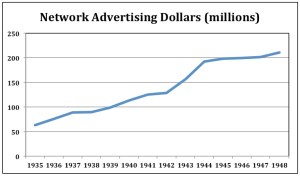
However, as Erik Barnouw notes in his preface to LeRoy Bannerman’s biography of this broadcasting legend, Corwin’s story is also bound up with a larger economic history of radio, unfolding during a period of intensified growth in and controversy surrounding commercial broadcasting. From Corwin’s first show for CBS in 1938 to his last network broadcast in 1947, the percentage of affiliated stations in the country grew from 52 to 97, while investment by commercial advertisers more than doubled. To answer critics of commercialism and give its network signs of distinction, CBS dramatically increased its public service commitments (what David Goodman refers to as “radio’s civic ambition”), investing heavily in “sustaining” (unsponsored) shows that gave producers like Corwin room for unprecedented aesthetic experimentation.
This second, institutional dimension of Corwin’s story warrants further consideration. Observing the Marxist adage that history is made by individuals not in conditions of their own making, I propose that assessing Corwin’s legacy for radio and sound studies demands we attend not only to the what of that legacy–the techniques Corwin pioneered and programs he produced–but also to its how and why: the institutional context that spawned and encouraged these aesthetic innovations. How, in other words, did commercial concerns at the structural level shape and enable the rise of the “Corwinesque” as a viable mode of sonic expression? What peculiar set of economic relations undergirded these grand experiments in twentieth century sound art, and what lessons might this period offer for understanding creativity and aesthetic innovation in subsequent eras such as our own?
Sounds of Commerce
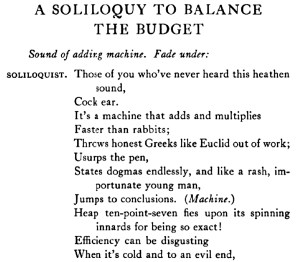
Corwin’s 1941 play, “A Soliloquy to Balance the Budget,” opened with the sounds of an adding machine and voice of a “soliloquist” tabulating the cost of each musical note and on-air gag. Such is the secret soundtrack of every broadcast since commercial radio’s inception, as one of the past century’s largest and most successful industries dedicated to the business of packaging and selling sounds for corporate profit.
Rather than seeing the flowering of the Corwinesque as a brief but “golden” reprieve from an otherwise dark history of commercial mediocrity, I propose we use the case of Corwin to critically interrogate presumed antipathies between opposing forces of art and commerce in U.S. broadcasting, and seemingly intractable tensions between competing goals of public service and corporate profit. Might we see in Corwin, instead, an instance where concerns with profit margins in fact facilitated aesthetic innovation, and where goals of public service and commercial success entered into strategic (if temporary) alignment?
This perspective is by no means intended as a neoliberal apologia for the commercial system. Yet, at the same time, the modes of aesthetic experimentation in which Corwin engaged were never so antithetical to run-of-the-mill commercial forms as traditional histories have implied. Corwin contributed to both sustaining and commercial programs, and the techniques he developed were eagerly copied by radio ad-writers. Moreover, public service programming for CBS was no mere loss leader, but rather offered opportunities for financial profit both in its own right and as part of a larger system of coordinated transmedia flows. Listening for the sounds of commerce in these programs demands a more sophisticated grasp of industry economics than the reductive binaries of traditional histories allow, beginning with an interrogation of the Romantic ideology of art on which those binaries rest.

De-Romanticizing Radio Art
Unlike other radio greats such as Robson and Welles who worked extensively on commercial series, what distinguishes Corwin in traditional accounts is his alignment with a protected sphere of noncommercial programming. Hired by CBS to work on sustaining series such as the Columbia Workshop, Corwin was celebrated by contemporaries like Richard Goggin as “pleasantly isolated from ‘commercial’ broadcasting,” with its “struggle for sales and maximum audiences” (63-4). His official biographer similarly praised him as an artist who “flourish[ed] in a freedom of ‘sustaining’ programming [that was] the hallmark of the Golden Age” and “refused to forsake this liberty for commercial earnings, although corporations clamored for his talent” (5).
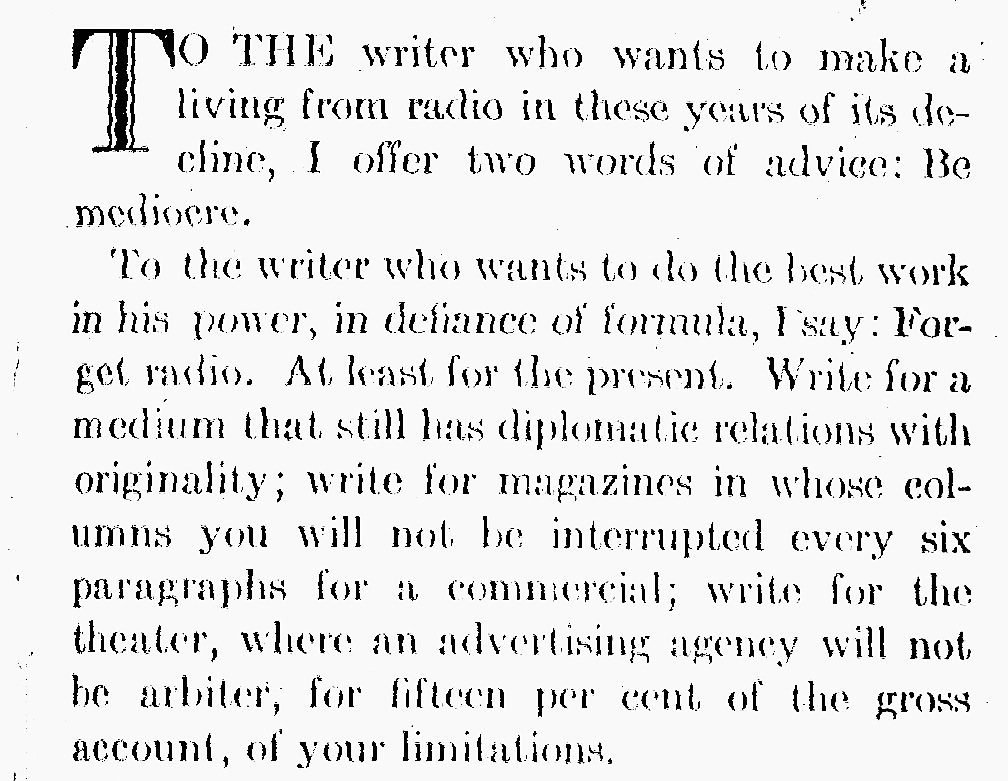
Corwin himself directly contributed to this anti-corporate mythos. In a 1944 book on radio writing, he advised those aspiring to work in radio to “Do the opposite of what a sponsor or an agency executive tells you, if you want to write originally and creatively” (53), while including regular jabs at network and advertising executives in scripts for sustaining shows such as his “Radio Primer” or “Soliloquy to Balance the Budget.” But by 1947, Bannerman explains, “the contest for higher ratings” had won out, and Corwin exited the network arena for greener pastures and a new job with the United Nations (10). In a 1951 article for The Writer, Corwin now recommended that “the writer who wants to do the best work in his power, in defiance of formula,” simply “forget radio,” and “until such time as [it] returns to a constructive attitude toward public service and the esthetic values in writing, look upon [it] as a trade outlet, not an art” (1, 3).
Setting aside the dubious merit of a narrative that denies any real aesthetic achievements for the 15 years preceding and 65 years following Corwin’s ten-year run in network radio–the apogee of a tragically brief “Golden Age”–we may recognize the conception of creativity espoused here as a distinctly Romantic one. Within this view, so-called “true art” flouts the rules and formulas on which commercially driven mass art depends, and is pursued for purposes other than financial gain. This Romantic ideology of art has been repeatedly challenged, from earlier work by M. H. Abrams, to more recent critiques by Noel Carroll and R. Keith Sawyer. My own concern is not with its veracity per se, but rather with the historical exclusions needed to sustain its underlying binaries of art/commerce and public service/commercialism vis-à-vis the work of Norman Corwin. These exclusions (acts of forgetting on which remembrances of Corwin’s legacy are grounded) may be grouped into three basic categories: the selective operations of canon-formation, cross-fertilization of techniques in commercial and sustaining programming, and profitability of public service within the CBS business model.
Canon-Formation
The received view immediately works to remove Corwin from the sphere of commercial programming, marginalizing his contributions to sponsored series such as the Cresta Blanca Carnival—whose ad agency Corwin himself commended for checking the customary “fear of anything suggesting artistic endeavor” (402)—or Dupont’s Cavalcade of America, for which he wrote his “Ann Rutledge” play, better known from its later revival on the Columbia Workshop. So, too, does it single out among his many production credits a comparatively small list of broadcasts for which he wrote his own scripts, while limiting its purview to his radio works at the expense of his contributions to other media. (For a comprehensive list of Corwin’s creative works, including his many commercial film and television productions, see the appendix in this volume.) As with all processes of canon-formation–a crucial component of what Michel Foucault calls the “author-function”–bids for Corwin’s artistry thus entail a series of selective filtering operations. The totality of the individual’s creative labor is negated within a synecdochical logic of “best” works that renders the exceptional as typical and relegates the typical to the realm of historical oblivion. What other “Corwins” might further scrutiny reveal?
Cross-Fertilization
Efforts to preserve the purity of Corwin’s art by maintaining its opposition to and inherent tension with commercial broadcasting also ignore the extent to which the advertising industry itself embraced Corwin’s techniques. In 1942, trade magazine Broadcasting reported with much clamor Corwin’s acceptance of a bronze medal at New York’s Annual Advertising Awards Dinner, given to honor an “individual, who by contemporary service has added to the knowledge or technique of radio advertising” (22). Authors of popular radio writing manuals noted, in particular, the impact of Corwin’s technique of “choral speech,” which Barnouw in his 1945 Radio Drama in Action claimed was “so successful with listeners that . . . producers of dramatized commercials . . . [now] use [it] for spot announcements to sell soap flakes” (204-5).
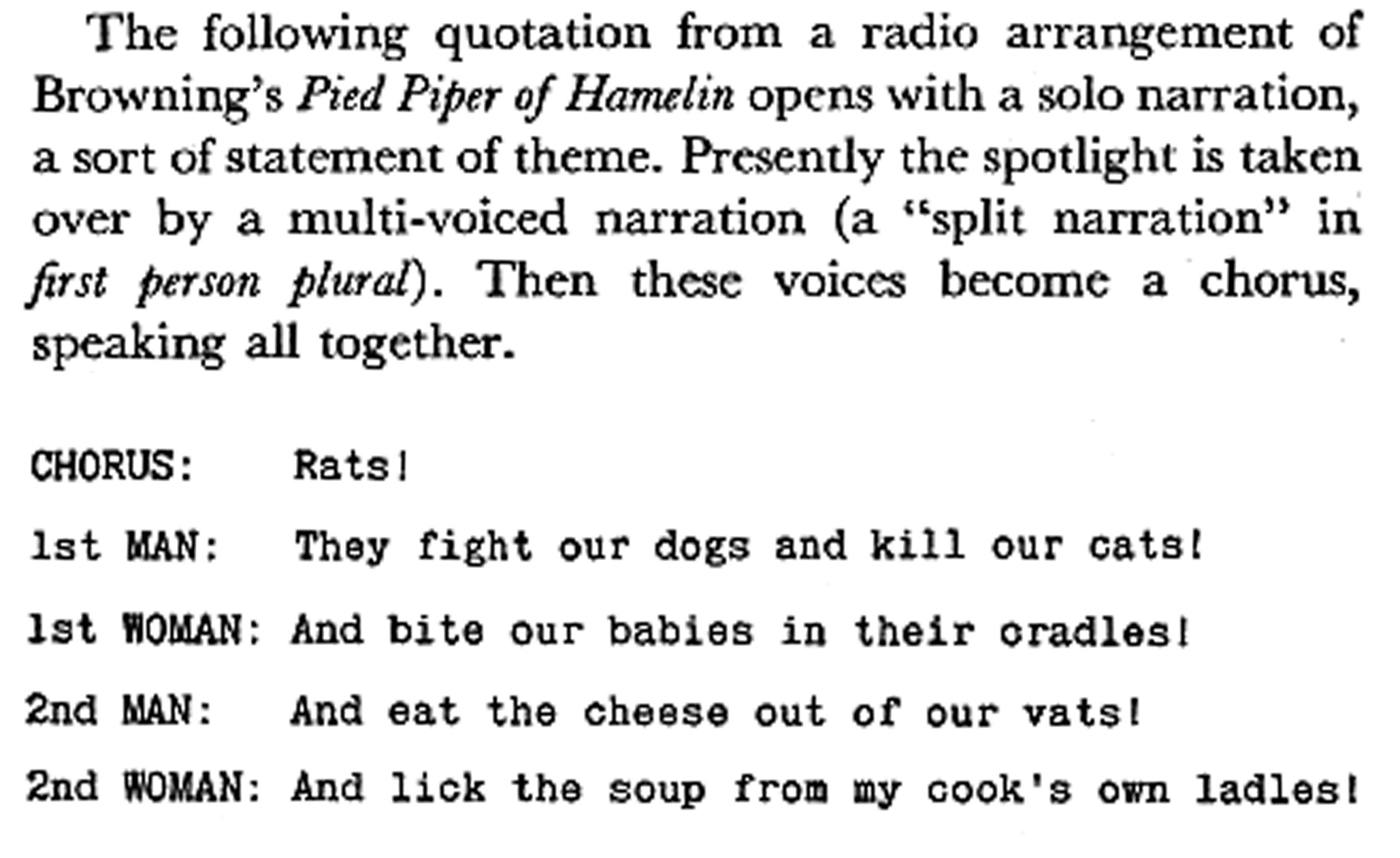
Choral Speech in ad for Ajax household cleanser, late 1940s
Omitted from later accounts, such lost tales of cross-fertilization suggest not simply blind spots in the received view, but a fundamental abnegation: the separation of art and commerce as much an achievement of historical memory as historical fact.
Profitability of Public Service
Positioning the art of Corwin in contradistinction to growing tendencies toward commercialism also ignores the tremendous profitability of public service programming within CBS’s business model, both in its own right and as part of a system of carefully coordinated, cross-platform media flows. As Barnouw notes in Vol. 2 his 1968 History of Broadcasting series, CBS ramped up its investment in sustaining programming during the 1930s as part of a race with NBC to attract affiliates and expand its national network. Whereas NBC charged affiliates for sustaining shows to defray production costs, CBS provided stations with sustaining programs at no charge in exchange for guaranteed carriage of its sponsored series. (NBC stations, by contrast, were given right of refusal for any sponsored shows they wished to opt out of.) For CBS, sustaining shows presented not a financial burden but a path to commercial profitability. Attracting stations eager for free “quality” programming, the network drew fresh revenue in membership fees for each new affiliate it added. Eager to capitalize on these expanded economies of scale and willing to pay the corresponding ad rates, sponsors in turn flocked to the network, giving CBS valuable new accounts and further revenue boosts.
Recognizing their economic value, CBS heavily promoted sustaining stars like Corwin as talented auteurs who represented the network at its best, while working to parlay their products across multiple media platforms. In a 1942 Broadcasting ad promoting Corwin’s newly published script collection, Thirteen by Corwin, the network highlighted his artistry while tracing its corporate signature into his own, reminding readers that these plays were “written and produced under the sponsorship of the Columbia Broadcasting System,” as a new “literature of the air . . . . [whose] first editions . . . [are] printed in decibels instead of type” (62-3).
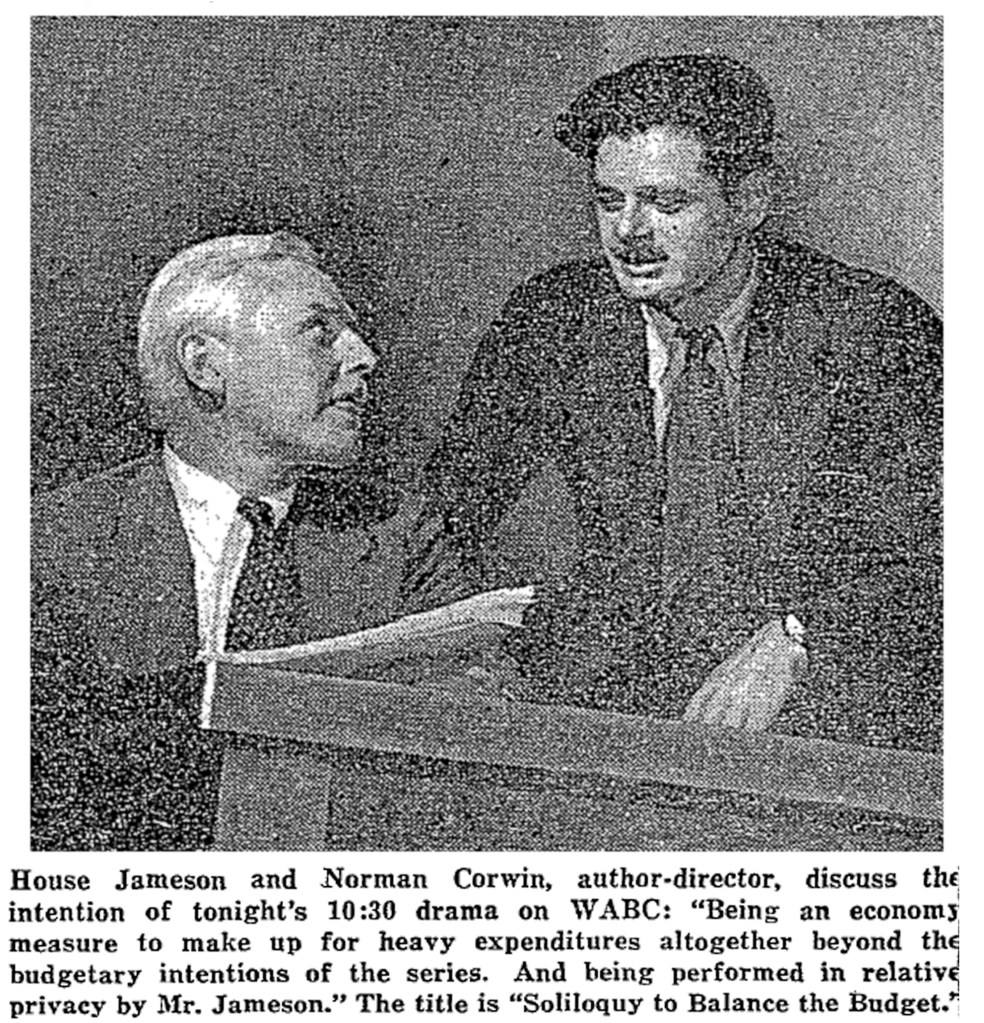
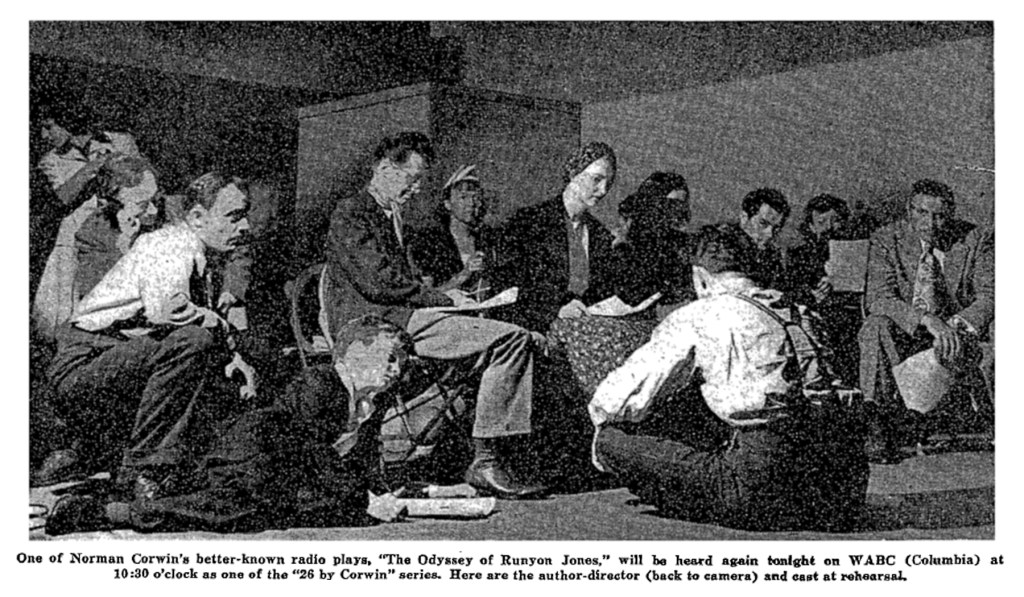
Corwin’s 1945 VE-Day celebration, “On a Note of Triumph,” was released not only in print, but also on disc by Columbia Records, converting an otherwise ephemeral sustaining feature into a source of direct profit while advancing the larger Columbia brand.
Whether attracting new affiliates and sponsors, or offering opportunities to improve brand recognition and exploit ancillary markets, CBS’s public service programming thus operated not in opposition to commercial forces but rather in the service of the network’s larger bid for economic competitiveness.
Lessons for Radio and Sound Studies
My remarks here are not intended to impugn Corwin’s artistic integrity, nor to imply a lack of commitment to loftier civic goals by CBS executives. The question, again, is a structural one: within what institutional context do the forms of aesthetic expression associated with “the Corwinesque” become possible and desirable? Put simply, how and why, from a structural perspective, do innovations in radio and sound art occur, and what forms can they take under given conditions?
Such inquiries are ill-served by presuming ipso facto oppositions between art and commerce or public service and commercial profit. Indeed, while often resting uneasily together, in the American system they have been bedfellows from the very beginning. To presume, moreover, that aesthetic innovation demands a protected space of noncommercial programming, or that such a space inherently fosters meaningful alternatives to commercial fare, would be a mistake. Within the received view, the legacy of Norman Corwin can be read only as a tale of lament: the death of public service and triumph of commercialism over art. Instead, I suggest we critically interrogate both present and past alike: the “Golden Age” is gone and likely never was, while closer scrutiny of earlier or subsequent eras may reveal aesthetic and institutional complexities hitherto unsuspected.
In a historical moment characterized by an unprecedented proliferation of new media outlets and alternative distribution platforms, but also an extreme concentration of media ownership, can we chart a critical trajectory that avoids both the Scylla of knee-jerk anti-capitalism and Charybdis of hyberbolic neoliberal and techno-utopian praise?


The proper course, whether studying conditions and possibilities for sound art in Corwin’s era or our own, lies somewhere in between.
—
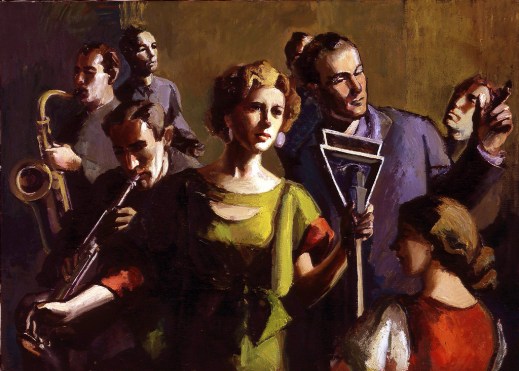
Featured Image Credit: Julia Eckel, Radio Broadcast, 1934, Courtesy of the American Art Museum. An idealized representation, it contains no scripts in hand, no call numbers on the microphone and, importantly, no sponsors’ symbols on the wall.
—
Shawn VanCour is a media historian and lecturer in Film and Media Studies at the University of South Carolina. He has published articles on radio music and sound style in early television, as well as essays on Rudolf Arnheim’s radio theory and the origins of American broadcasting archives. He is currently completing a book on production practices and aesthetic norms for early radio programming and pursuing work for a second project on the radio-television transition of the 1940s-1950s.
—
Share this:




Current Top Posts





April 2021

January 2020

November 2019

October 2019

August 2019

April 2014

November 2017

March 2015

December 2017

October 2015
 Sounding Out!
Recent Comments