
Singing Cowboys and Musical Podcasters: Defining Country Music Through Public History

“Grrrr. . .Nudie Suit” (2006) by Flicker User Romana Klee ShareAlike 2.0 Generic License (CC BY-SA 2.0)
DOI: ://doi.org/10.59350/jq92y-6kt89
In advance of International Podcast Day on 30 September, Sounding Out! finishes a series of posts exploring different facets of the audio art of the podcast, which we have been putting into those earbuds since 2011. Past posts have examined Gimlet Media’s Fiction Podcast Homecoming, Amanda Lund’s The Complete Woman? Podcast Series, and how podcasts position listeners as “stoic.” Today’s entry examines how country music podcasts do–or do not–consider the sound of the music itself in their episodes. Enjoy! –JS
If you’re a country music fan, you might be aware of the genre’s central contradiction: for all the references to classic, traditional, “real” country music, most of this music has not been preserved. The genre’s history is disappearing. Many of country music’s best recordings will never make it to digital archives or streaming services, save for a few generous YouTubers who upload their personal record collections for public enjoyment. Just try to find Stoney Edwards’ 1971 classic Down Home in the Country or Patti Page’s 1951 collection Folk Song Favorites on the streaming platform of your choice. These albums didn’t even make it to CD.
Books about country music history are even more rare, and some of the most insightful publications are long out of print. If you’re lucky enough to score a copy of Philip Self’s Guitar Pull: Conversations with Country Music’s Legendary Songwriters, for instance, the book will set you back over $70. A search of the nation’s university libraries reveals just four copies available in the entire United Sates.
Within the academic world, though, a new generation of scholars is bringing country history to the forefront, all while complicating the inaccurate racialized mythos perpetuated by the industry. Among other exciting work, Amanda Marie Martinez recently published on the intersection of punk and country in Reagan-era Southern California, and Francesca Royster has an innovative piece of the power of country artist Valerie June (and dropping new book in October 2022 called Black Country Music: Listening for Revolutions!) . The recent essay collection The Honky Tonk on the Left brings together a diverse cast of professors to challenge the received wisdom that the genre is solely home to political conservatism.

Beyond traditional academic channels, podcasting offers a new way of studying music history. The medium is both popular with the general public and tailor-made for sonic analysis. One of the best examples comes from Cocaine and Rhinestones, a podcast about the history of twentieth century country music. Hosted by Tyler Mahan Coe, the show examines forgotten or misunderstood country history while placing this history within the structural contexts of gender, race and class. Episode 2 of Season 1 breaks down country radio’s sexist gatekeeping, for example. Episode 7 of the first season covers Linda Martell, the first black woman to perform on the Grand Ole Opry, along with the racist label head who kick started her career. In Episode 3 of Season 2, Coe bluntly explains how the “sounds we associate with country music came from poor people working out techniques to produce art on cheap, low quality, often damaged, sometimes straight-up broken instruments.”
The obvious advantage of podcasting as a medium for telling music history is that you can listen to a given song as it’s being discussed. Traditionally, a music fan had to read a book or article, then go track down whatever recordings were discussed. Prior to the internet, this could easily be a multi-year endeavor of parsing through record stores, flea markets and garage sales. Now a fan can search for a song right after they read about it, and with a podcast like Cocaine and Rhinestones that research is already done.
In his 2014 SO! piece, “DIY Histories: Podcasting the Past”, Andrew Salvati argues that “podcasting can help us conceptualize an alternate cultural model of history – one that invites reconsideration of what counts as historical knowledge and interpretation, and about who is empowered to construct and access historical discourse.” While this DIY approach does not overturn elite control over podcasting, it opens space for history as an oral tradition, one which is more intimate and more empowering to listeners than, say, a university lecture or a high-budget, corporately sponsored program. Cocaine and Rhinestones is as DIY as a podcast can be; Coe writes, records and edits every episode himself.
The show’s power is most evident when compared to other recent attempts to bring country music history to a general audience. These popular histories tend to avoid critical analysis of the genre, repeating official narratives without scrutinizing how these narratives became official in the first place.

North Hollywood, California, USA, 1982,
Image by Flickr User Bill Vriesma, (CC BY-NC-ND 2.0)
One example is Ken Burns’s PBS series Country Music (2019). Working with some of the biggest stars in the business, the documentary is more or less a retelling of long-known stories. Despite its $30 million budget, the series doesn’t manage to break new ground, all while smoothing over more complicated portraits for the sake of narrative ease.
The documentary’s most glaring failure is its treatment of race. As Kimberly Mack observes in her article “She’s A Country Girl All Right,” the first episode focuses “exclusively on the black and white origins of country, instead of the racism that obscured this shared history.” Even though the documentary interviews Rhiannon Giddens, an acclaimed musician and expert on the racist obfuscation of country music’s black roots, the documentary employs selective editing and voice-over narration to avoid confronting how these black roots continue to be ignored. Acknowledging the importance of figures such as DeFord Bailey, for example, the first person to perform on the Grand Ole Opry and the first musician to ever record in Nashville, is important, but a simple acknowledgment does not explain how the contributions of such a crucial figure are suppressed through an inaccurate racialized conception of the genre’s history.

In the world of podcasting, Malcom Gladwell’s Revisionist History offers a disappointing rehash of country’s manufactured white southern roots. The episode “The King of Tears” (Season 2, Episode 6) seeks to reveal the secret behind country’s embrace of sad songwriting, but Gladwell ultimately fortifies an already whitewashed history.
Unlike Ken Burns, Gladwell does not approach country from within the industry. His episode is just one in a series of other, non-musical episodes. Like Ken Burns, though, Gladwell uses selectively edited interviews and voice-over narration to shoehorn a simplistic analysis of country music. Worse still, Gladwell doesn’t even acknowledge the genre’s multiracial origins. The episode presents a two-part theory. First, country music songwriting focuses on sad, autobiographically specific stories. Second, the only reason this sadness is communicable is because country music’s writers, performers and listeners are all part of the same social group. “It’s white, southern Protestants all the way down the line,” he says while discussing a list of critically acclaimed country performers.
The show is well edited and funded through corporate sponsorships. The podcast hops between Gladwell in the studio, on-sight interviews, and lush music clips. There is little discussion of the actual music, however. We hear next to nothing about instrumentation, production decisions or even singing style. When Gladwell wants explain why a particular song is sad, he just plays the song and talks over the recording. Take his analysis of “Golden Ring,” a 1976 duet from Tammy Wynette and George Jones. Gladwell introduces it as “a weeper,” but offers no explanation as to how the song conveys sadness.
A clip of the song starts playing at the 8:17 mark of the episode. The song fades but keeps playing in the background as Gladwell butts in to summarize the plot. He gives an anecdote from the songwriter, then the podcast cuts to an interview with the songwriter. The music stops while the songwriter speaks about a specific lyric, then comes back at full volume so the listener can hear the lyric in the final recording. We then go back to the interview sans music before hearing the final phrase of the song at full volume.
The transitions are smooth, and cutting between three sources of audio keeps the listener’s attention. Only later does the listener realize that very little was actually said about the song. In total, the section is just under a minute and a half, and barely thirty seconds is devoted to listening to the song. All we know is that it deals with divorce. We have no context for the recording and no explanation of why the song is uniquely sad.
Cocaine and Rhinestones offers the inverse––lower production quality with richer analysis. Compared to Coe’s better-funded peers, the show’s audio quality is sparse, especially in the first season. 128kps files in mono can only do so much sonic justice. Such limitations never hinder the historical message, though, and they might even enhance it. Cocaine and Rhinestones does not build a world with sweeping soundscapes and audio effects. It is Coe in his basement, more or less monologuing. There are no interviews. Music clips and the occasional radio or television broadcast are the only other thing you hear aside from Coe’s voice. For some, his voice takes getting used to, namely in the first few episodes of the series. You can hear Coe try to figure out how to talk within the context of a one-man show. His own family apparently chided him for the awkward initial performance, but he quickly found his groove, and by the mid-point of the first season he sounds clear and comfortable.
Coe was able to upgrade to stereo for the second season, allowing for more detailed sonic analysis. Just look at Episode 14 of Season 2, where Coe walks us through the writing and recording of George Jones’ 1970 hit “A Good Year for the Roses.” His analysis starts around the 1:23:28 mark.
As Coe explains, the record “opens with a rhythm section panned to the right and, in the left channel, a mysterious low-end swell, like a heavy dirigible lifting into flight, probably provided by a pedal steel player running their signal through a Jordan Boss Tone unit and a tape delay to mimic a cello.” Coe cuts out so we can hear the effect by itself. He then goes on to describe how those production choices pair with the lyrics to create one of the saddest recordings in Jones’s discography.
Whenever he discusses a moment in the song, he lets it play without voice-over. The transition between Coe’s voice and the song is less smooth than the transitions we hear in Gladwell’s podcast, but the comparatively abrupt cuts allow the listener to give their full attention to Coe, then to the song. By the end of the analysis, which runs significantly longer than Gladwell’s discussion of “Golden Ring,” we’ve listened to a combined minute and thirty seconds of “A Good Year for the Roses.” The setup takes longer, the observations are more detailed, and that patience lets the listener appreciate the devastating impact of specific artistic decisions.

While Cocaine and Rhinestones tackles everything from minute production choices to centuries-long historical arcs, the format of the show is simple. The first season covers a different artist every episode, while the second season is devoted to the life of George Jones. Episodes typically start with a historical anecdote––this could be the origin of the word ballad or the history of drag––then Coe details a given artist’s life, showing where they came from, what they contributed to the genre, and how their work is embedded within larger historical structures. Coe displays an impressive command of a range of topics, not just related to music but to a variety of historical subjects.
This attention to detail is a testament to Coe’s ability to not only listen but to help others listen with him. Even when episodes cross the two-hour mark, the main takeaway is that you have only scratched the surface. Sources are discussed in the show’s unique closing section, known as the Liner Notes. Coe explains why he chose to tell one story but not another, how a given book is useful (or useless) in relation to other books, and sometimes he will include asides that would have disrupted the episode’s main narrative. This is my favorite part of the show. It’s one of the best examples of annotated citation in any discipline (see season 2’s library here).
By openly discussing sources, not just sharing the books he read but detailing why, for example, a commonly cited source is not as accurate as previously assumed, Coe takes the extra step that big budget country histories won’t take. He shines a light on a suppressed history and explains how that history was suppressed in the first place. Cocaine and Rhinestones doesn’t just cherry pick a few examples to make a point––the show offers a patient, detailed analysis of how we came to understand what we now think of as country music and how the genre can be understood in new ways.
The second season recently ended, and a third is in the works.
—
Andrew Clark is a graduate of the University of North Carolina at Chapel Hill, where he studied physics and French. His undergraduate thesis, “Time, Space, and Capital: Walter Benjamin in Apollinaire’s ‘Zone’ and René Clair’s Paris qui dort,” examined utopian imagery in early twentieth century Paris. He currently lives in Cincinnati, OH and works at a local brewery. You can contact him at andrewclark.me.
Layout: J.L. Stoever
—

REWIND!…If you liked this post, you may also dig this:
Can’t Nobody Tell Me Nothin: Respectability and The Produced Voice in Lil Nas X’s “Old Town Road”–Justin Burton
Mapping the Music in Ukraine’s Resistance to the 2022 Russian Invasion–Merje Laiapea
“The (Magic) Upper Room: Sonic Pleasure Politics in Southern Hip Hop“–Regina Bradley
“I Love to Praise His Name”: Shouting as Feminine Disruption, Public Ecstasy, and Audio-Visual Pleasure–Shakira Holt
—
Share this:

Stir It Up: From Polyphony to Multivocality in A Brief History of Seven Killings

DOI: https://doi.org/10.59350/ffz7x-yzg28
For many, the audiobook is a source of pleasure and distraction, a way to get through the To Read Pile while washing dishes or commuting. Audiobooks have a stealthy way of rendering invisible the labor of creating this aural experience: the writer, the narrator, the producer, the technology…here at Sounding Out! we want to render that labor visible and, moreover, think of the sound as a focus of analysis in itself.
Over the next few weeks, we will host several authors who will make all of us think differently about the audiobook selections on our phone, in our car, and in our radios. Last week we listened to a book that listens to Dublin, in a post by Shantam Goyal. Today we have seven narrators telling us the story of an assassination attempt on Bob Marley. What will the audiobook whisper to us that the book cannot speak?
—Managing Editor Liana Silva
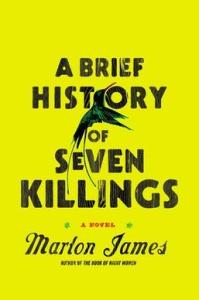
Reviews of A Brief History of Seven Killings, Marlon James’ 686-page rendering of the echoes of an assassination attempt on Bob Marley, almost invariably invoke the concept of polyphony to name its adroit use of multiple narrators. In The New York Times, Zachary Lazar maintained that the “polyphony and scope” of the 2014 novel made it much more than a saga of drug and gang violence stretching from 1970s Kingston to 1990s New York. And the Booker Prize, which James was the first Jamaican to win, similarly praised it as a “rich, polyphonic study,” with chief judge Michael Wood calling attention to the impressive “range of voices and registers, running from the patois of the street posse to The Book of Revelation.” It was thus not only the sheer number of voices in a preliminary three-page “Cast of Characters” that critics so unanimously admired but also the variety and nuance evident within them. Norwegian publisher Mime Books even took these polyphonic features a step further by hiring not one but twelve translators in a casting process that auditioned prominent novelists, playwrights, and performers.
James recalls realizing early on that this novel would be one “driven only by voice” (687), which might make such enthusiastic responses to its plurality of perspectives seem unsurprising. But what happens when such polyphony leaves the page behind and actual material voices drive its delivery? If the audiobook is a format of the novel (and here I follow Jonathan Sterne’s definition of format in MP3: The Meaning of a Format as “a whole range of decisions that affect the look, feel, experience, and workings of a medium” [7]), what lessons can listeners learn that print cannot provide? As I argue, the 26-hour-long audiobook version of A Brief History, which Highbridge Audio produced with seven actors (Robertson Dean, Cherise Boothe, Dwight Bacquie, Ryan Anderson, Johnathan McClain, Robert Younis, Thom Rivera), allows us to engage with multivocality rather than polyphony, which is to say the multiple vocal performances of a single individual rather than the presence of many narrators within a print work. And just as this novel’s polyphonic structure destabilizes any attempt at a definitive account of the events it portrays, the multifaceted performances of its audio format work to untrain ears that have been conditioned to hear necessary ties between voices and bodies.
Of course, this effect is not one that most listeners consciously seek, as reviews of the audiobook articulating various reasons for turning to this format as well as diverging responses to it readily attest. Gayle, on Audible, began with the print version: “but as soon as I got to the first chapter that was written in Jamaican patois I knew that I was not able to do that in my head and I was going to miss a lot.” Sound here conveys sense more swiftly than the page, the ear apparently better suited than the eye to encounter difference. (Woodsy, another reviewer, even felt emboldened to ventriloquize in text that sonically distinctive speech: “I found that listening to the Audible version was helpful. Now all me need do is stop thinking in Jamaican.”) Yet it was Andre who offered by far the most memorable characterization of the audiobook and its affordances. As he explained, in James’ novel “the language is a thick, tropical forest of words. Audiobook is the machete that slices through this forest of words so I can enjoy the treasures inside.” The violence of this metaphor matches that of the novel’s most disturbing scenes, yet what is most striking is the way it reiterates once more how reviewers found it easier to access the work aurally rather than visually.

These reviews, and other similarly favorable appraisals, rarely consider the audiobook on its own terms, insisting instead on comparisons with the text. Negative ones, however, often note distinctively sonic features, with some reviewers echoing one of the Booker judges—who reportedly consulted a Jamaican poet about the accuracy of James’ ear for dialogue—by questioning the veracity of the Jamaican accents in a novel that also features American, Colombian, and Cuban ones. Tending to readily identify themselves as Jamaican, these writers and listeners rarely acknowledge that at least some of the actors were born on the island when asserting that the accents are off. In any case, such efforts to link sound and authenticity, as Liana Silva has argued with respect to the audiobook, wrongly suggest that those who belong to a group must conform to a single sound. James, too, distrusts discourses of the authentic, as characters repeatedly cast suspicion and scorn on anyone uttering the phrase “real Jamaica.”
If the polyphony in James’ novel prevents any one perspective from becoming either representative or definitive, the audiobook pushes this process even further by demonstrating how a single performer’s voice can possess such range that it seems to contain multiple ones. Each performer is responsible for all the voices within the sections narrated by their primary characters, which means that the same character can occasionally be voiced by different actors. In one section, a performer does the voices of a tough-talking Chicago-born hitman and the jittery Colombians he speaks with in Miami; in others, that same performer is both a white Rolling Stone journalist from Minnesota who’s attuned to racial difference and the black Jamaicans he converses with in Kingston. Continuity or strict one-to-one correspondences between performer and character ultimately matter less than the displays of vocal difference that allow the audiobook to contest essentialized notions of voice.
As a result, the audiobook articulates just how constructed vocal divisions based on race, gender, and class are by having its performers constantly cross them. It amplifies the very arbitrariness of such divisions and thereby reveals how, if the page is the space of polyphony, then what the audiobook stages is multivocality. Although they might seem like synonyms, these two terms can actually help us appreciate crucial differences and, in doing so, highlight the specificity of the audio format. On the one hand, –phony or phōnē, as Shane Butler reminds us in The Ancient Phonograph, ambiguously refers to both voice and the human capacity for speech (36), whereas –vocality centers the voice. On the other, the shift from the Greek poly- to the Latin multi- signals a contrast in what gets counted: while polyphony names the quantity of perspectives contributing to a narrative (when introducing it in Problems of Dostoevsky’s Poetics, Mikhail Bakhtin emphasized that polyphony consisted of “a plurality of independent and unmerged voices and consciousnesses” [6]), multivocality instead specifies how the number of voices can exceed the number of performers. In this way, the concept of multivocality outlined here with respect to the audiobook resonates with its use in another context by Katherine Meizel, who mobilizes it with reference to singing and the borders of identity. In both cases, voice names a multiplicity of practices rather than an immutable or inevitable expression, which in turn aligns with Nina Sun Eidsheim’s argument in The Race of Sound about the voice being not singular but collective and not innate but cultural (9).
We can therefore say that where print-based polyphony works on the eye by placing various perspectives on a page without necessarily challenging visual perceptions of difference, multivocality in the audiobook can retrain an ear’s culturally ingrained ideas about voice. James himself has experience with these seemingly inescapable meanings assigned to vocal sounds. In a moving essay for The New York Times Magazine, he recounts how, even at the age of 28, “I was so convinced that my voice outed me as a fag that I had stopped speaking to people I didn’t know.” That was already long after high school, when, as he remembered in a New Yorker profile, he had begun “tape-recording his efforts to sound masculine, repeating words like ‘bredren’ and ‘boss.’” He was well aware of the links that listeners created between voice and identity and that could, as he suggests, prove risky in a place with overt homophobia like Jamaica. Writing, however, offered him a space to take on any voice and, at the same time, not be concerned with the sound of his own.
Yet if the page allowed James to effortlessly shift among narrative voices, the audiobook format exhibits voices that ostensibly shift without any effort. Perhaps the most compelling example emerges in the work of Cherise Boothe, whose performance of the novel’s sole female primary character presents the voices of other figures as well. Toward the end of the novel, this character, Dorcas Palmer, is a caretaker for a much older and wealthier white man with amnesia in New York. Boothe not only captures the changes as Palmer often eliminates her Jamaican accent and occasionally lets it loose but also registers the man’s moments of lucidity and confusion. Even if, as listeners, we understand that Boothe is the voice behind both of these characters, the two vocal performances are so distinct that they effectively erode the basis for any beliefs about how a certain body should sound.
Adopting different voices is certainly not unique to the audiobook, but it does provide one of the few forms of extended exposure to this practice. Yet it is worth noting that A Brief History markedly differs from the model of a more extensive cast like the one comprised of 166 voices that recorded George Saunders’ Lincoln in the Bardo. By assigning a performer to every character, such productions ultimately emphasize vocal uniqueness in roughly the same way that Adriana Cavarero conceives it, namely as an index of individuality. But there the voice remains something singular or somehow essential, for there is no opportunity to perform the plurality that appears across A Brief History. At the same time, the use of seven actors also offers a contrast with the opposite extreme: a single performer responsible for all the roles, which demonstrates multivocality but does so on such a small scale that it feels exceptional instead of ordinary. The middle ground, which is to say the model found in A Brief History, allows us to hear multiple instances of how the voice is entrained rather than essential, possibility rather than inevitability.
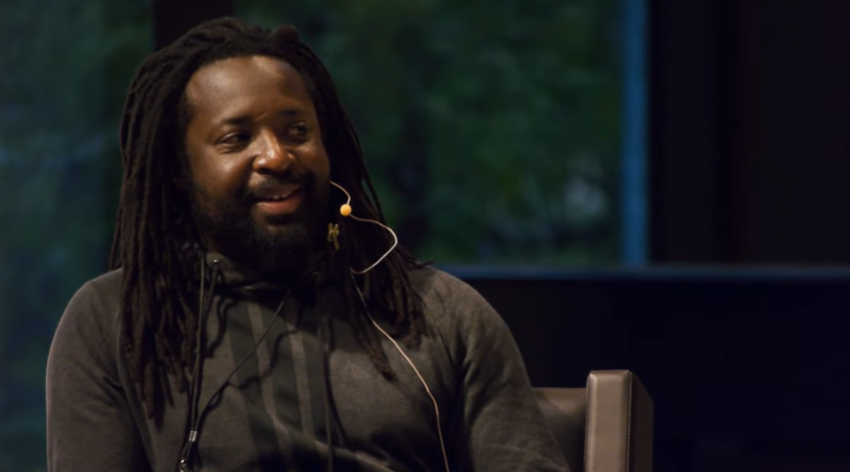
When briefly addressing audiobooks in an interview, James remarked that this format possesses a distinct advantage: “even something that is not necessarily plain can be translated because of tone and symbol and voice.” In other words, a voice can register its changing surroundings; conveying these subtle transformations on the page, however, is often far more difficult. This shortcoming is one that Edward Kamau Brathwaithe once memorably described when explaining why he insisted on using a tape recorder in a lecture on language in the Caribbean: “I want you to get the sound of it, rather than the sight of it.” The idiomatic familiarity of the first half, which clashes so sharply with the awkwardness of the second, suggests that the multivocality of an audiobook can open ears by accentuating how the voice is not fixed but in constant formation.
—
Featured Image: “Audiobook” by Flickr user ActuaLitte, CC-BY-SA-2.0
—
Sam Carter is a PhD Candidate in Romance Studies at Cornell University. His work on literature and sound in the Southern Cone has appeared in Latin American Textualities: History, Materiality, and Digital Media and is forthcoming in the Revista Hispánica Moderna.
—

REWIND! . . .If you liked this post, you may also dig:
SO! Reads: Jonathan Sterne’s MP3: The Meaning of a Format–Aaron Trammell
Radio de Acción: Violent Circuits, Contentious Voices: Caribbean Radio Histories–Alejandra Bronfman
“Scenes of Subjection: Women’s Voices Narrating Black Death“–Julie Beth Napolin
—
Share this:




Current Top Posts



April 2021
January 2020

November 2019

October 2019

August 2019

April 2014

November 2017
March 2015
December 2017

October 2015


Recent Comments