
Sound at MLA 2011
 MLA 2011 offers almost an embarrassment of riches for the sound studies scholar in the new year, testifying to the remarkable recent growth of the field. I have scoured PMLA in order to bring you everything and anything of interest for audio culture peeps, from panels that strike right at the center of the field (“Frost and Sound Studies” for example, or the panel that yours truly will be speaking on, “Literature and Sound,” organized by Amitava Kumar on Saturday from 5:15–6:30 p.m., Plaza III, J. W. Marriott ) to panels that provocatively push (and sometimes explode) the boundaries between sound studies and other fields such as literary studies, music, poetry, disability studies, history, music, urban studies, and trauma studies. This being a blog and all, I have also included relevant panels about digital humanities scholarship, a link to the field that has been strengthened not only by Sounding Out! but by HASTAC’s 2010 online forum, “Feel the Noise.”
Like my coverage of ASA this past November, I will be tweeting real-time sound-related thoughts and ideas inspired by the sound-related panels I attend at our twitterfeed:http://twitter.com/soundingoutblog; follow us (and the MLA 2011 backchannel) for the scoop!
If I somehow missed you or your panel, please let me know!: jsa@binghamton.edu
 Thursday, January 6th, 2011
Routes to Roots, Hollywood to Neighborhood
12:00 noon–1:15 p.m., Platinum Salon I, J. W. Marriott
Program arranged by the American Folklore Society. Presiding: Camilla Henriette Mortensen, Univ. of Oregon
“Routes to Roots, Hollywood to Neighborhood: A Soundtrack for the Angels,” Nick Spitzer, Tulane Univ.
For abstracts and sound track, visit http://americanroutes.publicradio.org/archives/show/623/ los-angeles-soundtrack-for-the-angels after 31 Dec.
Silence and Signification in Medieval and Renaissance Literatures: Formal Challenges
1:45–3:00 p.m., Platinum Salon A, J. W. Marriott
A special session. Presiding: Irit Ruth Kleiman, Boston Univ.
1. “Loving the Love of Silence: Material Silence in High Medieval Monastic Books,” Thomas
O’Donnell, Univ. of York
2. “Pilgrims in Jerusalem: Repetition of Silence,” Phillip Usher, Barnard Coll.
3. “‘Mescheance’ and Silence in French Romance,” Irit Ruth Kleiman
Theater and Performance in and of Los Angeles: Alternative Archives
1:45–3:00 p.m., Platinum Salon B, J. W. Marriott
Program arranged by the Division on Drama. Presiding: Ann Pellegrini, New York Univ.
1. “Acting like a Woman: Archival Engagement with the Women’s Building,” Lydia Brawner, New
York Univ.
2. “‘No, I’ve Not Forgotten’: Performance and Memory in Cambodian America,” Josh Takano
Chambers- Letson, Univ. of Cincinnati
3. “Records y Recuerdos: Music and Memory in Butchlalis de Panochtitlan’s The Barber of East L.A.,” Karen Tongson, Univ. of Southern California
Two- in- One: When the Same Individual Writes Both Words and Music
1:45–3:00 p.m., Platinum Salon I, J. W. Marriott
Program arranged by the Lyrica Society for Word-Music Relations. Presiding: Jeff Dailey, Five Towns Coll.
1. “Hildegard’s Own Singing: O Virga ac Diadema,” Janet Youngdahl, Univ. of Lethbridge
2. “Charles Dibdin: Troubled in Mind, like a Rolling Stone,” Betsy A. Bowden, Rutgers Univ., Camden
3. “Composers and Writers and Librettists in Musical Theater of Early- Twentieth- Century Spain: The Cases of Tomás Bretón and Pio Baroja,” Victoria Wolff, Univ. of Western Ontario
4. “Mathematical Music: Bob Dylan’s Extra- lyrical Appeal,” Justin Tremel, Univ. of Texas, Austin
For abstracts, write to cfanarts@aol.com.
Literary Research in/and Digital Humanities
3:30–4:45 p.m., Diamond Salon 1, J. W. Marriott
Program arranged by the Discussion Group on Libraries and Research in Languages and Literatures. Presiding: James Raymond Kelly, Univ. of Massachusetts, Amherst
Speakers: Heather Bowlby, Univ. of Virginia; Marija Dalbello, Rutgers Univ., New Brunswick; Amy Earhart, Texas A&M Univ., College Station; Manuel M. Martin- Rodriguez, Univ. of California, Merced; Susanne Woods, Wheaton Coll., MA; Abby Yochelson, Library of Congress
Respondent: Robert H. Kieft, Occidental Coll.
This session is the inaugural meeting of a new interdisciplinary MLA discussion group formed by
librarians in the association for the discussion of matters of mutual interest with scholars. Panelists will present current work, and the group will discuss its future and how it can promote the creation and curation of scholarly collections and archives, publications, research data, and teaching and study tools through professional associations and on their own campuses.
For abstracts, visit http://guides.library.umass.edu/MLA2011
Wallace Stevens’s Voices
5:15–6:30 p.m., Diamond Salon 8, J. W. Marriott
Program arranged by the Wallace Stevens Society.
Presiding: Elisabeth Oliver, McGill Univ.
1. “Less and Less Human: Stevens, Gibberish, and the Cry of the Animal,” Thomas Sowders, Louisiana State Univ., Baton Rouge
2. “The War of ‘Of’ and Other Polyvocal Syntaxes in ‘An Ordinary Evening in New Haven,’” David Joseph Letzler, Graduate Center, City Univ. of New York
3. “The Poet’s Voice in the Echo of Stevens,” Dean Rader, Univ. of San Francisco
Performances of Black Cultural Trauma and Memory
5:15–6:30 p.m., Atrium I, J. W. Marriott
A special session. Presiding: Lisa Thompson, Univ. at Albany, State Univ. of New York
Speakers: Herman Beavers, Univ. of Pennsylvania; Diana Rebekkah Paulin, Trinity Coll., CT;
Sonnet Retman, Univ. of Washington, Seattle; Valerie Smith, Prince ton Univ.; Lisa Thompson;
Lisa Woolfork, Univ. of Virginia
This roundtable will examine various ways African American novelists, poets, filmmakers, play-
wrights, and other artists engage with and evoke black cultural trauma and memory in their work. The six participants on this roundtable will con- sider how representations of black pain, horror, terror, suffering, violence, and struggle are memorialized, performed, evoked, and fetishized.
Friday, January 7th, 2011
Narrating Illness and Disability: Risks and Rewards
8:30–9:45 a.m., Olympic II, J. W. Marriott
A special session. Presiding: Ann Jurecic, Rutgers Univ., New Brunswick
1. “Listening, Telling, Suffering, and Carrying On: Reflexive Practice or Health Imperialism?”
Rita Charon, Columbia Univ.
2. “Life Narratives in the Risk Society,” Ann Jurecic
3. “Narrating Disability inside and outside the Clinic,” G. Thomas Couser, Hofstra Univ.
Respondent: Priscilla B. Wald, Duke Univ.
Planet Wiki? Postcolonial Theory, Social Media, and Web 2.0
8:30–9:45 a.m., 406A, LA Convention Center
A special session. Presiding: Amit Ray, Rochester Inst. of Tech.
1. “Border Politics on YouTube: Heriberto Yépez’s ‘Voice Exchange Rates’ (or the Bodies That Anti- matter),” Tomás Urayoán Noel, Univ. at Albany, State Univ. of New York
2. “Truths of Times to Come: Deleuze, Media, India,” Amitabh Rai, Florida State Univ.
3. “Remapping the Space In- Between: Social Networks of Race, Class, and Digital Media in the Brazilian City,” Justin Andrew Read, Univ. at Buffalo, State Univ. of New York
Respondent: Amit Ray
For abstracts and papers, visit https://honors.rit.edu/amitraywiki/index.php/Planet-Wiki
BBC Radio and British Writing
8:30–9:45 a.m., Diamond Salon 3, J. W. Marriott
Program arranged by the Division on Twentieth-Century English Literature.
Presiding: Allan Hepburn, McGill Univ.
1. “Cultural Tectonics; or, Why the BBC Became Afraid: Harold Nicolson and the New Spirit in Literature,” Todd Avery, Univ. of Massachusetts, Lowell
2. “The Listener as Interface,” Debra Rae Cohen, Univ. of South Carolina, Columbia
3. “Only Connecting? E. M. Forster, Empire Broadcasting, and the Ethics of Distance,” Daniel
Morse, Temple Univ., Philadelphia
New (and Renewed) Work in Digital Literary Studies: An Electronic Roundtable
8:30–9:45 a.m., Plaza I, J. W. Marriott
Program arranged by the Association for Computers and the Humanities.
Presiding: Bethany Nowviskie, Univ. of Virginia
Speakers: Ernest Cole, Hope Coll.; Randall Cream, Univ. of South Carolina, Columbia; Kathleen
Fitzpatrick, Pomona Coll.; Joseph Gilbert, Univ. of Virginia; Laura C. Mandell, Miami Univ., Oxford; William Albert Pannapacker, Hope Coll.; Douglas Reside, Univ. of Maryland, College Park; Andrew M. Stauffer, Univ. of Virginia; John A. Walsh, Indiana Univ., Bloomington; Matthew
Wilkens, Rice Univ.
Projects, groups, and initiatives highlighted in this session build on the editorial and archival roots of humanities scholarship to offer new, explicitly methodological and interpretive contributions to the digital literary scene or to intervene in established patterns of scholarly communication and pedagogical practice. Brief introductions will be followed by simultaneous demonstrations of the presenters’ work at eight computer stations.
For project links and abstracts, visit http://ach.org/mla/mla11
Analog and Digital: Texts, Contexts, and Networks
10:15–11:30 a.m., Atrium I, J. W. Marriott
A special session. Presiding: Victoria E. Szabo, Duke Univ.
1. “Digital Networks and Horizontal Textuality,” David S. Roh, Old Dominion Univ.
2. “The Work of the Text in Haggard’s She: Full-Text Searching and Networks of Association,”
Robert Steele, George Washington Univ.
3. “Taken Possession Of: What Digital Archives Can Teach Us about Nathaniel Hawthorne, Religious Readers, and Antebellum Reprinting Culture,” Ryan C. Cordell, Univ. of Virginia
For abstracts, visit www.duke.edu/~ves4/mla2011
Polyglot Poetics
12:00 noon–1:15 p.m., 306B, LA Convention Center
A special session. Presiding: Martin McKinsey, Univ. of New Hampshire, Durham
1. “Language Interference in Charles Bernstein’s Shadowtime,” Linda Reinfeld, Rochester Inst. of Tech.
2. “Bilingual Poetics and Representation in Robert Sullivan’s Star Waka,” Katherine Baxter,
Stanford Univ.
3. “Hsia Yü’s Posthumanist Polyglot Poetics,” Pao Chai Patricia Chiang, National Chung Cheng
Univ; James Rollins, National Chung Cheng Univ.
Film Simulations of Disability
12:00 noon–1:15 p.m., Atrium I, J. W. Marriott
Program arranged by the Division on Disability Studies. Presiding: David Mitchell, Temple Univ.,
Philadelphia
1. “Disability Film Festivals and the Politics of Atypicality,” David Mitchell; Sharon Snyder, Brace Yourselves Productions
2. “Faking It: Canadian Identity and Disability Cinema,” Sally J. Chivers, Trent Univ.
3. “Deaf by Design,” Robert L. Johnson, Midwestern State Univ.
4. “Filming Illiteracy: The Pathology of Dyslexia iin Claude Chabrol’s La cérémonie,” Lynn Tarte
Ramey, Vanderbilt Univ.
Satire, Wit, and Humor in the Works of Langston Hughes
12:00 noon–1:15 p.m., Platinum Salon I, J. W. Marriott
Program arranged by the Langston Hughes Society. Presiding: Sharon Lynette Jones, Wright State Univ.
1. “‘Go Home and Write a Page Tonight’: Sub- versive Irony and Resistant Reading in ‘Theme for English B,’” Daniel Charles Morris, Purdue Univ., West Lafayette
2. “When Music Fails as a Universal Language: The Human Violin in Langston Hughes’s ‘Home,’” Koritha Mitchell, Ohio State Univ., Columbus
3. “A Global Perspective of Jesse B. Semple: Echoes of ‘Bop’ in Ankara, Turkey,” Donna Akiba
Sullivan Harper, Spelman Coll.
For abstracts, visit www.langstonhughessociety.org
Silent Night: The Archives of the Deaf and Blind
1:45–3:00 p.m., Atrium I, J. W. Marriott
Program arranged by the MLA Committee on Scholarly Editions. Presiding: Marta L. Werner,
D’Youville Coll.
1. “Entering the Light: Deaf Studies Digital Journal and the Archives of Sign Language Poetics,”
H- Dirksen Bauman, Gallaudet Univ.
2. “Blindness and Exile in the ‘Dark Blue World’ of Jaroslav Jezek,” Michael Beckerman, New York Univ.
3. “Accessioning Helen Keller: Disability, History, and the Politics of the Archive,” David Serlin,
Univ. of California, San Diego
The History and Future of the Digital Humanities
1:45–3:00 p.m., Plaza I, J. W. Marriott
Program arranged by the MLA Program Committee. Presiding: Kathleen Fitzpatrick, Pomona Coll.
Speakers: Brett Bobley, NEH; Katherine D. Harris, San José State Univ.; Alan Liu, Univ. of California, Santa Barbara; Tara McPherson, Univ. of Southern California; Bethany Nowviskie, Univ. of Virginia; Morgantown; Stephen J. Ramsay, Univ. of Nebraska, Lincoln; Susana Ruiz, Univ. of Southern California
This roundtable will bring together many different perspectives, from humanities computing to
digital media studies, including senior and junior scholars, research and teaching institutions, and faculty and staff members, so that we might explore the overlap, diffusion, and multiplicity of
views of the digital humanities that result.
Good Vibrations and Globalization: LA Pop and the Urban Crisis
3:30–4:45 p.m., Platinum Salon H, J. W. Marriott
A special session. Presiding: Shaun Cullen, Univ. of Virginia
1. “Back Door Man: Jim Morrison between Watts and the Summer of Love,” Eric William Lott,
Univ. of Virginia
2. “‘What You See Is What You Get’?: Richard Pryor, Wattstax, and the Secret History of the Black Aesthetic,” Scott Saul, Univ. of California, Berkeley
3. “White Skin, Black Flag: SST Records and the Politics of White Ethnicity,” Shaun Cullen
Rethinking Style: Reinvigorating Writing Instruction with Rhetorical Stylistics
3:30–4:45 p.m., Platinum Salon B, J. W. Marriott
Program arranged by the Rhetoric Society of America. Presiding: Jordynn M. Jack, Univ. of
North Carolina, Chapel Hill
1. “Rethinking Stylistic Pedagogy: Imitation, Sentence Combining, and Generative Rhetoric for
the Twenty- First Century,” Paul G. Butler, Univ. of Houston
2. “Speaking Figures: Historical and Contemporary Perspectives on the Voiced Style,” Richard
Graff, Univ. of Minnesota, Twin Cities
3. “Teaching the Art of Amplifying,” Jeanne Fahnestock, Univ. of Maryland, College Pararrating Illness and Disability: Risks and Rewards, For abstracts, visit http://jordynnjack.com/rsa-at-mla/
 Saturday, January 8th, 2011
Textual Scholarship and New Media
8:30–9:45 a.m., Diamond Salon 8, J. W. Marriott
Program arranged by the MLA Committee on Scholarly Editions. Presiding: Michael Eberle-
Sinatra, Université de Montréal
1. “Comic Book Markup Language: An Introduc- tion and Rationale,” John A. Walsh, Indiana Univ., Bloomington
2. “Crowdspeak: Mobile Telephony and TXTual Practice,” Rita Raley, Univ. of California, Santa
Barbara
3. “Alternate Reality Games and Transmedia Textuality: Interpretive Play and the Immaterial Ar-
chive,” Zach Whalen, Univ. of Mary Washington
Henry James and Alfred Hitchcock: The Men Who Knew Too Much
8:30–9:45 a.m., Platinum Salon H, J. W. Marriott
A special session. Presiding: Susan Mary Griffin, Univ. of Louisville; Alan Nadel, Univ. of Kentucky
1. “Awkward Ages: James and Hitchcock in Between,” Mark Goble, Univ. of California, Berkeley
2. “Sounds of Silence in The Wings of the Dove and Blackmail,” Donatella Izzo, Università di Napoli l’Orientale
3. “Hands, Objects, and Love in James and Hitchcock: Reading the Touch in The Golden Bowl
and Notorious,” Jonathan E. Freedman, Univ. of Michigan, Ann Arbor
The Institution(alization) of Digital Humanities
8:30–9:45 a.m., Atrium III, J. W. Marriott
Program arranged by the Discussion Group on Computer Studies in Language and Literature.
Presiding: David Lee Gants, Florida State Univ.
1. “A Media Ecological Approach to Digital Humanities; or, How I Learned to Stop Worrying and
Love This Dynamic Field,” Kimberly Knight, Univ. of Texas, Dallas
2. “Power, Prestige, and Profession: Digital Humanities in the Age of Academic Anxiety,” Amy
Earhart, Texas A&M Univ., College Station
3. “Emerging Dialogue: Librarians and Digital Humanists,” Johanna Drucker, Univ. of California, Los Angeles
Narrating the (After)Life of a City: Sighting, Sounding, and Moving in Detroit
10:15–11:30 a.m., Platinum Salon F, J. W. Marriott
A special session. Presiding: Patricia Yaeger, Univ. of Michigan, Ann Arbor
1. “Detroit Still Lives: The False Movements of Spatial Stories in Ruins,” Renée Carine Hoogland, Wayne State Univ.
2. “Mean Martha Jean and the Queens of Soul,” Hortense Jeanette Spillers, Vanderbilt Univ.
3. “The Life of the Line: Finally Got the News All Cut Up,” Kathryne Victoria Lindberg,
Wayne State Univ.
Social Networking: Web 2.0 Applications for the Teaching of Languages and Literatures
10:15–11:30 a.m., Diamond Salon 2, J. W. Marriott
Program arranged by the MLA Committee on Information Technology. Presiding: Barbara Lafford, Arizona State Univ. West
1. “Writing for Nonprofits in Social- Media Environments,” Sean McCarthy, Univ. of Texas, Austin
2. “The Macaulay Eportfolio Collection: A Case Study in the Uses of Social Networking for Learning,” Lauren Klein, Graduate Center, City Univ. of
New York
3. “Social Media, Digital Vernaculars, and Language Education,” Steven Thorne, Portland State
Univ.
For abstracts, write to blafford@asu.edu
Other Sounds, Other Worlds: Literary Soundscapes in Asian and Transnational Contexts
12:00 noon–1:15 p.m., 304C, LA Convention Center
A special session. Presiding: Pieter Keulemans, Yale Univ.
1. “Sounding Spaces: The Role of Soundscapes in Amit Chaudhuri’s Novels Afternoon Raag and The Immortals,” Christin Hoene, Univ. of Edinburgh
2. “Auditors Abroad: Defamiliarized Listening in Japan and the West,” Kerim Yasar, Prince ton Univ.
3. “Selling the Soundscape of Beijing: Vendor Calls, Acoustic Attractions, and the Aesthetics of
the Literary Marketplace in Chinese Martial- Arts Fiction,” Pieter Keulemans
The Cold War in Africa
12:00 noon–1:15 p.m., 301B, LA Convention Center
A special session. Presiding: Gary Rees, Univ. of Houston
1. “South Atlantic Cold War Cartographies: Mapping State Terrorism in the Novels of Nadine
Gordimer and Mark Behr,” Kerry Bystrom, Univ. of Connecticut, Storrs
2. “Neoimperialism and the Body Politic: Chinua Achebe’s A Man of the People,” Gary Rees
3. “The Cold War, Radio Diplomacy, and the Works of Naguib Mahfouz: Retelling the Narrative of Suez,” Douglas Eli Julien, Univ. of Minnesota, Morris
4. “Nonalignment and the Postcolony: India and Kenya in the Cold War,” James Daniel Elam,
Northwestern Univ.
Technology, Culture, and Authenticity, 1850–1910
5:15–6:30 p.m., Diamond Salon 2, J. W. Marriott
A special session. Presiding: Douglas Mao, Johns Hopkins Univ., MD
1. “Feeling Real: Technology and the Sensations of Victorian War,” Rachel Teukolsky, Vanderbilt Univ.
2. “Authenticity in Utopia,” Douglas Mao
3. “Nature, Culture, and Technology: The Evolution of Subjectivities,” Regenia Gagnier, Univ. of
Exeter
Frost and Sound Studies
5:15–6:30 p.m., Diamond Salon 7, J. W. Marriott
Program arranged by the Robert Frost Society.
Presiding: Robert Faggen, Claremont McKenna Coll.
1. “Robert Frost and the Spoken Word,” Tyler Brent Hoffman, Rutgers Univ., Camden
2. “Skillful Breaks: The Cultural Discourse of Frost’s Meter,” Michael L. Manson, American Univ.
3. “Breath Units: Projecting Verse from Robert Frost,” Natalie E. Gerber, State Univ. of New York, Fredonia
Respondent: Timothy Steele, California State Univ., Los Angeles
For abstracts, write to rfaggen@cmc.edu
“Giant Steps”: Jazz and Poetry
5:15–6:30 p.m., Plaza I, J. W. Marriott
Program arranged by the Division on Poetry.
Presiding: Aldon Lynn Nielsen, Penn State Univ., University Park
1. “‘How to Stay Alive’: John Taggart’s Sheets of Sound,” Patrick J. Pritchett, Harvard Univ.
2. “Sex, Gender, and the Jazz Body in Contemporary Poetry,” Meta DuEwa Jones, Univ. of Texas, Austin
3. “‘All Blues’: The Role of Genre in the Poetic Tradition of Vernacaular and Experimental Black
Music,” Michael New, Penn State Univ., University Park
Ha- Ha Hungary: Humor in Hungarian Film and Literature
5:15–6:30 p.m., 304C, LA Convention Center
Program arranged by the Discussion Group on Hungarian Literature. Presiding: Gabriella Kec-
skes, Temple Univ., Philadelphia
1. “Why Laughter? Humor and Mockery in Petöfi and Mikszáth,” Enikö Molnár Basa, Library of
Congress
2. “‘Sirva vigad a magyar’: Melancholy Mirth and Witty Woe in Hungarian Literature,” Martha
Pereszlényi- Pinter, John Carroll Univ.
3. “Humor in Hungarian Folktales,” Katherine Mary Gatto, John Carroll Univ.
4. “Male Corpses, Female Voices: Images of European Gender Relations in György Pálfi’s Hukkle and Pedro Almodóvar’s Volver,” Gabriella Kecskes
For abstracts, write to gkecsk02@ temple .edu.
Literature and Sound
5:15–6:30 p.m., Plaza III, J. W. Marriott
Program arranged by the Division on Literature and Other Arts. Presiding: Amitava Kumar, Vassar Coll.
1. “The Vectorized Self: From Space to Sound in Joan Didion’s Play It As It Lays,” J. D. Connor, Yale Univ.
2. “Echo and the Siren’s Song: Ann Petry’s ‘On Saturday the Siren Sounds at Noon,’” Jennifer Stoever- Ackerman, Binghamton Univ., State Univ. of New York
3. “Ecstatic Time: The Syncopated Form of Holleran’s Dancer from the Dance,” Matt Bell, Bridgewater State Coll.
4. “Records, Race, and Rape in Wright and Ellison,” Erich Nunn, Auburn Univ., Auburn
 Sunday, January 9th, 2011
Writing the City
10:15–11:30 a.m., Atrium III, J. W. Marriott
A special session. Presiding: Jeffrey Allen Steele, Univ. of Wisconsin, Madison
1. “The Urban (Un)Seen,” Kimberly DeFazio, Clarkson Univ.
2. “The Mediated City in Sousandrâde’s ‘Inferno de Wall Street,’” Jacob Wilkenfeld, Univ. of North Carolina, Chapel Hill
3. “In the Heart of the City: Rewriting the Nineteenth- Century City through Adultery,” Vir-
ginia Piper, Univ. of Wisconsin, Madison
4. “Revisiting the Flaneur,” Dana Aron Brand, Hofstra Univ.
Parsing the Unspeakable
10:15–11:30 a.m., Diamond Salon 1, J. W. Marriott
A special session. Presiding: Barry George Stampfl, San Diego State Univ.
1. “The Death of Trauma,” Michelle Balaev, Wake Forest Univ.
2. “Unspeakable Fidelities: Violence, Justice, and ‘Being True,’” Naomi Iliana Mandel, Univ. of
Rhode Island
3. “Unspeakability and the Rhetoric of Cruelty,” Michael F. Bernard- Donals, Univ. of Wisconsin,
Madison
From the New Song and Rock en Español to Spanish and Iberian Pop
10:15–11:30 a.m., Platinum Salon H, J. W. Marriott
Program arranged by the Division on Popular Culture. Presiding: Silvia Bermúdez, Univ. of California, Santa Barbara
1. “Rock ’n’ Road Songs: Traveling New Routes in Spanish Rock Music,” Jorge P. Pérez, Univ. of Kansas
2. “Border Music in a Borderless World: Mapping the Sounds of NAFTA between Mexico and the United States,” William John Nichols, Georgia State Univ.
3. “Raperos, Boleros, and Salseros: Reconsidering the Authentic in Cuban Popular Music since
the Revolution,” Russell St Clair Cobb, Univ. of Alberta
Respondent: Frances R. Aparicio, Univ. of Illinois, Chicago
What the Digital Does to Reading
10:15–11:30 a.m., Diamond Salon 8, J. W. Marriott
Program arranged by the MLA Committee on Information Technology. Presiding: Laura C. Man-
dell, Miami Univ., Oxford
1. “What Would Jesus Google? Plural Reading in the Digital Archive,” Daniel Allen Shore, Grinnell Coll.
2. “Social Book Catalogs and Reading: Shifting Paradigms, Humanizing Databases,” Renee Hudson, Univ. of California, Los Angeles; Kimberly Knight, Univ. of Texas, Dallas
3. “Illuminating Hidden Paths: Reading and Annotating Texts in Many Dimensions,” Julie
Meloni, Washington State Univ., Pullman
For abstracts, visit www.users.muohio.edu/mandellc/digRdg.html after 15 Nov.
Literature and/as New Media
12:00 noon–1:15 p.m., 309, LA Convention Center
Program arranged by the Division on Literature and Other Arts. Presiding: Jon McKenzie, Univ. of Wisconsin, Madison
Speakers: Sarah Allison, Stanford Univ.; N. Katherine Hayles, Duke Univ.; Richard E. Miller, Rutgers Univ., New Brunswick; Todd Samuel Presner, Univ. of California, Los Angeles; Craig J. Saper, Univ. of Central Florida; Holly Willis, Univ. of Southern California; Michael L. Witmore, Univ. of Wisconsin, Madison
This session engages the nexus of literature and new media from several perspectives, ranging
from emerging forms of electronic literature to computer- enabled modes of literary analysis to
the broader implications of IT and new media for literary and cultural study. In an age of digital
poetry, graphic novels, and iPhone “appisodes,” how useful is the notion of distinct media? In what ways do quantitative methods of “distant reading” and “counting literature” extend traditional forms of analysis, and in what ways do they threaten or simply sidestep them? And what’s at stake in recent calls to critically mash up new media forms and processes in order to reboot the humanities as “new humanities,” “Big Humanities,” and “Humanities 2.0”?
Sound Reproduction and the Literary
1:45–3:00 p.m., Diamond Salon 6, J. W. Marriott
A special session. Presiding: Jentery Sayers, Univ. of Washington, Seattle
1. “Sound as Sensory Modality in Electronic Literature,” Dene M. Grigar, Washington State Univ., Vancouver
2. “‘Cause That’s the Way the World Turns’: John Edgar Wideman’s Sent for You Yesterday and the Mnemonic Jukebox,” Jürgen E. Grandt, Gainesville State Coll., GA
3. “Analog History: Kevin Young’s To Repel Ghosts and the Textuality of the Turntable,” Paul
Benzon, Temple Univ., Philadelphia
Respondent: Jentery Sayers
For abstracts, examples, and biographies, visit www.hastac.org/ after 1 Dec.
Literature and Opera
1:45–3:00 p.m., 304A, LA Convention Center
Program arranged by the Division on Nineteenth-Century French Literature. Presiding: Elisabeth
Akhimoff Ladenson, Columbia Univ.
1. “Otello’s French Connection,” William Germano, Cooper Union
2. “Stendhal’s Ear,” Nicholas Dames, Columbia Univ.
3. “ Saint- Saëns’s Samson,” Kevin Richard Kopelson, Univ. of Iowa


Share this:

Bob Seger, Champion of Misfits
 Bob Seger and the sort of classic rock he performs, embodies and represents, for me (and apparently many others), the relentlessly uncool. Youth, drugs and nonconformity have long been my standards of “rock,” and within this triad, Bob Seger’s formal, cinematic songs, have always come across as a little tired. Osvaldo Oyola wrote specifically last week about these foibles: the stilted piano and canned Chuck Berry riffs sound more like parody than gospel, while the parade of effects on Seger’s voice, also quite derivative, could have also fit on a Bruce Springsteen album (although you could replace the influence of Chuck Berry with that of the quintessentially less cool Phil Spector). Problematically, even though I loathe Seger’s catalog, I love Springsteen’s, this of course has made for some very popular conversations at the bar. In fact, it was last July at a local New Brunswick haunt that I had this conversation last. My friend, who will remain nameless, completely disagreed: Seger was cool, I just couldn’t hear it, in fact I had to see it to believe it.
In order to understand Bob Seger, I needed to watch Mask, a 1985 retelling of The Elephant Man starring Eric Stoltz as the deformed Rocky Dennis and Cher as his mother Rusty Dennis. Mask was released two years after Risky Business, and featured a number of Bob Seger songs predominantly in the soundtrack. These songs uniformly mixed to the foreground, often serving as Rocky’s theme, juxtaposed against an ambient soundtrack of songs by black musicians like Little Richard and Gary US Bonds. These black oldies, “Tutti Frutti” and “Quarter to Three,” are used thematically when Rusty’s friends, a bunch of guys in a motorcycle gang, are partying. Not only is Rocky othered from the kids at school because he is ugly, he is poor, raised by a single mother with a drug addiction. Although whiteness takes center stage in this film, it holds a complex relationship to blackness. Rocky and Rusty are atypically white, finding community only with each other and a super-masculine network of bikers; they are misfits, doing their best to pass in a mainstream and affluent white society.
Bob Seger’s “Katmandu,” is the song which introduces Rocky in the opening credits. It is guilty of the trademark Bob Seger whiteness: more refurbished Chuck Berry and piano so droll it could have been played by a metronome. In the context of Rocky and his struggle to identify with white society however, it paints Seger in a different light. Bob Seger’s uncoolness can be read as a failed attempt to pay homage to black musicians like the aforementioned Little Richard and Gary US Bonds. Instead of suggesting a totalizing narrative of white appropriation, I argue that Bob Seger can be understood as a musician who would never be completely accepted by his heroes or critics. Reflected in the posters on Rocky’s wall and Universal’s contract negotiations with Columbia Records (Bruce Springsteen had been first choice for the soundtrack), Seger was not even cool to the director of the film, Peter Bogdanovich, who refered to his music as “inappropriate.”
Toward the end of the movie, Rocky holds his blind girlfriend for the last time. Her parents, disgusted by his face (but probably also by his shabby clothing), keep the two separate. Contradicting the escape narrative of Springsteen’s “Born to Run,” Rocky evinces the power of fantasy toward coping with discrimination: “We can’t run away Diana. But we can sort of run away in our minds. We can remember camp, the mountains and the Ocean…especially New Year’s Eve” (Mask Part 11 4:40). Like Rocky, Seger can’t run away from his whiteness, even though he may not relate to it, or fully embrace it, it is ever present in his recordings. Songs like “Old Time Rock and Roll,” “Katmandu,” and even “Night Moves” are celebrations of music as a forum of imagination – one where identity, be it black or white, can be reimagined as something else. Though “Old Time Rock and Roll,” will sound forever white, it relates the experience of otherness. Try as he might, Seger has no idea how to sound authentically black, and this is evident through both its celebratory lyrics and contrived arrangement.
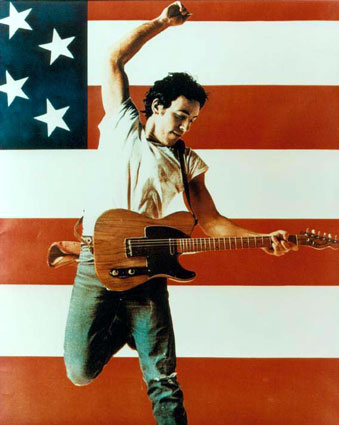 Growing up in a bi-racial household, where, depending on the holiday, my Jewishness could be as visible as my blackness, I feel a strong kinship to figures like Rocky, not completely belonging to any ethnic community. Perhaps this led to a juvenile obsession with Springsteen, who, according to my father, everyone could relate to, regardless of color (he worked at an all-night Jersey Shore diner, the Inkwell, in the early 1970s). Bruce though, was never really misfit, mulatto or poor; whether discussing his working class freehold roots, or his first guitar, his music epitomizes white privilege. Even his stage shows feature Clarence Clemons, The Big (Black) Man, notably subordinate to Bruce, or “The Boss.” Although now, my Bruce phase seems laughable, I wonder if it was also a fantasy of fitting in, of recovering a fantastic and invisible whiteness deep within myself. When he wrote “Old Time Rock and Roll,” was Bob Seger trying to do the same and recover a font of blackness deep within himself? I now see a complex web of identity politics informed by an economic and social history of Rock and Roll, but this holds an uneasy and complex relationship with the part of me that still believes in rock and roll. I was, am, and forever will be the misfit who found an identity in the church of rock and roll. Though the sermons have changed, in high school, Springsteen was the pastor, and I suspect that for my friend at the bar, Seger also conducted service. Even though I could never completely fit in to the rich white world of these artists, I wonder if this speaks to a fundamental affinity. Did Springsteen and Seger ever feel like outcasts, later to find solace in the black cool of Little Richard, Chuck Berry and Fats Domino? In the context of these figures and their music, how could whiteness seem anything but contrived, misfit and ugly – or in truth, is this dialectic really the beat which pushes rock and roll forward?
AT


Share this:


Current Top Posts





April 2021

January 2020

November 2019

October 2019

August 2019

April 2014

November 2017

March 2015

December 2017

October 2015
 Sounding Out!
Recent Comments