
Sound and Sanity: Rallying Against “The Voice”
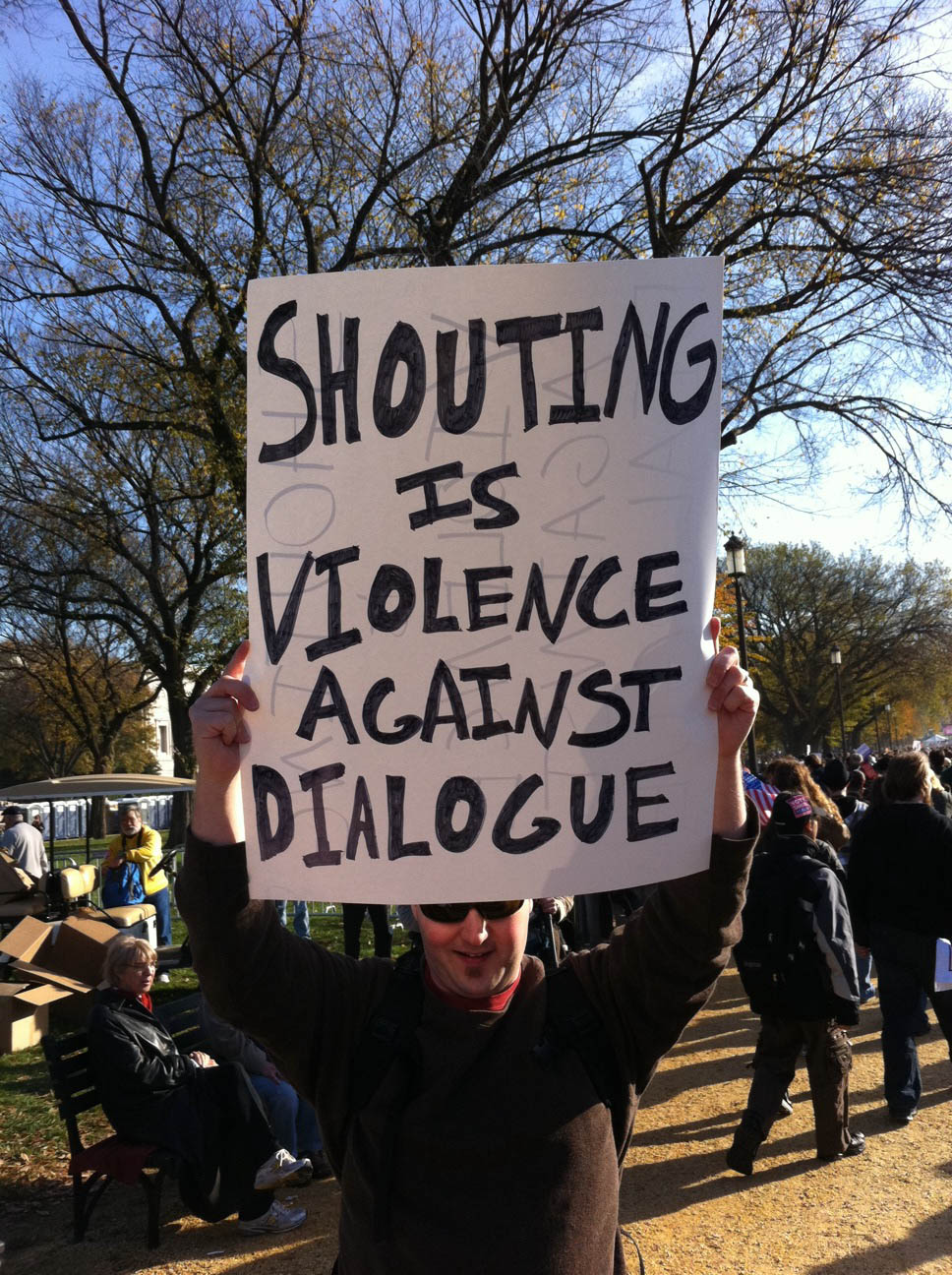 John Stewart’s recent Rally to Restore Sanity was an important political demonstration for all of the fairly-busy people in the USA. It was a moment when those who work forty hours per week or who have too many social bookings were able to come to the United States Capitol in order to proclaim with their “indoor voices” that the current political debates in America are characterized by too much irrationality and fear. As the RTRS website states, Stewart’s rally was expressly for “the people who think shouting is annoying, counterproductive, and terrible for your throat; who feel that the loudest voices shouldn’t be the only ones that get heard; and who believe that the only time it’s appropriate to draw a Hitler mustache on someone is when that person is actually Hitler. Or Charlie Chaplin in certain roles.” It’s interesting that the aim of this rally was ostensibly against the “shouting” and the “loudest voices” rather than any specific ideas, statements, or political positions. In other words, the problem, as Stewart sees it, is that public debates are too full of noise. And it is this noise that must be vanquished—or that, at least, should be modulated to an “indoor” level.
Stewart’s opposition between sound and sanity is actually quite common. Public noise is senseless sound, while rational debate is meaningful sound. The logic goes, then, that public debates need to have less sound or, at least, regulated sound. They must have two people who are willing to speak quietly and rationally, hear each other’s points, and raise and answer each other’s objections until some kind of consensus is built. Good public debates require less sound and more sanity.
But is this sonic modulation the right way to conduct public debate and to persuade others? The truth is that the relation between noise and reason, between senselessness and sanity, is very, very complicated. In fact, although it is a collective national fantasy that good debate is built on reason, there are lots of reasons to suggest that reason doesn’t always (or even predominately) come first. Rather, it’s often the sound that convinces people in an argument—not the reason. And in public debate, the particular sound is “The Voice.”
By looking at an episode of the animated TV show Batman: The Brave and the Bold let’s listen to how The Voice can persuade people to act against their own sanity. In “Mayhem of the Music Meister,” Neil Patrick Harris gives voice to the Music Meister, a singing villain whose tone and rhythm instantly hypnotize those who hear him and bend their actions to his will:
As the opening sequence begins, the audience is prepped for a standard showdown between three villains: Black Manta, Gorilla Grodd, and Clock King, who plan to steal a communications satellite; and three heroes: Black Canary, Green Arrow, and  Aquaman, who are prepared to save the day and stop the theft of the industrial hardware. But this showdown is interrupted when–to his surprise and seemingly against his self-control–Black Manta bursts into song, crooning, “I’m sounding shrill against my will.” Soon the other villains and heroes follow suit. All lose control of their voices and begin singing and acting against their own will. What’s interesting about this moment is that losing control of their voices signals a complete loss of self-control. Yet this loss brings with it a division within themselves. On one hand, they recognize that they are singing. On the other hand, they are conscious of the fact that they are equally unable to prevent their own actions. They must sing; they must dance; they must dissolve the initial division between heroes and villains and join together in a revised plan to launch the communications satellite.
From this vantage point, we can return to the alleged difference between sound and sanity. The first problem is that The Voice bypasses reason, making people comply without, or even in spite of, critical reflection. It generally does this in two ways. As the Music Meister episode illustrates, The Voice divides the hearer against himself, taking over his body while he remains fully aware of the situation. In other words, the Voice exerts a direct control over a body while the hearer remains in control of his or her consciousness. The Voice is a science fiction staple. For example, in Frank Herbert’s Dune, the Bene Gesserit are able to speak directly to the unconscious of the hearer while the conscious mind is aware that the body is controlled by The Voice. In the filmed version, an extra quality is added to The Voice in order to highlight the difference between its conscious and subconscious aspects. The Voice must sound different from the voice.
The second way that the Voice bypasses reason is in the way in which a voice– often described musically–makes people lose control of their ability for critical reflection. An example of this form of The Voice also comes from science fiction: the Jedi Mind Trick made famous in Star Wars. In this case, Obi Wan Kenobi bypasses the storm troopers’ ability to recognize the droids they are looking for, even as C3-PO and R2-D2 hang awkwardly from the back of his sandspeeder.
 When the logical reasons inevitably fail to account for the act of persuasion in public discourse, others come to the forefront. Often people will say the speaker has charisma, but often they are really referring to The Voice’s role as the persuasive element. What persuades? Not the logical argument, not sanity, but The Voice. And, often, this is against our better judgments or in spite of ourselves. So when Stewart acknowleges the role that “senseless” sound plays in public debates, he goes too far when he calls for “meaningful” sound instead. The two are not in opposition as the RTRS suggested. When all is said and done, sanity almost always depends on so-called senseless sound.


Share this:

Re: Chuck Klosterman – “Tomorrow Rarely Knows”
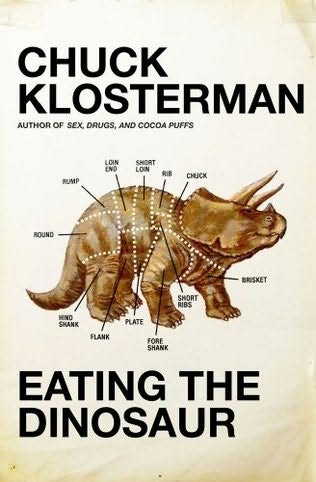 In Chuck Klosterman’s latest compilation of essays, Eating The Dinosaur, he pens an article entitled “Tomorrow Rarely Knows.” It is somewhat of a refresher course in time travel critique; geek-bait, essentially, designed to engross and compel sci-fi aficionados like myself. Although Klosterman is a critic of pop-culture, he is always at his best when writing about music. Therefore the most salient question posed by Klosterman here, is embedded within a footnote about Chuck Berry’s “Jonny B. Goode” halfway through the essay. Considering Back to the Future, Klosterman writes about how Michael J. Fox refers to “Johnny B. Goode,” as an “oldie.” Riffing on this idea he explains that in 1985 a twenty-seven year old rock song did qualify as an “oldie,” where paradoxically now no one would dare refer to Back to the Future, a twenty-four year old movie, an “oldie.” From this logic, Klosterman synthesizes:
“What seems to be happening is a dramatic increase in cultural memory: As culture accelerates, the distance between historical events feels smaller. The gap between 2010 and 2000 will seem far smaller than the gap between 1980 and 1970, which already seemed far smaller than the gap between 1950 and 1940.” (pg. 58)
Klosterman articulates two premises here, (1) There exists a cultural phenomenon in which people remember time in the past moving more slowly than it does in the present, and (2) This phenomenon occurs because culture accelerates. I take issue with the second premise – although I am uncertain of exactly what Klosterman means when he claims that culture is “accelerating,” I am confident that every possible explanation carries within it a set of presuppositions which are by their very nature determinist, teleological and ethnocentric. Most troubling is the idea that culture is ‘going’ somewhere, all progress is good progress. Culture is a metaphor used to describe a forever malleable set of material phenomenon, by constructing it as a quantifiable thing, Chuck projects a number of contemptible perspectives upon it.
Premise one however, is a much more interesting site for contemplation. Re-articulated: Why do some people remember time in the past as moving more slowly than it does in the present? My gut instinct is to argue that there is now a peculiar regime of nostalgia which delights in the rapid re-appropriation and re-articulation of all tangible media artifacts. Because recent changes in technology have made it so much easier to record, edit, splice, erase, duplicate, and distribute all media forms, we now live in a world where we are inundated by representations of the past all the time. This constant inundation is indicative of a growing cultural familiarity with past media ephemera and the subsequent changes in cultural bias. Do people even use the term “oldie,” anymore? Instead, descriptors like “retro” are used to accentuate the “cool” in instances of convergence-necromacy.
It is interesting that Klosterman constructs cultural memory through the ways that people remember music. It is therefore important to historicize the practice of listening within the history of audio technology. The 1980s historically mark the widespread dissemination of recording technology to the consumer market. This denotes a mnemonic shift, akin to the invention of writing or the printing press (Although I would argue that the printing press has more in common with the popularization of the Internet as a DIY publishing outlet). The cultural shift in language from “oldies” to “retro” has more to do with the sense of audio empowerment consumers have gained in the last twenty-four than Klosterman’s theory of cultural acceleration. It’s a shame also, Eating the Dinosaur contains Chuck’s best writing since Sex, Drugs and Cocoa Puffs.
AT


Share this:


Current Top Posts





April 2021

January 2020

November 2019

October 2019

August 2019

April 2014

November 2017

March 2015

December 2017

October 2015
 Sounding Out!
Recent Comments