
Experiments in Aural Resistance: Nordic Role-Playing, Community, and Sound
 Editor’s Note: Welcome to Sounding Out!‘s fall series titled “Sound and Play,” where we ask how sound studies, as a discipline, can help us to think through several canonical perspectives on play. While Johan Huizinga had once argued that play is the primeval foundation from which all culture has sprung, it is important to ask where sound fits into this construction of culture; does it too have the potential to liberate or re-entrench our social worlds? SO!’s Multimedia editor Aaron Trammell reflects upon using sound in role-playing games as a form of resistance. Ready, players?
—
When we play with sound, how does it influence the ways in which we understand, configure, and experience the world? I have already argued that non-diegetic sound can produce a visceral and emotive effect when connected to player interaction within a game world, that sounds are often structured within games to construct a sort of feedback between player and system, and that often within this feedback loop the narrative voice perpetuates problematic tropes of sexism and racism through its scripting. While I focused on the often dystopic production efforts of large and middle sized game companies in those prior essays, here I will be focusing on autonomous and grassroots examples of how sound is used as a way to stage social experiments which resist these often hegemonic ways that these dominant narratives constrict our views of the world.
Role-playing games, the focus of my post today, offer a more viable path of social resistance than better-known video games. Nordic larp style-games, for example, are written and played within not-for-profit communities, and they utilize themes of social inequality, transformation, and activism within their very scripts. Second, role-playing games, unlike computer games, do not require that their developers are able to code. Instead, games are often circulated by word-of-mouth, or in script format through player communities. In this sense, the genre itself is untethered from many of the problems of consumer capitalism. Many underground role-playing games are designed both around social issues and for local community needs as opposed to the market demands that necessitate big budgets, big programming teams, and few risks in the video game industry today. Finally, because role-playing games necessitate neither big budgets, the ability to code, nor mass audiences, they are an ideal site wherein game designers and referees can stage social experiments that speak to the unique wants and desires of the communities within which they are run.
In The Larpfactory Book Project, a forthcoming book containing several ready to play examples of Nordic larp (a big shout out to Lizzie Stark for hooking me up with an advance copy of this portion of the manuscript!), larpwrights Matthijs Holter and Fredrik Hossmann propose a game entitled “Before and After Silence,” focused on thinking through the collective experience of silence. From the game description:
In a world of more and more sound, silence is becoming more valuable. Before and After Silence is about limitations and listening, and about doing almost nothing. It is non-verbal and uses silence as its starting point. It is about shifting the point of view from “what is” to “what is not,” about shifting the focus from “the sounds” to “the spaces between the sounds,” from “the actions” to what is “between the actions,” and to “what is not done.” Rather than playing characters, we examine how we look at ourselves and how different filters can change how we see ourselves and others.
The game is structured as a social experiment for five to twelve players who are made to select two cards, one of which prompts players with an action they must complete only once during the hour of silence (one example reads “Go over to someone and whisper something in a language you don’t know”), and another which prompts players with a setting through which they should interpret the actions of the other players in the room (one example suggests a player imagine themselves in a community of prisoners, another makes a player imagine themselves as one in a society of telepaths). Before the game there are a set of workshops aimed at orienting players to the scope and silence of the game, and afterward there is a debriefing session where players compare their experiences of silence during the game.

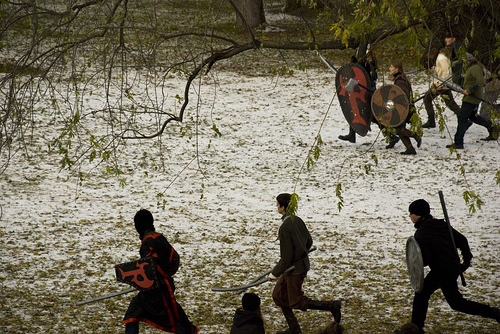
Tons of great examples of work in the Nordic larp genre are in this book. Image borrowed from FransBadger @Flickr.
Unlike American larps, which often take place in high-fantasy settings and direct their action around combat scenarios, Nordic larps often focus on the everyday and comparatively mundane, and as such tend to be more concerned the problems of the everyday as well. Even those that take place in more exotic environments, such as System Danmarc, a game set in the cyberpunk future of Copenhagen, engage players in real issues regarding class and poverty. After living in a shanty-town simulating the future streets of Copenhagen for a week of game-time (In Nordic-style larps, game-time is often equivalent to real time, and so a week in-game is equivalent to a week out of game) players are shown a documentary about the actual slums of Copenhagen where they realize that their experience within the space of play was made to mirror the experience of those struggling with the these very issues in the real world.
In the case of “Before and After Silence,” it is interesting to consider the ways in which the game designers here play with sound, and how these experiments in sonic game design might provoke new modes of subjectivity. As described earlier, players are both given a particular action and or noise to perform, but also are prompted with a way to imagine the actions that the rest of the players in the room are performing. The resulting group performance is an acid dream of sorts wherein each player is made to imagine the room’s soundscape in a very different way. Is the setting a long-lost silent film, or are you drifting through an ether of emotions and past romances? The game focuses on playing with silence in a way that makes the din of communication an unfamiliar and distant memory. The game affords players an opportunity to imagine the world sound. In doing this, “Before and After Silence” displaces the dominance of the voice as a mode of communication and through this questions the ways in which we imagine the world.
Not all is perfect, however, in this utopia of resistance. As Lisa Blackman (2009) argues in her essay “Embodying Affect: Voice-hearing, Telepathy, Suggestion and Modelling the Non-Conscious,” play with the exchange of subjectivities and sound marks an ontological shift from a praxiology of what bodies are to what bodies can do (p. 170). Moving forward from her work in understanding the ritual practices of voice-hearing communities, Blackman explains that similar forms of sonic play (including play with silence) allow for the experience, embodiment, and trade of desire, fear, and trauma. In the context of “Before and After Silence,” this means that as players sculpt and adjust the sonic space of the room, they run the risk of also shaping and altering each others psychic conditions, in unpredictable and perhaps dangerous ways.
The conflation which occurs between these spaces of real emotion and play emotion is, in fact, well documented, and referred to in larp communities as “bleed.” As role-playing scholar Sarah Bowman (2013), explains in her essay “Social Conflict in Role-Playing Communities: An Exploratory Qualitative Study,” even though bleed does occasionally create rifts in relationships (some participants that she has interviewed reported in-game events disturbing their out of game relationships), others seek it out as a form of extreme play. For this reason Nordic larps require ethical behavior on the parts of their players, and because of the nature of the psychic and social sculpting which can occur within the play spaces of the game, the possibility exists that a single unethical player could create a negative and perhaps concerning experience for many others. That said, there are several ways the community mitigates the possibility of this problem including meticulous casting processes, before-game workshops, after-game debrief sessions, and safe words for use during play.

Players debrief after a game. Image borrowed from Fiezi @Flickr.
“Before and After Silence” is a valuable cultural artifact that lies at the intersection of scholarship on sound studies and serious play. At the same time that it promises several new ways to think through how sound, communication, and silence influence the how we frame and approach the world, it also raises deeper questions regarding the nature of social control and the viability of autonomous modes of organization. As silence allows players to explore and interact with a world where the soundscape takes on an increased prominence, do sexist, racist, and homophobic modes of socialization still manage to creep into the play space? And does the voice, along with its physiological and cultural embodiment of race, class, and gender, offer an escape from these experiments in silence if and when they turn dystopic?
—
Featured image: “Larp” by Flickr user marten vaher, CC-BY-NC-SA 2.0
—
Aaron Trammell is co-founder and Multimedia Editor of Sounding Out! He is also a Media Studies PhD candidate at Rutgers University. His dissertation explores the fanzines and politics of underground wargame communities in Cold War America. You can learn more about his work at aarontrammell.com.
—
 REWIND! . . .If you liked this post, you may also dig:
Goalball: Sport, Silence, and Spectatorship— Melissa Helquist
GLaDOS, The Voice of Postfeminist Control— Aaron Trammell
Video Gaming and the Sonic Feedback of Surviellance: Bastion and the Stanley Parable— Aaron Trammell
Share this:

Goalball: Sport, Silence, and Spectatorship
 Editor’s Note: Today, SO! kicks off our summer series on “Sound and Sport,” an interrogation of the roles that sound and listening play in the interconnected aspects of many sports: athletic skill, spectatorial experience, laws of physics challenged and exploited, and politics expressed and created. Often, the true play in sports involves power–and sound is a key venue to help us understand its flows and snags, and parse out the actual winners and losers. And, perhaps more directly than other venues, sports is a heightened arena that helps us understand just how important sound is in our everyday lives, even if (and especially because) we take it for granted.
One of my favorite personal “sports metaphors” for sounds’ unacknowledged centrality involves the precise 3.5 seconds I snowboarded with an iPod before I hit an ice patch full speed and had one of the worst falls I have suffered in my 15+ years of the sport. While I was laying on the hard packed snow gasping for breath and trying to piece together what happened, I realized exactly how much I depended on my listening to provide me with crucial, even-life saving, information. With my ears overwhelmed with treble-y punk, I had charged straight into an icepatch that I would have deftly avoided as soon as I heard the inevitable and unmistakeable scratching sound signalling its location. That kinesthetic lesson has continued to inform my everyday, every day since it happened and has led me to ever deeper understandings about sound’s power and the various forms of power that it clarifies–and are clarified by it in turn. I hope that this series will do the same for you, but without the blood and the bruises, even as some of our writers will remind you about the complex and dubious relationship sports can draw between “pain” and “gain.”
Batting first up on our line-up is Melissa Helquist, who describes how the Paralympic sport Goalball challenges the norms of the spectator/athlete relationship. Look for a post on Muhammad Ali in June (Tara Betts), skateboarding in July (Josh Ottum) and an all-out Olympic extravaganza in August, including a podcast discussing the sonic transformations of Brazil’s favelas in anticipation of the world’s ears in 2016 (Andrea Medrado). This summer, it is Sounding Out! FTW. –-J. Stoever-Ackerman, Editor-in-Chief
—
it’s oh so quiet
it’s oh so still
you’re all alone
and so peaceful until
you ring the bell
bim bam
you shout and yell
hi ho ho
you broke the spell
–Bjork, “It’s Oh So Quiet”
During the London 2012 Olympics, the Copper Box venue, which hosted handball, was dubbed “the box that rocks.” The moniker was also, perhaps, a way to drum up interest in handball, a still obscure sport. And indeed, raucous spectators and the pulse and bounce of balls and shoes created a sonic spectacle.
.
When the Paralympics began a few weeks later, much was made of the transformation of “the box that rocks” into “the box that rocks you to sleep.” The game that supposedly will rock you to sleep is Goalball.
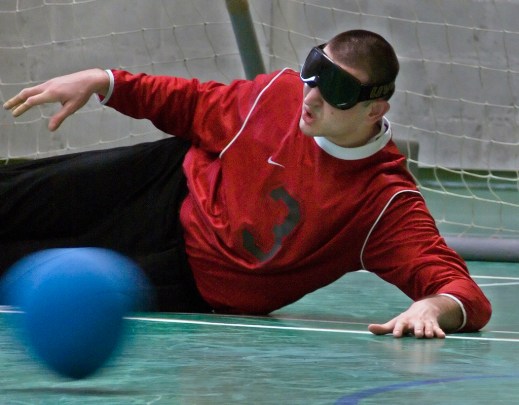
Goalball is a 3-a-side game, played in two 12-minute halves. The offensive team rockets the ball down the court (it must be rolling by mid-court), trying to gain the low and wide net on the other side. As the ball rolls toward the net, the defending players lie on their sides in front of the net, blocking the ball with their bodies. As the ball is pummeled back and forth across the court, it jingles—a simple, clear bell emanating from eight holes in the ball’s surface. In this sport, sound is quite literally a game changer.
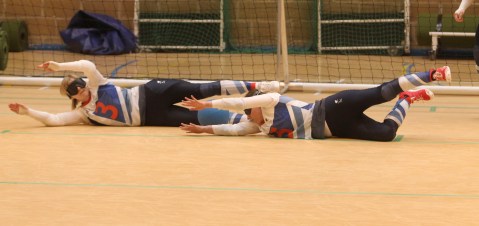
Goalball team practice at the ParalympicsGB Training Camp, Image by Flickr User The Department for Culture, Media and Sport
All goalball players are blind or low vison and wear blackout eyeshades to equalize the playing field and to ensure that any residual vision doesn’t get in the way of the gameplay’s sound. A pre-game equipment check includes referees ensuring that eyeshades don’t let in any light. Penalties include touching one’s eyeshades or making noises that disrupt the other team’s ability to hear the movement of the ball.
Goalball, a game first invented as a way to rehabilitate soldiers blinded in WWII, has been a Paralympic sport since 1976. It is one of the few sports designed specifically for blind athletes, rather than adapted from an existing sport. It is a game of sound and touch, a contrast to the visual perception typically associated with team-based ball games. The game, like many others in the Paralympics, expands the sensory experience of sport. The court’s borders are demarcated with tape-covered twine. Sonically, players orient themselves by calling out the position of the on-coming ball, rapping knuckles on the floor, and of course the jingle of the ball.
“Goalball” Courtesy of Perkins School for the Blind Archives
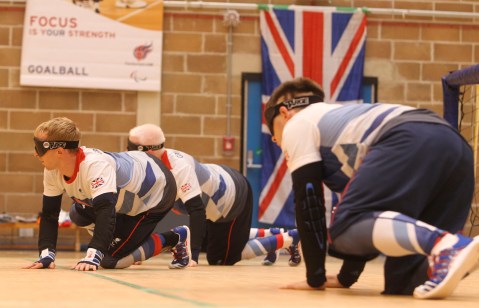
Image by Flickr User The Department for Culture, Media and Sport
The game is high impact; at the Paralympic level, the ball is thrown at speeds up to 60mph. Players launch the ball with high-velocity spins, something like a cross between a discus throw and bowling. Defenders block the ball with their entire bodies—hands, feet, torso. The game is intense, but it is also quiet.
The players’ reliance on sound demands new expectations of the audience. As spectators, we are watchers, but we are also noisemakers—shouters, shriekers, trashtalkers. Goalball spectators can (and do) cheer when a goal is scored, but when gameplay begins, silence is the rule. Before gameplay begins, referees demand, “Quiet Please!”
The Copper Box “was quite specifically designed to achieve a low background noise level so the blind athletes could play” (Soundscape, Issue 3, 38), enabling the venue to be transformed into an atypical space for the sound of sport and spectatorship, a place to challenge our assumptions and expectations.
Goalball? A description? from Daphnee Denis on Vimeo.
Goalball spectatorship doesn’t demand pure silence, but it is not the unfettered cacophony that we often expect in sports spectatorship. At the London 2012 Paralympics, Bjork’s “It’s So Quiet” was played during breaks in gameplay to remind spectators of their obligation. The song’s ebb and flow of silence and exuberance captures the sonic rhythm of Goalball, its pulsing cadence of silent attention and energetic eruption.
.
The nickname, “the box that rocks you to sleep” captures the discomfort spectators may have with Goalball’s soundscape. The silence during play is tense, but the scoring of a goal offers a sudden release. Spectators do not create a persistent cacophony, but rather a pulse, a constant pattern of lull and explosion. The silence of Goalball can feel disconcerting for spectators unfamiliar with the game. The sound of the crowd—the cheers, the clapping, the screams, the groans, the chants–often seem fundamental to the experience of sport.
Silent spectatorship, of course, is an expectation for other sporting events such as golf and tennis. Here, the demand for silence is linked ostensibly to concentration, but also invokes questions of tradition, class, and (in the case of tennis) gender. These sports are individualized demonstrations of skill, and we are admirers, observers.
Team sports invite identification from the crowd. We extend ourselves, making ourselves part of the team, often through sonic exuberance. Speaking about the crowd sounds of the London Olympics, Mike Goldsmith, author of Discord, notes:
Individual athletes commented that the crowd sound was a great source of energy to then, but could also distract. Their comments suggested that some of them used the crowd sound as a resource, that they could tap into or not as the moment demanded (Soundscape, Issue 3, 36).
Sound can feel like participation. Through sound, we make ourselves part of the game, cheering to support our team, hollering to distract a shot. Sound can make sport feel communal, and thus silence can feel like separation, a wall between spectator and team.
But the seeming silence of Goalball spectatorship offers an opportunity to pay attention to the sound of play, sounds that often get subsumed by the roar of the crowd. The meeting of disability and sport offers a “prime space to reread and rewrite culture’s makings” (Tanya Titchkosky, Reading and Writing Disability Differently, 2007), a space to hear sport differently. The culture of sport is rife with ableist assumptions about how we move, how we watch, how we play. Even when sound is part of sport, it is often an afterthought, an addition—sound might be distracting, it may affect play, but the center sensory preoccupation of sport is frequently visual. We watch, we spectate, we keep our eye on the ball. Sport is sight, but it is also sound. Spectatorship is raucous, but it is also silent.
zing boom shhhh.
—
Featured Image, “Goal Ball” by Flickr User BLac
—
Melissa Helquist is an Associate Professor of English at Salt Lake Community College and a PhD Candidate in Technical Communication and Rhetoric at Texas Tech University. Her dissertation research focuses on digital literacy and blindness and explores the use of sound to read, write, and interpret images. She is a 2012-13 HASTAC scholar and the recipient of a 2012-2013 CCCC Research Initiative Grant. She lives in Salt Lake City, where she hikes, camps, and canoes with her husband and daughter.
—
REWIND! . . .If you liked this post, you may also dig:
Eye Candy: The Absence of the Female Voice in Sports Talk Radio–Liana Silva
The Plasticity of Listening: Deafness and Sound Studies–Steph Ceraso
Taking Me Out of the Ball Game: Advertising’s Acoustic Pitch–Osvaldo Oyola
Share this:


Current Top Posts





April 2021

January 2020

November 2019

October 2019

August 2019

April 2014

November 2017

March 2015

December 2017

October 2015
 Sounding Out!
Recent Comments