
Listening in Plain Sight: The Enduring Influence of U.S. Air Guitar

The mention of “air guitar” might conjure images of the Bill and Ted series. Or Risky Business. Or maybe even Joe Cocker at Woodstock. You might think of air guitar as an embarrassing fan gesture. So when you hear there’s an annual U.S. Air Guitar competition, you might imagine an entirely superficial practice without any artistic merit. Maybe you just think of it as gimmicky. Or a celebration of the worst aspects of classic rock fandom and the white male guitar heroes that often populate its pantheon. In all honesty, I thought all of these things at first, until I began to take the competition seriously.
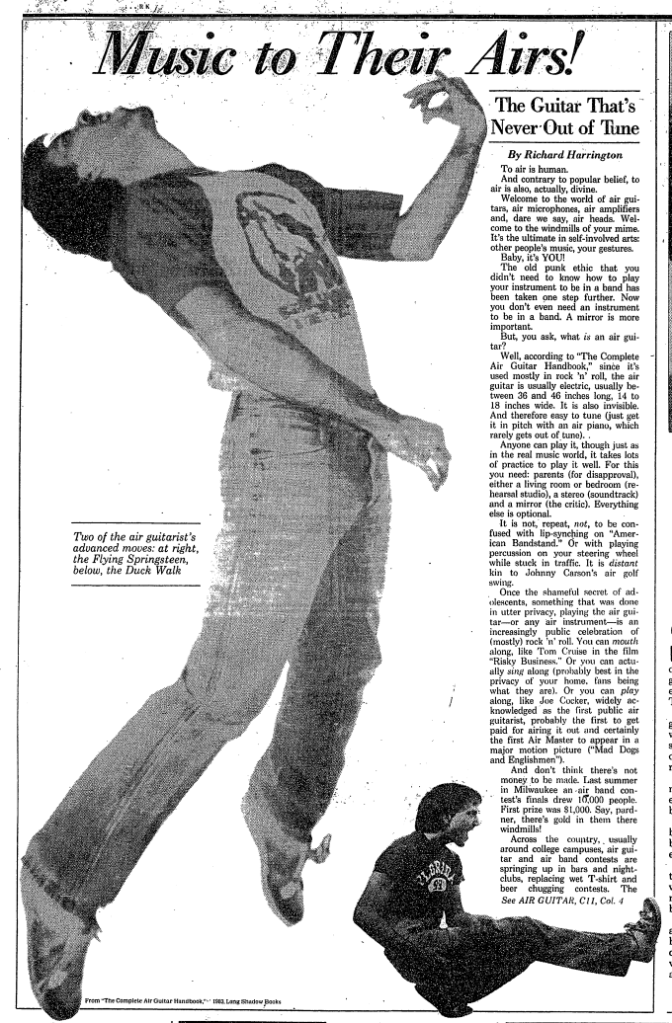
I did not realize, for example, that air guitar competitions have an enduring history since the late 1970s, existing as an incredibly influential popular music pantomime practice that informs platforms like TikTok. I did not realize how invested contemporary competitors could be—dedicating years to learning the craft. And I did not realize how these reconstructions of guitar solos could creatively rupture the relationship between guitar virtuosity and privileged identities in popular music’s past.
The U.S. Air Guitar Championships began in 2003 as the national branch of the Air Guitar World Championships, which began in 1996 in Oulu, Finland. The competition emerged as a bit of a joke alongside the Oulu Music Video Festival. Eventually, two people—Cedric Devitt and Kriston Rucker—founded U.S. Air Guitar, which expanded across the country (thanks, in part, to the influential documentary Air Guitar Nation). Today, folks compete in order to advance from local to regional to the national competition, ultimately hoping to be crowned the best air guitarist in the nation and sent to Finland to represent the United States (think: Eurovision but air guitar). United States air guitarists do incredibly well in the international competition, although they face formidable air guitarists from Japan, France, Canada, Australia, Russia, and Germany (as well as less-formidable air guitarists from elsewhere).
In each competition, competitors perform as personas, such as Rockness Monster, AIRistotle, Agnes Young, and Mom Jeans Jeanie. They don elaborate costumes. They painstakingly practice elaborate choreographies and compete in some of the most famous musical venues in the country—from Bowery Ballroom to the Black Cat. Competitors stage routines that bring a particular 60-second rock solo to life, using their bodies to simulate playing the real guitar (what air guitarists call “there guitar”). Think of these as gestural interpretations of the affective power of guitar solos, rather than a mechanical reproduction of particular chords, frets, and licks. They use their bodies to draw out timbre, rhythm, and pitch, and they also play with the juxtaposition of their own identities and those of the original artists. Judges evaluate performances based on three criteria:
· Technical merit (does the pantomime more or less correspond to the guitar playing in the music?)
· Stage presence (is it entertaining?)
· ‘Airness’ (does the performance transcend the imitation of the real guitar to become an art form in and of itself?)
Scores are given on a figure skating scale, from 4 to 6. So a perfect score is 666 from the three judges. Winners in the first round advance to the second round, where they must improvise an air guitar routine to a surprise song selection.
As part of my ethnographic work on air guitar, I competed in a local competition, where I was crowned third best air guitarist in Boston in the year 2017 (a distinction that will likely never appear on my CV). I have also conducted fieldwork in Finland twice and attended countless competitions in the U.S. I judged the 2019 U.S. Air Guitar Championships in Nashville alongside Edward Snowden’s lawyer, which resulted in a three-way air off to crown a winner.
Competitions depend on recruiting new competitors, celebrity judges, and large crowds, all of which can be at odds with creating an inclusive community. Organizers have worked hard to eliminate racist, sexist, ableist, and other forms of discriminatory language from judges’ comments. Women within U.S. air guitar have formed advocacy groups. The proceeds of the most recent competitions have been donated to Alabama Appleseed Center for Law and Justice, which took up the case of a disabled Black veteran named Sean Worsley who was incarcerated for playing air guitar to music at a gas station. Both organizing bodies at the national and international level emphasize world peace as central to their mission.
Air guitar routines are themselves political statements too. These acts of musical interpretation enable women, BIPOC, and disabled performers to author sounds credited to guitar idols, like Eddie Van Halen or Slash. Performers make arguments about their access to popular music, using only their bodies. Sydney Hutchinson’s work examines how air guitar can challenge Asian American stereotypes and gendered conceptions of dance.
My current work revolves around disabled air guitarists. Andres SevogiAIR drew me in, as a result of his expressive flamenco-inspired seated style he called “chair guitar.” He passed away but left me with an enduring appreciation for air guitar’s ability to challenge conventional virtuosity, a term that can often reproduce an ableist link between physical ability and musical virtue. I came to appreciate how air guitarists could invent imaginary instruments that serve their particular bodies. I witnessed competitors coupling chronic illness and impairments with air guitar routines, as well as competitors using air guitar to fully amplify their struggles with cancer.
I also came to appreciate how air guitarists embrace stigma (e.g., madness, craziness, and gendered forms of listening), turning taboo into a source of creativity. This led to academic writing that traces the history of madness in relation to air guitar, showing how imaginary instrument playing has often been pathologized, and yet contemporary disabled air guitarists reclaim these accusations of insanity as a source of power.
* * *
A few weeks ago, I received a request from Lieutenant Facemelter to judge the Midwestern Online Regional U.S. Air Guitar Competition. I accepted. As with many things these days, the contemporary competition has morphed into a Twitch-hosted online spectacle, featuring combinations of live and pre-recorded elements. One woman gave birth between first- and second-round performances (made possible by a multi-day filming period for an asynchronous part of the online competition). One man’s air guitar performance evoked an exorcism in his basement. Another middle-aged competitor competed while suffering the side effects of his second shot of coronavirus vaccine, ultimately winning the competition with a pro-vaccination message. His parents appeared in the livestream when he accepted the award, and the host of the show–the Master of Airimonies–jokingly said to them: “You two must be so proud.”

I think of U.S. Air Guitar as a stained-glass window, through which prisms of popular music history shine through. The competition can bring troubling facets of that history to light, but the competition can also revise that history (or, at least, reimagine how that history can influence the future). Either way, performers celebrate the idea that rock solos live most powerfully in the embodied listening practices of everyday people. Listening becomes the subject of these performances–the source material for these persuasive displays of music reception. Indeed, air guitar can be one of the strangest things you’ll never see.
The competition continues this summer.
—
Featured Image: US Air Guitar National Finals, The Midland Theater, Kansas City, MO, August 9, 2014, by Flickr user Amber, (CC BY-NC-ND 2.0)
—
Byrd McDaniel | Byrd is a scholar who researches disability, digital cultures, and popular music. He currently works as a Postdoctoral Fellow in the Fox Center for Humanistic Inquiry at Emory University. His forthcoming book–Spectacular Listening— traces the rise of contemporary practices that treat listening as a performance, including air guitar, podcasts, reaction videos, and lip syncing apps. Byrd is enthusiastic about work that addresses any facet of air guitar, including global and historical approaches. He welcomes outreach from those who want to research these topics.
—

REWIND! . . .If you liked this post, you may also dig:
SO! Reads: Steph Ceraso’s Sounding Composition: Multimodal Pedagogies for Embodied Listening–Airek Beauchamp
Digital Analogies: Techniques of Sonic Play–Roger Moseley
Experiments in Aural Resistance: Nordic Role-Playing, Community, and Sound—Aaron Trammell
Share this:

The Queerness of Wham’s “Last Christmas”

Christmas pop songs tend to revolve around just a few basic topics: 1) Jesus, 2) Santa, 3) Did you notice it’s winter?, and 4) Love. These aren’t mutually exclusive categories, of course. For instance, the overlap between the second and fourth category produce a sub-genre I’d call Santa Kink, exemplified by “Santa Baby” and “I Saw Mommy Kissing Santa Claus.” And the overlap between the first and fourth categories—between Jesus songs and Love songs—is, I would argue, complete overlap. The dominance of Christian ideology in the United States means that even when Christmas pop songs don’t explicitly say anything about Christianity, they are reenforcing dominant Christian ideology all the same. That’s how hegemonies work: hegemonic ideas are always already implicit in a variety of discourses whether those discourses are closely or remotely related to that ideology. So while pop stars may shy away from Christmas songs about Jesus because they don’t want to seem too religious, any song with Christmas as its theme will inherently fold back onto Christian ideology regardless of an artist’s intentions.

“Last Christmas” by Flickr user Helgi Halldórsson, CC BY-SA 2.0
So, what does it mean when Love and Jesus overlap in Christmas songs? It’s quintessentially heteronormative: a man, a woman, and a baby who will rescue humanity’s future. But hegemonies aren’t totalizing, so while they dominate discourse, it is possible to craft ontologies that map out other ways of being. Here, I’m going to engage the queerness of “Last Christmas”—the original Wham! version (1984)—and a 2008 Benny Bennasi remix of the original song. What each have in common is a failure to achieve heteronormativity that, in turn, undermines the Love/Jesus trope of Christmas pop songs; this failure orients us toward queer relationalities that plot alternatives to Christian heteronorms.
Looking back at those four categories of Christmas pop songs, three of them make lots of sense for a Christmas song topic: Jesus, Santa, and winter. But why love? In part, it’s because most pop music boils down to love in some way. Beyond that, though, a love song in the context of Christian heteronormative ideology yields what Lee Edelman calls “reproductive futurity”:
terms that impose an ideological limit on political discourse as such, preserving in the process the absolute privilege of heteronormativity by rendering unthinkable, by casting outside the political domain, the possibility of a queer resistance to this organizing principle of communal relations.
In other words, the heteronormative imperative of reproducing and then protecting (white) Children is embedded so deeply in politics that it isn’t even up for debate. It is, instead, the societal framework within which debate happens, and anything outside that framework resonates as queer.

“Traditional Nativity Scene” by Flickr user Leonard J Matthews, CC BY-ND 2.0
Pivoting back to Christmas, it’s instructive to contemplate the nativity scene. It can be built with a variety of details, but at its center every time is Jesus, Mary, and Joseph—baby, mom, and dad. In a reproductive futurist society, recurring images like the nativity scene underscore the normalcy of the nuclear family, regardless of how utterly abnormal the details of the story surrounding the nativity scene might be. The heteronormativity of the nativity scene “impose[s] an ideological limit” on the discourse of Christmas love songs: every cuddle next to the fireplace, each spark under the mistletoe, all coercive “Baby, it’s cold outside”s are a reproduction of the christian Holy Family (baby, mom, and dad). What on the surface is simply Mariah Carey’s confession that all she wants for Christmas is you becomes miraculously pregnant with a dominant religio-political ideology that delimits queerness and manufactures White Children. That’s why pop stars sing Christmas love songs when they don’t want to sing about Jesus or Santa or winter; it’s because the love songs buttress a Christian ideology that squares comfortably with dominant political discourse even when they don’t explicitly mention religion.
The texture of my “Last Christmas” analysis is woven from a few theoretical strands. Jack Halberstam’s queer failure and Sara Ahmed’s queer phenomonology each orient us to queer relationalities that emerge from getting heteronormativity wrong. Hortense Spillers’ vestibular flesh and Jayna Brown’s utopian impulses tune us to the vibrations of alterity buzzing just beyond hegemony’s earshot. Taken together, these theories open space for hearing how a Christmas pop song about love might resonate queerly even in the midst of heteronormative dominance. Instead of rehearsing the nativity scene, a queer Christmas pop song might undo, sidestep, detonate, or otherwise fail to recreate the nativity. A queer analysis of Christmas pop songs looks and listens for moments of potential disruption in the norm.

Screenshot from official video from “Last Christmas”
In a reproductive futurist world, Wham!’s “Last Christmas” is a nightmare: heartbreak, disillusionment, and loneliness. Lyrically, the hook tells us that this year our singer has found someone special, but the verses betray the truth: he’s still hung up on last year’s heartbreak and has already started hoping that, actually, maybe next year will be the one that works out for him. I think we can push deeper than this lyrical message of hope (strained though it is) and find something a little Scroogier in the structure of the song, a denial of fulfilled desire that projects a queer, non-reproductive future:
Intro (8 measures) (0:00)
Chorus (16 measures) (0:15)
Post-Chorus (8 measures) (0:53)
Verse 1 (16 measures) (1:11)
Chorus (1:47)
Post-Chorus (2:23)
Verse 2 (2:41)
Chorus (3:17)
Post-Chorus (with partial lyrics from Verse 2) (3:53)
Post-Chorus (4:11)
There’s a reason we all know the chorus so well: it’s a double chorus that happens three times. That is, from “Last Christmas” to “someone special” is only 8 measures long, but that quatrain is repeated twice for a 16 measure chorus. So that’s six different times we hear George Michael summarize what happened last Christmas, and it becomes easy to recognize that this is less a celebration of having someone special than it is an attempt to convince oneself of something that isn’t true. When we compound the double chorus with the percussion part, which hits a syncopated turnaround every four measures (the turnaround signifies moving on to a new part; by repeating the same one every four measures in the middle of lyrical monotony, the song suggests a failure to really move on), the effect is one of extreme repetition. We rehearse, over and again, the failure of last Christmas, the failure to hetero-love, the failure to reproduce anything but, well, failure.
What I’ve labeled the Post-Chorus is a bit of an oddity here, a musical interlude played on festive bells that separates Chorus from Verse. The work it performs is best understood in conjunction with the music video. In the video, a group of friends meet to enjoy a getaway at a ski lodge; the character played by George Michael is here with this year’s girlfriend, and last Christmas’s girlfriend brings this year’s boyfriend. Intrigue! The visual narrative matches the song. In the same way the jolly instrumental seems largely unaware of Michael’s downer lyrics, the group of friends seem oblivious to the furtive, hurt glances between last Christmas’s lovers. This structural oddity, the Post-Chorus, proves key to the visual narrative. There’s a Scrooge in this story, and the Post-Chorus will visit him in the night.
The first Post-Chorus is the ghost of Christmas present. As the friends crowd into a ski lift that will take them to their lodging, the first bell hits right as last year’s girlfriend is center screen (0:53 in the video above), and we watch as the friends arrive at their getaway, the final two measures playing over a wide-angle shot of a ridiculously large cabin. The second Post-Chorus is the ghost of Christmas past. Here, as everyone gathers around a feast, all holly and jolly, the bells (2:23) strike at the moment Michael catches sight of the brooch he gave last Christmas’s girlfriend. He broods. The payoff comes in the second half of Verse 2 (2:59), when we see a flashback to the happy couple the year before, when they frolicked in the snow, lounged by the fire, and exchanged fabulous 80s jewelry. Finally, the third Post-Chorus is the ghost of Christmas future. This time the bells strike as the group is hiking back to the ski lift, returning to the point where they began. We hear the Post-Chorus twice this time, and the first instance (3:53) is accompanied by lyrics pulled from the flashback section of Verse 2, where Michael describes himself and the heartless way he’s been treated. This time, though, instead of finishing the line with “now I’ve found a real love, you’ll never fool me again,” Michael can only offer a breathy “maybe…next year.” In this third Post-Chorus, we have future (maybe next year) overlapping with past (the flashback lyrics) accompanied by visuals that close the narrative circle – a return on the same ski lift we see during the first Post-Chorus. In other words, Michael’s character can sing about someone special all he wants, but the song knows last year’s failure to reproduce will repeat again and again. The fourth Post-Chorus hammers this repetition home: as the friends debark from the lift and the screen fades, we hear this Christmas ghost haunting, lingering at the edges, reproducing heteronormative failure ad infinitum (the fade in the music suggests there’s no definitive ending point).
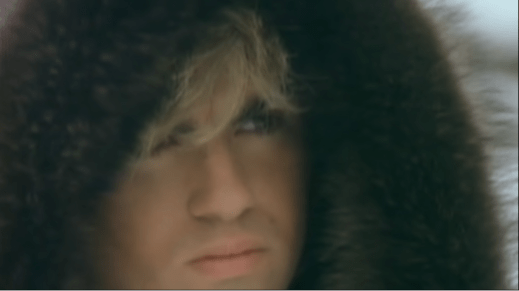
Screenshot from Wham’s “Last Christmas”
George Michael, of course, was publicly closeted for a long time. It’s unsurprising that we see some horror motifs in this heterofest. The wide-angle shot of the isolated cabin, the close up of a brooding, tortured hero…There may well be a queerness in the absence of gendered pronouns and in the visual aesthetic of the music video. But the real disruption, I think, comes in the structural repetition, the rehearsal of the singer’s failure to reproduce each year at the moment that reproduction is most central. If Christmas love songs circulate in a framework of reproductive futurity, “Last Christmas” Scrooges its way onto the airwaves every year and projects an utter failure of a future.
Most Christmas pop songs come and go. The drive to fill the airwaves with a genre of music that is only functional for 6-8 weeks of the year yields heaps of treacly sonic detritus. Christmas pop songs are, by nature, ephemeral. A few of these songs, though, become classics that artists return to and cover or remix over and again. “Last Christmas” is one of these classics, settling onto November and December playlists in its original form and the myriad cover versions that have piled up over the years. Benny Benassi’s “Last Christmas” remixes the Wham! song in a way that maintains the original’s queerness even as it flips the idea of looping failures.
Benassi’s “Last Christmas” revolves around two main sections: a driving techno beat (A) and a reworking of Wham!’s chorus (B).
A (48 measures)
B (48 measures) (1:25)
A’ (24 measures) (2:22)
B’ (56 measures) (3:04)
A” (32 measures) (4:15)
The A sections include a voiceover from a computerized voice affected so that it sounds like some dystopic transmission. “We would like to know if something does not sound quite right,” the voice starts, and then preps the entry of section B with “to guarantee safety to your perfect celebration, be sure – when playing this tune at maximum volume level – to chant around like everybody else is.” It’s hard to be more on-the-nose than this: an android voice instructing us how to fit in at our reproductive futurist holiday gatherings. “You know, just…I don’t know, just do what the others are doing?”
The B sections are each a sequence of three “Last Christmas” choruses (B’ includes an extra eight measures of the third in the sequence). The first is a sped-up but otherwise unaltered Michael singing about last Christmas. It’s a jarring entry, as the cool machinery of Benassi’s beat suddenly gives way to shimmery 80s pop. The second time through that familiar double chorus, we can hear Benassi’s groove faintly in the background and growing louder and fuller toward the end. It’s a straightforward remix technique: here’s the thing, here’s the thing mixed with my beat, and now here’s what I’m really getting at.
It’s the third sequence (1:53), then, where Benassi really crafts his own “Last Christmas.” Here, the beat we heard when the android told us how to fit in combines with Michael’s chorus as Benassi stutters and clips not only the lyrics but the instrumental, too: nothing is stable. Michael can’t finish a sentence (“La-a-as-a-ast, I gave you my gave you my hear-. Thiii-i-i-i-is year to save me from save me from, I’ll give it to someone, I’ll give it to someo-o-one.”), and the beat can’t get a firm start. While Wham!’s “Last Christmas” uses the Post-Chorus to form a closed loop where past and future circle back around to each other, Benassi’s “Last Christmas” denies reproductive futurity by chopping off the beginnings and ends of phrases. Built on a simple two-measure loop that otherwise motors smoothly through the song, Benassi’s “Last Christmas” can’t loop in the third sequence of the B section because there’s nothing to latch onto.

“last christmas” by Flickr user Dako Huang, CC BY 2.0
While Wham! loops queer failures in their overarching forms, Benassi’s version of the song queerly fails to loop. Both versions of “Last Christmas” bah and humbug at reproductive futurism. They’re Scroogey reminders each year to listen for disruptions of nativity, refusals of politically delimited desires that are queerly vibrating through our earbuds.
_
Featured image: “GOOD BYE and THANK YOU” by Flickr user fernando butcher, CC BY 2.0
_
Justin aDams Burton is Assistant Professor of Music at Rider University. His research revolves around critical race and gender theory in hip hop and pop, and his book, Posthuman Rap, is available now. He is also co-editing the forthcoming (2018) Oxford Handbook of Hip Hop Music Studies. You can catch him at justindburton.com and on Twitter @j_adams_burton. His favorite rapper is one or two of the Fat Boys.
_
 REWIND! . . .If you liked this post, you may also dig:
Benefit Concerts and the Sound of Self-Care in Pop Music–Justin Adams Burton
Audio Culture Studies: Scaffolding a Sequence of Assignments– Jentery Sayers
“Hearing Queerly: NBC’s ‘The Voice’”– Karen Tongson
Share this:


Current Top Posts





April 2021

January 2020

November 2019

October 2019

August 2019

April 2014

November 2017

March 2015

December 2017

October 2015
 Sounding Out!
Recent Comments