
Slow, Loud, and Bangin’: Paul Wall talks “slab god” sonics
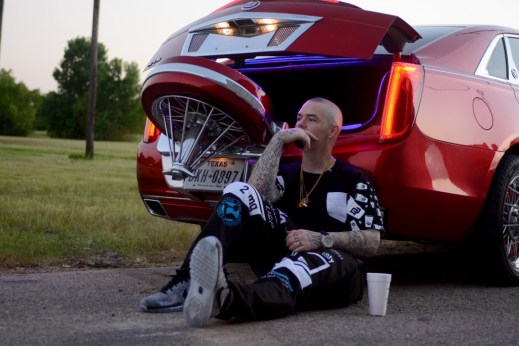
slab god, Paul Wall’s latest project, surpasses many recent rap releases via its stripped down sound, minimalistic in a non-trendy, monastic sort of way. Sonically, slab god is solemn, thoughtful and surprisingly provocative, especially in the context of Wall’s entire discography (his early material with the Color Changin’ Click, for example, was much more lighthearted and playful). Wall professed, “it’s just something that I wanted to do differently. All the music in Hip Hop right now sounds the same and I wanted to do something that didn’t sound like what was coming out right now, so that’s why I came with this.” Unlike many of Wall’s projects based mostly on freestyles, Slab god took several years to produce.
 As soon as Wall recorded “Swangin’ in the Rain,” the first song arranged for slab god back in 2010, he wanted to make the whole album sonically in line with the single: “music to put in the car and bump and ride to.”
SLAB= Slow, Loud, AND BANGIN’, see: Houston Car Culture
In 2012, Wall embarked on his second beginning by releasing No Sleep ‘Til Houston, his first mixtape as an independent artist again, after departing from his eight year relationship with Atlantic Records. For Wall, that was his opportunity to get back to his roots. Committed to this conviction, he disregarded his mainstream momentum in order to “make music not tainted with outside influence from the music industry.” So, pursuant to the title No Sleep ‘Til Houston, Wall followed this self-prescribed antidote until he reintroduced himself to the city where he started, Houston, Texas.
After Wall felt reconnected, he dropped #Checkseason in 2013. Like many of Wall’s projects, it was about getting money; Wall said, “it was meant to be like a motivation mixtape. When you are on your hustle you pop it in.” And in 2014, Wall dropped Po Up Poet, which was according to Wall, titled after “a nickname one of my boys gave me because I’m always talkin’ ‘bout drankin’, po-in’ up, and leanin’.” To Wall, “the lean culture has taken over globally. There’s Brazilian rappers talking about lean. There’s German rappers talking about lean.” [ed.’s note to Paul Wall: Sounding Out! has talked about lean. See Kemi Adeyemi’s “Straight Leanin’: Sounding Black Life at the Intersection of Hip-hop and Big Pharma” (Sept. 2015)]. As a response, Wall released Po Up Poet, “to claim something for Houston.”
I met up with the enterprising Paul Wall while he was in New York City promoting slab god and had the opportunity to “grill” Wall about his new slab sonics for Sounding Out!. In what follows, Wall explains the oral transmission of slab culture, the sonic tension between regionalism and globalism, and Houston Hip Hop. Wall explored some fascinating concepts, namely, how the stimuli for slab god consisted of a jambalaya of subtropical weather and hyper-local Houston folklore along with the pursuit of fun, money, and aesthetics. He also explains how his new sound makes clear that he is a full-on “slabagogue.”
Douglas Doneson: This album took you several years to make. You recorded “Swangin’ in the Rain” in 2010.
Paul Wall: When we did the song “Swangin’ in the Rain,” immediately, it was special to me. It is my favorite song that I have ever personally made.
Another thing is that there has never been a song about rain and slabs or anything screwed up related with rain. Sometimes when it rains the radio plays the rain mix, where all the songs have a rain theme. In L.A., I recorded “Swangin’ in the Rain,” [and] it rained, and of course it never rains in L.A. I just remember thinking, man it’s a blessing these artists don’t even realize because they get free radio play every time it rains. You know what I am saying? So I was like it would be dope if there was a rap song, especially like a Houston type of themed rap song having to do with rain because it rains all the time in Houston. So shit, you get lucky with a jamming song about rain in Houston, there is going to be a lot of radio play.
After I made the song, I was like man I am going to make a whole album like this. So I went to the studio and [it] went to a folder. I have a few different types of folders. I have one where it is songs about money, another folder where it is mostly songs about drank and syrup, and another where it is mostly songs about cars, because that is what I rap about the most, getting money, driving cars, jewelry, and lean. So those are my different folders.
When “Swangin’ in the Rain” came out, I wanted to make a whole album like that: music for the car, music to put in the car and bump and ride to. If you have a journey or you have to ride across town or ride home from work or wherever, this is something I’ll want to put in. It is riding music.
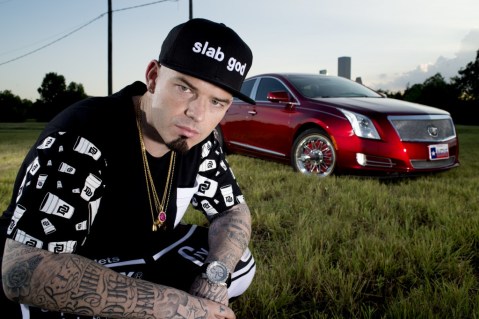
Paul Wall and the Houston Skyline, Photo by Mike Frost
DD: Who are some of the featured artists?
PW: On slab god some of the features I got are definitely a lot of H-Town collaboration on there, starting off with my boy Dead End Red, Sosa Man, Le$, Devin the Dude, Curren$y, Burner, and Snoop Dogg.
DD: I was surprised to see DJ Chose on there. Tell me more about that collaboration.
PW: I met him a while back and I did a song with him before for one of his projects. You see the passion in him; he really looks at what he is doing as art. I ain’t going to lie; we all looked at it like it was a hustle. We didn’t look at it from an artistic aspect of music; we all looked at it like this is something we do for fun and we are going to go hustle it and make some money off of what we do for fun. But with DJ Chose, you could see the way he records; his style is artistic and a little different. I had wanted to work with him for a while. This is one of those things where you’ve got to get him on the right song. You get him on the right song and he’s going to kill it. That’s what he did.
DD: As far back as I can remember, even back in the Color Changin’ Click days, your rhymes have generally been lighthearted and playful, but slab god, especially your verse on “Crumble the Satellite” is confrontational. A line that stuck out to me the most is, “and just because your shirt say it, that don’t make you trill.” What’s going on here?
PW: Well, number one, I wanted to drop some bars, some quotables, where you’ve got to rewind it, [and ask] “what he say,” “he said what?” You know, some of them type of quotables. It took a little time because that’s not stuff you freestyle, that’s something you think about because it’s got to be said right and wording has to be right. It’s more work and I’m not scared of hard work. It’s more time in the studio perfecting things and getting it right.
I ain’t going to lie, I did my verse first, and I didn’t know where to take the song. I just knew the beat was jamming. When I heard the beat it kind of reminded me of “Still Tippin’” with the bass, the drums, and I always remember my boy T Farris telling me when we did “Still Tippin,’” “go in there and freestyle.” So I heard that in the back of my head and it sounded like “Still Tippin,’” so I went in there and did a little freestyle and I was talking about a bunch of random shit. My verse wasn’t a 12 or a 16 bar verse. It was like a 24 bar verse. Originally, it was going to be just me and I wasn’t even going to put a hook on it. I was going to leave it like a freestyle. But at the end when I said, “crumble the satellite,” I said you know what I’m going to call it that and then I sent it to Curren$y and Devin to jump on and both of them boys came right on with it.
DD: The title of your newest album is slab god. What is a slab god?
PW: I was going to call it Slab Life. I wanted to call it something slab related and I didn’t want to call it Slab King, because Lil’ Keke and Corey Blount are Slab Kings, so I didn’t want to say that like I was trying to take their throne. Someone gave me the nickname, they said, “you are the slab god.” I was like, you ain’t lying, I am. I done had over 20 slabs, so shit. I kept [god] with a lower case “g” because I didn’t want to be blasphemous. People are still like, “you are going to hell for that.” I’m like man, shit. I didn’t make nothing difficult. I’m not saying I’m the almighty God. I am also not saying I am the slab god. I am one of several slab gods. There are lots of other people in Houston who are slab gods. We are carrying on the culture, carrying on the torch for the slab. We are just trying to hold it down.
DD: You mentioned Lil’ Keke is a Slab King. On the song “Checklist” with Lil’ Keke off of slab god, you break down the elements of a slab. What are some of the features of a slab?
PW: It is a fluid list. It is always changing. New technologies come, [now] there are new Halo Oracle headlights you can get installed, but three years ago you couldn’t get that. Same with the Ghost Lights on the door; when you open the door up and the lights shine on the ground. They weren’t available two years ago. The checklist keeps getting bigger.
You’ve got to make it your own. That’s the other thing about a slab, is it’s your personal upgrade. There are definitely a few must haves like, you’ve got to have the Texan Wire Wheels Swangas, the ‘84s; there are several different sizes and variations. But you’ve got to have Swangas and you’ve got to have Vogue tires. If you don’t have Vogue tires and you just have regular black tires or something than nah, it’s no deal. You’ve got to have candy paint on it, music in the trunk, some people put tint on it, some people leave it without tint, and a front grill in the front—that’s a must.
On the older cars you put a hood ornament on it like a woman in the front or something. But on the newer cars you don’t really do that too much. We also put a fifth wheel on the back, which is just a spare tire or rim on the back, but you can’t use it, it’s not for practical purposes, it’s for decoration. We put hydraulic pumps on the fifth wheel and on the trunk, so when you hit the switch, the trunk opens up and you got neon lights showing in there with a word or phrase. You’ve [also] got [to have] speakers in there, and that’s pretty much it. Some slabs have convertible, some have a sun roof, and maybe the other thing about slabs is you’ve got to bang Screw. You’ve got to jam Screw in the slab.
DD: It seems like a lot of slab culture is passed down by oral tradition through the O.G.s and Slab Kings such as Corey Blount. In your song “Top Diine” off of slab god, you say, “Texas Ed taught me how to drive extra patient.” Who is Texas Ed?
PW: Man! He going to LOVE that you said that! [Laughs]. That’s my boy [who] I went to elementary, junior high, and high school with. “Top Diine,” I did with Happy Perez. He produced that track and we did that song four years ago or maybe five years ago, so that’s a nice one that we’ve been sitting on for a while [that] we’ve been waiting to put out. But, Texas Ed is my homeboy. We grew up together. He lived in a neighborhood next to mine. When I was in high school, he was one of the ones riding slab, so he was one of the forefathers before me who showed me how to do it.
DD: On your song “Forever Hustle” off of slab god, each line in your verse is like a new phrase ripe for Houston Hip Hop adoption. Drop a few of your favorite lines and talk to me about them.
PW: With that song I wanted to do a flip on word play. First of all, I thought that beat was just jamming so hard and I was like whatever I do to this, I better not fuck up this jamming beat. That’s really what I was thinking. But other than that it, the hook kept coming to me. I don’t know what I was going through at the time, but I heard Slim Thug say one time in a rap, “man I’m going to do this for 10 more years, I ain’t never falling off.” So, shit, that made me realize that as long as there are things I want, [and] as long as I want these things, then I’m going to have to hustle for them. There is no lottery ticket, where you never have to work again. As long as Cadillac makes cars, I’m going to want one. That’s my dream car. My dream car is whatever the newest Cadillac is. As long as they got Swangas and Vogues to put on them I’m going to be putting them on. You know what I’m saying? [Laughs].
I really wanted to do a word play- “I’ma sip mud, ‘til I’m in the mud,” “I’ma sip syrup, until I’m in the dirt.” The rhyme scheme wasn’t a normal bar for bar rhyme; I broke it up in halves and did different shit. “I’ma let the trunk wave, ‘til I’m in the grave,” and “I’ma bang Screw, ‘til I join him,” all that man, shit. It was just something different I wanted to do.
DD: Tell me about your special connection to Slab culture.
PW: For one, it is something that is ours in Houston. There are other places like Austin [and] we generally say Texas, but there’s a lot of places in Texas where they don’t ride slab. There’s not too many people in Dallas that ride slabs, maybe outside Austin, maybe San Antonio, and maybe a few other places; a couple of people in Madisonville, and some of the smaller towns, but as a whole, we try to say Texas, but it is really more of a Houston thing.
The greatest things to me in the world are the most local things. You know when you go to certain areas of the world and they got that cuisine? There is nothing like eating a cheese steak in Philly, there is nothing like going to Louisiana and eating some creole food or Cajun food, and there is nothing like going to Texas and eating some Tex-Mex. With these types of things the localized aspects of it are always the best. It’s something that we got that’s our own and the fact that the rest of the world don’t ride makes it even more special to me because if everyone else did I wouldn’t want to because it was just be something everybody else is doing. That sense of Texas pride is instilled in you when you come from Texas. Texas history from when you were in school, to “everything is bigger in Texas,” to all the companies that come from Texas that are so Texas proud like Blue Bell, and stuff like that. Everybody is so Texas proud. They just teach you that sense of pride in Texas, so our car culture is no different.
The Screw music is another thing that’s ours that came from Texas so, it’s part of that culture and goes right along with the slab culture, so it’s like something I take a lot of pride in because its comes from where we are from, so I want to represent it that much more, you know what I am saying?
Sometimes I might be riding somewhere and there might be somebody, like an old person who don’t like my car and they might give me a dirty look or something and that makes me smile because it reminds me that this is not for everybody and this is something that is just ours. Like my album, I know this album is jamming, so if somebody says they don’t like it then hey it might not be their type of music, or maybe they hate it, or maybe they listened to the wrong album, but I know it’s not because I ain’t do my thing right. Same thing with my car, I know my car looks good. I’m not saying that it’s the best. There are definitely things I should improve, but I know my shit is clean. So if someone else don’t like it then that just means it’s not for them, or they are just a hater, or whatever, but that’s cool because it’s for me, you know what I’m saying?

“Paul Wall Texas Longhorns,” photo by Mike Frost
DD: In an interview you recently did with Devi Dev on KHOU Houston, Texas, you state, “the best artists ever in the world have always been true to their local culture, local style, and local sound.” However, a lot of music critics claim that one reason Houston artists have a hard time popping off is because they won’t let go of their close connection to their culture, isolating themselves from audiences outside of Texas. How has this so-called language barrier affected you?
PW: What the critics have said has been one of the main obstacles of Texas artists achieving super main stream success. We’ve achieved mainstream success but not to a level of a Jay-Z or where Lil’ Wayne is now. We got to where Lil’ Wayne was 10 years ago, you know what I’m saying? We all made it to that level. But none of us made it to the level where Lil’ Wayne is at now! Partially, they are right because [of] Texas culture, a lot of people don’t have any clue what we are talking about. Therefore, when they hear us talking about it, its gibberish or it’s another language, so people are ignorant to what we are saying, when really we might be dropping some hella-fied metaphors, and similes, and bars that are real lyrical. People don’t take it like that because they hear the accent; they hear the slang references, or the culture references that are different than their culture so they just look at it as being bullshit. For instances, if Tupac came out right now and was rapping Russian, I don’t think he’d be looked at as the greatest rapper ever because most people wouldn’t understand what he was saying. But since he spoke in English, we understood what he was saying. So our culture is like speaking Russian.
DD: I love how you brought that up. You transport the Houston sound to other regions. I’m fascinated with your trip to Poland to work with Kazcor. How’d that come about?
That’s dope you asked me about that. Kazcor will be excited about that. This is my dream job. Growing up in Houston, a lot of us never left the neighborhood. I have friends who still, have never left the North Side of town or the South Side of town. You don’t drive past the Galleria, the Galleria is as far as you go. [DD note: Gu raised his hand and indicated he rarely leaves his neighborhood. Everyone laughs] The first time he left the South Side is probably when we went out of town somewhere. There’s a lot of people like that so, that’s how we are brought up in Houston. We just stick to our own area and that’s it and the only reason we’d travel to the other side of town is to go to AstroWorld or something.
The Polish flag and the Texas flag are a lot similar. The only difference I think is the star. So I always wondered if my fan base in Poland was big because the flag is kind of similar. We find excuses or reasons to associate with people for whatever reason. So anyway, a guy I know grew up in Russia, but he moved to Chicago, then he moved to Milwaukee, and then when the recession hit, he and his family moved back to Poland. They went to their family business, which was the slaughter house business and he was just homesick one year for Christmas and was like man, “I am homesick and you were my favorite rapper, so I am going to bring you to Poland and do a concert.” He wasn’t a concert promoter or nothing like that. He wanted to have a dope concert and he was homesick. So I went out there and for me being able to travel around the world to different places like that is a once in a lifetime opportunity, especially when I’m going to these places and literally, I know people who haven’t crossed I-10 in their life; the only time they crossed I-10 was to go downtown to court.
Poland is dope. Some parts of Europe, they speak English, but in Poland, nobody spoke English. It was not an English speaking country; English wasn’t their first language, English wasn’t their second language, [and] English wasn’t their third language. But man, I was inspired by their Hip Hop scene over there. The first time I went, Kazcor, had beef at the time with another rapper, and he performed right before me, and his whole performance was like 50 Cent at Summer Jam, bringing out a blow up doll, doing skits, all related to his beef with another Polish rapper. I was like damn; the beef history of Hip Hop is traveling. I was inspired by that.
They had their own producers out there; rappers, rap scene, rap culture, and DJs and none of them were at all familiar with what was going on in America. It’s not like you know, when Texas is popping now its popping out there, if Atlanta music is popping, its popping out there. It’s not even like if it’s popping, a few months later it’ll be popping there. No man, whatever was going on in America, they didn’t even know who they were. When I would talk to people, I’d be like [have you] heard of this person or that person? They’d say, “nope.” I was inspired that they were completely out of touch with what was going on in Hip Hop in America but, yet and still Hip Hop in Poland was thriving, healthy, and they had their own award shows.
DD: Another example of you bringing the Houston sound to another region is you Screwed and Chopped the album Haunted Cities, by California based rock-rap group The Transplants. Whose idea was that?
PW: I met Skinhead Rob and Travis Barker in the Atlantic offices right when I signed to Atlantic. Of course I knew who Blink 182 was, but I met both of them and they were both cool as a fan. After that, I started researching more of their music and got familiar with it and it was dope.
Skinhead Rob was the one who was like, “man, why don’t you do a Screwed and Chopped version of this? There never been anything like this done before.” First of all, if something has never been done, I’m already like “yep, I’ll do it.” And it was also jamming, so we were on the same level. It was easy to do. So when Skinhead Rob put that play in motion, I was like, hell yes. I am proud of that one, man.
DD: On slab god you mention Jacka. I was wondering who that is and if you feel comfortable talking about him.
PW: For sure. He’s a rap artist from the Bay. He was in a group called the Mob Figaz. My boy Husalah is on the album too, he’s in the group Mob Figaz. Jacka got killed a few months ago, this year. He was a real close friend of mine. Before I had even met him, I was a big fan of him. Matter of fact, my boy Skinhead Rob turned me onto him. Skinhead Rob turned me on to a lot of underground music. He turned me on to Mac Dre, Andre Nikatina, the Mob Figaz, Jacka, Husalah, Mitchy Slick, and to a lot of West Coast artists.
But, Jacka, I still remember meeting him, when the All Star Game was in Houston, 2006 Super Bowl. I remember meeting Jacka; somebody in the club saying in the microphone, “shout out to the Jacka, Mob Figaz in the house.” I was like, “what? Where is he at? I got to meet him.” I just asked somebody who I knew from the Bay, I was like, “bro, is Jacka in here? Where he at?” He said that’s him over there. So I went up to him and was like, “bruh, I fuck with your shit.” Because I really did jam his music like that. I think he was taken back like, “man are you for real or are you just like saying this?” And I said, “nah, bruh.” I was quoting lyrics and quoting lines, dropping bars, like I really fuck with you. He was literally one of my favorite rappers, especially at the time and still now.
I get stuck in my personal zone where I only listen to a few artists, and he was one of them for sure. He just was a good person and that’s how we met [and] over the years we did other things, shows, songs, we got an album together, it hasn’t come out yet, but we’ve been working on that. We really have two albums together.
Something I always admired about him was how he preached gems in his music. In his music, he’ll drop a spiritual gem that will make you reevaluate your relationship with God and in his raps he would inspire people to be better. And one thing that I always loved about him, anytime I ever would be with Jacka he would always have me feeling like I could conquer the world. He was a hell of a pep talker and a lot of people I know who knew him say the same thing. That was my boy. He got killed [and] I just wanted to do a song for him, dedicate it for him, let the whole world know, and more specifically, put people in Texas on to him because he reminds me of a Z- Ro type of artist. Z- Ro will say God related things or spiritual things to help better yourself sometimes [and] you’ll be like damn this boy Z- Ro is deep. And that’s just kind of how the Jacka is.
DD: Is there anything else you want to share with us?
PW: slab god is in stores now. Houston Oiler is on the way.
—
Featured Image: Paul Wall, his slab, and the white cup, Photo by Mike Frost
—
Douglas Doneson writes about Houston rap music. He has written for The T.R.O.Y. Blog, Complex, Noisey, and God is in the TV.
—
 REWIND!…If you liked this post, check out:
“This is Your Body on the Velvet Underground“–Jacob Smith
“The (Magic) Upper Room: Sonic Pleasure Politics in Southern Hip Hop“–Regina Bradley
Culture Jamming and Game Sound: An Interview with foci + loci–Skot Deeming and Martin Zeilinger
Share this:

Listening to Sounds in Post-Feminist Pop Music
Some of the most popular early 21st century feminist approaches to pop culture are rooted in a collapse of visual and aural representations. For example, though Disney princesses have become visibly more diverse and realistic, linguists Carmen Fought and Karen Eisenhauer have compiled data showing that women characters in Disney princess films speak less in films released between 1989-1999 than they did in films released in the 1930s-1950s. Writing in Noisey in 2015, Emma Garland wonders whether we “have created an environment in which female artists are being judged only on their feminism.” Both in her own analysis and in the thinkpieces she references, that judgment addresses the verbal content of song lyrics or artists’ public statements and the visual content of music videos. Noting that “a lengthy Google search will drag up hundreds of editorial pieces about the [Rihanna’s] ‘BBHMM’ video” (The Guardian alone hosts six), but barely any reviews of the actual song, Garland illustrates just how much feminist analysis of pop music skews to the visual and away from sound and music. Popular post-feminist analysis focuses on the visual and verbal because of the influence of law and legal theory on 20th century American feminism. However, in post-feminist pop, the sound lets in the very same problems the lyrics and visuals claim to have solved.
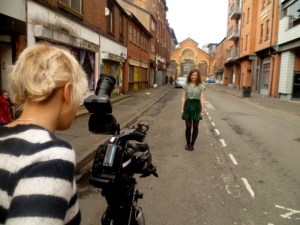
“filming of the HTML music video” by Flickr user MadLab Manchester Digital Laboratory, CC BY-SA 2.0
In her article “Liberal Feminism From Law To Art,” L. Ryan Musgrave argues, “many early feminist accounts of how art is political depend largely on a distinctly liberal version of politics” (214). This is a classical contractarian liberalism where “equality meant equality before the law…[and] democratic representation in a state” (214). Legally, these principles inform foundational liberal values like freedom of speech (e.g., the First Amendment to the US Constitution) and equality of opportunity (e.g., the Fourteenth Amendment to the US Constitution). 20th century feminist artists and art scholars translated these legal principles into ideas about how art should be made and interpreted. According to Musgrave, the political principle of free speech is translated into an aesthetic principle of “free expression…we should celebrate in order to be inclusive, straightforward expressions of either one’s individual experience or one’s identity as a member of an historically disenfranchised group” (223). This type of feminist aesthetics sought to counter the tendency to silence, ignore, trivialize, and censor women’s art.
In pop music, liberal feminism informs discussions of the marginalization of women artists in a particular genre, or celebrations of women’s self-expression, like ‘90s “girl power” and “revolution girl style now” aesthetics. As an aesthetic principle, equality of opportunity manifests as a two-pronged commitment to non-exploitative modes of production and to representational accuracy: women should not be objectified by or excluded from artistic practice, and they should be truthfully, realistically depicted in art (Musgrave 220). Pop and hip hop feminisms often appeal to this type of feminism, generally in discussions of women’s bodies: were women objectified in the video-making process? Do they appear on screen only as objects? Do the images of women accurately depict “real” women, or are they unrealistic images of too-thin, too-blonde ideals?
With its commitments to free speech and equality of opportunity, mainstream Anglo-American feminist aesthetics translates liberalism’s concept of political representation into a concept of aesthetic representation. The outcome of this translation is a “realism focused on the content of artworks” (Musgrave 223; emphasis mine) and “the conviction that it is the job of art or creative work to get it right, to show how it ‘really’ is, to come clean of previously incorrect and ideologically weighted images” (226). A feminist aesthetics focused primarily on the representational content of artworks and the subjectivity (or objectification) of artists translates classical liberalism’s ideas of what politics, injustice, and equality are into artistic terms.
Meghan Trainor’s infamous “All About That Bass” and “Dear Future Husband,” Lilly Allen’s “Hard Out Here,” and even Usher’s “I Don’t Mind” are recent examples of songs that trade in equality of opportunity-style liberal feminism. For example, “All About That Bass” and “Hard Out Here” address a disjoint between how women are portrayed in the media and how they “really” look. “Dear Future Husband” and “I Don’t Mind” are about (partnered, heterosexual) women’s entitlement to work, even sex work. Both of these approaches share the underlying assumption, drawn from liberalism, that art re-presents reality in the same way a vote re-presents a citizen’s will or an elected representative re-presents the will of their constituents: accurately and truthfully, in the sense of truth as correspondence between statement and fact, signifier and signified.

“In Her World” by Flickr user Nana B Agyei, CC BY 2.0
Within a liberal feminist framework, sound can only be political if it has a representational content that depicts or expresses a subject’s voice or identity. This is why post-feminist approaches to pop music overlook sound and music: requiring attention to things like formal relationships, pattern repetition and development, the interaction among voices and timbres, and, well, structure, they don’t fit into liberalism’s understanding of what politics is and how it works. But because the music part of Anglo-American pop music always does more than this, it has political effects that this liberal feminist framework can’t perceive as political, or as having to do with gender (or race).
This can be both a good thing and a bad thing. On the one hand, this emphasis on the visual to the exclusion of sound opens a space for radical and subcultural politics within the mainstream. For example, as Regina Bradley has argued here at Sounding Out!, Beyoncé uses sound to move outside the politics of respectability that her visual image often reinforces. On the other hand, it creates a back door through which white supremacist patriarchy can sneak in. This is the same back door that all liberalisms have, the back door that lets substantive inequality pass as equality before the law and/or the market (Falguni Sheth, Charles Mills, and Carole Pateman talk extensively about this).
Popular post-feminist pop refers back to liberal aesthetics in order to establish its “post-”ness, that is, to show that the problems liberal feminism identified are things in its and our past. For example, inaccurate representation and objectification or silencing are precisely the things that the contemporary pop examples I cited claim to have fixed: Trainor and Allen accurately represent “real” women, and Usher’s song talks about a stripper as an empowered (near) equal rather than an object. However, the sounds in these songs tell different stories; they make white supremacist patriarchy entirely present.
Usher’s “I Don’t Mind” uses sound to straighten out some of the ratchetness in hip hop sexuaility. L.H. Stallings’s “Hip Hop & the Black Ratchet Imagination” argues that
the strip club genre and the hip hop strip club also develop as a result of the unacknowledged presence of black women with various gender performances and sexual identities within the club, on stage and off, whose bodies and actions elicit new performances of black masculinity. Moreover, when woman is undone in this way, we note the potential for such undoing to temporarily queer men.” (138)
Though it’s conventional to see women strippers and their male rapper audience in terms of heterosexual desire and normativity, the dancers’ use of black dance performance traditions and aesthetics displace scripts of femininity and put their bodily gender performance in transition. And because “this is what rappers get caught up in–the fantasy of woman whose origin is in the female dancers’ undoing of woman,” (138), this fantasy also undoes them as “men.” The dancers’ performances are a type of “corporeal orature” (138) that puts outwardly heteropatriarchal gender and sexuality in transition, bending it away from respectability (the reproduction and transmission of wealth, property, and non-deviance qua whiteness) and toward ratchet.
The booty clap synth patch is one way this corporeal orature gets translated into sounds. It’s a particular variation on the hand-clap drum machine sound, and it translates the “booty clap” dance move and the rhythm of twerking into music. Following the dancers’ rhythm, the patch is usually used in a four-on-the-floor pattern, as for example in Juicy J’s “Bandz A Make Her Dance.” Featuring Juicy J as the misogynist foil to Usher’s progressive nice guy, “I Don’t Mind” is easy to hear as a direct response to “Bandz.” Like “Bandz,” “I Don’t Mind” is a song about men’s desire for strippers. However, “I Don’t Mind” straightens that desire out and classes it up by rewriting–indeed, erasing–the corporeal orature translated into the 4/4 booty-clap synth rhythm. Throughout “I Don’t Mind” that same synth patch is used on beats 2 and 4; it takes a “ratchet” sound and translates it into very respectable, traditional R&B rhythmic terms. Sound is the back door that lets very traditional gender and sexual politics sneak in to undermine some nominally progressive, feminist lyrics.
Sound plays a similar role in much of Meghan Trainor’s work. In “Dear Future Husband,” she sings apparently feminist lyrics about economic and sexual empowerment over do-wop, a backing track that sounds straight out of an episode of Happy Days (a 1970s TV program about 1950s nostalgia). Similarly, “All About That Bass” puts lyrics about positive body image over a very retro bassline that has more in common with the bassline in the theme song to David Simon’s New Orleans series Treme than it does with the bass in either Iggy Azalea’s “Black Widow” or Jessie J’s “Bang Bang”—two of the other singles consistently in the top five slots during “All About That Bass’s” weeks-long dominance of the Billboard Hot 100 in fall 2014.
Especially after the success of 2014’s “Uptown Funk” by Mark Ronson and Bruno Mars, this retromania isn’t unusual. But few pop songs look back as far as these post-feminist songs do, to the 1950s and even earlier. Appealing to pre-Civil Rights era sounds, these songs double down on the racialized sexual normalcy of white women’s performances of post-feminist empowerment. “Dear Future Husband,” “All About That Bass,” and “Marvin Gaye” (Trainor’s collaboration with Charlie Puth) all take rhythms, timbres, and genre conventions appropriated from black pop music, but which have, over half a century, been assimilated to bourgeois respectability. They recall Grease more so than Little Richard.

“Vintage Sindy Record Player” by Flickr user
Tai O’Leary, CC BY 2.0
For example, James Shotwell describes “Marvin Gaye” as taking “an innocent approach to talking about sex, with accompaniment that is straight out of your grandma’s favorite sock hop memories…Just like how Mark Ronson and Bruno Mars have made a mint in recent years with a revitalization of funk ethos, Meghan Trainor and Charlie Puth are now doing the same for pop, only with less risk.” “Marvin Gaye” sounds less sexually risky because it recalls what, for whites, was a more racially “innocent” time, a pre-Civil Rights era when white ears could more easily avoid the sounds of black radical politics in either James Brown’s funk or Gaye’s soul. In “Marvin Gaye,” old-school sounds evoke a time when society was organized by the same sort of comparatively simple racial politics that organize the song itself. For example, its bridge follows the trap convention of using a male-chorus “Hey!” on the 2 and 4 of every measure. Its verses, however, put that same “Hey!” patch only on 4. Sounds evoke racial non-whiteness to generate tension, but then resolve that tension sonically. Definitive sonic resolution shuts down the transitional effect ratchet sounds, like those heard in the bridge, can have on sexuality and gender.
In “Marvin Gaye” and the other retromanical post-feminist pop songs, sounds do the white supremacist patriarchal work the lyrics and videos claim to have progressed past. Even though these women’s speech and appearance are outside the bounds of traditional femininity, the sounds reassure us that this newfangled gender performance isn’t racially and sexually deviant, that it isn’t “ratchet” in Stallings’ sense. Using liberalism to define the paramaters of political (in)justice, contemporary post-feminist aesthetics focus our attention and effort on verbal content and visual mimesis; this creates an opening for sound and music to either destabilize or double down on normative gender, sexual, and racial performance. As the “Marvin Gaye” example shows, this opening is an essential component of neoliberal post-feminism: sound recodes white women’s transgressions of traditional femininity as racially and sexually normal.
—
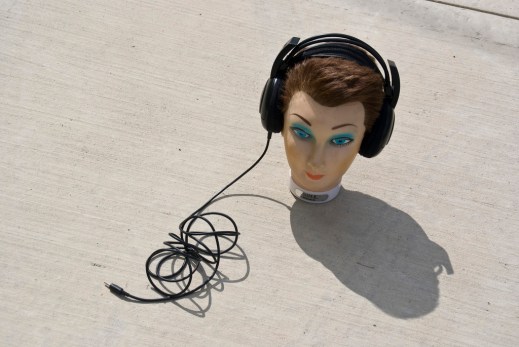
Featured image: “mannequin head on concrete with headphones” from Flickr user J E Theriot, (CC BY 2.0)
—
Robin James is Associate Professor of Philosophy at UNC Charlotte. She is author of two books: Resilience & Melancholy: pop music, feminism, and neoliberalism, published by Zer0 books last year, and The Conjectural Body: gender, race and the philosophy of music was published by Lexington Books in 2010. Her work on feminism, race, contemporary continental philosophy, pop music, and sound studies has appeared in The New Inquiry, Hypatia, differences, Contemporary Aesthetics, and the Journal of Popular Music Studies. She is also a digital sound artist and musician. She blogs at its-her-factory.com and is a regular contributor to Cyborgology.
—
REWIND! . . .If you liked this post, you may also dig:
Love and Hip Hop: (Re)Gendering The Debate Over Hip Hop Studies–Travis Gosa
SO! Amplifies: Mega Ran and Sammus, The Rappers With Arm Cannons Tour–
Share this:


Current Top Posts





April 2021

January 2020

November 2019

October 2019

August 2019

April 2014

November 2017

March 2015

December 2017

October 2015
 Sounding Out!
Recent Comments