
Doubled Double Consciousness and the Sound of New Afrikan Expression

 Inspired by the recent Black Perspectives “W.E.B. Du Bois @ 150” Online Forum, SO!’s “W.E.B. Du Bois at 150” amplifies the commemoration of the occasion of the 150th anniversary of Du Bois’s birth in 2018 by examining his all-too-often and all-too-long unacknowledged role in developing, furthering, challenging, and shaping what we now know as “sound studies.”
It has been an abundant decade-plus (!!!) since Alexander Weheliye’s Phonographies “link[ed] the formal structure of W.E.B. Du Bois’s The Souls of Black Folk to the contemporary mixing practices of DJs” (13) and we want to know how folks have thought about and listened with Du Bois in their work in the intervening years. How does Du Bois as DJ remix both the historiography and the contemporary praxis of sound studies? How does attention to Du Bois’s theories of race and sound encourage us to challenge the ways in which white supremacy has historically shaped American institutions, sensory orientations, and fields of study? What new futures emerge when we listen to Du Bois as a thinker and agent of sound?
Over the next two months, we will be sharing work that reimagines sound studies with Du Bois at the center. Pieces by Phillip Luke Sinitiere, Kristin Moriah, Aaron Carter-Ényì, Austin Richey, Jennifer Cook, Vanessa Valdés, and Julie Beth Napolin move us toward a decolonized understanding and history of sound studies, showing us how has Du Bois been urging us to attune ourselves to it. To start the series from the beginning, click here.
Readers, today’s post by Austin Richey considers the possibilities of Du Bois’ idea of double consciousness, as it applies to the Black Atlantic in general. He approaches “doubled double consciousness” through the case study of two artists: Tendai “Baba” Maraire and Efe Bes.
–Jennifer Lynn Stoever and Liana Silva, Eds.
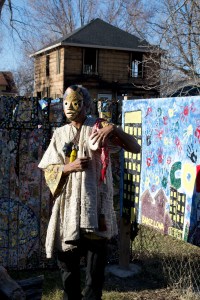
Efe Bes with his tama at Ohana Gardens, Highland Park, MI – taken by the author
In his 1903 text The Souls of Black Folk, W.E.B. Du Bois expresses the “otherness” of Black American identity as a “double consciousness,” an internalized condition whereby an individual’s self is contested by what Du Bois describes as the “sense of always looking at one’s self through the eyes of others…One ever feels his two-ness, an American, a Negro; two souls…; two warring ideals in one dark body” (2). This in-between status requires one to negotiate between these dual perspectives, and through the sonic expressions of cultural mediation, we may hear the tactics with which Black American culture creators select and present a particular version of their cultural identity.
In this essay, I argue for a doubled double consciousness that extends Du Bois’s conception into an increasingly interconnected space that Paul Gilroy called the Black Atlantic, a space which includes the histories and traditions of distinct African cultures, diasporic African communities, and Pan-African ideology. Based on the sonic practices of two artists, Seattle-based Zimbabwean American rapper and multi-instrumentalist Tendai Maraire, and Detroit-located Afrikan drummer and storyteller Efe Bes, we may hear doubled double consciousness as a multi-dimensional site of negotiation whereby musicians source from plural geographic, temporal, and cultural springs to compose a sonic “mix” of Black musical histories; this “mix” echoes the space where the hip hop DJ “noisily bring[s] together competing and complementary beats without sublating their tensions” (Weheliye 13). This anti-anti-essentialist tactic, as Carter Mathes describes in “The Sounds of Anti-Anti-Essentialism: Listening to Black Consciousness in the Classroom,” demonstrates that “it is the open space of sound that invests the project of black radical thought with the uncanny spontaneity of experimentation.”

“Tendai Maraire of Shabazz Palaces, Sub Pop Silver Jubilee, Pop Stage” by Flickr user Jeff Few, CC BY-NC-ND 2.0
Importantly, doubled double consciousness is a challenge to the received status of the “other,” and reveals a multiplicity of gazes through which an individual is viewed. As Maraire reflected,
I always felt that America saw us the same; not as African-American, Zimbabwean or even Black. Just Ignorant Negroes. As I got older my friends and I learned we’re all in the same social and economic positions. But I still had American friends who thought I felt better than them because I was Zimbabwean, and friends that were from Zimbabwe who thought I was better than them, or lost my culture because I had a curl and wore Jordans. (quoted in Devriendt)
Maraire assumed a singular, hegemonic gaze, yet his lived experience in America and Zimbabwe exposed him to critiques from black Americans, diasporic Africans, cosmopolitan and rural Zimbabweans, not to mention advocates, and sometimes appropriators, of different cultural lineages in a diverse city like Seattle.
While Du Bois claimed that the doubly conscious individual “does not wish to Africanize America,” the sonic expressions of doubled double consciousness reflect a particular Afrikan perspective, that is, a redefined social discourse which emerged from the intertwining of Black American activist efforts and knowledge derived from plural ancestral histories and African culture. By positioning themselves as Afrikan – not American, not African, but in-between – these artists showcase how doubled double consciousness is not a condition, but a tactic of negotiation and re-presentation.
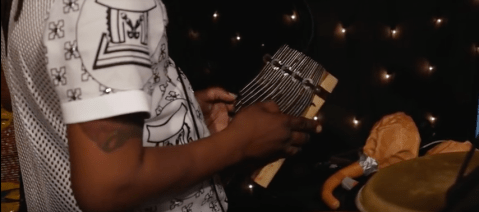
Screenshot of Maraire playing the nhare mbira, from the video “Chimurenga Renaissance – The B.A.D. Is So Good (Live on KEXP)”
Rapper and multi-instrumentalist Tendai “Baba” Maraire has been a staple of the Seattle hip hop scene since the early 1990s. While he honed his lyrical style in the cyphers of Seattle’s Columbia City, his parents Dumisani Maraire and Lora Chiorah-Dye, a renowned Zimbabwean ethnomusicologist and performer, and Zimbabwean dancer and instructor respectively, fostered a cosmopolitan Zimbabwean household; musically, Maraire performed live with his parents’ drum, dance, and marimba ensemble, sung Christian hymns in Shona, and opened for hip hop legends Snoop Dogg and Slick Rick. This provided Maraire with an extensive sonic palette to source from, yet his early attempts to bring these worlds together into an Afrocentric message were met with resistance:
[Audiences] didn’t even know what I was playing when I pulled out an mbira [a Zimbabwean lamellaphone] on stage 20 years ago and rapped with it. No one cared, rappers laughed. The world just wasn’t ready for that. With gangsta music at the time…they didn’t want to accept a dude with an mbira talking about political views out in Zimbabwe.” (Maraire interview)
Today, as half of the Afrofuturistic hip hop duo Shabazz Palaces, Maraire has continued to incorporate the mbira, ngoma (drums), and hosho (gourd rattles) into his musical production; as Shabazz Palaces toured with artists such as Radiohead and Lauryn Hill, Maraire’s Afrikan hip hop style reached a global stage.
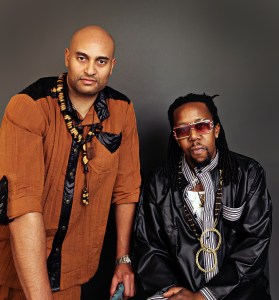
Tendai Maraire and Hussein Kalonji – courtesy of the artists
Doubled doubleness tactics come out forcefully in Maraire’s side project Chimurenga Renaissance, a moniker which connects chimurenga, a Zimbabwe-specific political struggle, to a global Black consciousness movement. Maraire and musical partner Hussein Kalonji, son of the famous Congolese Rhumba guitarist Raymond “Braynck” Kalonji, blend the melodic elements of Zimbabwean mbira and Congolese guitar with the sounds of the Roland 808 drum machine, funk and soul samples, topped by Maraire’s stream-of-consciousness lyrical flow.
Chimurenga Renaissance’s single “Pop Killer,” from 2013’s Defenders of the Crusades EP, exemplifies the power of doubled double consciousness to signify complex ideas to a variety of audiences: through his dismantling of problematic pop musicians who have left their culture behind, Maraire aims his Afrikan hip hop at American and Zimbabwean communities who have critiqued his cultural claims, as well as encourages other black musicians to dig deep and proudly represent their heritage. The video for the track follows Maraire as he travels to the ruins of Great Zimbabwe, the capital of the Kingdom of Zimbabwe (11th-15th centuries), with his mbira to confer with his ancestors. Sonically, the song has three distinct sections whose juxtaposition showcases the multiple sound cultures which make up Maraire’s complex identity.
The track opens with sound of wind, followed by a sampled and chopped up boom-bap drum beat. As Maraire improvises on his reverb-drenched mbira he is joined by a sampled walking bassline, while the chorus and reverb effects Kalonji uses for his arpeggiated melodies complement the timbre of Maraire’s amplified mbira. In the second section, the mbira remains while sampled drums are replaced by hand clapping, hosho, and ngoma, signifying a shift from the reproduction of electronic sounds to the liveness of group participation. Over this, Maraire’s unremitting lyrics call out those who reject their histories, telling them, “This ain’t a show, this a sacred ritual. You can’t possess it because your life is hypocritical.” As Kalonji’s guitar re-enters, the track slows to a third section where Maraire’s raps: “The gold on my pinkie represents where I’m from. If you ain’t never seen it then we ain’t close enough. I got some bigots in my wallet, sativa’s in my pocket, passport to touch the world cause the man can’t stop me.”
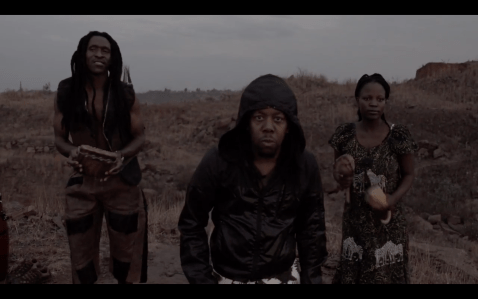
Jacob Mafuleni, Tendai Maraire, and Martha Thom in a still from Chimurenga Renaissance’s “Pop Killer”
The official video also includes a bonus verse, featuring Maraire rapping live in a field accompanied by Zimbabwean musicians Jacob Mafuleni and Martha Thom; this rural scene, featuring an unamplified mbira and driving rhythms from the hosho, further amplifies Maraire’s connection to ancestral life, while his raw vocals and intense delivery are reminiscent of a rap cypher.
In Detroit, Afrikan drummer and storyteller Efe Bes has used doubled double consciousness as a platform to critique those who have lost a cultural connection to African ancestors.
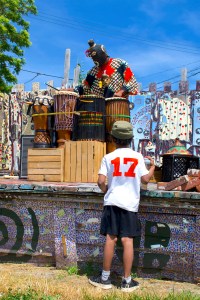
Efe Bes performing at Dabls’ MBAD African Bead Museum, Detroit, MI – taken by author
His own Afrikan-ness is marked not just visibly by his self-made Afrikan masks but also aurally through his unique musical instrumentation and style: Bes plays a collection of drums from across the African continent, including Senegalese sabar drums, West African tama and dundun, and South African ngoma, as well as a modified kora, balafon, and multiple drum machines. Bes performs complex patterns that source from the polyrhythms of West African music to the shuffle of American Blues, occasionally over instrumental recordings of popular hip hop singles, such as rapper Future’s “Fuck Up Some Commas.” For Bes, these musical traditions are connected by an emphasis on the drum, and his performances are marked by shifting patterns that easily move from the deep swing of the blues to the automated soul of techno, a tactic which he developed while DJing for Aretha Franklin in the early 1990s. Weaving these multiple black musical traditions, Bes creates a soundscape that simultaneously looks back to ancestral sound cultures while pushing the boundaries of what Detroit’s musical legacy will sound like in the future.
In addition to live performances, Bes produces his own music videos and promotes his music through YouTube. His archive of over 200 videos shows the breadth of his musical abilities, ranging from spoken word poetry combined with talking drum, to his most viewed original song, “Gimme Back My Shit,” an Afrikan funk tune in which Bes demands reparations for the devastation of Black culture worldwide.
The song begins with Bes humming and performing the main melody of the piece on electric piano. While his humming is laid back, the insistent rhythms of the piano foreshadows the lyrical intensity of this “real reparation song”; this is highlighted by the piano’s synthesized guitar sound, whose bright, cutting timbre and plucked sound are reminiscent of an amplified kora. This introduction leads to the main groove, where looped samples of syncopated funk drums and guitar accompaniment create a foundation for improvised tama drumming and his soulfully styled yet acerbically lyrical vocal performance.
“Give me back my shit, you done had it for so long you think that you own it.
I’m not talking about some, I’m talking all of it.”
Bes’s lyrics go beyond simple criticism, and instead, demand reparations in the form of cultural repatriation, or as Bes sings, “Give me back my ancestors you grave-robbing bitch.” In the self-produced music video, visuals of Pan-African statues, masks, and Mbuti pygmies are juxtaposed with images of Cecil Rhodes, starving children, and cellphones which rely on conflict materials like coltan; these images are punctuated by the sounds of African languages, such as the clicks and pops of Xhosa, as well as the sound of deforestation, such as gas-powered saws, further emphasizing the degradation and destruction of African cultures through the loss of music, language, tangible culture, and environment.
Through the sonic practices of Tendai Maraire’s Afrikan hip hop and Efe Bes’s Afrikan drumming, we may hear how doubled double consciousness is a tool used to negotiate complex ancestral recall. For these artists, doubled double consciousness is not simply a condition, but a powerful space to negotiate and re-articulate what it means to be Afrikan in America.
—
Featured image: Screenshot from video “Pop Killer” by Chimurenga Renaissance
—
Austin T. Richey is a Ph.D. candidate in Ethnomusicology at Eastman School of Music in Rochester, New York. His current dissertation research is based in his hometown of Detroit, Michigan, where he is exploring the resonances between diasporic African musical, dance, and visual arts and Detroit-specific musical genres, such as techno, in this historically multifaceted American city.
Richey has published original research in African Music, and has forthcoming articles in the Routledge Handbook of Music in the New African Diaspora and Opioid Aesthetics: Expressive Culture in an Age of Addiction, published by West Virginia University Press. Support for his work has come from the Society for Ethnomusicology’s African Libraries Prize, the Frederick Douglass Institute, as well as the Society for American Music, where he is an Adrienne Fried Block Fellow. Richey is also an active performer, playing regularly in the New York area with Serevende Mbira and Mounafanyi Drum and Dance.
—
 REWIND! . . .If you liked this post, you may also dig:
“Most pleasant to the ear”: W. E. B. Du Bois’s Itinerant Intellectual Soundscapes–Phillip Luke Sinitiere
On Whiteness and Sound Studies–Gustavus Stadler
Unlearning Black Sound in Black Artistry: Examining the Quiet in Solange’s A Seat At the Table–Kimberly Williams
Share this:

Deep Listening as Philogynoir: Playlists, Black Girl Idiom, and Love


Here at Sounding Out! we like to celebrate World Listening Day (July 18) with a blog series. This year, we bring your attention to the role of listening when it comes to the sounds of the K-12 classroom, and by extension, the school.
Any day in a K-12 school involves movement and sounds day in and day out: the shuffling of desks, the conversations among classmates, the fire drill alarm, the pencils on paper, the picking up of trays of food. However, in many conversations about schools, teaching, and learning, sound is absent.
This month’s series will have readers thinking about the sounds in classrooms in different ways. They will consider race, class, and gender, and how those aspects intersect how we listen to the classrooms of our past and our present. More importantly, the posts will all include assignments that educators at all stages can use in their classrooms.
Time’s up, pencils down, and let’s listen to Shakira Holt‘s playlists, compiled by three of her high school graduates. –Liana Silva, Managing Editor
—
This past school year, in my roles as a high school teacher who likes what music can do for the classroom environment and as a Link Crew Coordinator who oversees student leaders as they host a mixture of freshman-only and schoolwide events, I frequently found myself sternly censoring black female student contributions to musical playlists. Although I emphasized the criterion of “clean” with increasing exasperation, my students just did not seem to get it. Strangely overlooking “ni**a,” “f***,” and “s**t,” they brought me songs, which, if played, would have gotten me called into the principal’s office, literally. When they triumphantly approached me with “clean” versions, they typically cast not a moment’s thought towards the lyrical content of drugging, drinking, fighting, and sexing, topics no less hazardous for campus play. Clearly, my students and I were working from battling notions of “clean.”

Parental Advisory label, By RIAA (RIAA) [Public domain], via Wikimedia Commons
Feeling every bit the forty-year old school marm that I am, I remain abundantly clear on my objections to these songs for general classroom and campus use. However, I confess that my effectual silencing of these young women never sat quite right with me. It nagged me with worries over what I was really refusing to hear, to make space for by shutting off the voices of these young black women in this way.
However outré, daring, or trouble-making I may fancy myself as a scholar and thinker, when placed within the K-12 context, I am, it turns out, your average, workaday campus censor. I hypocritically feign alarm at cussing. I fake-clear my throat with loud ahems whenever that blue talk ventures into the X-rated. While I fully respect the creativity and naughtiness of student-to-student speech and spend a good bit of time pretending not to hear what is meant to be conversation among peers, there is a limit I feel compelled to enforce. Whenever the volume grows too loud for me to pretend not to have heard or when the word choice becomes spectacularly adventurous, the expectations of the classroom/campus setting demand my intervention. Dutifully, I step in as judge and censor.
“DSC02583_ep_gs” by Flickr user Erik Parker, CC BY-NC 2.0
Nor is this a singular feature of schools. Places and spaces of all kinds depend heavily upon the extent to which both occupants and itinerants adhere to place-based expected modes of behavior and speech. It is important to note that even when enforced and observed by people of color, these behavior and speech norms remain overwhelmingly middle-class and white in origin and character, which can lead to interesting, sometimes alarming, and even deadly implications for people of color who enter “allegedly public” spaces without observing these norms, as Jennifer Lynn Stoever points out. In the Introduction to The Sonic Color Line: Race & the Cultural Politics of Listening, Stoever argues that in failing to act or speak in ways that reflect the place-based expected modes of behavior and speech governing such spaces, people of color frequently run the risk of falling prey to what she calls “white Americans’…implicit, sometimes violent, control over…an ostensibly ‘free,’ ‘open,’ and ‘public’ space” (2). This risk, as Stoever illustrates, often exposes non-compliant people of color to condemnation, confrontation, and even bodily harm.
 The collision of place/space, race, and gender is a natural element of life in the U.S. and has become a regular and needful facet of contemporary national discourse. In a brilliant analysis of this collision as it took place in the 2013 George Zimmerman trial, Regina Bradley explores how the presence of Rachel Jeantel laid bare the way in which enforcement of place-based norms is often racialized and gendered. Rachel Jeantel is the young black woman whose body, comportment, and speech set off waves of derision and controversy as she testified in court regarding the last living moments of her close friend, Trayvon Martin. Bradley recalls how critics ignored Jeantel’s anguish, her grief, and her trauma in order to train excessive focus on her “refusal and inability to conform to expected cultural and aural scripts of black womanhood within the confines of the courtroom.” The courtroom’s “cultural and aural scripts of black womanhood” demand overt demonstrations of respect, if not outright intimidation, passivity, and general humility in tone and demeanor which would typically compensate for any deviations from Standard American English speech norms. Jeantel’s speech played only by the rules of what Brittney Cooper has called “her own particular, idiosyncratic black girl idiom” as created by her “Haitian and Dominican working-class background, her U.S. Southern upbringing, and the three languages—Haitian Kreyol…Spanish, and English—that she speaks,” and not by the rules of SAE. Thus lacking both the gentle mien expected of black women in court and an acceptable mainstream speech pattern, Jeantel suffered a broad range of brutal racist, classist, and sizeist critiques centering not only on her attitude and her speech, but also on her weight, her skin tone, her hair, and her general unfitness for public consumption.
Like the courtroom, the K-12 classroom and campus are place-based contexts that possess their own “expected cultural and aural scripts.” These scripts prescribe and police such speech elements as volume, tone, syntax, diction, and content. Like courtrooms and other spaces, the K-12 classroom and campus can easily become oppositional, and sometimes downright antagonistic, towards the young black female people who occupy these spaces while speaking their “own particular, idiosyncratic black girl idiom[s].” The idiosyncrasies of their idioms can so completely transgress the K-12 cultural and aural script that these young black female people often lose the right of being heard altogether, of achieving any attention at all beyond opprobrium for their transgressiveness. Bradley writes pointedly of Jeantel, “Her emotionally charged question ‘are you listening?’ jolted not only [George Zimmerman’s attorney, Don] West but those watching the trial. Were we listening? What were we listening for?” I find overwhelming resonance here because when I reframe my students’ playlists and song choices as alternative types of “idiosyncratic black girl idiom,” I must also reframe myself as an agent of what Bradley calls “hyper-respectability,” a source of censure and scorn. I must then answer Jeantel and Bradley’s questions honestly: For most of the year, I was not listening to my black female students. Too preoccupied with listening for speech that matched the cultural and aural scripts of the K-12 classroom and campus, I repeatedly silenced idiosyncratic black girl idiom, enacting an all too-frequent response to black female voices.

“son of roots” by Flickr user Brittany Randolph, CC BY-NC-ND 2.0
This sin against my students becomes even clearer when I consider it in the context of terms set forth by Robin James in “How not to listen to Lemonade: music criticism and epistemic violence.” James discusses at length how music criticism can inflict great violence upon “black women’s cultural and creative work” by “recentering [white] men as authorities and experts.” When white men are recentered as omniscient, innately generic, and consummately universal arbiters of culture and artistry, cultural and creative work emerging from outside of their personal and cultural frames of reference become subjected to filters, demands, and expectations often inapplicable or inappropriate to the work but especially to the black female experiences and vantage points from which that work arises. Hence the “epistemic violence” of which James’ title speaks. Without difficulty, I can replace James’ “black women’s cultural and creative work” with Cooper’s “idiosyncratic black girl idiom,” or even have my own go at it with “black female vision and voice.” I can then also substitute James’ “recenter[ed white] men with “recentered elder/teacher/agent of hyper-respectability.” Having done so, I arrive once again at the epistemic and ontological violence I enacted upon my students—for good reason, of course, but to the same unfortunate end.
My intention is not to intimate that I should have green lighted their every choice and let their music go blaring from the loud speaker at lunch while high school kids enjoyed our classic recess days, during which big kids actually had fun at lunch, dancing and tossing the football (girls, too!) and jumping double-dutch. In retrospect, I see now that there was a way to keep that aural space PG-13 AND to listen deeply to the songs that mattered most to these young women, to hear not only what the songs were saying to them but more importantly to hear what they were saying through the songs. I am saddened that I could have been generating ways throughout the year to center and amplify the very black female student voices I stifled and silenced far too often, for far too long.

“Afro Punk Fest 2013” by Flickr user J-No, CC BY-NC-ND 2.0
This post is an attempt at redemption for all my huffy exasperation and my quickness to relieve them of the aux cord this school year. Enlisting the help of the three seniors (now graduates) who bore the brunt of all my aux cord snatching, I have set about putting things right. I asked them to compile playlists of their top five songs, along with the lyrics. I then asked these young women either to come in and speak with me about their songs or to submit written commentary about the music they chose. I took off all restrictions and encouraged them to select whatever songs their hearts desired.
When I first imagined the critical value of engaging in this project, I figured that I might be able to mine their playlists and commentaries for some Patricia Hill Collins-esque crystallization of black female thought as it exists at this moment, late in the second decade of the new millennium, among high school seniors on the cusp of black womanhood in a country which remains steadfastly anti-woman, anti-black, and anti-black woman. That is indeed a worthy project and one which deserves completion. For this post, however, I simply want to listen to my students at long last. I want to listen closely, and I want to listen deeply. I want others to listen to them, too.
Attending fully to the thoughts and words and feelings of black female people, is but one means of expressing a form of love I call philogynoir. Clearly, this term plays with and off of Moya Bailey’s misogynoir, which she defined upon its 2010 inception as a “the particular brand of hatred directed at black women in American visual & popular culture.” Philogynoir is my attempt to rise to the challenge of naming, which Bailey identified as essential to addressing social ills. She told Mic.com last year, “I think we have to refine language in a lot of different ways so we can actually come up with solutions that help the communities we want to address,” she said. “When you use language that’s generic or unspecific you can get at some of the problem, but not all of it.”
If misogynoir calls out racist-sexist hatred aimed squarely at black women so that that hatred can be challenged and ultimately eliminated, then the concept of philogynoir provides a name for conscious gestures of love towards those same people—words, acts, and artifacts of acknowledgement, admiration, and adoration which have the potential to neutralize and ultimately undo the effects of the hatred. Deep listening, as I imagine it, in its potential to affirm, to humanize, to dignify, and to amplify, can be activated as a powerful form of philogynoir.
Other than the chance to redress my teacherly wrongs, the greatest honor I experienced in this philogynoir project was the opportunity to attend to the hurts of my students by listening to their distress, their agony. To be sure, their playlists and commentaries demonstrate that the idiosyncratic black girl idiom is highly equipped to express a full range of feelings, thoughts, experiences, and yearnings, so I hesitate to make any move which might define and confine the black female experience or its idiosyncratic idiom only in terms of pain and trauma, especially when there is such little space for black girl pain beyond its most fetishized pop culture iterations. The pain and the trauma are there, however, and deserve witness and respect.

“Listen to the music” by Flickr user Ludo Rouchy, CC BY 2.0
I call attention to the pain and the trauma in my students’ idiosyncratic black girl idiom because it is precious. These are sacred hurts, holy injuries—not because they were inflicted by a deity, but because where they touched the lives of these young women, they became creative forces, shaping the signs and symbols by which these young women will know and be known, by which they will call and be called. There is tragedy here, yes, and terrible misery—but there is also mystery and great, thrilling, healing power, as well. My fervent wish for these young women is that with time, they will come to embrace the mystery and to know healing in every hurting place. My prayer is that they will each, in time, wield that creative force of their own accord to make something beautiful and lasting in the genius of their own idiosyncratic black girl idiom.
What follows are the playlists, with commentary, of these three young black women (whose names I have changed), both bespeaking and spoken in the “idiosyncratic black girl idiom” of each individual young woman, articulating each unique voice and vision and innately honoring the experiences that have shaped them. I have included no critiques of the songs or even of their commentaries. For the time being, these playlists represent a sacred line in the sand across which I will not venture with critique.
I am simply listening now. I’m listening to them, and I’m listening for them…in solidarity and in love.

“Afro Punk Fest 2013” by Flickr user J-No, CC BY-NC-ND 2.0
Amani’s List
- Long Song Away by Kevin Ross
This whole song is jazzy, especially the intro. It’s about a girl in the rush of it all. I connected to it because I had so many responsibilities at home. I never had time for fun. My life was joyless. I was like a robot. I finally had to have a conversation with my mom and let her know that she would have to let me live a little and be young. There had to be some kind of fun in my life. This song is about slowing down and just letting the record play.
- Confidently Lost by Sabrina Claudio
This song speaks to me. I’ve been lost before and I got to a place where I was comfortable with my lostness. I love the part about “I don’t need you to find me cuz I’m not hiding anything.” This is a good soul/R&B song about how hard it is to figure out what will bring you fulfillment but that’s not a bad place to be. Being lost is not necessarily anything negative. It means you’re going somewhere.
- Redbone by Childish Gambino
This song makes me want to put on some skates and roll-bounce to it. A lot of people like the groove on this song, but they miss the deeper meaning. It’s telling people to wake up and be known for who you are. It has a lot of references to the Black Lives Matter Movement and the dangers involved in being black. When he says “scandalous” and “creep up on you,” he’s talking about police brutality and racism, especially with the president we have now, and when he says “greenlight,” that’s a code for “wake up” as in “be woke.”
- Location by Khalid
This one is about early teenage love and it’s talking about how we are all too attached to our electronics, so when he says “send me your location,” he’s talking about using the electronics as a way to get to face-to-face communication.
- Put It On Me by Jah Rule feat. Lil Mo & Vita
I like this song maybe because I was born in them days. It’s about a thug and his ride-or-die chick. I like the part when he says, “Every thug needs a lady.” But this song actually means more to me than just the song. In my family, I have many family members who have ties to gangs. I’m looking out for my little brother and doing everything I can to keep him from that life. One of the things we do is perform in the house. We always do this song, like we act it out and everything. So I always think of my brother when I hear this song, especially the part where he says, “Where would I be without you?” I’m that person for my brother. If I wasn’t there for him, he’d be in a gang. I also have a close friend who used to be affiliated, but she’s not anymore. I think about her on the part where it says, “A tear for a tear,” because when she cries, I cry.
Rikki’s List
- Coming Out Strong by Future & The Weekend
I chose this song because it reminds me that no matter what, I can never give up on myself even if I’m in a bad position in life.
- Do For Love by TuPac
I like this song because it tells a story and the way TuPac loves the girl and never gave up on her….I wish someone could do the same for me.
- Confidently Lost & Much Too Late by Sabrina Claudio
I chose these two songs by this particular singer because she talks about love in a different aspect compared to everyone else these days. Her take on love is different, like it’s more thoughtful and more mature. It’s not just sex and drama.
- Candy by Cameo
I chose this song because I just have to have some funk in my life. LOL
- Ride of Your Life by Tinashe
I like the beat of this song and it’s kind of catchy in a way.
- Habits (Stay High) by Tove Lo
I chose this song because after my first love broke my heart, I developed bad habits because my heart was traumatized.
- Kiss It Better by Rihanna
I wish someone could kiss my heart better, but it seems like everyone is the same.
- Party Monster by The Weekend
After my bad habits formed like having sex with no love interest hoping it would make me feel better some type of way….This song talks about sex, drugs, and waking up next to someone and not really knowing them.
Zora’s List
- The Letter by Kehlani
“‘The Letter’ by Kehlani is featured on her album You Should Be Here. It was released in April of 2015. The song speaks on a loved one who abandoned Kehlani at a young age. She references her mother, and it goes through the motions of abandonment and feeling unwanted. In the song, she says,
And if you weren’t gonna guide me
Why bring me into the light?
Must have done something
To make you want to run and hide
Why oh why didn’t you just live your life?
And every girl needs a mother, and dammit, I needed you.
I chose this song because it was the first time I felt like I could personally and truly relate to art. My mother left my life when I was 15. Similar to Kehlani in the song, I had so many things going on in my head for years. But then I heard the song…and it said everything I didn’t know how to say at the time. I blamed myself like she did for a while, and I questioned her motives every day. My mother left during a crucial stage of my childhood, and it’s something I still don’t know how to recover from. The experience in this song plays a role in my story because it showed me that I’m not the only one, and that I had a choice to let the loss make me or break me. I chose for it to make me stronger.”
- Keep Ya Head Up by Tupac
“Keep Ya Head Up” by Tupac was featured on his album Strictly for My N.I.G.G.A.Z. which debuted in February of 1993. This song talks about a lot of issues in today’s society but particularly women’s roles. He speaks on rape culture and women’s rights.
I wonder why we take from our women
Why we rape our women — do we hate our women?
I think it’s time to kill for our women
Time to heal our women, be real to our womenAnd since a man can’t make one
He has no right to tell a woman when and where to create one
So will the real men get up?
I know you’re fed up, ladies, but keep ya head up
I chose this song because it relates to my womanhood. Tupac speaks on our lesser value in today’s society and our mistreatment. Women are allowed to be raped without any repercussions and we are constantly STILL fighting for our own rights, even today.
- 1st of Tha Month by Bone Thugs-n-Harmony
“1st of Tha Month” by Bone Thugs-N-Harmony is featured on their 1999 Eternal album. The song centers around receiving welfare checks in lower income areas and how the community rejoices.
Wake up, wake up, wake up
It’s the 1st of the month
So get up, get up, get up
So cash your checks and come up
I chose this song because I know that feeling, of not having much to eat all month. Sometimes you could feel that emptiness and you resort to doing things you wouldn’t normally do if you weren’t put in that situation. Getting those checks brought solace to my household. That economic struggle made me who I am, and made me appreciate so much. But the 1st of the month… The whole hood would feel that deposit.
- Weary Blues by Louis Armstrong
“Weary Blues” by Louis Armstrong was released in the year of 1925 and is featured on his Jazz Collected album, collaborating with Hot Five and Hot Seven. The song feels like soul. With the rhythm, all the way to the emotion, you can feel celebration. I chose this song because it reminds me of Louisiana itself. It reminds me of Mardi Gras, the crawfish, the Southern lingo. It reminds me of my Southern culture which plays a huge role in my life.
- Wishing by Edo G feat. Masta Ace
“Wishing” by Edo G and Masta Ace is featured on Edo G’s album, My Own Worst Enemy, which released in 2004. The song speaks about problems reflected in the system, that need to be addressed. Being lied to by presidents, lack of healthcare, blacks being murdered, drugs, and many other issues. In the first verse Masta Ace says,
I wish the president would stop lying
Black babies would stop crying
And young brothers would stop dying
I wish the police would stop killing
Politicians stop stealing and acting like they not dealing
When they know they got bricks in the street
I’ve chosen this song, because it speaks about problems that often are ignored that go on within my community. It also speaks about political corruption, which is something I care about. These issues affect me as an American because they are American issues. Being black and low income, you are subjected to a lot of different deprivations. This song highlights them and throws up a red flag. For change.
—
Featured image: “Afro Punk Fest 2013” by Flickr user J-No, CC BY-NC-ND 2.0
—
Shakira Holt is a lifelong Los Angeles resident and teaches literature on the secondary level. She earned a doctorate degree in English from the University of Southern California and works primarily in the area of black women’s literature and culture. o
—
REWIND! . . .If you liked this post, you may also dig:
What Feels Good to Me: Extra-Verbal Vocal Sounds and Sonic Pleasure in Black Femme Pop Music-Robin James
This is What It Sounds Like . . . . . . . . On Prince (1958-2016) and Interpretive Freedom-Ben Tausig
A Listening Mind: Sound Learning in a Literature Classroom–Nicole Furlonge
Share this:


Current Top Posts





April 2021

January 2020

November 2019

October 2019

August 2019

April 2014

November 2017

March 2015

December 2017

October 2015
 Sounding Out!
Recent Comments