
Orality and Cybernetics in Battleship
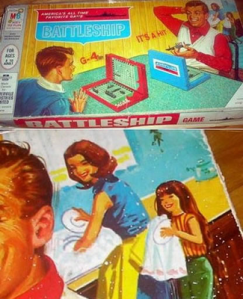
The gendered space of play. Borrowed from superpunch.blogspot.com.
His moment has come. After having scoured each vector of a ten by ten grid, the young tactician makes his move. “G-4,” he announces, possessing some intelligence of a large ship in the south-west quadrant of enemy territory. There is a moment of tension, as his dad sizes up the situation. “It’s a hit,” Dad admits, smiling, as he resignedly lifts a token from his board. The women in the family beam proudly from the kitchen. For a brief moment the social hierarchy is undermined as the house patriarch on the front of the Battleship box concedes victory to his progeny.
Sound has been integrated in different ways into the production of simulated warfare after World-War II. Simulated warfare involves, namely, the cybernetics of paper machines (as board games have been coined by Matthew Kirschenbaum), and the gradual effacement of oral mediation therein. As technologies of interactivity improve, the need for oral communication amongst the games participant’s decreases. The following is a case study of four Battleship commercials that aims to chronicle a set of shifting cultural tendencies parallel to the integration of sound-effects within the material game-form.
As Ong (1982) has noted, writing is powerful because it mediates the vastness of imagination. Once spoken words become grounded in text and inscribed on paper, they become, “locked in our visual fields forever” (p. 11). This is not as totalizing as it sounds, for as words are recirculated in oral cultures, the trace of writing yields slowly to the performative nature of ritual, oral culture. The rules of tabletop games, such as Battleship, although first established in the manual included with the game, are passed through oral ritual more often than not (Fine, 2002; Bowman, 2010). The oral maintenance of game rules is a practice which lends itself, critically, to the cultural attitudes of the group which maintains them. As is evident in the box art above, the game of Battleship is a gendered space where the rules have likely been explained (and maintained) by the household patriarch, then shared with his enthusiastic son.

Borrowed from badhaven.com.
There is an ideological element at play here as well. The box art for Battleship is unmistakably American. From Milton Bradley’s strong red-and-blue branding to the white trim of the son’s shirt, dad’s sweater and the soap suds in the kitchen. After all, the company owed its success to America and the war effort. A 1940s bailout saw Milton Bradley producing landing gear for fighter planes and gunstock for soldiers alongside portable game kits for soldiers seeking diversions in their down-time. The production of board games in post-World War II America owes as much to the military-industrial complex, as the production of video games does today (Dyer-Witherford and dePeuter, 2009). The relationship between the military production and simulation has been well documented by Crogan (2011), who has argued that the production of game interfaces, from the start, has been the by-product of a military desire to map real space onto the virtual in the design of ballistics. To this point, the bombastic introduction to a late-1960s commercial for Battleship (see video below) should come as no surprise. The sonic blast of a real-world battleship is calculated to lure consumers into believing that the game is an authentic simulation of maritime warfare.
The players in this commercial are actively engaged in a discussion amongst themselves. They laugh, and joke as they engage one-another in a tactical crossfire. In some cuts, the players seem particularly engrossed in the games strategy. Even though the commercial showcases two players actively engaged in oral communication, it is important to note that the players are both white males, and that the winner callously gloats as his opponent tumbles into the water. Milton Bradley’s connection to the American military is distinct here, and it plays out as a set of social relationships between the players. Reminiscent of Cold-War politics, the games action plays out as a series of tactical exchanges. Consumers are urged to practice at winning in their living-rooms, or on the go. The portable elements of Battleship are played down in an advertisement about 15 years later. Here, Battleship is situated as a centerpiece of family life.
Also integrating stock footage of real-world military battleships the narrative in this mid 1980s commercial begins with a squabble over domestic space. The actors are (at first) two boys (10 and younger), playing Battleship in the bedroom. After winning, the older boy banishes his younger brother, presumably forever, from his bedroom. Although this act could easily be imagined as selfish, in the context of the 1985 nuclear family, competition is fostered and encouraged. In a second skit, the older boy emerges again victorious at Battleship, his opponent (and father) slouches, consoled by the mother while the grandfather eagerly congratulates the young victor. Electronic Battleship is introduced here as a product as well, and the players are depicted commanding the electronic elements of the game. Feedback is given to the players sonically, as programmed game moves result in dynamic military explosions. There is still a residue of oral communication here, notably the father lamenting, “You sunk my battleship,” as the older boy lets out a strong cheer. Even though the embarrassed father is a commercial trope designed to stimulate the consumer imagination of aspiring child tacticians, it also functions as an in-joke for caring parents looking to instantiate intellectual (mathematical) competition as a centerpiece of domestic life in the age of Reagan’s Star Wars economics and family values.
Ten years later, the commercial narrative has more to do with overt warfare than family life. The competing children are spliced alongside clips of competing Navy officers performing various technical tasks on a real Battleship. As the background music takes on a tense, and somewhat militaristic tone, a command to “Man your battle stations,” is echoed as the two boys careen into their chairs. No longer is the narrative established as a civil exchange between two military masterminds, Electronic Talking Battleship uses sound to enhance the player experience of the simulation. When a hit is scored, a quick shot of the player pumping their fist and shouting is quickly replaced by stock footage of a battleship-explosion. Even wavy radio-lines are used to enhance the over-the-top comic feel of the product’s sound. A number of shots showcase the players programming their battle-stations. The commercial explicitly connects the discourse of soldier-controlled military technology, to player controlled information technology. Good players are able to program on their toes, the only conversation between players is a series of taunts and cheers. At one point, a player refers to the rules. Electronic Talking Battleship is evidence of the increasing capital of information technologies, and deterioration of orality in electronic games in the mid-1990s.
A final, 1997, commercial for Electronic Talking Battleship disposes entirely of the oral element of gameplay. The commercial begins with a child in what seems like an office conference room. After he presses a green button, a virtual matrix appears before him, and two navy officers materialize across the table from him. The viewer is to assume that one is an officer, and the other his superior. The narrative has the Navy officers desperately trying strategies against a hooting and smiling child. The Navy officers are a metaphor for the game’s computer, which can, at this point, serve as a virtual Battleship opponent. The affective work of companionship, which was once performed by one’s friends and family is now, in at least this commercial, replaced by a machine interface. The oral communication, which once governed the rule-set in a social space, has been outsourced to a machine which governs the rules, precisely, in cybernetic space
As computers begin to take a more active role in our culture, a by-product is the exchange of oral ritual for cybernetic participation. This odd shift can be read as having both positive and negative potential. One positive aspect is the estrangement of the social hierarchies which have been a necessary for the ritual infrastructure of oral communication dating back to Homeric times. While the children in the commercials (and on the original box) seem increasingly autonomous, they also begin to dialogue less with themselves, and more with the game. This, unfortunately, is the negative potential of this cybernetic shift. Where the early advertisements of the game depicted a product which provided a potential escape from a war-ravaged world, later advertisements seek to situate the consumer in the center of the action. A common thread amongst these social, and technical shifts is the instantiation of an electronic voice and interface as keeper of the rules. And, with this shift, the military discursivity of the game-form and its accompanying electronics is inscribed, and made to seem innocent in our imagination and understanding of childhood games and play.
—
Aaron Trammell is co-founder and multimedia editor of Sounding Out! He is also a Media Studies PhD student at Rutgers University.
Share this:

Sounds Difficult: James Joyce and Modernism’s Recorded Legacy
 Today’s post from Damien Keane marks the first in our recurrent series, “Live from the SHC,” which will broadcast the research of this year’s Fellows at Cornell University’s Society for the Humanities, directed by Timothy Murray, whose theme for 2011-2012 is “Sound: Culture, Theory, Practice, Politics.” The Society’s Fellows study a diverse range of sound studies topics: the relationship between sound and urban space, the moment when musical sound enters (and exits) the body, the sound of popular culture in interwar Egypt, the role of sound in constructing pious Muslim communities in secular European countries, and the manipulation of sound by “circuit benders”–to name just a few of the projects being researched up at the A.D. White House (To see the full list of Fellows, click here. To see the slate of SHC courses being taught at Cornell this year, click here). To allow our readers the opportunity to listen in to the goings on at the SHC, Sounding Out!‘s correspondent on the inside, Editor-in-Chief and SHC Fellow Jennifer Stoever-Ackerman, will be curating the online conversation amongst the fellows about their current research (and, of course, their sonic guilty pleasures)–so look (and listen) for it on selected Mondays from now through May 2012. –JSA
—-

Anyone remember these? "Gramophone" by Flickr User My Little Finger
I began asking my students how many of them had turntables almost nine years ago, when, as a graduate student teaching a course on the twentieth century, I found myself seventy pages into Dracula and having to explain what a phonograph is: then, only one or two hands went up, or half-up, in response to the question. A year ago, when I put this question to students in a course on modernism, fully two-thirds of the thirty-five students in the room raised their hands – although more than a few of them also believed that Steve Jobs had invented the mp3. Even allowing for self-selection and/or misrepresentation on their part, and for a soft form of administrative research and/or miscounting on my part, this swing is quite dramatic.
But what I find intriguing about the uptick is how it tracks with an equally dramatic rise in the use of a kind of allusion in commentaries about the effects of digital media on education. I am referring to those parenthetical asides that so often follow mention of residual technologies such as turntables and albums (e.g. “anyone remember those?”). While these asides are delivered in the manner of a stand-up comic doing material about blind dates or the post office, they serve to euphemize powerful attitudes about technology and what it is to be modern that are even less funny than such shtick, perhaps most directly by assuming the unqualified and unimpeachable newness of the present. Asking if anyone remembers the record player – or the chalkboard or the library or the secretarial staff – takes for granted that you’ve already taken it to the next level, having left off your turntable with parietals and rumble seats.

The limited edition of Joyce's _Anna Livia Plurabelle_ (1928). All further images by the author, Damien Keane
Which brings me to the gramophone recording that James Joyce made of the ending of Anna Livia Plurabelle, an episode of what would eventually become Finnegans Wake. Joyce had begun publishing pieces of his work in progress in 1924, and the Anna Livia Plurabelle section was by far the most visible of these, having appeared in several variant forms by the turn of the decade. Among these were its publication as a stand-alone, limited edition book in 1928, and the release of the recording that had been made at C.K. Ogden’s Orthological Institute in Cambridge, as a double-sided twelve-inch gramophone disc in 1929. Each did surprisingly well, and in tandem they helped to secure acceptance of Joyce’s formally challenging aesthetic procedures among readers. Indeed, some in the literary field, such as T.S. Eliot, hoped that recordings of authors’ readings would soon supplant, or at least augment, the market for limited and deluxe editions.

The label for side 2 of ALP gramophone recording (1929)
The fact that recordings did not replace books would be of little interest now, were it not for the way that their relationship in 1929 neatly conjures the supposedly defining trait of our own moment: the demise of one media epoch and the emergence of another (and with economic catastrophe at hand, too). Yet it is the gramophone recording – the “new media” format of that past moment – that is considered thoroughly obsolete today. What then can be said about the “listening history” of the recording? How has the sound of Joyce’s recorded reading interacted with perceptions of the readerly difficulty of the text, which, whether rightly or wrongly, are the pre-eminent “mode” through which readers approach Finnegans Wake? Put simply, if reading the text is hard, is listening to a recorded reading of that text hard?
.

The front cover of Hazel Felman’s setting of ALP (1935)
In thinking about these questions, what catches my attention is the slippage between different senses of “difficulty,” between the positive inflections of literary difficulty and the negative connotations of sonic interference. Contemporary listeners tend to emphasize the crackles and pops that compete with the sound of Joyce’s voice and its language, and thereby locate the “difficulty” of the recorded reading in the sound of the recording itself. It is as though the recording medium actually impedes access to Joyce’s language or somehow imposes itself between the listener and his voice – despite the fact that the medium enables this access in the first place. This is to say, the “low” fidelity of the recording of Joyce’s voice simply cannot reproduce the literary experience of Joyce’s prose, that most elusive, or rarified, object of speculation. (Is it the singularity of literature or is it Memorex?) Today’s default reaction to the recorded reading might be juxtaposed to a much earlier response, Hazel Felman’s setting of the very end of the passage for piano and voice, published in 1935. Here is her explanation of the genesis of her composition:
The emotional reaction I experienced on hearing a recording which James Joyce made of the last pages of ANNA LIVIA PLURABELLE was profound. As I listened to the record time and again, the conviction grew upon me that if I could re-create in music the mood that the author creates when he reads the closing chapters of ANNA LIVIA PLURABELLE, I would be justified in translating into a musical idiom what already seemed to be sheer music.

A Close-Up of Felman's Music
Felman’s response pivots on the aural clarity of the Anna Livia Plurabelle recording – she notes, for example, that D is used as a pedal point in the setting because Joyce’s voice modulates around a pitch of D in the recording – and the “sheer music” she heard there was mediated by that very recording.
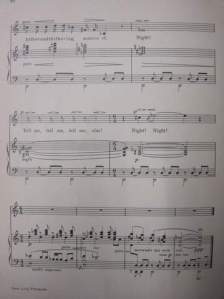
The ending of Felman’s setting, including D pedal points.
Almost eighty years after Felman, today’s hi-fi listeners more often hear in the recording only a poor realization of Joyce’s text, a judgment that has nothing to do with Joyce’s performance and everything to do with the grossly uneven staking of the recording’s semiotic content against its materiality. Yet we do well to recall that surface noise is just as “modernist” as Joyce’s innovative prose. Why do we always forget that? To ask this question brings us back to turntables and students. (Anyone remember them?)
—
Damien Keane is an assistant professor in the English department at the
State University of New York at Buffalo. He is nearing the completion of
a manuscript entitled Ireland and the Problem of Information.
Share this:


Current Top Posts





April 2021

January 2020

November 2019

October 2019

August 2019

April 2014

November 2017

March 2015

December 2017

October 2015
 Sounding Out!
Recent Comments