
Kawa: Rediscovering Indigeneity in China via Reggae
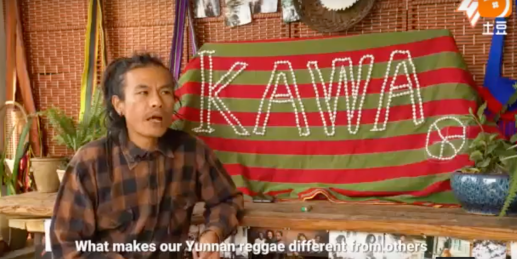
Kawa is a reggae group from Yunnan’s Ximeng, an autonomous county for the Wa people in the southwest of China, bordering Myanmar. When I learned about Kawa’s story in 2016, I was first intrigued by the geographical similarities between Yunnan and Jamaica: both regions are characterized by tropical climates, lush vegetations, and perhaps most prominently, proximities to marijuana plantations. Outsiders often associate the musical style of reggae with a stereotypical “laidback” lifestyle projected onto these locales. Known as “Yunnan Reggae,” Kawa’s music indeed exhibits some of the most characteristic elements of reggae music—slower tempos, remixed vocals, and repetitive chords falling on the offbeat.
“Yunnan Reggae”–Kawa
Recently I realized this climate connection was simplistic and reductive, and what I failed to grasp in Kawa’s music was far more important—a notion of indigeneity manifested through reggae’s generic elements. In Steven Feld’s “From Schizophonia to Schismogenesis: The Discourses and Practices of World Music and World Beat” in 1995, he noted the affinity of many indigenous cultures for reggae music. “Its [reggae] perception by indigenous peoples outside the Caribbean as an oppositional roots ethnopop form has led to its local adoption by migrants and indigenes in places as diverse as Europe, Hawaii, Native North America, Aboriginal Australia, Papua New Guinea, South Africa, and Southeast Asia” (110). In the 1970s, “roots” reggae translated the everyday lives of Jamaicans as well as their Rastafarian spirituality into a stark resistance to racial oppression, economic inequality, and colonial capitalism that they had experienced in history. The music was deeply embedded in the Jamaican culture. Around the same time, however, engineers and producers in Jamaica–many of them Chinese and Chinese-Jamaican–began to experiment with remixing reggae songs, contributing to an adaptive style of pop music as well as its international popularity. Therefore, against the global market force for “a world music,” reggae was quickly adopted to preserve indigenous cultures, remixing a wide range of ethnomusical elements.
But note that Feld’s list did not include East Asia. In fact, indigeneity as a discourse has been largely absent in this region. Taiwan is perhaps the only exception, where the Austronesian peoples have claimed their indigenous status and political rights. Japan and the Koreas are often considered as the most ethnically homogeneous countries in the world. And China, while officially acknowledging its ethnic diversity, never thought its internal migration of the Han majority as a potential threat to its ethnic minorities and indigenous cultures. I grew up in the southwest of China in the 1990s, when the internal migration of ethnic groups was already a norm. I could not remember if “indigeneity” meant anything even remotely political. I could not remember if the cultural traditions of ethnic minorities were meant to be tied up to the land on which they are/were practiced. What I do remember is that there are regions where the ethnic minorities concentrate and in which they integrate.
This post examines how the Chinese reggae group Kawa introduces an indigenous discourse through the sonic elements of reggae. In their performances, Lao Han often opens with a statement about being an indigenous ethnic minority. Most members of the group have non-Han Chinese backgrounds—Wa, Hani, Aini, and Hui. And even the name Kawa refers to the Wa people in their own language.
Kawa always find the most innovative ways to incorporate ethnic elements into their interpretations of the genre. In “Yunnan Reggae,” for example, sampled vocals from Wa people, lyrics written in Wa language, and traditional Wa instrumentation all work together to portray living cultural traditions closely associated with the Wa ethnic identity. However, it is the intimacy with the land Kawa expresses in their music that foregrounds their indigenous sentiments.
Although the entirety of the lyrics consists of two lines, the song “Red Hair Tree” reveals an indigenous life dwelling on the land—in its neighborhood, locality, and proximity.
Such a huge red hair tree
Hitting the wooden drum sounding dong dong
“Red Hair Tree” resembles a labor song narrating the mundane activities of logging and drum crafting. The first line describes the tree’s size, invoking a reverence for its sublimity. The glistening red color contributes to the plant’s vibrant animacies. As Ai Yong explains, “If you have chatted with the elders on the A Wa Mountains about this land, you will see an extraordinary beam of light glistening in their eyes, carrying endless assurance and reverence” (translated by Meng Ren). The second line translates that reverence into a more intimate whispering. Due to the Wa people’s animist beliefs, the red hair tree’s spirit is reincarnated in the wooden drum. The “dong dong” sound then embodies an invocation of the natural spirits. “The Wa ancestors believe, where there is the red hair tree, there is god’s blessing. In the past, the tall and robust red hair trees surrounded all Wa villages.” As Ai Yong continues to explain, the natural spirits are called for protection in exchange for the people’s worship.
“Red Hair Tree” is not the first time when reggae prompted the Han Chinese to confront questions about migration and indigeneity, however. It is often forgotten that the Chinese diaspora in Jamaica contributed to the development of reggae. Stephen Cheng’s “Always Together (A Chinese Love Song)” in 1967 is a rare yet symptomatic example of how the Chinese imagined indigeneity through remixing reggae.
Despite its obvious rocksteady overtone, the song combines a wide range of Chinese elements. It opens with a pronounced bass line coupled by the guitar and then the accented drum beat. Although this rhythmic beat is reminiscent of typical reggae songs, the music flow is somehow disrupted by the sudden appearance of the male vocal. Stephen Cheng sings in Mandarin. His chest voice meanders across a wide range, registering a sonority that is more often heard in Chinese opera than in reggae songs (or pop music in general). His delivery accentuates on the extended vowels, exaggerating the dramatic ups and downs of the tonal language—Mandarin Chinese. In fact, the music is adapted from a well-known Taiwanese folk song “Green is the Mountain (Gao Shan Qing).” On the surface, it is a romantic love story. It depicts the scenic landscape of the mountains and waters of Alishan, which the Taiwanese indigenous Tsou people traditionally inhabit. Through a metaphorical parallel, the romantic love between a young Tsou couple is embodied in the companionship between the mountain and the water, which resonates with its English title “Always Together.”
Indeed, “Green is the Mountain” was written by the Han Chinese who fled to Taiwan during the Chinese Civil War, and it is often criticized for romanticizing the experience of the indigenous peoples who were forced to move into the mountain. When the song is rendered into reggae by Cheng, however, it re-contextualizes this imagined indigeneity as a diasporic yearning to restore the lost connections between land and culture. “Always Together” was produced by Byron Lee, a Chinese-Jamaican who founded the renowned ska band Byron Lee and the Dragonaires. As record producers, sound system owners, or band managers, numerous Chinese-Jamaicans like Lee contributed “Chinese elements” to reggae during its formative years. In return, reggae carries on the tradition of cultural remix, always opening itself up to local adaptions.
Reggae has always been an eclectic music form. As we have seen, both examples combine a wide range of musical elements from different cultures—from ethnic minorities in China to Chinese and African diaspora in Jamaica. Despite almost a half century apart, the two reggae songs foreground a discourse on indigeneity that is shaped by the migration of people and the mixing of culture. Despite the most generic “pop” elements, the local adoption of reggae reveals an attempt to comprehend the relationship between ethnic identity, cultural practice, and the land. Understood in this way, Kawa’s reggae music becomes an important voice in understanding ethnic differences and indigeneity in today’s China.
—
Featured Image: Screen Shot from “Kawa: Chinese Yunnan Reggae Band”
—
Junting Huang is a Ph.D. Candidate in the Department of Comparative Literature at Cornell University. His research areas include literary studies, film/media studies, and sound studies. His dissertation project “The Noise Decade: Intermedial Impulse in Chinese Sound Recording” examines the figure of noise in contemporary Chinese literature and new media art. It analyzes how noise is conceptualized through the recorded sound as a materializing force that indexes the shifting social relations in the 1990s.
—
 REWIND! . . .If you liked this post, you may also dig:
Decolonizing the Radio: Africa Abroad in the Age of Independence– Samantha Pinto
“Everyone I listen to, fake patois…”– Osvaldo Oyola
Radio de Acción: Violent Circuits, Contentious Voices: Caribbean Radio Histories–Alejandra Bronfman
Share this:

Vocal Anguish, Disinformation, and the Politics of Eurovision 2016

Eurovision—that televisual song pageant where pop, camp, and geopolitics annually collide—started last week. This year’s competition is hosted in Tel Aviv, and continues a recent trend in the competition in which geopolitical controversy threatens to overshadow pop spectacle. Activists accuse the Israeli government of exploiting Eurovision as part of a longstanding government PR strategy of “pinkwashing”: championing Israel as a bastion of LGBT+ tolerance in order to muddle perceptions of its violent and dehumanizing policies towards Palestinians. The BDS movement mobilized a campaign to boycott Eurovision. Reigning Eurovision champion Netta Barzilai, echoing many pro-Israel voices (as well as celebrities concerned about “subverting the spirit of the contest”), referred to the boycott efforts as “spreading darkness.”

Protesters outside BBC Broadcasting House demonstrate against the 2019 Eurovision song contest being held in Israel. Photograph: Penelope Barritt/Rex/Shutterstock
While this year’s competition opened already mired in contention, I’m going to listen back to the controversial winning song of the 2016 contest, whose media frenzy peaked in its aftermath. That year’s champion, a pop singer of Crimean Tatar heritage who goes by the mononym Jamala, represented Ukraine with a song called “1944.” Just two years before, Crimea had been annexed from Ukraine by Russia following a dubious referendum. Some Crimean Tatars—the predominantly Sunni-Muslim Turkic-language minority group of Crimea—fled to mainland Ukraine following the Russian annexation, viewing the Ukrainian state as the lesser threat; many of those that stayed continue to endure a deteriorating human rights climate (though there are some Crimean Tatars who have bought into—and who reap benefits from—the new Russian administration of the peninsula.)

Screen capture from Stopfake.org
Jamala’s very presence in the contest inevitably evoked the hot geopolitics of the moment. Her victory angered many Russians, and the subject of Eurovision became fodder for conspiracy theories as well as a target of disinformation campaigns waged online and in Russian-influenced media in Ukraine. In much of the Western European and North American media, the song was breathlessly interpreted as an assertion of indigenous rights and a rebuke to the perceived cultural genocide enacted against Crimean Tatars by Russian state power.
In the wake of her victory, many commentators described Jamala as giving voice not only to the repressed group of Crimean Tatar indigenes living in the Russian-annexed territory of Crimea, but to threatened indigenous populations around the world (for better or worse). But indeed, it was not only her metaphorical voice but the sound of vocal anguish that intensified the song’s effectiveness in the contest and made it relevant well beyond the specific geopolitical bog shared by Crimean Tatars, Ukrainians, and Russians. Specifically, the timbre, breath, and dynamic force of Jamala’s voice communicated this anguish—particularly during the virtuosic non-lexical—wordless—bridge of the song. Despite her expertly controlled vocal performance during the dramatic bridge, Jamala’s voice muddies the boundaries of singing and crying, of wailing from despair and yelling in defiant anger. To pilfer from J.L. Austin’s famous formulation, what made Jamala’s performative utterance felicitous to some and infelicitous to others was as much the sound of her voice as the words that she uttered. Put simply, on the bridge of “1944,” Jamala offers a lesson in how to do things with sound.
“Netta from Israel Wins the Eurovision Song Contest” by Flickr User David Jones, CC BY 2.0
Some background: the world’s longest-running televised spectacle of song competition, the Eurovision Song Contest began in 1956 with the peaceful mandate of bringing greater harmony (sorry not sorry) to post-war Europe. Competitors—singers elected to represent a country with a single, three-minute song each—and voters come from the member countries of the European Broadcasting Union. The EBU is not geographically restricted to Europe. Currently, some fifty countries send contestants, including states such as Israel (last year’s winner), Azerbaijan, and Australia. Many of the rules that govern Eurovision have changed in its 62-year history, including restrictions governing which language singers may use. Today, it is common to hear a majority of songs with at least some text sung in English, including verses of “1944.” Some rules, though, have been immutable, including the following: songs must have words (although the words need not be sensical). All vocal sounds must be performed live, including background vocals. Voters, be they professional juries or the public—who can vote today by telephone, SMS, or app—cannot vote for their own nation’s competitor (though unproven conspiracy theories about fans crossing national borders in order to vote in defiance of this rule have, at times, flourished.) Finally, reaching back to its founding mandate defining Eurovision as a “non-political event,” songs are not permitted to contain political (or commercial) messages.
Both the title and lyrics of Jamala’s “1944” refer to the year that Crimean Tatars were brutally deported from Crimea under Stalinist edict. Indicted wholesale as “enemies of the Soviet people,” the NKVD rounded up the entire population of Crimean Tatars—estimated to be some 200,000 people—packed them into cattle cars, and transported them thousands of miles away, mostly to Uzbekistan and other regions of Central Asia. The Soviet regime cast this as a “humanitarian resettlement” intended to bring Crimean Tatars closer to other Muslim, Turkic-language populations. However, Crimean Tatars, who estimate that up to two-thirds of their population perished before arriving in Central Asia, consider this a genocidal act. They were not given the right to return to Crimea until the late 1980s. So, through clear reference to a twentieth-century political trauma with consequences that stretch into the present, “1944” was not the feel-good fluff of classic Eurovision.

“Coin in memory of the genocide of Crimean Tatar people” by Flickr User National Bank of Ukraine (CC BY-NC-ND 2.0)
Jamala’s performance of “1944” at Eurovision was also atypical in that it largely eschewed pizzazz and bombast. Little skin was shown, there were no open flames, no smoke machines befogged the scene. Instead, Jamala stood, mostly still and center stage, encircled by spotlight. Large projections of flowers framed the stage for the first two minutes of the song, as she sang verses (in English) and a chorus in (Crimean Tartar) that utilized lyrics from a well-known twentieth-century Crimean Tatar protest song called Ey, Güzel Qirim (Oh, My Beautiful Crimea). The groove of the song is spare and rather slow, and the singer’s voice meanders within a fairly narrow range on both verse and chorus.
But then comes the vocalise on the bridge: two minutes and fifteen seconds into the Eurovision performance, the song’s chilled-out but propulsive motion stops, leaving only a faint synthesizer drone. In the sudden quiet, Jamala mimes the act of rocking an infant. Beginning in the middle of her range, she elaborates a melismatic wail that recalls the snaking modal melody of the traditional Crimean Tatar song Arafat Daği. The bridge consists of two phrases interrupted by a forceful and nervous inhalation of breath. Her breath is loud and intentional, calling attention to the complex ornaments that she has already executed, and preparing us for more ornaments to come.
Over the course of eight seconds, Jamala’s voice soars upwards, increasing steadily in volume and intensifying timbrally from a more relaxed vocal sound to an anguished belt. At the apex of the bridge, the Eurovision camera soars above the stage just as the singer looks into the camera’s eye. Meanwhile, the screens framing the stage explode into visuals that suggest a phoenix rising from the ash. The crowd erupts into applause.
Other renditions of “1944” deliver a similar emotional payoff at the climax of the bridge. In the dystopian narrative of Jamala’s official music video, a tornado whips free, setting a field of immobilized human figures into chaotic motion (minute 2:35). In a reality TV song contest called Holos Kraïny (the Ukrainian Voice), a young singer’s powerful elaboration of the bridge propels a coach out of her seat as she wipes tears from her eyes (minute 3:42). In other covers, the bridge is too difficult to attempt: one British busker leaves the “amazing vocal bit in the middle” to “the good people of Ukraine to sing along.”
Timbrally and gesturally, I also hear the resonance between the plangent sound of the duduk—a double-reed wind instrument associated most closely with Armenia, and often called upon to perform in commemorations of the 1915 Armenian genocide—and Jamala’s voice on the vocalise. According to Jamala (who generously responded to my questions via email through her PR person), this was not intentional. But the prominence of the instrument in the arrangement, the lightly nasal quality that her voice adopts in the bridge, and the glottalized movements she uses between pitches suggest that this connection might have been audible to listeners. After all, the opening melodic gesture of “1944” is sounded by a duduk, and it re-enters spectacularly just after the peak of the bridge, where it doubles Jamala’s vocal line as it cascades downwards from the high note. Through sonic entanglement with the duduk, Jamala here communicates anguish on another register, without translation into words.
The performance of sonic anguish through the voice might be understood, in Greg Urban’s terms, as a “meta-affect.” Jamala delivers the emotion of anguish but also fosters sociality by interpellating listeners into the shared emotional state of communal grieving. I paraphrase from Urban’s well-known analysis of “ritual wailing” to argue that Jamala, through this performance of vocal anguish, makes both intelligible and acceptable the public sentiment of grief. This utterance of grief is a statement of “separation and loss that is canonically associated with death” (392) that included the Eurovision audience as co-participants in the experience of grieving, of experiencing anguish over loss. A popular fan reaction video by “Jake’s Face Reacts,” posted to YouTube, and the hundreds of comments responding to it, attest to this experience of co-participation in the experience of grief. Furthermore, the power of this meta-affect is almost certainly heightened through normative gendered associations with performative anguish. Lauren Ninoshvili (2012) identifies this in the “expressive labor” of mourning mothers’ wailing in the Republic of Georgia, while Farzaneh Hemmasi (2017) has recently elucidated how the voice of the exiled Iranian diva Googoosh became iconic of the suffering, feminized, victimized nation of Iran.

“Googoosh, collection du pasteur de l’église St Paul” by Flickr User Stéphane Gschwind (CC BY-NC-SA 2.0)
The sociologist of music Simon Frith once wrote that “in songs, words are the sign of the voice” (97). To put it in slightly banal terms, songs, as we generally define them, include words uttered by human voices. (Or if they don’t have words uttered by voices, this becomes the notable feature of the song, c.f. Mendelssohn Songs Without Words, Pete Drake’s talking guitar, Georgian vocable polyphony). But non-lexical vocalities also function as a sign of the voice, and, as scholars such as Ana Maria Ochoa (2014) and Jennifer Stoever (2016) have argued, expand our capacity to recover more complex personhoods from the subjugated vocalities of the past. In fact, often the most communicative, feelingful parts of songs occur during un-texted vocalizations. As generations of scholars have argued, timbre means a lot—Nina Eidsheim’s The Race of Sound: Listening, Timbre, and Vocality in African American Music (Duke University Press: 2019) presents a very recent example—and it is often overlooked when we take the key attributes of Western Art Music as our sole formal parameters for analysis: melody, rhythm, harmony, form. So as we watch the parade of aspiring Eurovision champions duke it out in the pop pageant of geopolitics, let’s attune ourselves to the vocal colors, the timbral gestures, the ululations and the growls, to the panoply of visual and auditory stimuli demanding our attention and, more important (depending on where we live), our vote.
_
Featured Image: “Jamala” by Flickr User Andrei Maximov, CC BY-NC-ND 2.0
_
Maria Sonevytsky is Assistant Professor of Ethnomusicology at the University of California, Berkeley. Her first book, Wild Music: Sound and Sovereignty in Ukraine, will be out in October 2019 with Wesleyan University Press.
_
 REWIND! . . .If you liked this post, you may also dig:
Won’t Back Down: Tom Petty, Jason Aldean, and Masculine Vulnerability – Justin Burton
Contra La Pared: Reggaetón and Dissonance in Naarm, Melbourne – Lucreccia Quintanilla
“To Unprotect and Subserve:” King Britt Samples the Sonic Archive of Police Violence – Alex Werth
Share this:




Current Top Posts





April 2021

January 2020

November 2019

October 2019

August 2019

April 2014

November 2017

March 2015

December 2017

October 2015
 Sounding Out!
Recent Comments