
SO! Reads: Nicole Brittingham Furlonge’s Race Sounds: The Art of Listening in African American Literature

 Is literature truly a primarily visual entity? Do we only read books or are we actually actively “listening in print”(1)? These are the main questions that Nicole Brittingham Furlonge explores in Race Sounds: The Art of Listening in African American Literature (2018). As Black literature is often considered in terms of its attention to music, listening has therefore been limited to the musicality of stories, and many voices are left unheard. What Furlonge does in Race Sounds is go back to these unheard voices and focus our attention on them to see what we have been missing.
Furlonge wants to demonstrate how to “uncover the different ways of knowing that emerge from aural engagement” (3) such as exposed in Invisible Man, Their Eyes Were Watching God, and Sterling Brown’s “Ma Rainey.” She urges us to learn to “decode print differently” (4) by attuning the reader to the practice of listening, as well as to (black) sound(s) studies in more general terms, by referring to the essential scholars of the field: Tsitsi Jaji, Fred Moten, Kevin Quashie, Jennifer Stoever, and Alexander Weheliye – to name a few. Furlonge further “joins a collective effort to shift from a heavy emphasis on sounding to an attention to listening practices” (9). By redirecting the reader to listening practices, Furlonge leads us to reconsider our own “coexistence among humans.” (9)
 Furlonge, previously chair of the English Department at the Princeston Day School, and new Director of Teacher’s College’s Klingenstein for Independent School Leadership is not only an experienced scholar, but a teacher experiencing first hand what it means to listen: in a classroom and in society. Race Sounds is a five chapter book, moving from a consideration of “Literary Audiences” (chapter one), to the “Silence of Sound” (chapter two), to various forms of Listening (chapters three-five). Her fifth chapter, as well as her epilogue, have an especially interesting approach to Sound Studies through her lens as an educator. Not only does Furlonge have extensive classroom experience and administrative expertise in curriculum development, diversity issues, faculty development and issues regarding equity and access, but she is in a good position, as an independent scholar, to reflect on listening practices in and out of academia. It is quite exceptional to consider pedagogy in a critical text, as it observes education in the classroom and citizenship, in addition to her critical analysis.
By guiding her reader to listening in new modes throughout the book, Furlonge demonstrates how to “read in a multimodal way” (109) in order to learn to listen. This multimodal method includes an attention drawn beyond the book to “sonic literacy,” “aural pedagogies,” as well as the full sensory process of listening (from hearing, to vibrations, to sensory immersion of many kinds, and so on). She insists that, “while hearing is a physiological form of reception, listening is interpretive, situated, and reflective” (83), and this is ultimately what she presents in Race Sounds.
Furlonge aims at an audience of readers and listeners ready to deepen their understanding of the importance of sounds through the multisensory experiences that she proposes, especially as she describes her experience of “Aural Listening in the English Classroom.” She “aim[s] to amplify listening as a creative, aesthetic, and interpretative practice in ways that provoke robust motivations to develop our capacities to listen” (15) and manages to do just that by guiding her readers to consider sounds, voices, vibrations, silences, and historical listening, such as (re)reading Zora Neale Hurston’s Their Eyes Were Watching God in a new light, pointing to protagonist Phoebe’s listening throughout the novel.
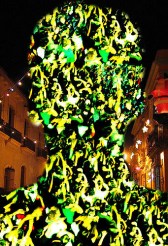
Image by Flickr User Adrian Sampson, from a series of three art pieces engaged with Ralph Ellison’s Invisible Man (CC BY 2.0)
By close reading, or listening, to many canonic texts such as Their Eyes Were Watching God, The Chaneysville Incident, and Invisible Man, Furlonge performs an in-depth understanding of sound and what it means to “unmute words in print” (109). She renews the ways to interpret the texts by teaching her readers how to hear sonic literature. After situating the texts in the literature, she depicts what sounds and silences in the narratives tell the reader. For instance, in the first chapter, “Our Literary Audience,” Furlonge distances herself from the often-times asked question of “whether or not Janie realizes her voice over the course of [Their Eyes Were Watching God]” and thinks about “Phoebe’s hungry listening” (25) and what it adds to the conversation. Rather than analysing the story’s narrator yet again, Furlonge turns the reader’s attention towards her friend, the listener. The reader is presented with the importance of listening with an analysis of the “storyhearer” (60) and the work that they accomplish by listening in proper ways, which allows the speaker to develop a voice they know is heard. In this sense, “storyhearers” are used to critique and bring the listening back into stories. As Furlonge considers the body a “living archive” (63), the intake of sounds and its use and reiterations transport the stories and transform the listener into an archive that will allow the story to live on and be transported.
Race Sounds, therefore, brings to the discussion ideas of what it means to listen and one’s responsibility of listening properly and carrying the story within one’s self. “Historical listening” (82) further defines the importance of the audiences in engaging with sounds. As one’s listening, in becoming knowledge, develops this importance, as well as a civic responsibility, to bring the story where it needs to be. Furlonge wonders about the same question Peter Szendy asks, “Can one make a listening listened to? Can I transmit my listening, as unique as it is?” (102). Through reading of The Chaneysville Incident, she demonstrates the carrying of such stories through sound, “a sound that contains memories” (117), and its historical as well as civic importance.
Furlonge also brings new insight to Ralph Ellison’s Invisible Man, a novel often studied in African American Sound Studies, such as in Weheliye’s Phonographies, because of its use of the phonographand its attention to the use of music. However, Furlonge diverges from the usual exploration of Ellison’s narrator with his phonograph and insists on vibrations and the experience of “tactile listening” (55), or the materiality that comes with the listening experience. In shifting the conversation, Furlonge presents the physicality of sound and voices, and does so throughout Race Sounds. Redirecting the reader’s attention to how listening practices affects the novel’s narration, Furlonge aims for the reader to rethink their own listening practices in turn.

Teagle F. Bourge in Oren Jacoby’s adaptation of Ralph Ellison’s INVISIBLE MAN. At the Huntington Theatre Company Jan. 4 – Feb. 3, 2013. Photo: Michael Brosilow (Court Theatre production), (CC BY 2.0)
By directly addressing our way of being in the world, Furlonge creates a text that speaks to the reader, and cannot leave one indifferent. In her last chapter, a walkthrough of her class on listening, Furlonge plunges with the reader into a sense of meaning; everything that one has just read comes together into her classroom. The result of Furlonge’s observations guide the reader into finding a new listener within themselves. Before concluding her book, she describes:
While I hoped students would grow as listeners, I did not anticipate that their perceptions of themselves as readers and writers would also shift. […] Helping students learn to listen, to be attentive to others, and to be discerning of all the talk that comes their way can lead to enduring understandings about themselves and the ways in which they want to engage with and change their world. (118)
As optimistic and ambitious as this statement is, I believe Furlonge manages to teach exactly this to the reader of Race Sounds. By concretely applying in her classroom what she presents in this book, not only does she prove how her work furthers the conversation of Sound Studies, she demonstrates how it belongs in larger conversations about our society’s listening practices and the role of every person in it.

“Students travel around the world with books” image by Flickr User Garrison Casey, (CC BY 2.0)
Furlonge’s book intends to speak to anyone interested in their own listening practices. By being conscious of one’s own body as a “living archive,” it may allow a story to live on by listening properly to it. Finally, “we are unaware of the conversations we miss when we speak” (120) concludes the book on a reflection unto the self to be a better listener, in order to allow our surroundings to teach us to listen differently, and maybe hear things we have not heard before.
—
Featured Image: Quinn Dombrowski,(CC BY-SA 2.0)
—
Alexandrine Lacelle is mainly interested in Modernist literature, women’s writing, and Sound Studies (especially silences). She is pursuing her Master’s degree in English Literature at Queen’s University, where she will be starting her PhD in the fall of 2019, with a focus on the use of wordlessness and sounds in early 20th century literature by women. Originally from Montreal, she completed her BA in English Literature at Concordia University, where she was able to practice her background in French, English, and German.
—
 REWIND!…If you liked this post, you may also dig:
SO! Reads: Dolores Inés Casillas’s ¡Sounds of Belonging!–Monica De La Torre
SO! Reads: Roshanak Khesti’s Modernity’s Ear–Shayna Silverstein
SO! Reads: Kirstie Dorr’s On Site, In Sound: Performance Geographies in América Latina–Benjamin Bean
Share this:

Listening to the Beautiful Game: The Sounds of the 2018 World Cup

I heard them before I saw them. Walking to my apartment in Moscow’s Tverskoy District, I noticed a pulsating mass of sound in the distance. Turning the corner, I found a huge swath of light blue and white and—no longer separated by tall Stalinist architecture—was able to clearly make out the sounds of Spanish. Flanked by the Izvestiia building (the former mouthpiece for the Soviet government), Argentinian soccer fans had taken over nearly an entire city block with their revelry. The police, who have thus far during the tournament been noticeably lax in enforcing traffic and pedestrian laws, formed a boundary to keep fans from spilling out into the street. Policing the urban space, the bodies of officers were able to contain the bodies of reveling fans, but the sounds and voices spread freely throughout the neighborhood.
Moscow is one of eleven host cities throughout Russia for the 2018 FIFA World Cup, which runs from June 14 to July 15. Over one million foreign fans are expected to enter the country over the course of the tournament, and it is an important moment in Vladimir Putin’s attempt to reassert Russia’s power on the global stage. Already, it has been called “the most political tournament ever,” and discussions of hooliganism, safety concerns, and corruption have occupied many foreign journalists in the months leading up to the start. So gloomy have these preambles been that writers are now releasing opinion pieces expressing their surprise at Moscow’s jubilant and exciting atmosphere. Indeed, it seems as though the whole world is not only watching the games, but also listening attentively to try to discern Russia’s place in the world.

Police officers during World Cup 2018 in Russia, Image by Flickr User Marco Verch (CC BY 2.0)
Thus it comes as no surprise that the politics of sound surrounding the tournament have the potential to highlight the successes, pitfalls, and contradictions of the “beautiful game.” Be it vuvuzelas or corporate advertising, sound and music has shaped the lived experience of the World Cup in recent years. And this tournament is no exception: after their team’s 2-1 win over Tunisia on June 18, three England fans were filmed singing anti-semitic songs and making Nazi salutes in a bar in Volgograd. That their racist celebrations took place in Volgograd, formerly known as Stalingrad and the site of one of the bloodiest battles of World War II, added historical insult and even more political significance. The incident has shaped reception of England fans and their sounds across the country. As journalist Alec Luhn recently tweeted, police cordoned off singing England supporters in Nizhny Novgorod after their victory over Panama, ostensibly keeping the risk of hooliganism at bay. The incident stands in stark contrast with the police barrier around the Argentina fans, who were being protected not from supporters of other nationalities, but rather from oncoming traffic.
England fans in Russia sing songs…behind a line of police. Part of the reason there hasn’t been any hooligan violence pic.twitter.com/RwXz8XtLHf
— Alec Luhn (@ASLuhn) June 23, 2018
More than anything, however, sound has facilitated cultural exchange between fans and spectators. In recent years, historians and musicologists have paid more attention to the multivalent ways musical exchanges produce meaningful political and social understandings. Be it through festivals, diplomatic programs, or compositional techniques, music plays a powerful role in the soft power of nations and can cultivate relationships between individuals around the globe. More broadly, sound—be it organized or not—shapes our identity and is one of the ways by which we make meaning in the world. Sound, then, has the potential to vividly structure the experience of the World Cup—a moment at which sound, bodies, individuals, and symbolic nations collide.
At the epicenter of all of this has been Red Square, Moscow’s—and perhaps Russia’s—most iconic urban space. The site of many fan celebrations throughout the World Cup, Red Square’s soundscape brings together a wide variety of national identities, socio-economic considerations, and historical moments. To walk through Red Square in June 2018 is to walk through over five-hundred years of Russian history, emblematized by the ringing bells and rust-colored walls of the Kremlin; through nearly eighty years of Soviet rule, with the bustle and chatter of curious tourists waiting to enter Lenin’s tomb; and through Russia’s (at times precarious) global present, where fans from Poland join with those from Mexico in chants of “olé” and Moroccan supporters dance and sing with their South Korean counterparts. The past, present, and an uncertain future merge on Red Square, and the sonic community formed in this public space becomes a site for the negotiation of all three.

Map of Red Square
In the afternoon of June 19, I walked through Red Square to listen to the sounds of the World Cup outside the stadium. At the entrance to Red Square stands a monument to Grigory Zhukov, the Soviet General widely credited with victory over the Nazis in World War II. Mounted upon a rearing horse, Zhukov’s guise looms large over the square. In anticipation of that evening’s match between Poland and Senegal at Moscow’s Spartak Stadium, Polish fans were gathered at the base of Zhukov’s monument and tried to summon victory through chants and songs (Poland would end up losing the match 2-1.) Extolling the virtues of their star player, Robert Lewandowski, the fans played with dynamics and vocal timbres to assert their dominance. Led by a shirtless man wearing a police peaked cap, the group’s spirit juxtaposed with Zhukov’s figure reiterated the combative military symbolism of sporting events. Their performance also spoke to the highly gendered elements of World Cup spectatorship: male voices far outnumbered female, and the deeper frequencies traveled farther across space and architectural barriers. The chants and songs, especially those that were more militaristic like this one, reasserted the perception of soccer as a “man’s sport.” Their voices resonated with much broader social inequalities and organizational biases between the Women’s and Men’s World Cups.
From there, I walked through the gates onto Red Square and was greeted by a sea of colors and hundreds of bustling fans. Flanked by the tall walls of the Kremlin on one side and the imposing façade of GUM (a department store) on the other, the open square quickly became cacophonous. Traversing the crowds, however, the “white noise” of chatter ceded to pockets of organized sound and groups of fans. Making a lap of the square, I walked from the iconic onion domes of St. Basil’s cathedral past a group of chanting fans from Poland, who brought a man wearing a Brazil jersey and woman with a South Korean barrette into the fold. Unable to understand Polish, the newcomers were able to join in on the chant’s onomatopoeic chorus. Continuing on, I encountered a group of Morocco supporters who, armed with a hand drum, sang together in Arabic. Eventually, their song morphed into the quintessential cheer of “olé,” at which point the entire crowd joined in. I went from there past a group of Mexico fans, who were posing for an interview while nearby stragglers sang. The pattern continued for much of my journey, as white noise and chatter ceded to music and chants, which in turn dissipated either as I continued onward or fans became tired.
Despite their upcoming match, Senegalese fans were surprisingly absent. Compared to 2014 statistics, Poland had seen a modest growth of 1.5% in fans attending the 2018 World Cup—unsurprising, given the country’s proximity to Russia and shared (sometimes begrudgingly) history. Meanwhile, Senegal was not among the top fifty countries in spectator increases. That’s not to say, of course, that Senegalese supporters were not there; they were praised after the match for cleaning up garbage from the stands. Rather, geography and, perhaps, socio-economic barriers delimited the access fans have to attending matches live as opposed to watching them from home. With the day’s match looming large, their sounds were noticeably missing from the soundscape of Red Square.
Later that evening, I stopped to watch a trio of Mexico fans dancing to some inaudible music coming from an iPhone. Standing next to me was a man in a Poland jersey. I started chatting with him in (my admittedly not great) Polish to ask where he was from, if he was enjoying the World Cup so far, and so on. Curious, I asked what he thought of all the music and songs that fans were using in celebrations. “I don’t know,” he demurred. “They’re soccer songs. They’re good to sing together, good for the spirit.”
Nodding, I turned back toward the dancing trio.
“You are Russian, yes?” The man’s question surprised me.
“No,” I responded. “I’m from America.”
“Oh,” he paused. “You sound Russian. You don’t look Russian, but you sound Russian.”
I’d been told before that I speak Polish with a thick Russian accent, and it was not the first time I’d heard that I did not look Russian. In that moment, the visual and sonic elements of my identity, at least in the eyes and ears of this Polish man, collided with one another. At the World Cup, jerseys could be taken off and traded, sombreros and ushankas passed around, and flags draped around the shoulders of groups of people. Sounds—and voices in particular—however, seemed equal parts universal and unique. Emanating from the individual and resonating throughout the collective, voices bridged a sort of epistemological divide between truth and fiction, authenticity and cultural voyeurism. In that moment, as jubilant soccer fans and busy pedestrians mingled, sonic markers of identity fluctuated with every passerby.
I nodded a silent goodbye to my Polish acquaintance and, joining the crowd, set off into the Moscow evening.
—
Featured Image: “World Cup 2018” Taken by Flickr User Ded Pihto, taken on June 13, 2018.
—
Gabrielle Cornish is a PhD candidate in Musicology at the Eastman School of Music. Her research broadly considers music, sound, and everyday life in the Soviet Union. In particular, her dissertation traces the intersections between music, technology, and the politics of “socialist modernity” after Stalinism. Her research in Russia has been supported by the Fulbright Program, the Glenn Watkins Traveling Fellowship, and the Cohen-Tucker Dissertation Research Fellowship from the Association for Slavic, East European, and Eurasian Studies. Other projects include Russian-to-English translation as well as a digital project that maps the sounds and music of the Space Race.
—
 REWIND! . . .If you liked this post, you may also dig:
Cauldrons of Noise: Stadium Cheers and Boos at the 2012 London Olympics–David Hendy
Goalball: Sport, Silence, and Spectatorship— Melissa Helquist
Sounding Out! Podcast #20: The Sound of Rio’s Favelas: Echoes of Social Inequality in an Olympic City–Andrea Medrado
Share this:


Current Top Posts





April 2021

January 2020

November 2019

October 2019

August 2019

April 2014

November 2017

March 2015

December 2017

October 2015
 Sounding Out!
Recent Comments