
Teach Me How To Dougie Like A Mediocre White Man

In the third episode of Twin Peaks: The Return (2017), we meet Dougie Jones, a new character who is, as an otherworldly being will tell him, “manufactured.” Dougie’s sonic presence on the show is primarily marked by repetition, as the majority of his dialogue involves him parroting those around him. Though Dougie has been received as a symbol of purity or a magical conduit for others’ best selves (14:53-19:00), a close listen to his repetitions suggests that he is instead what Sarah Hagi has dubbed the “mediocre white man.”
DAILY PRAYER TO COMBAT IMPOSTOR SYNDROME: God give me the confidence of a mediocre white dude
— Sarah Hagi (@geekylonglegs) January 21, 2015
Hagi’s so-called prayer is a brilliantly concise instance of intersectional analysis that can also provide a framework for understanding Dougie Jones. In a few short words, she’s able to 1) demonstrate how white supremacist patriarchy makes her life more difficult, 2) call into question the achievements of those who hold so much power that it’s doled out to the most mediocre among them, and 3) situate the entire critique in a systemic framework. That is, though one possible reading of this tweet is that Hagi suffers from a shortcoming she is responsible to correct–a lack of confidence–the fact that she frames her critique as a prayer suggests that this confidence isn’t so much an inner belief in oneself as it is a privilege granted to some but not others. Twin Peaks: The Return offers, in the vocal interactions of Dougie, an extended meditation on the systemic mechanizations that produce the kind of mediocre white man Hagi laments.
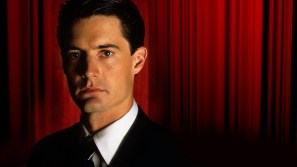
“Twin Peaks Returns to Television in 2016” by Flickr user BagoGames, CC BY 2.0.
For readers who aren’t Twin Peaks viewers, hang on: explaining the origin of Dougie Jones requires a few sentences that may read as something bordering on nonsense outside the show’s bizarre universe. Dougie is played by Kyle MacLachlan, who also plays the show’s main character, Agent Dale Cooper, as well as The Return’s Mr C, Cooper’s evil doppelganger who overcame Cooper in an extradimensional realm in the Season 2 finale and who has been living in the “real world” ever since, while Cooper is stuck in another dimension. The show implies that Mr C has only 25 years–roughly the amount of time since the show’s first run in the early 90s–before Cooper switches places with him (extradimensional bureaucracies, amiright?). As a ploy to stay in the real world, Mr C “manufactures” Dougie Jones so that when Cooper is finally released from extradimensional detention, he replaces Dougie, not Mr C. For the bulk of The Return, Mr C continues wreaking havoc across the Midwest and Western US, while Cooper, adversely affected by his transit across dimensions, is trapped in Dougie’s life, barely able to function beyond the level of a small child. Technically, then, the character called Dougie Jones is really Dale Cooper, but Cooper’s episodes-long inability to regain control of himself leads to an extended case of mistaken identity, where everyone in Dougie’s life believes Cooper to be Dougie.
Significantly, Dougie’s family and co-workers are barely phased by his ineptitude. At worst, like when he doesn’t know how to use the bathroom, people are annoyed by Dougie. But, more often than not, Dougie’s moments of silence and often erratic behavior — including befuddlement over how to feed or dress himself — are interpreted as quirky, humble, and endearing. More than that, Dougie’s boss believes him to be a courageous and principled whistle-blower whose cryptic drawings on insurance forms outs one of his co-workers for defrauding the company’s clients.
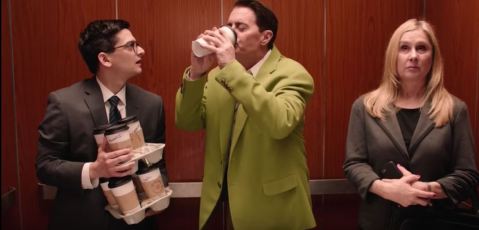
Screenshot of Twin Peaks: The Return
Dougie is beyond mediocre, yet over the course of the season, he falls into hundreds of thousands of dollars, a luxury car, a family life that seems to be fulfilling for his wife and son, and the respect and gratitude of his boss. Confidence isn’t something this mediocre white man possesses; rather, it’s a trait projected onto him by everyone around him. In riffing on the way people exist in systems of inequity, Sylvia Wynter notes in On Being Human As Praxis (2015) that we end up keeping “the reality of our own agency opaque by attributing that agency to extrahumanly mandating entities” (45). Put another way, the god who would grant us the confidence of a mediocre white man isn’t a deity but a system of patriarchal white supremacy that makes itself opaque behind the rationale that a person like, say, Dougie Jones couldn’t possibly be as successful in his life if he hadn’t earned it.
The primary marker of the mechanization of Dougie’s confidence is a sonic one: we can hear his ascendence in moments of repetition. Twin Peaks is a show comprised of overlapping aural and visual loops, recurring sounds, and doubled and tripled characters, so keying in on the sound of Dougie’s repetition fits into the series’ aesthetic. Early in Dougie’s presence in the series, when Cooper is fresh from the other dimension, his repetition is delayed, partial, and generally out of synch with regular patterns of conversation; people react to this repetition with concern. The following scene occurs in the moments just after Cooper has replaced Dougie Jones; his scene partner, Jade, was in the shower when the switch happened.
This clip is cut so that the phrase “Jade give two rides” happens back-to-back, but in the episode, there’s over a minute of a screen time between Jade saying (a grammatically correct version of) it and Dougie repeating it. Dougie’s imprecise and ill-timed repetition suggests to Jade that something may be wrong with him, and she rightly advises him to find some help. A similar interaction occurs in Episode 6, which opens with Dougie standing outside his work at night, unaware of what people do when work is over. When a police officer tries to shoo him away, Dougie is able to repeat back information he had heard several days earlier, and his delayed reaction again elicits concern from the person he’s with. A few scenes later, “Jade gives two rides” returns.
As the season progresses, however, Dougie begins to repeat back exact phrases or words that have just been spoken to him. The effect is one of understated agreement or even prescience, as if he’s repeating something he’s known for some time and has been waiting for others to realize, too. Note the way Dougie responds in the following two videos. In the first, he’s asked a question, which rises in pitch in the final syllables, and Dougie repeats the phrase with a falling pitch figure, which his conversants interpret to be confirmation. In the second, he’s given advice, and he responds by repeating the last word in uptalk, which his conversants interpret as a hilarious joke rather than the limitations of a person whose interdimensional travel has left his verbal skills lacking.
As Dougie’s repetition locks into a quicker, more immediate responsorial pattern, the people around him no longer worry about his well-being and, in fact, begin to project onto him a confidence he’s incapable of possessing. This repetition, the kind that immediately plays with or confirms what his boss or potential murderers say, suggests a couple different theoretical constructions of repetition. Butler, in describing the performativity of gender, notes that gender norms are “the stylized acts of repetition through time,” the rehearsed and rehashed ideas that we ascribe, in this case, to white men: well-timed humor on the one hand, and wise confirmation on the other (520). Sara Ahmed underscores a similar idea, noting that “compulsory heterosexuality” is “the accumulative effect of the repetition of the narrative of heterosexuality as an ideal coupling” (145). Here, Dougie’s white masculinity isn’t all that makes him the target of others’ projections of confidence and competence; his nuclear family also marks him as a productively repetitive person, a person capable of reproduction. To modify Hagi’s tweet a bit, the world projects onto Dougie the confidence of a mediocre, white, reproductive man.
Both Butler and Ahmed also gesture toward distinctly sonic phenomena present in Dougie’s repetitions. Repetition accumulating over time becomes not just distinct events happening in succession but a discrete, singular thing unto itself. When thinking in terms of systemic oppression like white supremacy or cisheteropatriarchy, the repetitive privileging of white masculinity congeals into a continuous power flow. In musical terms, we hear the accumulative, rapid retriggering of a sound as pitch rather than many distinct events. Timing matters here: if the repetition is delayed or metered just so, we can perceive instances of the same events as moving in concert either melodically or harmonically. The shift in Dougie’s repetitions over the course of The Return is the sound of institutional privilege tuning white masculinity, retriggering moments of repetition–which sounds like a rise in pitch as the repetitions move closer together, a literal ascent–until those around Dougie stop worrying about him and start believing that this mediocre white straight man must have earned the success he seemingly enjoys.
Though a perusal of Twin Peaks: The Return analyses and recaps demonstrates that viewers and critics have been far more interested in the archetypal Jekyll/Hyde duality of Dale Cooper and Mr C than they have been in the nature of Dougie Jones, Dougie’s relative lack of drive or desire offers the opportunity to hear how white male mediocrity is made. The Return checks in on Dougie regularly from his introduction in the third episode until he transforms back into Cooper, then is remanufactured and sent home to his family in the sixteenth and eighteenth episodes. What we’re privy to in that time is a different kind of manufacturing, where Dougie is constructed by his surroundings to be wise, caring, attentive, upright, and brave, though we know he’s none of those things. The slow burn of Twin Peaks: The Return means that we’re stripped of any easy excuses for Dougie’s upward momentum in the season beyond the obvious explanation that the gods of mediocre white men have gifted him with treasures out of reach for others. Dougie repeats what he hears, and what he hears is that his mediocrity is good enough.
—
Featured image: Screenshot from “‘Dougie’ Cooper – All Phrases (Twin Peaks Compilation)” by Youtube user AKA.
—
Justin Adams Burton is Assistant Professor of Music at Rider University. His research revolves around critical race and gender theory in hip hop and pop, and his book, Posthuman Rap, is available now. He is also co-editing the forthcoming (2018) Oxford Handbook of Hip Hop Music Studies. You can catch him at justindburton.com and on Twitter @j_adams_burton. His favorite rapper is one or two of the Fat Boys.
—

REWIND! . . .If you liked this post, you may also dig:
DIANE… The Personal Voice Recorder in Twin Peaks-Tom McEnaney
Malcolm Gladwell’s Bad Aesthetics–Justin Burton
Listening to Sounds in Post-Feminist Pop Music-Robin James
Share this:

“Ich kann nicht”: Hearing Racialized Language in Josh Inocéncio’s Purple Eyes (Ojos Violetas)

In Spring 2017, I brought Houston-based playwright/performer Josh Inocéncio to my campus—the University of Houston—to perform his solo show Purple Eyes (for more on the event, see “Campus Organizing, or How I Use Theatre to Resist”). Purple Eyes is what Inocéncio calls an “ancestral auto/biographical” performance piece which explores his upbringing as a closeted gay Chicano living in the midst of the cultural heritage of machismo. Following a legacy of solo performance storytelling aesthetics seen in John Leguizamo’s Freak and Luis Alfaro’s Downtown, Inocéncio plays with memory to understand how the United States and Mexico have influenced his family and his own identity formation. Moreover, Purple Eyes explores the intersections of queerness and Chican@ identity alongside the legacy of machismo in his family (For more on the play, see “Queering Machismo from Michoacán to Montrose”).

Still from Purple Eyes (Ojos Violetas), with permission from Josh Inocencio who retains copyright.
During my Intro to LGBT Studies course following the performance, students discussed issues of representation and how many of them had never seen a queer Latin@/x play or performance, with some of them having never seen a live play. Many students picked up on how Purple Eyes foregrounds the intersections of race, ethnicity, gender, and sexuality. While these discussions were indeed fruitful, what struck me most was how both classes harped on Inocéncio’s use of different linguistic registers. Put simply, what stayed with them was how the performance sounded. My students obsessed over the Spanish in the play, leading me to question why this group of students at a Hispanic-Serving Institution in a city that is over 40% Latin@ had so much trouble whenever Inocéncio spoke Spanish, or the sounds of Latinidad.
In what follows, I discuss how my students heard Purple Eyes. While the play is predominately in English, Inocéncio often code-switches into Spanish and German to more accurately embody particular family members. This blog adds to previous research by Dolores Inés Casillas, Sara V. Hinojos, Marci R. McMahon, Liana Silva, and Jennifer Stoever on the relationship between the Spanish language and non-Spanish speaking Americans. Indeed, my students racialized the Spanish in Purple Eyes while completely disregarding the German in the play. Why?
Drawing from sociology, racialization is the process of imposing racial identities to a social practice or group that might not have identified in such a way. Typically, the dominant group racializes the marginalized group; i.e. Latin@s in the U.S. become racialized by the mainstream. Even so, Latin@s are not a race, but are an ethnic group. Yet, I argue that non-Latin@ Americans view Latin@s through a lens of race which often becomes a sonic one, in which language becomes one of the most overt identity markers. In terms of Spanish, while many races and ethnicities speak the language, in the United States it is often viewed as a way to mark Spanish-speaking Latin@s as Other. In this way, language plays a fundamental role in shaping mainstream ideas about race. According to Dolores Inés Casillas, “For unfamiliar ears, the sounds of Spanish, the mariachi ensemble, and/or accented karaoke all work together to signal brownness, working-class,” and as Jennifer Stoever argues, the sounds of Latinidad indicate “illegality” in the U.S.
Drawing from the intersections of race, language, and racism, the relatively new academic field Raciolinguistics has emerged as a means to explain how people use language to shape their identity (For more, see Raciolinguistics: How Language Shapes Our Ideas About Race). Branching off from Raciolinguistics, I am most interested in exploring how the mainstream hears languages and racializes what they are hearing. The result is that Spanish is seen as Other, meaning that monolingual U.S. listeners hear Spanish-speakers as inherently different and a threat to a mainstream United States cultural and, more importantly, national identity.

Still from Purple Eyes (Ojos Violetas), with permission from Josh Inocencio who retains copyright.
Reflecting Inocéncio’s cultural multiplicity, Purple Eyes features English, Spanish, and German strategically used at different moments in the play to reflect the temporality, positionality, and relationship to language of each character that Inocéncio inhabits. While the chapter on his father is entirely in English, the final chapter focusing on Josh himself opens with a monologue in Spanish in which the performer narrates the events of the FIFA World Cup before finally announcing to the crowd that the epilogue is Inocéncio’s journey of young love and heartbreak on his journey of queer discovery. This moment features the longest extended use of Spanish in the play. The remaining Spanish is sprinkled in as Josh code-switches between the two languages for added cultural specificity.
While some of my Spanish-speaking students appreciated hearing a play that reflected their linguistic identities, monolingual English speakers in my class claimed that the Spanish confused them and made it difficult for them to follow certain parts of the play. After several students echoed these thoughts, a student from Mexico without full fluency in English comprehension told others about how her experiences were the exact opposite. She had trouble following some of the parts in English since she is still learning the language. I then pivoted the conversation to discuss how my English-dominant students approached the play with the assumption that English is the norm and a performance on a university campus should reflect this. Case in point: several told me that the show should have been subtitled.
But what was most telling was the following exchange. After several expressed confusion over the Spanish, one particularly woke student from Nigeria raised her hand and said: “I haven’t heard anyone say anything about the German in the play and not being able to follow the play during the German part.” She then noted how, in the United States, Spanish is racialized whereas German is not. In fact, most of the students did not even recall German in the play. Admittedly, the play features far more Spanish than German, but the scene in which Inocéncio speaks German occurs while dramatizing his Austrian grandmother’s abortion. As Inocéncio (as Oma) frantically repeated “Ich kann nicht” (I can’t), my students had no trouble; to use some Millennial vernacular, it was with Spanish that they “couldn’t even.” Arguably, this is the most intense scene in the performance and one that my students wanted to discuss. That the majority of them understood this scene without fully registering the German, coupled with their confusion over lines spoken in Spanish, speaks to not only how race and ethnicity impact how languages are heard in the United States. German is viewed as familiar and accessible whereas Spanish is immediately heard as foreign, i.e. undesirable, not welcome here.
As the Latin@ population continues to grow and the Spanish language becomes an increasingly present reality in U.S. everyday life, audiences must consider possibilities not grounded in an English-only narrative. My experiences with Purple Eyes are not unique. I have witnessed and heard many stories about audiences at mainstream theatre companies who have struggled whenever a play included Spanish. While I don’t claim to have the answers to address this across the nation, as an educator, I question what tools I can give my students to help prepare them for sonic experiences outside of their comfort zone and, specifically, how they become aware of subconscious racialization practices. What will they hear? And, more importantly, how will they react?
—
Featured Image: Still from Purple Eyes (Ojos Violetas), with permission from Josh Inocencio who retains copyright.
—
Trevor Boffone is a Houston-based scholar, educator, writer, dramaturg, producer, and the founder of the 50 Playwrights Project. He is a member of the National Steering Committee for the Latinx Theatre Commons and the Café Onda Editorial Board. Trevor has a Ph.D. in Latin@ Theatre and Literature from the Department of Hispanic Studies at the University of Houston where he holds a Graduate Certificate in Women’s, Gender, & Sexuality Studies. He holds an MA in Hispanic Studies from Villanova University and a BA in Spanish from Loyola University New Orleans. Trevor researches the intersections of race, ethnicity, gender, sexuality, and community in Chican@ and Latin@ theater and performance. His first book project, Eastside Latinidad: Josefina López, Community, and Social Change in Los Angeles, examines the textual and performative strategies of contemporary Latin@ theatermakers based in Boyle Heights that use performance as a tool to expand notions of Latinidad and (re)build a community that reflects this diverse and fluid identity. He is co-editing (with Teresa Marrero and Chantal Rodriguez) an anthology of Latinx plays from the Los Angeles Theatre Center’s Encuentro 2014 (under contract with Northwestern University Press).
—
 REWIND!…If you liked this post, you may also dig:
“Don’t Be Self-Conchas”: Listening to Mexican Styled Phonetics in Popular Culture*–Sara V. Hinojos and Dolores Inés Casillas
Deaf Latin@ Performance: Listening with the Third Ear–Trevor Boffone
Moonlight’s Orchestral Manoeuvers: A duet by Shakira Holt and Christopher Chien
If La Llorona Was a Punk Rocker: Detonguing The Off-Key Caos and Screams of Alice Bag–Marlen Rios-Hernández
Share this:


Current Top Posts





April 2021

January 2020

November 2019

October 2019

August 2019

April 2014

November 2017

March 2015

December 2017

October 2015
 Sounding Out!
Recent Comments