
Sounding Boards and Sonic Styles: The Music of the Skatepark
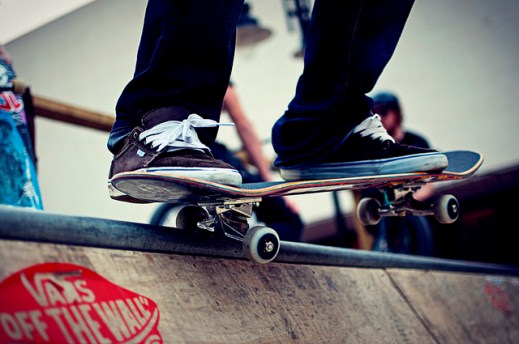
 Welcome back to our summer series on “Sound and Sport.” In today’s post, Josh Ottum discusses the sonorous sounds and unique rhythms of the sport of skateboarding. For an instant replay of last month’s post, click Tara Betts‘s “Pretty, Fast, and Loud: The Audible Ali.” For May’s post, click Melissa Helquist‘s “Goalball: Sport, Silence, and Spectatorship.” Next month’s grand finale will feature a doubleheader on Brasil, with a post by Kariann Goldschmitt on the promotional sounds of FIFA 2014 and a podcast by Andrea Medrado entitled “The Sounds of Rio’s Favelas: Echoes of Social Inequality in an Olympic City.” We’ll close with another take on the Olympics, excerpted from David Hendy‘s recent Noise broadcasts for BBC Radio 4 on the politics of boos at the games. For now, get out your board, strap on your helmet, and prepare to jam. —J. Stoever-Ackerman, Editor-in-Chief
—
Seven layers of screen-printed, sugar pine maple whack the concrete. Aluminum axles pivot on rubber bushings as they slide across steel coping. Circular, molded polyurethane encases lubricated bearings that spin in midair before slamming onto birch. Vocal cords are strained as exclamations are made in response to a maneuver. These are the unmistakeable sounds of the skatepark. As skaters ride through the park, a unique sonic tapestry emerges revealing a constantly shifting array of timbre, pitch, and rhythm. This sliding aural space is similar to the compositional flow between rehearsed maneuvers and improvisatory actions, connecting skaters in the skatepark to musicians improvising in a jam session.
Just as the results of a musical performance depend on acoustics of the venue and the idiosyncrasies of the instrument, the skater is beholden to a similarly complex signal chain. The aural atmosphere of the skatepark relies on the number of other players, as well as their chosen instruments, and unique approach to playing. While surveying the sonic and social dynamics of four skateparks in Ohio and California for this study, the line between performer and listener was often unclear. Skaters are consistently sliding between roles as passive observers and active participants, watching and being watched, making sound and listening to the sounds of others. And, just as an improvising musician aims to develop her own unique voice, the skater intertwines sonic and visual elements into a unique stylistic signature all her own. In this study I will look at the skatepark as a site for skaters to express themselves much in the same way that a musician plays an instrument at a jam session. I will explore the board and terrain, the importance of style, and the culture of the park itself. To begin, I will contextualize the ways in which the skateboard has been constructed as a sonic instrument.
The Instruments
As a skater lands an ollie in the Vans Skatepark in Orange, California, the sound of hard polyurethane wheels slamming against a hollow birch ramp emanates throughout the warehouse, entangling with distinctive sounds made by other participants. The listener is made acutely aware of each skater’s instrument and stylistic approach to performance. What differentiates the rider on a board in the skatepark from a guitarist playing in a rock club? Just as the materials of the electric guitar and its signal chain inform the sonic nature of the instrument, the skateboard and its engaged terrain sound out unique and identifiable characteristics of each device. I spoke with a skater at Flipside Skateboard Shop in Athens, Ohio about the specifics of wheel construction and his own personal preferences:
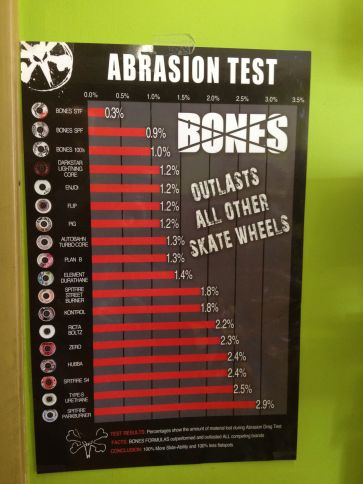
Abrasion test chart, Flipside Skateboard Shop, Athens, Ohio
Just like the layered wood of an electric guitar body, boards are made through a multistep manufacturing process that involves layering thin plies of wood. Maple is most commonly used with the relative flexibility of the deck determining qualities of audible resonance as a skater ollies or railslides. And trucks, which function as axles, can be heard grinding along a surface such as pool coping, a painted curb, or a handrail.
In order for these materials to make sound they must be controlled by a rider and engage with some kind of terrain. The combination of what materials are chosen and how they are used result in a rider’s unique approach. In the skatepark, skaters swathe themselves in clothing, pads, and helmets while riding devices wrapped in visual signposts of self-expression that sound out the priorities of the particular rider.
Sonic Style
Following Henri Lefebvre, Iain Borden speaks of the skateboard as a “lived component of the body, its actions and its self-image in relation to the terrain” (28). Similarly, from my time spent at skateparks in Ohio and California, I have noted the malleability of terrain as a domain to express one’s own unique style. Skaters use their devices as instruments, playing the park, repeating phrases, overlapping with sounds emitted from their peers. All the while, advertisements adorn both bodies and instruments and maneuvers mimic the iconic moves of sponsored skaters viewed in magazines. Visiting Focus Boardshop across the street from the Etnies Skatepark in Lake Forest, California reminds the observer that the elusive, focal point of style in the world of skateboarding is not only confined to the visual realm. As reissued decks from Powell Peralta, Slimeball wheels, and multiple videos adorn the walls of the shop, teenage skaters hang out, asking to bend and stand on decks and spin wheels, all the while watching and listening to newly released videos. Just as guitars and synthesizers reflect the users aesthetic outlook, the look and sound of skateboards signal to a skater’s audience (often other skaters in the park) what kind of skater he or she is.
Tara Rodgers’ insightful article on wood paneling on synthesizers for Sounding Out! has its analogue in the spiritual aura of the object in skateboarding. Bound up in this aura are genre-shaping histories that have taken the sport in innumerable directions. Whether it is the catwalk ethos of Vision Street Wear, Danny Way’s connection with Monster and Red Bull energy drinks, or enjoi’s self-referential marketing, the graphics that wrap around skate gear carry with them weighty connections to the sport’s most original moments. These moments are, of course, defined by marketing campaigns, hosted in influential magazines such as Thrasher and Transworld, and the zietgeist of the time. Intertwined with these branded materials is the sonic quality of the instrument. The sound of the instrument itself reflects the particular ethos of the skater who selected it. In the clip below, an employee working at Focus Boardshop in Lake Forest, California talks about the particular way his board’s sound reflects the idiosyncratic nature of its components. Notice how he skater speaks about the sound of his bearings as a direct link to his style, connecting to Borden’s idea of the board as a lived component of the body.
During my visit to the community skatepark in Athens, Ohio I come across two skaters who have returned to the sport after a two-decade break. One skater sports a longboard with 70a wheels so soft you can’t hear him skate through the concrete pool. Immediately after interacting with the longboarder, another skater finishes a session in the pool at the Athens skatepark with a long slide. I ask him about the role of his wheels and what he calls “the best sound in the world”:
Soft Wheels
Hard Wheels
Skaters related the histories of their boards to me with a sense of fond nostalgia. These histories functioned, primarily, as a mode of individuation, through which those observed were seen refining their identities within the community through conversation. As more time is spent at each of the parks, I begin to notice communal flows of conversation between skaters and their engaged terrain as well. Competitive aspects to out-do each other, synchronized maneuvers, and vocal responses are percolate the soundscape. As listeners perform and performers listen, connections with well-formed cultural codes of improvisational music begin to emerge.
Jamming the Skatepark
Improvising musicians often use the context of the jam session as an opportunity work out new ideas and rehearse repertoire. Minton’s Playhouse in New York is one of the original sites for the jazz jam session. Here, “cutting contests” allowed players the opporunity to outplay each other with virtuosic displays of improvisational prowess. Musicians play to hear each other individually and as a unit, often pushing each other to extremes. The sound is composed, listened to, and then reacted to. Skateparks provide a similar atmosphere. A trick (like an ollie) is immersed in the sonic flows of the surrounding skaters. The skatepark is simultaneously encouraging and competitive, forgiving and relentless.
When I visited the Vans Skatepark on National Go Skateboarding Day park employees tempted skaters to display their best moves throughout the park with the promise of free swag. The environment remained friendly and encouraging as skaters rose to the challenge, welcoming the pressure.
The rituals of the skatepark are varied in their scope. When a skater lands a difficult trick, it is common to hear the tapping of board tails on the ground; applause. Vocal reactions to maneuvers (landed or failed) are also quite common.
What sets the sonic atmosphere of the skatepark apart from the sound of skating outside the park is the palpable lack of intruding sounds from the outside world. As communities continue to accept the skatepark as part of their permanent landscape, the once transgressive sound of the sport takes on a new meaning. The scrapes and slides that once signaled intrusion are now contained in a controlled space. While visiting these jam sessions, it became clear that the sounds of the skatepark remain a mostly male-dominated activity. While the instruments and terrain remain available to the wider public the sound of the skatepark reflects a relatively closed environment often shrouded in platitudes of youth culture. However, once a sense of acceptance and experimentation is cultivated, some other aspects of the skatepark are revealed. The skatepark is a place to play and explore the range of one’s repertoire. It is a place to engage with the limitations of the instrument and one’s own physical faculties. And, it is an environment that encourages friction, noise, and distortion. The skatepark is a communal amplifier, obscuring and reflecting sound as the players immerse themselves in the ultimate sounding board.
Bonus Material:
While immersing myself in the sounds of the skatepark for this project, the idea came up to reimagine the sounds of the skatepark as a musical composition. I asked musicians Michael Deakers, Casey Foubert, Junior High, and Ryan Richter to make a piece that used any portion of the recordings of the four skateparks I visited. Their work reflects a deep connection to the rehearsed and improvisational aspects of music-making and skateboarding. The sounds of these pieces emerged from hours of practice and spontaneous decisions allowing for a particularly effervescent creative outcome. To hear these, check out out my Soundcloud here.
—
Featured Image, “Grinding” courtesy of Luke Hayfield Photography
—
Josh Ottum holds an MFA in Integrated Composition Improvisation and Technology from UC Irvine and is currently a PhD student at Ohio University in the School of Interdisciplinary Arts. His research interests include sound, energy extraction, Van Dyke Parks, Southern California, library music, and synthesizers. As a singer-songwriter, composer, and producer, Josh has released multiple records on various labels, completed numerous international tours, and composed music that has appeared on MTV, AMC’s Mad Men, and NPR.
—

REWIND! . . .If you liked this post, you may also dig:
“Tofu, Steak, and a Smoke Alarm: The Food Network’s Chopped & the Sonic Art of Cooking“–Seth Mulliken
“Sounding Out! Podcast Episode #5: Sound and Spirit on the Highway“–David Greenberg
“Sound-politics in São Paulo, Brazil”–Leonardo Cardoso
Share this:

Toward a Practical Language for Live Electronic Performance

Amongst friends I’ve been known to say, “electronic music is the new jazz.” They are friends, so they smile, scoff at the notion and then indulge me in the Socratic exercise I am begging for. They usually win. The onus after all is on me to prove electronic music worthy of such an accolade. I definitely hold my own; often getting them to acknowledge that there is potential, but it usually takes a die hard electronic fan to accept my claim. Admittedly the weakest link in my argument has been live performance. I can talk about redefinitions of structure, freedom of forms and timbral infinity for days, but measuring a laptop performance up to a Miles Davis set (even one of the ones where his back remained to the crowd) is a seemingly impossible hurdle.
Mind you, I come from a jazzist perspective, which means that I consider jazz the pinnacle of western music. My classicist interlocutors will naturally cite the numerous accomplishments of classical composers as being unmatched within jazz. That will bring us to long debates about the merits of Charles Mingus and Duke Ellington as a composers, which leads, for a good many, to a concession on the part of Duke at least, but an inevitable assertion of the general inferiority U.S. composers compared to the European canon. And then I will say “why are we limiting things to composition when jazz goes so much further than the page?” To which I will get the reply: “orchestral performers were of the highest caliber.” Then I will rebut, “well why was Europe so impressed by Sidney Bechet?” But I digress.
Why talk about classical music in a piece on electronic music, you, my current interlocutor, may ask? Well, in placing electronic music in a historical context, its current stage of development keeps pace with the mental cleverness found in classical but applies it to different theoretical principles. The electronic musician’s DAW (Digital Audio Workstation) file amounts to the classical composer’s score; the electronic musician’s DSP (Digital Signal Processor) parallels the classical composer’s orchestra. I could call electronic music “the new classical” and I’d have a few supporters. But. . .taking it to the level of jazz? Electronic music would have to include not only the mental cleverness, but the physical cleverness as well.
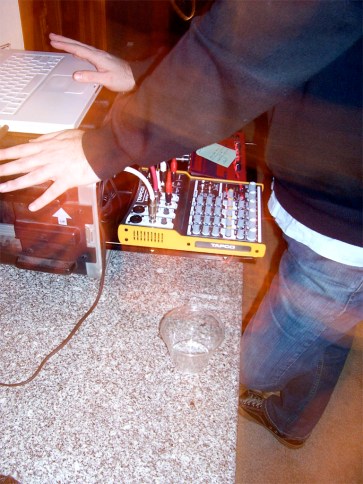
Electronic artist using Ableton 5 Live, Image by Flickr user Nofi
Let’s back up for a bit. A couple years back, I did a piece for Create Digital Music on Live Electronic performance. I talked to a diverse group of artists about their processes for live performance, and I wrote it up with some video examples. It ended up being one of the most discussed pieces on CDM that year, with commentary ranging from fascination at the presentation of techniques to dismissal of the videos as drug-addled email inbox management.
This was to be expected, because of the lack of a language for evaluating electronic music. It is impossible to defend an artist who has been called a hack without the language through which to express their proficiency. Using Miles Davis as an example–specifically a show where his back is to the audience–there are fans that could defend his actions by saying the music he produced was nonetheless some of the best live material of his career, citing the solos and band interactions as examples. To the lay person, however, it may just seem rude and unprofessional for Davis to have his back to the audience; as such, it cannot be qualitatively a good performance no matter what. Any discussion of tone and lyrical fluidity often means little to the lay person.
The extent of this disconnect can be even greater with electronic performances. With his back turned to the audience, they can no longer see Miles’ fingers at work, or how he was cycling breath. Even when facing the crowd, an electronic musician whose regimen is largely comprised of pad triggers, knob turns, and other such gestures which simply do not have the same expected sonic correspondence as, for example, blowing and fingering do to the sound of a trumpet. Also, it is well known that the sound the trumpet produces cannot be made without human action. With electronic music however, particularly with laptop performances, audiences know that the instrument (laptop) is capable of playing music without human aid other than telling it to play. The “checking their email” sentiment is a challenge to the notion that what one is seeing in a live electronic performance is indeed an “actual performance.”
In the time since writing the CDM piece, I’ve seen well over a hundred live sets, listened to days worth of live recordings, spoken in-depth with countless artists about their choices on stage, and gauged fan reactions many times over: from mind-blowing performances in barns to glorified electronic karaoke in sold-out venues, tempo locked beat matching to eight channel cassette tape loops, ten thousand dollar hardware to circuit bent baby toys. After all of that, I still don’t know that I can win the jazz vs. electronic music debate, but I will at least try.
*****
A while back, I was paging through the December 2011 edition of The Wire when I came upon a review of a Flying Lotus performance, the conclusion of which stood out:
On record, the music has the unruly liquidity of dream logic wandering from astral pathways down alphabet street, returning via back alleys on its own whims. Maybe the listening mind, presented with pretty straight analogues of those tracks, rebels, expecting something more mercurial, more improvised. The atmosphere in the venue reflected this upper-downer tension and constraint: the crowd noise was positive, but crowd movement was minimal – a strange sight in the midst of FlyLo’s headier jams. When the hall emptied there was a grumbling undercurrent as the tide of humanity was spilling slowly down the Roundhouse steps, whispers of it must have reached the upper levels. One casualty high above leaned over to berate them: “You don’t know, even understand, what you just FELT.” Sadly though, he didn’t stick around to enlighten anyone.
It should be noted that there are positive reviews of the show, and while not necessarily the best gauge, the videos from the event may seem to tell a different story.
What stood out for me from the review however, was that in trying to write about what the writer felt was a less than stellar performance, there was only one critique which could directly be attributed to the music, which was to say that Flying Lotus performed “straight analogues” of his tracks. Beyond that, the writer was left describing the feelings from the audience.
Feelings are tricky things. We all have them and they are the fundamental point of connection we seek when experiencing music. The message conveyed through the medium of music is meant to be an emotional one. But measuring those emotions is a task which cannot escape subjectivity. In a case like this when one writer is attempting to speak for the feelings of the whole audience, it becomes really tricky. Sure the writer may consider their analysis to have been objective, but it was still based on their perception of the audience, not the audience’s perception. Even more, this gauging of the audience dynamic does not tell us how the actual music performance was regardless of the varied perspectives from within the audience. I contend that this gap occurs because the language for discussing electronic performance has not yet been established.
Around the time I read The Wire review I was also reading Adam Harper’s Infinite Music, which offers variability as a primary factor of analysis in music. Instead of building on traditional music theory, Harper takes cues from those on the fringes of western music. He builds a concept of ‘music space’ by expanding John Cage’s “sound space,” the limits of which are ear determined. Furthermore, Harper’s non-musical variables and how they play into creating individually unique musical events, strengthens Christopher Small’s notion of musicking as a verb. In this way, Harper creates a fluid language for discussing music which might prove practical for these purposes.
It is helpful to use one of the central concepts of Harper’s music space, musical objects, as a means of distinguishing electronic performance.
Systems of variables constitute musical objects – Adam Harper
Going back to Miles Davis, his instrument is a monophonic musical object with a limited pitch and dynamic range in the upper register of the brass timbre. His musical talent is evaluated based on how he is able to work within those limitations to create variable experiences. His band represents another musical object comprised of the individual players as musical objects as well. The venue in which they are playing is a musical object, as is the audience and Davis’ decision to perform with his back to it. It is the coming together of all of these musical objects that creates the musical event (an alternate event includes the musical object which recorded the performance, and the complete setting of the listener as an individual musical objects upon playing the live recording). In a musical event comprised of these musical objects – Davis performing live in front of an audience with his back turned so he can face the band–it is possible to imagine a similar reaction to the above commentary about Flying Lotus, including a guy berating the audience for not making the connection.
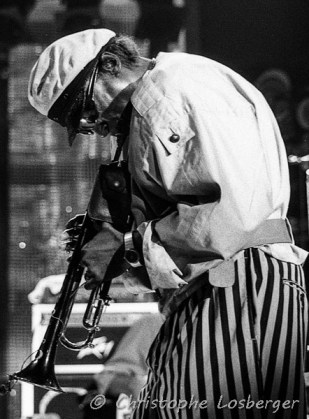
Miles Davis @ Montreux, 8.7.1984 Image by Flickr user Christophe Losberger
In this Davis example however, we could listen to the audio to determine whether or not it was a “good” performance by analyzing the musical objects which can be observed in the recording (note: this would be technical analysis of the performance, not the event or its reception). Does Davis’s tone falter? How strong are the solos? Is he staying in the pocket with the rest of the band? Evaluation of these variables would be a testament to his proficiency which could be compared to other performances to determine if it measures up.
Flying Lotus’s set however is a bit different. Yes, we could listen back to the audio (or watch the video) and determine if indeed it measures up to other sets he has performed, but unlike with Davis, we cannot translate what we hear directly to his agency. When we hear the trumpet on the Davis recording we know that the sound is caused by him physically blowing into his instrument. When we hear a bass in a Flying Lotus set, there isn’t necessarily a physical act associated with the creation of the sound. With all of the visual cues removed in the Davis example, we can still speak about the performance aspect of the music; the same is not necessarily so about an electronic set, even with visual cues. In many electronic sets, it is only when something goes wrong that actual agency in the music being performed can be attributed.
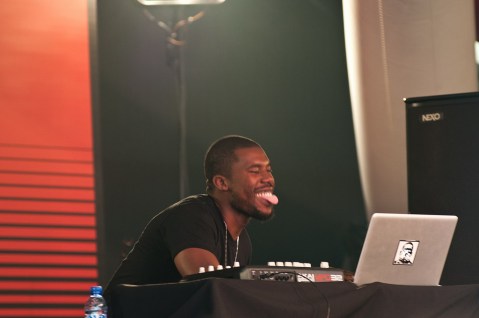
Flying Lotus,@ SonarDome, Sonar 2012, Image by Flickr user Boolker
Where the advent of the laptop and DSP advances for music have expanded creative possibilities, they only shroud what the performers using them are actually doing in more mystery. It’s an esoteric language, or perhaps languages, as ultimately each artist’s live rig configuration amounts to different musical objects, across which there may not be compatibilities.
However, in certain musical circles there are common musical objects. Perhaps the most common musical object for performance in electronic music right now is Ableton Live, which results in common component musical objects across performances by different artists. Further, an Ableton Live set can sound just like a Roland 404 set, which can sound just like a DJ set with a Kaoss pad, all of which can sound identical to a set not performed live but produced in the studio (or bedroom as the case may be) for a podcast. The reason for this is that much of the music is already fixed. What changes is the sequencing of these fixed pieces of music over time, their transitions and the variety of effects employed. The goal for these types of sets is a continuous flow of pre-arranged music, which parallels that of a DJ set.
In the past few years, the line between a live electronic set and a DJ set has been blurred extensively. Fans have become fairly critical of artists, to the point that it has become standard practice for promoters to list whether performances will be live or a DJ set. Even on the DJ end of the spectrum there’s a lot of questions, as artists have been called out for their DJ set being an iPod playlist. To qualify as a live set however, an artist must be doing more than just playing songs. How much more is debatable, but should it be?

Flying Lotus – Sónar 2012 – Jueves 14/05/2012, Image by Flickr user scannerfm
Nobody in their right mind would call Miles Davis a hack. Even if they didn’t like specific performances, few would question his proficiency with the instrument. The reason for this is that his talent rises above the standard performance, beneath which someone could be qualified as a hack. If a trumpet player spent a whole night performing only shrill notes of a C major chord around middle C, without properly qualifying that their performance would be so constrained as a stylistic choice, one might consider calling that artist out as a hack (I apologize in advance to the serious musician that fits in this description).
The rationale behind this assessment is based on knowing the potential variability of the instrument and realizing that the performer is not exploring any of that variability. Perhaps there could be other layers of variability (e.g. an effects chain) added to the trumpet to make it interesting musically, but it can be objectively said that they don’t measure up to a standard quality of a trumpet player. If we say that the trumpet has an extensive dynamic range, a tonality which can go from smooth to harsh and a pitch range of just over three octaves, we can see how the player in our example is exhibiting quite a low proficiency.
This goes across all styles of trumpet playing. Were a style to impose limitations on a player, it could be said that the style did not allow for the full expression of proficiency on the instrument. A player within that style could be considered proficient in that context, but would require a broader performance to be analyzed for general proficiency. So the player in our example could be a master of “Shrill C” trumpet, but in order to compare with a Miles Davis they would have to perform out of style. Conversely, Miles Davis may be one of the world’s greatest trumpet players, but possibly the worst “Shrill C” trumpet player ever.
From this we can see that the language of variability provides a unique way to objectively speak on the performance of musical objects, while fully taking into account the way styles can play into performance. Using this language we open the world of electronic performance up for analysis and comparison.
—
This is part one of a three part series. In my next installment, I will use some of the language here to analyze the instruments and techniques used in electronic performance today. Once we have a fluid language for describing what is being used, I believe we will be better equipped to speak about what happens on stage.
—
Featured Image by Flickr User Scanner FM, Flying Lotus – Sónar 2012 – Jueves 14/05/2012
—
Primus Luta is a husband and father of three. He is a writer and an artist exploring the intersection of technology and art, and their philosophical implications. He is a regular guest contributor to the Create Digital Music website, and maintains his own AvantUrb site. Luta is a regular presenter for the Rhythm Incursions Podcast series with his monthly showRIPL. As an artist, he is a founding member of the live electronic music collectiveConcrète Sound System, which spun off into a record label for the exploratory realms of sound in 2012.
—
REWIND! . . .If you liked this post, you may also dig:
Experiments in Agent-based Sonic Composition–Andreas Pape
Evoking the Object: Physicality in the Digital Age of Music–-Primus Luta
Sound as Art as Anti-environment–Steven Hammer
Share this:


Current Top Posts





April 2021

January 2020

November 2019

October 2019

August 2019

April 2014

November 2017

March 2015

December 2017

October 2015
 Sounding Out!
Recent Comments