
Listening to Tinnitus: Roles of Media When Hearing Breaks Down
 Editor’s Note: Welcome to the third installment in our month-long exploration of listening in observation of World Listening Day on July 18, 2012. For the full introduction to the series click here. To peep the previous posts, click here. Otherwise, prepare yourself to listen carefully as Mack Hagood contemplates how sound studies scholars can help tinnitus sufferers (and vice versa). –JSA
—-
One January morning in 2006, Joel Styzens woke up and life sounded different. Superimposed over the quiet ambience of his Chicago apartment was a cluster of sounds: pure, high-pitched tones like those of a hearing test. Loud, steady, and constant, they weren’t going away. He walked to the bathroom to wash his face. “As soon as I turned on the water on the faucet,” he told me in an interview, “the left ear was crackling… like, a speaker, you know, being overdriven.” Joel was 24 and a professional musician, someone who made his living through focused and detailed listening.
As days passed, he grew more fearful and depressed. For two months, he barely left the house. The air brakes of a city bus or a honking horn were painful and caused his heart to race. His sense of himself, his environment, and his identity as a musician were all undermined. This man who lived through his ears now faced the prospect of a life of tinnitus (ringing or other “phantom sounds”) and its frequent companion, hyperacusis (sound sensitivity sometimes accompanied by distortion). Joel could even identify the dominant pitch of his torment: it was A sharp.
We humanistic and qualitative sound scholars—particularly those of us focused on media and technology—can learn a lot from listening to tinnitus and the people who have it. Scholars of science and technology studies (STS) often utilize moments of technological breakdown to reveal the processes and mechanisms that constitute things we take for granted. Tinnitus and hyperacusis are, in the words of anthropologist Stefan Helmreich, “moments when hearing and listening break down” (629). Because sound scholars understand sound, hearing, and listening not only as the material effects of physics and physiology, but also as culturally and technologically emergent phenomena, we can potentially contribute much to the growing public conversation around tinnitus.
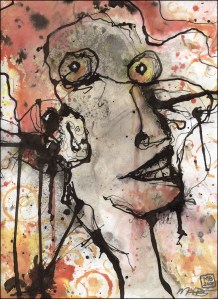
“Tinnitus” by Merrick Brown
And there is a lot at stake. Tinnitus affects 10-15% of adults and is the top service-related disability affecting U.S. veterans returning from Iraq and Afghanistan. Tinnitus and hyperacusis are also fairly common among musicians who work in loud performance and media production environments. It is perhaps ironic, then, that mediated sound and music are audiologists’ primary tools in helping people recover from these conditions.
My own study of tinnitus centers on its articulation with audio-spatial media—devices such as bedside sound machines, white noise generators, and noise-canceling headphones, all used to fabricate a desired sense of space through sound. People with tinnitus are among the most avid users of these devices, carefully mediating their aural-spatial relations as tinnitus becomes more evident in quiet spaces and hyperacusis flares up in noisy ones. During my fieldwork in audiology clinics and conferences, tinnitus support groups, and online forums, I observed that audio media were being deployed as medicine and technologies of self-care. Gradually, I came to the realization that the experience, discourse, and treatment of tinnitus is always bound up in mediation. In fact, I believe that tinnitus signals the highly mediated nature of our most intimate perceptions of sound and self. Below, I sketch just a few of the places I think aural media scholarship could go in conversation with tinnitus and hyperacusis.
The sound of media aftermath
Hearing experts do not consider subjective tinnitus to be a disease, but rather a condition in which individuals experience the normal, random neuronal firing of their auditory system as sound. Although it may be tied to various diseases and disorders, tinnitus itself is benign and does not inherently signal progressive hearing loss nor any other malignant condition.
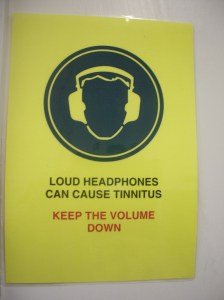
Image by Flickr User Phil Edmonds
Nevertheless, research shows a frequent association between tinnitus and reduced auditory input, comparable to a sound engineer turning up the volume on a weak signal and thus amplifying the mixing board’s inherent noise. This “automatic gain control” theory neatly explains a classic 1953 study, in which 94 percent of “normal hearing” people experienced tinnitus in the dead silence of an anechoic chamber. Unfortunately, it also helps confirm the fear that the ringing heard after a night of loud music is due to hearing loss, known clinically as “temporary threshold shift.”
As Joel’s case suggests, when repeated, such threshold shifts lead to permanent damage. Audiologists increasingly see media-induced hearing loss and tinnitus as an epidemic, with ubiquitous earbuds often positioned as the main culprits. I have heard clinicians express dismay at encountering more young people with “old ears” in their offices, and youth education programs are beginning to proliferate. These apparent relations between aural pleasure and self-harm are an intriguing and socially significant area for sound and media scholarship, but they should also be considered within the context of moral panics that have historically accompanied the emergence of new media.
Objectifying phantom sound
For both clinicians and sufferers, one of the most frustrating and confounding aspects of tinnitus is how hard it is to objectify, either as a subject of research and treatment or as a condition worthy of empathy and activism. For both clinicians and sufferers, media are the primary tools for converting tinnitus into a manageable object.

Media marketed to protect musicians against Tinnitus, Image by Flickr User Jochen Wolters
Although media scholars haven’t yet studied it as such, the audiologist’s clinic is a center of media production and consumer electronics retail. Having audio production experience, I felt a sense of recognition on seeing the mixer-like audiometer in the control room of Joel’s audiologist, Jill Meltzer, separated by a pane of glass from the soundproofed booth where her patients sit. It was a studio where Meltzer recorded hearing rather than sound, as she attempted the tricky work of matching the pitch, volume, and sensitivity levels of tinnitus and hyperacusis. Since medication and surgery are not effective treatment options, the remedies for sale are media prosthetics and palliatives such as wearable sound generators, “fractal tone” hearing aids, Neuromonics, and sound machines that help distract, calm, and habituate patients to the ringing. Meltzer and other clinicians consistently told me that they have only two tinnitus tools at their disposal—counseling and sound.
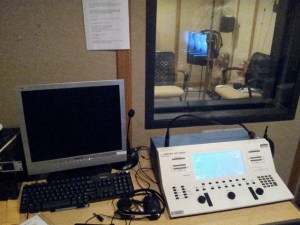
Audiometer and testing booth, Image by the author
The subjectivity of tinnitus is most frustrating for sufferers, however, who often encounter impatience and misunderstanding from family, friends, bosses, and even their doctors. Again, media serve to externalize and objectify the sound. Joel did this through music: “A Sharp,” Styzens’ first post-tinnitus composition, represents tinnitus with chordal dissonance and hyperacusis with a powerful change of dynamics on a guitar. He eventually recorded an entire album that explored his condition and raised awareness.
.
Other individuals, in an attempt to communicate the aural experience that drives their sleeplessness, depression, anxiety, or lack of concentration, create YouTube videos designed to recreate the subjective experience of tinnitus.
.
The American Tinnitus Association, an advocacy group, has used broadcast and social media to raise awareness and research funding, as we see in this PSA from 1985.
.
However, such dramatic uses of media may be in some ways too powerful. In fact, “raising awareness of tinnitus” might be as bad as it literally sounds.
Communicable dis-ease
In the process of externalizing their experience for others to hear, people with tinnitus can make their own perception of the sound grow stronger. They may also generate anxiety in others, encouraging them to notice and problematize their own, previously benign tinnitus.
Neuroscientist Pawel Jastreboff’s groundbreaking and influential neurophysiological model of tinnitus postulates that tinnitus becomes bothersome only when the auditory cortex forms networks with other areas in the brain, resulting in a vicious circle of increasing perception and fear. The implication of this model, now substantiated by clinical research, is that the way people think about tinnitus is a much greater predictor of suffering than the perceived volume of the sound. As Jastreboff told me in an interview, “Incorrect information can induce bothersome tinnitus.” Information, of course, circulates through media. It may be productive, then, to think of tinnitus suffering as a communicable dis-ease, one strengthened in circulation through networks of neurons, discourse, and media.
I think there is both a need and an opportunity in tinnitus for an applied sound studies, one that intervenes in this mediated public discourse, works against moral panic and hyperawareness, and suggests the quieting possibilities that open up when we grasp the constructed nature of our aurality. Listening to tinnitus as a networked coproduction highlights the ways in which our most subjective aural perceptions are also social, cultural, and mediated—perhaps the fundamental insight of sound studies. My hope is that by listening to tinnitus we can speak to it as well.
__
*Featured Image Credit: A representation of Tinnitus by Flickr User Jason Rogers, called “Day 642/365–Myself is against me”
Share this:

my mother’s voice, my father’s eye, and my other body: the sound of deaf photographs

Editor’s Note: This post is the second in a three-part Sounding Out! series on deafness, Sound Studies, and Deaf Studies during February 2012. Read last week’s post by Liana Silva here–JSA
dizzy snapshots
Lately, I’ve been halted by a particular photograph of my mother. Like Roland Barthes’ wonderland photo of his mother in Camera Lucida,
this picture “corresponded to a discomfort I had always suffered from: the uneasiness of being a subject torn between two languages, one expressive, the other critical” (8).
It began when my father reorganized his photographs. Since retirement, he’s taken on archival projects with renewed fervor. He began with 1974 (the year I was born), made it all the way to 1984 and from there slipped back. My mother, a freckled farm girl in South Dakota, standing in front of a box house and snow, lots of snow. The year, 1957 or so. My father in a high chair in Sepulveda, California. Perhaps 1948. By then my grandparents knew he was deaf.
And every couple of weeks or so my dad calls me. I finished another year, come see the pictures, he tells me via the Iphone, his slow, thoughtful typing shaped by many years of TTY-use (TTYs, or “Text Telephones,” are increasingly receding from every day use, replaced by chatting and text messaging). I imagine him at home in my old room, surrounded by generations of Waldners, Cardinales, Jensons and Ewings. Eagerly, he fills an old stereoscope viewer with 3d slides. His favorite is of my brother and me at the Buschart Gardens in Victoria, Canada. My brother is six and I am eight; our young faces are carefully tilted towards the pale cabbage roses. My father fits more years into fewer albums, filing the stray photos in new Costco cardboard photo boxes. And yet, as he reduces by putting old pictures into new boxes, he continually finds older pictures, older boxes.
The last time he called me, he was in 1984. These pictures depress my dad; he won’t spend much time here. In the photos I’m always on the phone or covering my face. Perhaps he remembers, as I do, the times he would attempt to enter my teenage world of sound. He’d follow the knotted coil of the cord, pick up the phone and say “huh-lllll-ooo,” exaggerating his lips in a comical lip-synch, emitting a low, guttural voice while I danced for the phone. We’d both laugh as if we secretly agreed: hearing language is silly, ugly; my father rarely uses his voice.
But within 1984 was a stack of black and white 5×6 matte photographs bound by a rubber band. They were a series of still television shots of my mother. We lived in Berkeley then, and my mother would drive to San Francisco to record the DeafNews; I remember being sleepy, confused, and excited when my mother’s face appeared on the TV. These photographs frame my mother the way I saw her: her face elongated by the distorting concave screen surrounded by blackness; in the picture she seems still to be floating in TV space. I wonder, who stood in front of the television, through several barriers and captured these stills of language?

In high school, I went to a dance at the Fremont School for the Deaf where my parents were chaperones. It was easy to find the dance; you could hear the throbbing bass from across campus. It was so loud, it hurt. When I walked in, I wasn’t surprised to see a wall full of uncomfortably dressed teenagers holding balloons to feel the sound and bobbing their heads in tempo. “Careless Whispers” played as it did at all high school dances and embraced couples locked bodies in a slow sway on the dance floor. The music, the discomfort of boys in pressed shirts and Drakkar Noir, it was no different than the stiff dances at Ramona High school down the street. But it was Deaf more than any silence could be. When my friends found out my parents were deaf they nearly almost always gasped: “I bet your house must be so quiet!”; they nearly always got it wrong. Here, in this cafeteria-turned “sea of love,” Deafness announced itself. Deafness was not mute.
sound does not just enter the gateway of hearing; it can also be perceived through the sense of force” (77).
The song changed to M.C. Hammer, and the dancers on the floor continued slowly rocking. A nervous looking redhead held his palm out with one hand and with the other shaped his hands to form legs; he put the two signs together and asked me to dance.
I was flattered, and acutely aware that I was the foreigner there. As I took his hand, I was filled with adolescent shame forever demanding: “be quiet! People can hear.”
sonnet xvii
así te amo porque no sé amar de otra manera,/sino así de este modo en que no soy ni eres/tan cerca que tu mano sobre mi pecho es mía,/tan cerca que se cierran tus ojos con mi sueño–Pablo Neruda, 100 Love Sonnets Cien Sonetos de Amor
I am six, and eight, and thirteen. The door is open, so I crawl into my parents’ bed, and the pull of the sheets awakens my mother. She grasps my hand. I whisper in sign language so my father won’t be disturbed by the light. Then, I take her hand and listen, tracing the terrain of her fingers, following the curves to read her words. I fall asleep talking to my mother, her hand in mine, my father’s snoring vibrating the bed.
I am twenty-nine and I am watching her hands, her signing, and seeing my own. Her name, signed with a sweep from a handshape “L” to a curved “C” down the shoulder to the wrist (my name, the same “C”)— “now I know your mother, you sign just like her.” And my punctum—sting, speck, prick—the kind of subtle beyond—as if the image launched desire beyond what it permits us to see: not only toward ‘the rest’ of nakedness, not only toward the fantasy of a praxis, but toward the absolute excellence of a being, body and soul together. Barthes again.
Her hands—her hands and my hands, let me see your hands she tells me. She too sees herself on my body; we are both always looking at the blurrr of her hands.
And looking, I return always to a short story by Julio Cortázar, “Axototl” from Blow-Up and Other Stories about a boy who spends hours at the aquarium watching the axolotls; he is transfixed, haunted, obsessed, and keeps returning to watch these fish, no not fish. The boy consults a dictionary and discovers that they are the larval stage of a kind of Mexican salamander. I find the boy and his axolotls among my books, and discover highlighted in purple:
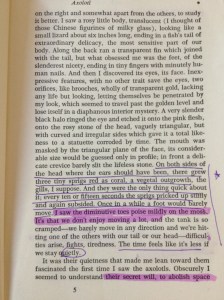
I was, I am, struck by this passage. These atavistic creatures capture, compress space and being. Identity breaks down—I, we, they are no longer discrete. What side are you on? Mother, Father Deaf.
non-negotiable photos
When I was eleven our family bought a deluxe conversion Dodge Caravan complete with metallic bronze customized paint job, rust colored velour captain’s chairs, and a boomerang-shaped television antenna. I went with my parents to the car dealer on a sticky August afternoon. “We want a minivan,” my mother signed to me, I voiced to the short man with greasy black hair and uncomfortably freckled arms. He immediately took us past rows of suburb-like cutouts of vans and led us to the Las Vegas model of minivans—all the deluxe features and without a deluxe price. A special deal. I signed this eagerly—I wanted my parents to understand as I did—we were lucky to see this car. It’s a familiar scene: father adjusting the seats and falling in love with cruise control; mother insisting it was more than they budgeted; the dealer crawling in the back and hollering out through the nifty sliding third door all of the fantastic features.
Inside the car. Tell them the back seat can be removed for more room. Tell them there’s an acoustical equalizer for the stereo. Tell them there’s air conditioning. Tell them there’s a threeyearthirtythousandmilewarranty. Tell them we do financing right here in the lot. Tell them.
Outside the car. Is this the best price? Does he have anything less expensive? Does it come with a warranty? Do you have special discounts? Are you telling us everything?
“Yes, they like all the extras.” No—best price.
We left the dealer and got back into our happy orange VW van. My bare legs stuck to the vinyl seats and I cried. My mother was upset: “What’s wrong? Did you want that car?”.
 The salesman knew my parents didn’t care about the equalizer or the TV monitor in the back seat; but he didn’t know they understood. “How nice of you to help your mother go to the store and do the groceries” while my mother writes a check, looking at the cash register screen for the correct amount. I am the mute one. “What did the lady say?” my mother asks; “nothing,” is my silent reply. Nothing. Nothing. Nothing.
Yes, my mother has a college degree. Table 7 shows that the proportion of persons 18 years of age and over with under 12 years of education increases monotonically as the level of their hearing ability decreases. A bachelor of library sciences. No, she does not work in a library. They were afraid of what would happen if she answered the phone. They were afraid of hearing a deaf woman speak. We moved several times when the rent for one reason or another had to go up; even being six you become familiar with friendly discomfort. Interpreting for my mother when she caught my landlord in a contradictory lie—the distrust on both sides boomeranged off my nine-year old body.
In that parking lot, the traffic of misunderstanding and mistrust, all I wanted to do was to hide my lips, shield my transparent body so that neither side would see they were being betrayed.
talking pictures
The stage is dark, but the theatre is vibrating. “Red hots . . .” lingers in the air. My dad taps me on the shoulder. What does the music sound like?
My father is sitting to my left, my husband to my right. It is between scenes at the DEAFWEST performance of Tennessee Williams’s A Streetcar Named Desire. I’m thrilled to watch the interpreters peering from the balcony above; their voices float above the Deaf actors who take center stage. Sign language takes center stage. The interpreters are for the hearing. The dividing line of the stage is several feet ahead of us. Blanche Dubois begins signing to Stella on the stage. But unlike the other Deaf actors, Blanche speaks with her own voice; the interpreters above are silent. Her signs are stiff, they struggle to keep up with her vocal cadence. I nod as I watch, transfixed: everything has been reversed.
I quickly sign to my father: She is speaking. She’s hearing! Then I lean over and whisper to my husband: her signing. It’s not Deaf. She’s hearing.
I am signing Deaf. I am whispering Hearing.
Cara Cardinale gives sound to her narrative with her mother’s voice–“sounding out” against audist notions of sound that keep Deaf voices silent and perpetuate the idea that deafness is interchangeable with muteness. She would like to thank her mother for sharing her beautiful voice, which to a CODA is a distinctive and comforting sound but often carries a stigma outside the home. Cara uses her own signing body here, not as interpreter, but as primary narration of this intimate photograph.
From his jacket pocket, my father pulls out his hearing aid still marked with red dormitory tape from his years at the residential state school for the Deaf; the opaque embossed letters have slowly curled back on themselves. He adjusts the petrified, squealing earmold then smiles at me.
photo emulsion
Her hands are strapped to the hospital bed. More violent than the search for willing veins to take the sedatives, is the silencing. I cover my mouth to keep from gagging. In the darkness, I watch the television screen as it shows the tour of my mother’s internal body: my face looking back at me against the glass.
The doctor freezes the image and points out the polyps clinging to the intestinal walls. But I see gestation, birth—I am looking from the inside out:
If there exists a border-line surface between such an inside and outside, this surface is painful on both sides. When we experience this passage . . . intimate space loses its clarity, while exterior space loses its void–Gaston Bachelard, The Poetics of Space (218).
It was my body in her body and I found myself looking for the lost baby from years ago; perhaps it was there, inside of her body, my body.
The intimacy, the motion still in the blurrr of the photograph. I am fascinated with a delightful dread, horror. Her name in captions, my name. Her body, my body. That picture says everything about my body. Everything about sitting between my father and my husband: lines drawn between us in the newly reupholstered seats, steel blue like everything new, between the actors and the audience, close enough to see the eyeliner drawn in for emphasis, between the Deaf actors on the stage and the hearing interpreters peering over them on the balcony.
I am transfixed. No transition and no surprise, I saw my face against the glass, I saw it on the outside of the tank, I saw it on the other side of the glass. Then my face drew back and I understood.
Florescent lights saturate the room. I lean forward; take a breath; faint.
center of vision
Sometime within the last six months, my father’s left eye has had an aneurysm. This led to a detached retina and a burst blood vessel. The blood has been slowly moving towards the center of vision. During the day, my father sees shadows. And my mother has been hearing things. Last week she was startled by a high pitched noise; moments later the light in the kitchen flashed indicating that the phone was ringing. Lines are bleeding. The darkness is terrifying for my father in the same way that sound has become disorienting for my mother. And lately I’ve been on the verge of vertigo. It seems as if it were the moving forwards and looking backwards at the same time that’s been disorienting me.
I go with my father to see a retinal specialist. Once in the examining room, I am in the dark again. I am signing in the dark, but my father cannot hold my hand. He is across the room, peering at me with one eye, seeing my signs with the shadow of the pinlight. It must be dark, they explain, his eye needs time to dilate, to open so we can see inside. He will be injected with a kind of serum so that the shadow can be seen.
While we wait for the dizzy eye to dilate, I describe my vertigo to my father. He notes with interest and nods, yes, mother took me to doctors in Washington D.C. He looks at me. Your age. Even the emergency room. Nothing wrong. Gone—he signs with a shrug. Maybe gone—he points at me—soon.
The doctor returns and looks into my father’s eye. The serum has worked, and the image is transparent.
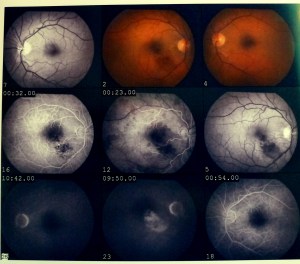
I see his eye, enlarged, disembodied, projected on the screen behind him. It is beautiful and dark, a moonscape clouded over by an eclipse. Everything is transparent, and I think of the axolotls.
—
C.L. Cardinale has a PhD in English Literature from University of California, Riverside. Currently she is editing her manuscript on what she calls “look-listening”—deafened gestures—in twentieth century narratives. She also publicly reads Proust, edits for Lettered Press, and sings with her one and six year old in California’s east bay.
Share this:


Current Top Posts





April 2021

January 2020

November 2019

October 2019

August 2019

April 2014

November 2017

March 2015

December 2017

October 2015
 Sounding Out!
Recent Comments