
Oh Say Can You Hear?: Singing the National Anthem
 In my decade as a play-by-play broadcaster and sports reporter, I’ve covered more than 1,300 games in sports ranging from high school football to Major League Baseball. Every one of those games has been preceded by “The Star-Spangled Banner,” the national anthem of the United States of America. One season, I was responsible for selecting the national anthem singers for all the home games of a minor-league basketball team I worked for. I’m about as familiar with “The Star-Spangled Banner” as someone who’s never performed the song can be. Yet, I wonder why anyone would want to sing “The Star-Spangled Banner” before a sporting event.
For starters, it’s a very difficult song to sing, which isn’t surprising when you consider that “The Star-Spangled Banner” wasn’t originally designed to be sung. What we now know as our national anthem started off as part of a poem written by lawyer and author Francis Scott Key. The poem, titled “Defence of Fort McHenry,” was Key’s thoughts on a battle he witnessed during the War of 1812. [See guest blogger Jeb Middlebrook’s post “Prison Music: Containment, Escape, and the Sound of America” for more on the Star Spangled-Banner as a prison song.–Editor] Key’s brother-in-law noticed that the poem’s words could be set to the music of “The Anacreontic Song“, a popular English drinking song. Within weeks, Key’s words were printed in newspapers throughout the country, the name changed to “The Star-Spangled Banner.” Although all four verses of Key’s poem were converted to song, only the first verse was designated as the official national anthem of the United States of America in 1931.
No one has pinpointed the first sporting event that had “The Star-Spangled Banner” sung before it. However, there’s evidence the song was sung both before and during Major League Baseball games while World War I was going on. During the first game of the 1918 World Series between the visiting Boston Red Sox and the Chicago Cubs at Weeghman Park (known today as Wrigley Field), a band performed “The Star-Spangled Banner” during the seventh-inning stretch (“Take Me Out to the Ball Game” was ten years old in 1918, but the Tin Pan Alley song had yet to become a seventh-inning stretch standard). It wasn’t until World War II when the national anthem was performed before every baseball game, an affirmation of the American spirit during such a difficult time.
It’s fitting that baseball was the first sport whose games were preceded by the national anthem; baseball’s status as America’s national pastime and as one of its defining cultural institutions was undisputed for most of the 20th century. Also, in the 1940s, professional basketball was just getting off the ground, professional football was barely 20 years old, and professional hockey was dominated by Canadians and only played in a handful of American markets. If the tradition of pre-game anthem singing had begun in one of those sports, it would’ve taken much longer to catch on, if it caught on at all. Eventually, all the other professional leagues followed baseball’s example.
When I was an account executive for the Yakima (Washington) Sun Kings of the Continental Basketball Association during their 2002-2003 season, my boss assigned me the responsibility of choosing our pre-game national anthem singers. Fortunately, it proved to be an easy task, since folks who were interested in singing regularly called the team’s offices, and as long as they could hold a tune I booked them. All I could give the singers were tickets to the game at which they were performing, but no one ever bemoaned the lack of compensation.
When I think about all of the games I’ve covered, I honestly can’t remember any vocal renditions of “The Star-Spangled Banner” that stand out because of their greatness. However, I remember all of the terrible singers I’ve heard. There was the raven-haired woman in Keizer, Oregon who got halfway through the song, screwed up the lyrics and started over. There was a middle-aged man in Binghamton, New York who messed up the song’s pitch and pacing so badly, there was a good three seconds of stunned silence when he finished, followed by polite applause. There was the teenager in Kalamazoo, Michigan whose voice cracked every time she hit a high note. And, that’s just the tip of the iceberg. So, you work your butt off to sing an extremely difficult song, you manage not to mess it up, you get some nice applause once you’re done and then you’re forgotten right after the first pitch. Singing the national anthem is a thankless job, yet there’s no shortage of people willing to do it.
When I think about the people who volunteered to sing at Yakima Sun Kings games, I don’t recall anyone who who looked at singing the anthem as a way to honor their country. There was one woman who lived an hour and a half away who volunteered her anthem-singing services to every professional and college team within three or four hours of her home. I asked her why she put in all this effort and she said “I just like to sing.” The one singer I rejected was an eight-year-old girl whose mother bragged over the phone about her daughter being such an outstanding singer that “she brings people to tears.” Her mother seemed to think singing the national anthem before about 3,000 people in the middle of nowhere would lead her daughter to stardom. I was out of the office when a CD arrived with 10 tracks and the young lady’s picture on the cover (her mother called the office twice to make sure her husband had dropped off the CD and that I had received it). I listened to the one track that featured her singing “The Star-Spangled Banner” and I didn’t think it was very good; she had a nice voice but she was trying way too hard. Thankfully, I never heard from her mother again.
Other than that young lady (or, more accurately, her mother), none of the aspiring anthem singers I encountered seemed to be seeking stardom. Perhaps these singers were more patriotic than they – or I – realized. Perhaps they just wanted to cross an item off their bucket list. Or, they were big sports fans and relished an opportunity to go to a game free of charge. Maybe they just thought it would be a cool thing to do and a great way to gain the admiration of their family and friends; many people are petrified of doing anything in front of an audience and those who aren’t are often seen as heroic, even if their anthem singing is immediately forgotten.

Photo: “National Symphony Orchestra violinist plays at Nationals v. Diamondbacks” by Flickr user angela n. under Creative Commons 2.0 License
However, the best way to get your rendition of “The Star-Spangled Banner” to be noticed and remembered is not to sing it but to play it on a musical instrument. Live instrumental performances of the national anthem are rare, so even an average instrumental rendition is more memorable than a great sung rendition. In my stint as national anthem booker for the Yakima Sun Kings, I encountered just one non-singer: a 13-year-old boy who taught himself how to play “The Star-Spangled Banner” on his saxophone. The amount of positive feedback I received from the fans on his rendition was easily double or triple the feedback on all the anthem singers combined; he was one of only two performers I booked for multiple games. When I lived in Binghamton, New York, my favorite national anthem performers were a pair of trumpeters; they played “The Star-Spangled Banner” before a variety of sporting events in the area. I still get chills when I think about the exceptional national anthem rendition performed by trumpeter Jesse McGuire – the former lead trumpeter for the Lincoln Center Jazz Orchestra in New York City – prior to the seventh game of the 2001 World Series in Phoenix, Arizona, the only World Series I’ve covered.
Nowadays, “The Star-Spangled Banner” is far from the only song sung at many American sporting events. In games featuring teams from Canada (the NBA, MLB and NHL all have Canadian franchises), “O Canada”, the Canadian national anthem, is sung pre-game along with “The Star-Spangled Banner.” “O Canada” is a much easier – and shorter – song to sing. Many baseball teams also recruit singers for “Take Me Out to the Ball Game” during the seventh-inning stretch. You don’t even have to sing as much as you have to lead the crowd in singing “Take Me Out to the Ball Game” and being an expert singer isn’t required. However, my guess is more people would rather sing “The Star-Spangled Banner” over anything else at a sporting event. Singers aren’t looking for easy or simple. They’re looking to showcase their talents singing a song we all learned growing up, a song we’ve heard countless others sing on big and small stages and a song that demands the utmost respect and importance requiring both fans and participants alike to stop what they’re doing and to salute the American flag.
—
Robert Ford is currently a reporter and radio pre- and post-game show host covering Major League Baseball’s Kansas City Royals. He has also been a radio play-by-play broadcaster for several minor league baseball, college and high school teams, allowing him to call places like Yakima, WA, Kalamazoo, MI and Binghamton, NY home at various points in his life. Follow him on Twitter: twitter.com/raford3 and read his blog: http://radioguydiaries.wordpress.com/
Share this:

‘Corn-ing’ the Suburbs on Halloween, a Sonic Trick and Treat

It was a crisp Saturday night in late-October. I was probably seven or eight. My brother and I were sitting on the couch watching “It’s the Great Pumpkin, Charlie Brown” for the zillionth time.
And then we heard it.
To our stunned ears, it seemed as though my parents’ bay window, situated directly behind us, had shattered to pieces. But, mysteriously, it was still there, in tact.
Our tiny nervous systems were not prepared for this sonic assault, especially because it didn’t make sense. We stared in disbelief at the window for a minute, waiting for it to spill its shards. When we got enough courage to get up and peer out the front door, we saw the lanky silhouettes of teenagers running away into the dark of the trees. Piles of dried out corn kernels were scattered all over the porch like empty shells. We had been corned.
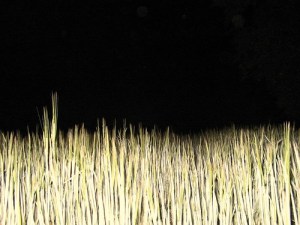
“Corn-ing,” a longstanding Halloween tradition in the suburbs of western Pennsylvania, is a popular prank in which kids sneak up to houses after dark and throw pre-hardened corn kernels at their windows, producing a truly startling sound effect. Corn-ing’s treat lies in the sonic trick—corn is able to convincingly sound like something else entirely. Thinking back on my experiences as both a victim of and participant in corn-ing, it occurs to me that this prank is sonic through and through—from listening for farmers in the corn fields before snatching husks from their crops, to locating one’s corn-ing partners in pitch black environments by the sound of the kernels bouncing rhythmically in their backpacks.
When early October rolled around each year, it was like an alarm went off in the heads of the kids that lived in my neighborhood. October meant it was time to procure ears of corn from the farms located on the outskirts of our Wonder-Years-ish suburb. In the days before we had our drivers’ licenses, this was an arduous task. We’d have to ride our bikes on the hilly back roads in mid-day (night time was too scary after we’d seen Children of the Corn), ditch them in the woods near the fields, and listen carefully for any signs of life in the corn—farmers, animals, blood-thirsty fundamentalist Christian children named Malachi, etc.
We couldn’t rely on our sight in these instances because the corn was so tall. We had to stop filling our backpacks every so often and listen for sounds of danger—for the rustles and crunches of stalks.
After our backpacks were filled to the brim, the preparation process began. The corn would sit for weeks in our garage, getting harder and harder. Once it became pebble-like in consistency, we’d shuck it back into our backpacks, listening to the pinging sound as it accumulated. On Friday afternoons, anxiously waiting for the sun to go down, we’d talk strategy. We decided that corning old people was out of the question. Even in our pseudo-delinquent state, we realized that sound had consequences—that spooking someone could give them a heart attack. So we mostly stuck to mean neighbors like old man Haybee, who was notorious for the unsightly cursive green “H” that was bolted to his chimney like a garish fast food sign. He never gave out candy to trick or treaters, so he was basically asking for it. Once a plan of attack was developed, it was time to suit up in all-black clothing and put on our packs. As soon as the streetlights came on, we were off.
My memories of these adolescent adventures are predominately sonic—the crunch of the fallen leaves, pounding hearts and nervous breathing, barely muffled laughter, and of course the sound of corn making contact with glass. Indeed, the success of the prank was measured in sound. The louder the sound the corn produced, the louder the aftermath tended to be. It was a true victory if dogs barked, or if people came out of their houses to yell. “You damn kids better run!” they would scream, sometimes only half seriously. And we did. We ran for our lives, despite the oppressive weight of the corn on our backs.
Click for the sound of sorn-ing: corn-ing
I wanted to capture the sounds of a real corn-ing experience to include here, but I quickly realized what an incredibly stupid idea that would be (what you heard, by the way, was the sound of me and my neighbor corning our own apartment building). As an almost 30-year-old Pittsburgher living in a fairly rough neighborhood, sneaking up to people’s houses at night in order to produce startling noises would most likely result in an encounter with police or violence of some kind. In the suburban environment of my adolescence, the sound of corn-ing was associated with a silly prank. Neighbors came to expect (and even get a kick out of) this Halloween tradition. In an urban environment in which the corn-ers are no longer in their teens, however, the sound of corn-ing would most almost certainly be interpreted as an aggressive or threatening act.
This just goes to show that different configurations of sound, spaces, and bodies (particularly raced and classed bodies) can result in vastly different understandings about what it means to share sound in a community. In Pittsburgh, I find myself constantly bombarded with the sounds of emergency and panic—police and ambulance sirens, firetrucks, helicopters. In my community’s soundscape, loud, startling noises are definitely not associated with fun and folly. Rather, they are a constant reminder of the looming danger that apparently surrounds me, as well as the incessant surveillance and policing of the city. This does not leave much room for sonic play.
This is not to say that there was no danger in corn-ing the burbs. For instance, this recent tragedy, in which a corn-er accidentally was hit by a car, happened in a suburb not far from the one where I grew up. Back when I was pitching corn, my best friend Courtney was once tackled by a man who thought she was slashing the tires of his truck (she was really just hiding behind a tire with a fistful of corn). And my brother Matt and I often found ourselves taking cover in the neighbors’ shrubbery waiting for the town patrolman to finish his watch. But I’d imagine that these war stories would not even come close to the dangers of corn-ing in the city. It is clear that the effectiveness of corn-ing as a prank is contingent upon the specific time, season, location, and culture in which its sounds occur.
Perhaps the real trick of sound, then, is that the context of its sounding can completely transform its effects and affects. But if you can get the sounds in sync with the right context, well, then you’ve got yourself a real treat.
—–
Steph Ceraso is a 4th year Ph.D. student in English (Cultural/ Critical Studies) at the University of Pittsburgh specializing in rhetoric and composition. Her primary research areas include sound and listening, digital media, and affect. Ceraso is currently writing a dissertation that attempts to revise and expand conventional notions of listening, which tend to emphasize the ears while ignoring the rest of the body. She is most interested in understanding how more fully embodied modes of listening might deepen our knowledge of multimodal engagement and production. Ceraso is also a 2011-12 HASTAC [Humanities, Arts, Science, and Technology Advanced Collaboratory] Scholar and a DM@P [Digital Media at Pitt] Fellow. She regularly blogs for HASTAC.
Share this:


Current Top Posts





April 2021

January 2020

November 2019

October 2019

August 2019

April 2014

November 2017

March 2015

December 2017

October 2015
 Sounding Out!
Recent Comments