
Audiotactility & the Medieval Soundscape of Parchment


series co-editors Dorothy Kim and Christopher Roman
Each of the essays in our “Medieval Sound” forum focuses on sound as it, according to Steve Goodman’s essay “The Ontology of Vibrational Force,” in The Sound Studies Reader, “comes to the rescue of thought rather than the inverse, forcing it to vibrate, loosening up its organized or petrified body (70). These investigations into medieval sound lend themselves to a variety of presentation methods loosening up the “petrified body” of academic presentation. Each essay challenges concepts of how to hear the Middle Ages and how the sounds of the Middle Ages continue to echo in our own soundscapes.
Read all the previous posts here, and, HEAR YE!, in April 2017, look for a second series on Aural Ecologies of noise! –Guest Editors Dorothy Kim and Christopher Roman
—
As humans, we engage all of our senses in every undertaking, whether or not we consciously perceive our sensory interactions. For instance, when we consume a gourmet meal, we don’t simply taste the food—we also see it, smell it, and feel it. We might also hear it as it is being prepared and/or consumed, and the meal’s pleasure can be enhanced by conversation. Overall, our experiences are enriched (or worsened) through our multisensory engagement. Similarly, reading involves multimodal feedback. While we might think of it as solely a visual experience, both auditory and tactile interactions occur within the process. As The Handbook of Multisensory Processes (518) tells us, audiotactile (sound+touch) and visuotactile (sight+touch) interactions are of great functional importance as they link remote senses to the body.
Thus, our interactions with everyday objects are multisensory, even if we do not consciously realize that fact. Arguably, although the sense of hearing is the first to develop in the womb, it is often the sense we overlook in solitary pursuits such as reading. Nevertheless, every human action occurs within a soundscape, much like they take place within a landscape. A soundscape is “an environment of sound with emphasis on the way it is perceived and understood by the individual, or by a society. It thus depends on the relationship between the individual and any such environment” (Handbook for Acoustic Ecology, 1978). Like landscapes, soundscapes must be considered in context and in relation to multisensory experience.
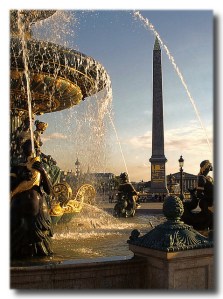
Fontaine des Mers, France, Image by Flickr User Daniel Mennerich
In particular, audio-visual interactions have been shown to have an effect on soundscape perception. Soundscape design elements reflect this concern. For example, a plan might include adding fountains, both as a noise control element and as a deliberate introduction of a soothing sonic feature. At the same time, fountains are a managed version of a natural element (water) that incorporate certain visual effects (e.g. reflective space and sparkling sunlight) creating textured and appealing landscapes. How the element is introduced into the environment has an effect on the perception (and appreciation) of the space. Furthermore, the touch of cool, clean water can supplement the overall impression, heightening the soothing effect initiated by the tinkling sound of the moving water. This is an audiotactile experience; that is, sounds connected with the sense of touch, an ecological system that combines the haptic and the aural.
Although the field of audiotactile integration has been somewhat dormant in the biological sciences since Paul von Schiller suggested back in 1932 that sounds, especially patterned noises, could affect tactile perception of roughness, recently some researchers have conducted experiments that test audiotactile qualities of materials. Several have suggested that these results might be synthetic—that is, the impact the sounds have modulate the haptic perception of the material being touched. For the most part, there seems to be connections between the perceptions of the sounds involved in touch and the perceptions of the stiffness of material. However, one study demonstrates that synchronized movements and sounds can affect the perception of the subject’s own skin. Suffice it to say, then, that sounds and texture and material quality are linked, both physically and perceptively.
Although humans rarely display deliberate awareness of audiotactile interaction, both auditory and haptic stimulation share similar temporal and psychological patterns in human consciousness. This connection would have perhaps been even more true in the Middle Ages than it is now, since the context of parchment and manuscript production and consumption was more immediately personal than paper production and reading is today.
To understand both the historicizing of the senses and the impact of shifting modes of literacy, it is possible to recreate some of the former immediacy of parchment production. During the summer of 2015, I participated in a National Endowments for the Humanities Seminar on Manuscript Materiality. This occasion provided me with the opportunity to make a manuscript page replica, starting from the “ground up” with the creation of parchment. We also studied theory, page layout, and other material circumstances, allowing us to really think about how people—both medieval and modern—engage with manuscripts using their senses. Elsewhere I have discussed the sense of touch. Here, I want to extend that discussion to include the sense of hearing; that is, I will focus on the sounds of parchment-making and parchment-reading, as activated through touching.
Parchment (Latin pergamenum) is the general term used for an animal hide that has been prepared for writing. Vellum (Latin vitulinum) more specifically refers to prepared calfskin. Parchment is made through an extended process of skinning, cleaning (de-fleshing and de-hairing), stretching, and scraping. It is stretched and scraped on special frames with adjustable screw pegs. The parchment maker scrapes the skin to the desired thickness with a curved tool, adjusting the pegs as the skin dries and changes texture. Often the skin is rewetted, scraped, and stretched numerous times in order to achieve the desired thickness. Sometimes a pumice stone finish is used at the end to create a surface porous enough to accept and retain ink. This is a vastly different process than tanning, which involves chemical alteration of the skins.
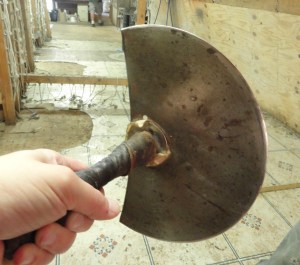
A close up of the scraping tool crafted by Jesse Meyer of Pergamena.
In the seminar, our parchment master was Jesse Meyer of Pergamena. He provided tools, guidance, and expertise as we participants stumbled through the process. Parchment making is hard, smelly work. My hands ached after only a few go-rounds with the tools, which included a pumice-like concoction of over-baked bread mixed with ground glass, knives that had been reshaped and re-handled, and Jesse’s special skin-refiner tool discussed below. Jesse told us many eye-opening things over the days of parchment making; however, possibly one of the most intriguing was how parchment masters could make a parchment “sing,” and how they, through this sound, knew whether or not the skin had reached its full potential.
So when Jesse demonstrated the various techniques on his sample skin, I listened carefully to the sounds he made by scraping as well as watching what he did with his hands. As he scraped away, the parchment did indeed sing. You can hear it yourself:
Audio Clip of Jesse’s “Parchment Singing”
.
This aspect of parchment making fascinated me. After our seminar was done, I got back in touch with Jesse to talk further about the sounds of parchment making. He was more than forthcoming about his experiences. When Jesse first read about medieval parchment making, he ran across several mentions of the “ringing” sound that parchment masters produced when shaving their skins. He, like many of us, had never considered that aspect before. So he started paying attention to the different sounds he made as he used various tools on the skins. Right now, he uses a handmade tool that consists of a saw blade shaved to his specificity with a handmade handle on it. Each of us got a chance to hold it and try it on our own skin. It was an unwieldy tool for the uninitiated, and my parchment did not “sing” like Jesse’s did.
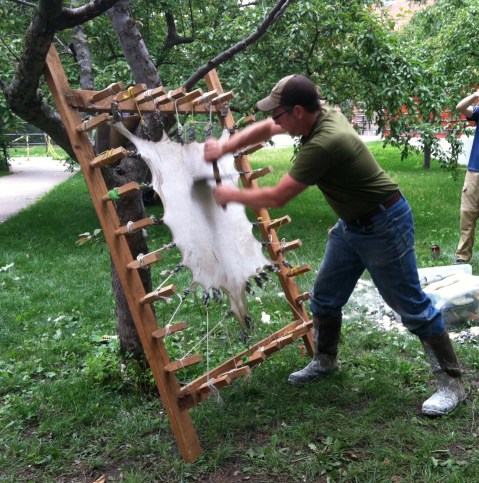
Parchment master, Jesse Meyer of Pergamena demonstrating his technique using a tool he created himself, designed after the fashion of medieval instruments. Image by author.
.
Jesse is an expert, but even he says he cannot quite tell the nuances among the different types of skins by sound alone, although he notes that there are similarities among the types. Perhaps that skill could be developed over years of working solely with parchment, as a master in the Middle Ages would have. What Jesse has shared, however, is valuable: thicker skins are not as flexible, but they produce a “better,” that is clearer, sound.
Close up of parchment “dust.” Image by author.
Thickness of parchment can be due to a number of factors including preparation technique, but also the age and type of animal. Older animals yield thicker skins. Thicker skins are usually smoother and yield a cleaner sound. Of course if the animal has been injured or diseased, the skin may not be smooth. The firmer and tighter a skin is, the denser it is, and the easier it is to shave as well. In fact, Jesse says that denser skins can also make full, warm, “drum-like” sounds. Even more intriguingly, when I asked Jesse if he had ever noticed a difference between the hair side and the flesh side of skins, he said yes: the hair side of parchment sounds better to him because it is cleaner once the hair has been removed. The flesh side often retains fibrous bits even after many scrapings, and produces a more diffuse sound. When this side is scraped, it leaves behind a “fuzzy” residue until it has seen many passes with the scraper.
The relative dryness and “freshness” of the skin can also alter the clarity of the “ringing.” For example, compare the sound from the freshly prepared goatskin last summer to the sound from scraping a drier goatskin in Jesse’s workshop:
Repeat of first audio clip of Jesse’s “parchment singing”
Comparison clip of Jesse making a drier parchment sing
Both of these clips were produced from goatskins, and both were produced by Jesse who also used the same tool on each. While the sound is very similar, and both ring true, the drier skin produces a clearer, purer sound.
Plainly, then, the sounds of parchment making are vital to quality production. Most medieval manuscripts are made of three types of animal skins: sheep, goat, and calf. The prevalence of each animal is geographically dependent (sheepskin is more common in England, calfskin in France, and goatskin in Italy), although of course manuscripts traveled, and wealthy patrons commissioned materials they preferred. (see “DNA May Reveal Origins of Medieval Manuscripts” from Livescience)
Age, breed, size, and animal health can all contribute to the audiotactile qualities of a skin. However, there are some general guidelines. Sheepskins, for instance, are stretchier than goat skins, so their “ringing” can be muffled. Goatskins, which are thinner and stiffer, make a higher pitched “ring.” Calfskins are larger and easier than the others to get clean, and thus often make the cleanest “ring” and can do so more quickly than the others.
The type of skin is not the only factor in play. A rough blade would have produced a rough sound; conversely, an even, sharp blade would have produce the cleanest sound. The tautness of the skin in the frame can also affect pitch and tone, as can its dryness, its fatty content, and the age of the animal. As noted in a recent study, “The density of collagen fibrils in calf and goat parchment, compared with a more open weave and higher fat content in sheep parchment, favors the former two species [for producing the finest parchment]” (15070). Nevertheless, master parchment makers should have been able to manipulate any skin to produce superior results. As long as the corium (the dermis layer of skin containing all the connective tissues, including collagen, elastic fibers, hair follicles, sebaceous glands, blood vessels, and a number of other components) is sufficiently ground down, the parchment produced can be made very fine. And as the corium wears away, the sound of the scraping grows ever cleaner and clearer, just as the feel of the skin grows ever smoother. Overall, the tone gets higher as the skin gets thinner, and as long as the scrape is even, the tone should remain pure.
Here’s a video of Jesse scraping a calfskin. Compare this clear “ringing” to the goatskin scrapings:
https://www.instagram.com/p/BEByB4cFi8Y/?taken-by=runninghands
.
That’s all well and good for production of manuscripts, but texts are made for consumption. Earlier, I mentioned my having considered the qualities of hapacity and manuscripts involving Christ’s side wound in another blog post. One of the manuscripts I discussed, London, British Library, MS Egerton 1821, was clearly designed to be touched. This unusual manuscript contains a number of woodcuts that reflect devotion to the wounds of Christ, but, more strikingly, opens with three pages painted black, covered in drops of paint meant to emulate Christ’s flowing blood.
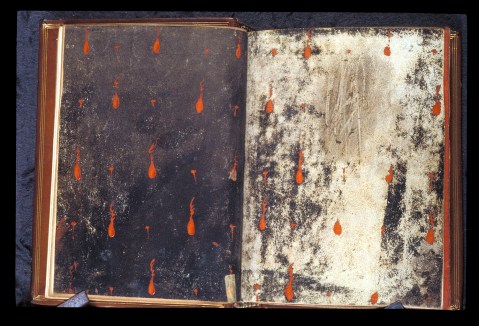
Image of MS Egerton 1821, British Library, London.
After a series of woodcuts, seven more pages appear. These are painted red with darker red paint splatters representing drops of blood. Although these pages do not contain specific images, they are meant to evoke interactive piety. The reader is invited to touch Christ’s wounds while praying or meditating. The worn appearance of Folio 2r demonstrates just how frequently the pages were touched and rubbed.
How did those pages feel to a medieval reader? Did they feel rough or smooth? Did the reader feel a frisson of excitement? Animal skin, such as parchment, carried with it the essence of the life of the animal, thus imbuing the images painted onto it with some semblance of life force, such as suggested by Thomas Aquinas in his Question 8 (Summa Theologica) regarding the potential for divinity placed within material objects. To a certain extent, then, touching an image of Christ was akin to touching a proxy of his body, allowing a powerful and individual haptic experience of faith. But what about the sounds made when these images became the subject of interaction? Was the medieval reader aware of touching the page, touching Christ’s wounds, even more because he or she would hear the interaction?
I took it upon myself to rub the worn folio in Egerton 1821. I did so reverently, if not because I felt a mystical connection to Christ, but because I felt awed at being able to reproduce a medieval experience (albeit 500 years later). There was a distinct sound, which you can hear in this clip:
Clip of the author rubbing the worn folio in Egerton 1821
I was surprised at the resultant sound. The worn part of the page looked soft, and the paint splatters looked cracked. Instead, to my surprise, the worn portions felt rougher than the cracked paint. Like the modern studies demonstrated, my audiotactile perceptions were altered initially by what I saw, but then by what I heard. At first, I touched hesitantly, but when the sounds produced became rhythmic, my hands felt smoother and the noise sounded more even. If I were repeatedly rubbing the same spot, in the same manner, producing the same sounds—much as a medieval reader might have done—the combined sensations would likely have produced a soporific and meditative state. That is, combining touch, particularly of a textured surface, with measured reading might have resulted in the ideal perceptive state for experiencing an immersive religious experience.
If, as numerous studies have demonstrated, vibrotactile stimuli can facilitate hearing, both for those with and without hearing impairments, then the sounds hand and fingers make when exploring a surface must contribute to an individual’s haptic perception and vice versa. How, then, would this connect on the behavioral or emotional level? Researchers have been exploring the reciprocal interactions of the auditory, tactile, and visual (sometimes referred to as cross-modal effects), often concentrating on sensory thresholds, information processing performance, and spatial navigation; however, only recently are studies beginning to investigate the emotional and physical benefits of such exchanges. For instance, one such study suggests auditory-tactile stimulation as a means to increase health and well-being.
Thus, a combination of touch felt by a reader with sound heard by a reader at the same time might influence the reader’s state of mind in a positive way, resulting in a positive effect on the body as well. A desired state can be reached more quickly through an audiotactile combination, resulting in a sensory illusion (perceiving something not physically extant but mentally present)—a powerful manner of evoking emotion. Similarly, the positive physical effects include relaxation, stress relief, and sleep enhancement. Again, this seemingly suggests that multisensory integration, especially the combination of touch and sound, might have produced a mental state in the (medieval) reader that made them particularly receptive to spiritual experience.
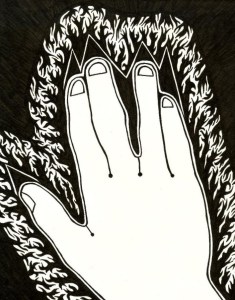
“Touch” by Daniel Friedman (CC BY 2.0)
I would suggest, then, that as medieval scholars, we should examine how audiotactile events are processed during dynamic contact between hands and material. Since different sensory modalities are integrated in the human brain to form our perceptions as a whole, including spatial and temporal relationships, it is important that we consider multisensory interactions that code the location of external events relative to our own bodies. Thus, to think through the process of making, touching, and hearing medieval parchment opens up a lot of possibilities for the study of medieval materiality—indeed for materiality in general as a field. The importance of the whole body sensory experience, including hearing, in reading is something we need to continue to imagine, to reimagine, to recreate, and to explore.
—
Michelle M. Sauer is a professor at the University of North Dakota in the English Department. She recently released her latest book, titled Gender in Medieval Culture (Bloomsbury, 2015).
—
REWIND!…If you liked this post, you may also dig:
Sounding Out! Podcast #54: The Sound of Magic-K.A. Laity
Mouthing the Passion: Richard Rolle’s Soundscapes–Christopher Roman
EPISODE LI: Creating New Words from Old Sounds–Marcella Ernest, Candace Gala, Leslie Harper, and Daryn McKenny
Share this:

“Share your story” – but who will listen?
 Editor’s Note: Welcome to the second installment in the “DH and Listening” blog series for World Listening Month, our annual forum that prompts readers to reflect on what it means to listen. This year’s forum considers the role of “listening” in the digital humanities (DH, for short). We at Sounding Out! are stoked to hear about (and listen to) all the new projects out there that archive sound, but we wonder whether the digital humanities engage enough with the the notion of listening. After all, what’s a sound without someone to listen to it?
On our opening week, Jacqueline Wernimont from the Vibrant Lives team shared with us about the ethics of listening to 20th century sterilization victims’ records. Then, Emmanuelle Sonntag introduces us to a figure from a long time ago, “la soeur écoute,” a nun whose was responsible for sitting in and listening when another nun had a visitor. This week, Fabiola Hanna reflects upon what DH means when it talks about participatory practices. –Liana Silva, Managing Editor
—
Germanic and Holocaust historian and Digital Humanist Todd Presner has worked through more than 52,000 testimonies of the Shoah Foundation’s Visual History Archive, perhaps the largest archive of testimony, to investigate “the ethics of the algorithm.” The scale of this participatory archive has prompted Presner to ask: is it possible for a computer to listen to testimony?
Digital Humanities (DH) projects are, in varying degrees, led by the desire to engage with a wider public. Some often include actions such as inviting participants to share their stories, images, audio clips, drawings, and videos. In order to avoid lumping all DH works under a broad category that includes, among others, text analysis, mapping, visualization, 3D, and archiving. Below I examine DH projects that collect oral histories: memories, stories, and testimonies.
I argue that it is not enough to share stories; it is also important to recognize how these stories are shared. A majority of these living histories end up in an audio or video database displayed in full on a webpage, not unlike oral history transcripts ending up in a dusty closet. Listening as an active mode of participation can provide us with a framework that reveals the relationships, aesthetics and politics engendered by participation. Although seemingly about access (and some have started questioning whether users of such an archive should have access by default, or whether you need to be part of a community in order to access certain stories, see Mukurtu CMS), my focus is rather on the medium that these stories are circulated in, how they are displayed to the user and what the user’s participation does to these stories.
I take the space here, on the one hand, to think through participation from two fields, archives and interactive documentary (i-docs), and on the other hand to write about how sound studies, particularly an attention to listening and its aesthetics, its affordances, and its politics, can offer another approach to participation.

SO! Screen Capture from Irene Lustzig’s “The WorryBox Project”
DH + participation: steps towards making place for popular
The work of requesting participation is in itself an accomplishment. It’s only been since the 1950s/60s, and perhaps more broadly since the 1990s, that ordinary peoples’ stories have been valued in the tradition that oral historians have established. It is possible to trace the field’s origins to Augusto Boal’s Theatre of the Oppressed (itself rooted in Paolo Friere’s work), to Howard Zinn’s A People’s History of the United States, or to postmodernism, the death of the author, and the end of grand narratives. With the arrival of Web 2.0, oral history seemed like the perfect medium for the ideals of participation on the Internet, precisely because it was about the everyday and involved “anyone” (with an internet connection). Video, audio and live streaming technologies made it possible for oral history to be recorded and displayed, and social media enabled unprecedented circulation through sharing. So the recent push to preserve everyday histories online, in DH projects, follows these ideals of stories from below.
Listening to stories as a mode of engagement is fitting with regards to oral history and testimony. Making space with openness and silence for someone’s testimony, especially when difficult, is a mode of participation that we aspire to. Media scholar Wendy Chun has argued that “a politics and practice of listening [is] a necessary complement to a politics of testifying.” In the case of Holocaust testimony, for instance, many scholars have argued that there is a responsibility to listen (Laub & Felman and Henry Greenspan).
I differentiate between two types of listening:
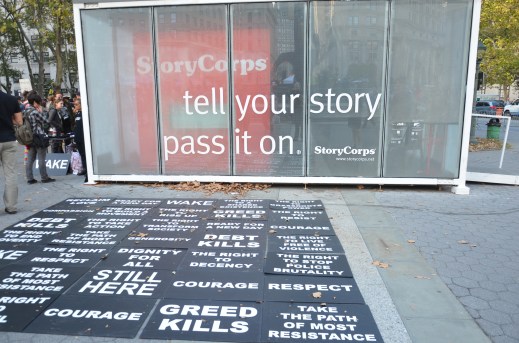
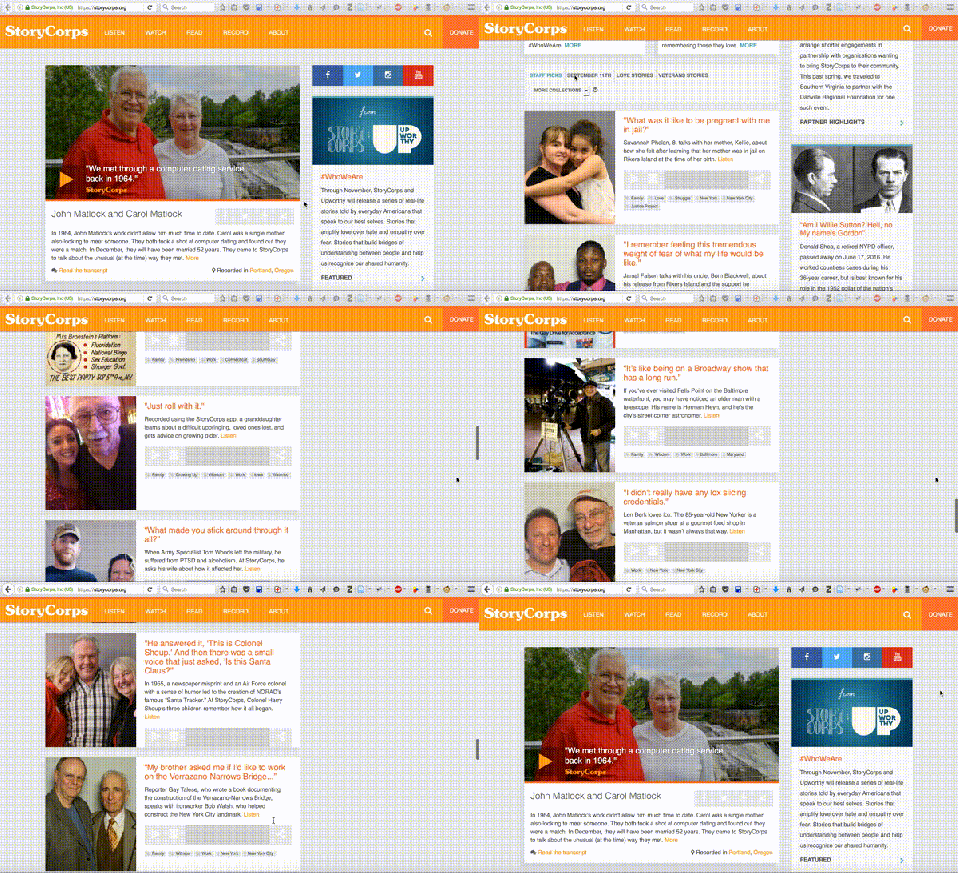
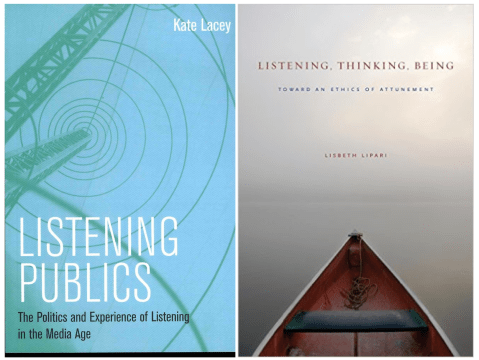
- Listening on the part of the users of these DH projects. Is it realistic to expect that users will listen to large archives of testimony? In Listening Publics, Kate Lacey writes that listening has been absent from theories of the public sphere, even where “the objective of political agency is often characterized as being to find a voice – which surely implies finding a public that will listen, and that has a will to listen” (viii). Because of their scale, these large archives of testimony pose a significant design challenge to the user, which could be resolved through curation. To build on one of the most successful digital storytelling projects, the Storycorps team knows very well that if they didn’t curate and edit together shorter versions, then no one would listen to the longer interviews in full.
- Listening on the part of the interface and its design. This involves questioning the medium and its effects on what it houses. Here I find Susan Bickford’s work very useful in her definition of listening and what it accomplishes: ‘the riskiness of listening comes partly from the possibility that what we hear will require change from us’ (1996, 149). If interfaces for stories pre-close any openness to what contributed stories could change, then listening is not being considered. This is more directly seen in the tagging of videos and their categorization without additional interpretational work. This will to not “add” to these stories seems to come from the premise that these testimonies should “speak for themselves” (I get to this point in a little bit); that no added interpretation is needed, even that any added interpretation distracts from the directness of the stories. But this often also means the medium and its effects on these stories are not carefully examined.
Contrary to Western cultural beliefs, listening can be seen as an active mode of participation in conversation. As Jodi Dean rightly argues, it is not enough to express one’s opinion, or for a message to be circulated: it is crucial to get a response to the message. Lisbeth Lipari writes that even in Dean’s formulation, however, the response as speech is still emphasized, thereby ignoring the work that happens beforehand: the listening. Apart from the major contribution of Susan Bickford, mentioned above, with the concept of political listening, little attention has been paid to listening in the field of political theory.
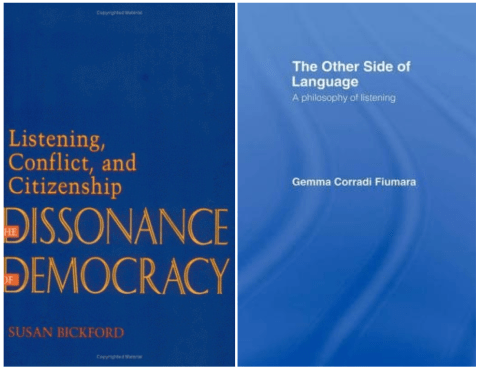
As arguably the most important philosopher on listening, Gemma Corradi Fiumara, writes: “listening involves the renunciation of a predominantly moulding and ordering activity; a giving up sustained by the expectation of a new and different quality of relationship” (as quoted by Lipari, 8). For Fiumara, listening is a mode of participation that is open and that does not pre-close potential possible contributions. Listening, therefore, as a mode of engagement can provide a useful method for thinking about participation in various contexts.
DH + Archives + i-docs
If a mission of a certain DH project is to engage with a wider public, then preservation of stories is not enough. More often than not, DH projects are already under difficult strain of resources, due to costs for developing technological projects and time for interviewing, collecting, indexing, tagging, uploading and making sense of these larger collections. DH have taken on a lot: preserving and archiving everyday stories with the mission to share with a wider public. It is useful to draw from experts who have been working through ideas of preservation and access: archivists. Archives generally have a mission of preservation, but when demands of sharing with a public arise, there are not many models from which to draw. Rick Prelinger writes that although the archive as a theoretical concept is overly theorized, its practice (in the plural form of the word) is under theorized.
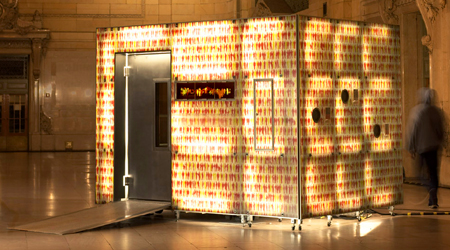
Image of StoryCorps collection area by Aaron “tango” Tang (CC BY 2.0).
Francis X Blouin and William G. Rosenberg trace the intersection of history and archives and found that Ranke, during the enlightenment, conceptualized history as a scientific endeavor in that truth could be extracted from archives through rigorous methodologies. This led to the idea that documents could “speak for themselves” (Blouin, 24). As if simply making documents available, without providing context of any sort, would reveal their inner truth. This is one of many cases where the reading of documents is taken for granted. It also ignores the effect that archivists have on the collecting, saving, and indexing of documents. Influential archivists such as Terry Cooke, Richard Brown and Brian Brothman have brought about new attitudes to repositories with an acknowledgment of the effect that archivists have on documents (as quoted by Richard J Cox, 33). This relatively recent push in archival theory, therefore, points to the flaws in the claim that documents on their own can represent themselves: that would be ignoring all the various power relationships at play, as well as the medium itself in which the stories are communicated.
In thinking about collaboration, with the unstated but implied goal of providing knowledge of a given subject, non-fiction film has experimented by inviting self-interested participants online and offline to contribute to projects. Sandra Gaudenzi makes clear that interactive documentaries, also called i-docs (documentaries designed for online or mobile viewing), are very distinct and that it is important to recognize the varying strategies employed by these digital projects: “uploading content is the most common way to collaborate in the case of online documentary, but it is definitely not the only one. […] contributions of content lead to co-creation but not to co-authorship, since the latter require a degree of intervention in the overall concept (i.e., form) of the product.” In her differentiation of co-creation and co-authorship, Gaudenzi points to the medium-limiting effect that users have in their participation. The “degree of intervention,” as a coming in between that leads to change, which Gaudenzi requires for co-authored documentaries, might be attained through listening, a listening through the work itself, such as The WorryBox Project.
Listening in The WorryBox Project
Irene Lusztig’s The WorryBox Project (2011) web-based documentary invites mothers to write their worries in an online form, which Lusztig then individually writes down on a piece of paper, rolls-up and stores in a physical box. The act of writing down in analog form what was input into a digital box goes an extra step beyond collection. It is emblematic of an extended care for these worries. The additional layer of documenting these actions, as part of the artwork itself, not only points to the embodiment of these worries but also to their representation.

Because listening has often been thought of as passive and feminine, it is also associated with a specific kind of caring, also in its passive and feminine forms. But I don’t equate that definition of care with listening, which surely the readers of this blog will question. In this case, care extends as a mode of listening because it pushes against the active/passive binary for speaking/listening. I use care in the sense it gave to curating (care is its early root), where curating points to the work of engagement and conversation. Curating as a form of listening.
This extended care would be an example of the listening I am thinking of. The work of translating the form’s digital input into the handwritten words and the documentation of that act stretch the layering of interpretation and with it the care given to these submissions. The change that occurs in this writing is definitely not an agreement or an endorsement of what is submitted but an open attitude of listening, of reception. This reinforces the notion that listening is not passive, but an active mode of participation.
This mode of listening does not imply an understanding, as the receipt of information in cybernetics theory suggested by Shannon and Weaver. Rather this mode of communication embraces the notion that listening does not necessarily mean an understanding. The audio action collaborative Ultra-Red conveys this idea perfectly: “Sound possesses a palpable promiscuity in relation to the body. One may say what one means, but somewhere between the mouth that speaks and the ear that hears, sound always exceeds its master. Politically, it may be useful to say that we hear the truth in the voice or that we listen with obedience, but sound always transgresses such duties.” So for DH storytelling projects to be participatory, it is beneficial to allow stories the space for listening, in a similar sense to Hannah Arendt’s “distancing” in order to understand. This brings me to media and communication’s scholar Lisbeth Lipari’s term for this: “listening otherwise.”

SO! Screen Capture of Irene Lustzig’s “The Worry Project”
For Lipari, in engaging with difficult stories or perhaps stories that offer different perspectives: “It is […] a listening otherwise that suspends the willfulness of self- and foreknowledge in order to receive the singularities of the alterity of the other” (185, emphasis in original). For this “listening otherwise” to work online, I argue that it is important for the employed structures, systems and processes to reflect this specific kind of participation. In other words, in addition to placing “different voices” side-by-side, it is equally critical for these different perspectives to exist in a space where the medium, whether the recording, the software, the interface and its design, listens to what these differences are. An interface designed in order not to predetermine, not to predict or preclose what others might contribute would then be an example of this listening. Anthropomorphizing aside, for a computer to listen to testimony, as Presner asks, it must be designed to be open to changing itself.
—
Fabiola Hanna is a new media artist & software designer currently working towards a PhD in Film and Digital Media at UC Santa Cruz where she also holds an MFA in Digital Arts & New Media. Her doctoral work is on building an automatic editing machine that weaves together competing narratives about the history of Lebanon, which has led her to engage with software studies & digital humanities, archives & memory and new media art activism.
Her work has been exhibited widely in California at the Museum of Art and History in Santa Cruz, the New Children’s Museum in San Diego, the SubZero Festival in San Jose, the Digital Arts Research Center in Santa Cruz, and the Maker Faire in San Mateo. She is also a 2015 fellow of the Institute for Critical Social Inquiry at the New School, New York and has previously taught at University of California, San Diego and at various maker spaces including FabLab San Diego and MakerPlace.
Her website is fabiolahanna.com and she can be reached by email fhanna {@} ucsc {dot} edu.
—
Featured Image: “Story Corps” by Steve Rhodes, (CC BY-NC-ND 2.0)
—
REWIND!…If you liked this post, you may also dig:
What Mixtapes Can Teach Us About Noise: Reading Shannon and Weaver in 2010–Aaron Trammell
Machinic Ballads: Alan Lomax’s Global Jukebox and the Categorization of Sound Culture–Tanya Clement
“Digital Analogies: Techniques of Sonic Play“-Roger Moseley
Share this:


Current Top Posts





April 2021

January 2020

November 2019

October 2019

August 2019

April 2014

November 2017

March 2015

December 2017

October 2015
 Sounding Out!
Recent Comments