
Musical Objects, Variability and Live Electronic Performance

This is part two of a three part series on live Electronic music. To review part one, click here.
In the first part of this series,”Toward a Practical Language for Live Electronic Performance,” I established the language of variability as an index for objectively measuring the quality of musical performances. From this we were able to rethink traditional musical instruments as musical objects with variables that could be used to evaluate performer proficiency, both as a universal for the instrument (proficiency on the trumpet) and within genre and style constraints (proficiency as a Shrill C trumpet player). I propose that this language can be used to describe the performance of electronic music, making it easier to parallel with traditional western forms. Having proven useful with traditional instruments we’ll now see if this language can be used to describe the musical objects of electronic performance.
We’ll start with a DJ set. While not necessarily an instrument, a performed DJ set is a live musical object comprised of a number of variables. First would be the hardware. A vinyl DJ rig consists of at least two turntables, a mixer and a selection of vinyl. A CDJ rig uses two CD decks and a mixer. Serato and other vinyl controller software require only one turntable, a mixer and a laptop. Laptop mixing can be done with or without a controller. One could also do a cassette mix, reel to reel mix, or other hardware format mixing. Critical is a means to combine audio from separate sources into one uniform mix. Some of the other variables involved in this include selection, transitions and effects.
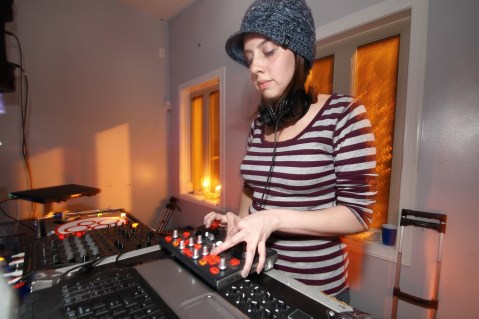
DJ Lush, FORWARD Winter Session 2012, Image by JHG Photography (c)
Because DJ sets are expected to be filled with pre-recorded sounds, the selection of sounds available is as broad as all of the sounds ever recorded. Specific styles of DJ sets, like an ambient DJ set, limit the selection down to a subset of recorded music. The choice of hardware can limit that even more. An all-vinyl DJ set of ambient music presents more of a challenge, in terms of selection, than a laptop set in the same style, because there are fewer ambient records pressed to vinyl than are available in a digital format.
Connected to selections are transitions, which could be said to define a DJ. When thinking of transitions there are two component factors: the playlist and going from one song to another. The playlist is obviously directly tied to the selection; however, even if you select the most popular songs for the style, unless they are put into a logical order, the transitions between them could make the set horrible.
One of the transitional keys to keeping a mix flowing is beat matching. In a turntable DJ set the beat mapping degree of difficulty is high because all of the tempos have to be matched manually by adjusting the speed of the two selections on the spinning turntables. When the tempos are synchronized, transitioning from one to the other is accomplished via a simple crossfade. With digital hardware such as the laptop, Serato and even CDJ setups, there is commonly a way to automatically match beats between selections. This makes the degree of difficulty to beat match in these formats much lower.
Effects, another variable, rely on what’s available through the hardware medium. With the turntable DJ set, the mixer is the primary source of effects and those until recent years have been limited to disc manipulation (e.g. scratching), crossfader, and EQ effects. Many of the non vinyl setups and even some of the vinyl setups now include a variety of digital effects like delay, reverb, sampler, granular effects and more.
With these variables so defined it becomes easier to objectively analyze the expressed variability of a live DJ set. But, while the variables themselves are objective, the value placed on them and even how they are evaluated are not. The language only provides the common ground for analysis and discussion. So the next time you’re at an event and the person next to you says, “this DJ is a hack!” you can say, “well they’ve got a pretty diverse selection with rather seemless transitions, maybe you just don’t like the music,” to which they’ll reply, “yeah, I don’t think I like this music,” which is decent progress in the scheme of things. If we really want to talk about live electronic performance however we will need to move beyond the DJ set to exemplify how this variable language can work to accurately describe the other musical objects which appear at a live electronic performance.

Joe Nice at Reconstrvct in Brooklyn NY on 2-23-2013, Photo by Kyle Rober, Courtesy of Electrogenic
Take for example another electronic instrument: the keyboard. The keyboard itself is a challenging instrument to define; in fact I could argue that the keyboard is itself not actually an instrument but a musical object. It is a component part of a group of instruments commonly referred to as keyboards, but the keyboard itself is not the instrument. What it is is one of the earliest examples of controllerism.
On a piano, typically fingers are used to press keys on the keyboard, which trigger the hammers to hit the strings and produce sound. The range of the instrument travels seven octaves from A0 to C8, and can theoretically have 88 voice polyphony, though in typical that polyphony is limited to the ten fingers. It can play a wide range of dynamics and includes pedals which can be used to modify the sustainabilty of pitches. With a pipe organ, the keyboard controls woodwind instruments with completely different timbre, range, and dynamics; the polyphony increases and the foot pedals can perform radically different functions. The differences from the piano grow even more once we enter the realm where the term “keyboard,” as instrument, is most commonly used: the synthesizer keyboard.
The first glaring difference is that, even if you have an encyclopedia of knowledge about keyboard synthesizers, when you see a performer with one on stage you simply cannot know by seeing what sounds it will produce. Pressing the key on a synthesizer keyboard can produce an infinite number of sounds, which can change not just from song to song, but from second to second and key to key. A performer’s left thumb can produce an entirely different sound than their left index finger. Using a keyboard equipped with a sequencer, the performer’s fingers may not press any keys at all but can still be active in the performance.

Minimoog Voyager Electric Blue, Image by Flickr User harald walker
When the keyboard synthesizer was first introduced, it was being used by traditional piano players in standard band configurations, like a piano or organ, with timbres being limited to one during a song and the performance aspect being limited to fingers pressing keys. Some keyboardists however used the instrument more as a bank for sound effects and textures. They may have been playing the same keys, but one wouldn’t necessarily expect to hear a I IV V chord progression. Rather than listening for the physical dexterity of the player’s fingers, the key to listening to a keyboard in this context was evaluating the sounds produced first and then how they were played to fit into the surrounding musical context.
Could one of these performers be seen as more competent than the other? Possibly. The first performer could be said to be one of the most amazing keyboard players in the piano player sense, but where they aren’t really maximizing the variability potential of the instrument, it could be said they fall short as a keyboard synthesizer performer. The second performer on the other hand may not even know what a I IV V chord progression is and thus be considered incompetent on the keyboard in the piano player sense, but the ways in which they exploit the variable possibilities shows their mastery of the keyboard synthesizer as an instrument.
Well, almost.
While generally speaking there isn’t a set of variables which define the keyboard synthesizer as an instrument, if we think of the keyboard synthesizer as a group of musical instruments, each of the individual types of keyboard synthesizers come with their own set of fixed variables which can be defined. Many of these variables are consistent across the various keyboards but not always in a standard arrangement.
As such, while the umbrella term “keyboard” persists it is perhaps more practical to define the instruments and their players individually. There are Juno 60 players, ARP Odyessy players, MiniMoog players, Crumar Spirit players and more. Naturally an individual player can be well versed in more than one of these instruments and thusly be thought of as a keyboardist, but their ability as a keyboardist would have to be properly contextualized per instrument in their keyboard repertoire. Using the MiniMoog as an example we can show how its variability as an instrument defines it and plays into how a performance on the instrument can be perceived.

Minimoog, Image by Flickr User Francesco Romito
The first variable worth considering when evaluating the MiniMoog is that it is a monophonic instrument. This is radically different from the piano; despite one’s ability to use ten fingers (or other extremity) only one note will sound at one time. The keyboard section of the instrument is only three and a half octaves long, though the range is itself variable. On the left-hand side there is a pitch wheel and a modulation wheel. The pitch wheel can vary the pitch of the currently playing note, while the modulation wheel can alter the actual sound design.
As a monophonic instrument, one does not need to have both hands on the keyboard, as only one note will ever sound at a time. This frees the hands to modify the sound being triggered by the keyboard exemplified via the pitch and modulation wheels, but also available are all of the exposed controls for the sound design. This means that in performance every aspect of the sound design and the triggering can be variable. Of course these changes are limited to what one can do with their hands, but the MiniMoog also features a common function in analog synths, a Control Voltage input. This means that an external source can control either the aspects of the sound design and/or the triggering for the instrument.
Despite this obvious difference from the piano, playing the MiniMoog does not have to be any less of a physical act. A player using their right hand to play the keyboard while modulating the sound with their left, plays with a different level of dexterity than the piano player. The right and left hand are performing different motions; while the right hand uses fingers to press keys as the arm moves it up and down the keyboard, the left hand can be adjusting the pitch or modulation wheels with a pushing action or alternately adjusting the knobs with a turning action. Like patting your head and rubbing your belly, controlling a well-timed filter sweep while simultaneously playing a melody is nowhere near as easy as it sounds.
At the same time playing the MiniMoog doesn’t have to be very physical at all. A sequencer could be responsible for all of the note triggering leaving both hands free to modulate the sound. Similarly the performer may not touch the MiniMoog at all, instead playing the sequencer itself as an intermediary between them and the sound of the instrument. In this case the MiniMoog is not being used as a keyboard, yet it retains its instrument status as all of the sounds are being generated from it, with the sequencer being used as the controller. Despite not having any physical contact with the instrument itself, the performer can still play it.

Minimoog in Live DJ Performance, Image by Fluckr Users Huba and Silica
Taking it one step further – if a performer were to only touch a sequencer at the start of the performance to press play and never touch the instrument, could they still be said to be playing the MiniMoog live? There is little doubt that the MiniMoog is indeed still performing because it does not have the mechanism to play by itself, but requires agency to illicit a sonic response. In this example that agency comes from the sequencer, but that does not eliminate the performer. The sequencer itself has to be programmed in order to provide the instrument with the proper control voltages, and the instrument itself has to be set up sonically with a designed sound receptive to the sequencer’s control. If the performer is not physically manipulating either device however, they are not performing live, the machines are.
From this we can establish the first dichotomy of electronic performance; the layers of variability in an electronic performance can be isolated into two specific categories: physical variability and sonic variability. While these two aspects are also present in traditional instrument performance, they are generally thought to not be mutually exclusive without additional devices. The vibrato of an acoustic guitar is only accomplished by physically modulating the strings to produce the effect. With an electronic instrument however, vibrato can be performed by an LFO controlling the amplitude. That LFO can be controlled physically but there does not have to be a physical motion (such as a knob turn) associated with it in order for it to be a live modulation or performance. The benefit of it running without physical aid is that it frees up the body to be able to control other things, increasing the variability of the performance.
In a situation where all of the aspects of the performance are being controlled by electronic functions, the agency in performance shifts from the artist performing live, to the artists establishing the parameters by which the machines perform live. Is the artist calling this a live performance a hack? Absolutely not, but it’s important that the context of the performance is understood for it to be evaluated. Like evaluating the monophonic MiniMoog performer based on the criteria of the polyphonic pianist, evaluating a machine performance based on physical criteria is unfair.

Daniel Carter on horn during Overcast Radio’s set at EPICENTER: 02, Photo courtesy of Raymond Angelo (c)
In the evaluation of a machine performance, just as with a physical one, variability still plays an important role. At the most base level the machine has to actually be performing and this is best measured by the potential variability of the sound. This gets tricky with digital instruments, as, barring outside influences, it is completely possible to repeat the exact same performance in the digital domain, so that there is no variation between each iteration. But even such cases with a digital sequencer controlling a digital instrument, with no physical interaction, are still a machine performances; they just exhibit very little variability. The performance aspect of the machine only disappears when the possibility for variability is completely removed, at which point the machine is no longer a performance instrument but a playback device as is the case with a CD player playing a backing track. The CD player if not being manipulated physically or by an external control is not a performance instrument as all of the sound contained within it can only be heard as one fixed recorded performance, not live. It is only when these fixed performances are manipulated either physically (ie a DJ set) or by other means, that they go from fixed performances to potentially live ones.

Mala and Hatcha in Detroit, Image by Tom Selekta
From all of this we arrive at four basic distinctions for live electronic performances:
• The electro/mechanical manipulation of fixed sonic performances
• The physical manipulation of electronic instruments
• The mechanized manipulation of electronic instruments
• A hybrid of physical and mechanized manipulation of electronic instruments
These help set up the context for evaluating electronic performances, as before we can determine the quality of a performance we must first be able to distinguish what type of performance we are observing. So far we’ve only dealt with a monophonic instrument, but even with its limitations can see how the potential variability is quite high. As we get into the laptop as a performance instrument that variability increases exponentially.
This is part two of a three part series. In the next part we will begin to exemplify the laptop as performance instrument, using this language to show the breadth of variability available in electronic performance and perhaps show that indeed, where that variability continues to be explored, there is merit to the potential of live electronic music as an extension of jazz.
—
Native Frequencies at the Trocadero 2013, Featured Image Courtesy of Raymond Angelo (C)
—
Primus Luta is a husband and father of three. He is a writer, technologist and an artist exploring the intersection of technology and art, and their philosophical implications. He is a regular guest contributor to the Create Digital Music website, and maintains his own AvantUrb site. Luta is a regular presenter for the Rhythm Incursions Podcast series with his show RIPL. As an artist, he is a founding member of the live electronic music collective Concrète Sound System, which spun off into a record label for the exploratory realms of sound in 2012.
—
 REWIND! . . .If you liked this post, you may also dig:
Experiments in Agent-based Sonic Composition–Andreas Pape
Evoking the Object: Physicality in the Digital Age of Music–-Primus Luta
Sound as Art as Anti-environment–Steven Hammer
Share this:

Sounding Boards and Sonic Styles: The Music of the Skatepark
 Welcome back to our summer series on “Sound and Sport.” In today’s post, Josh Ottum discusses the sonorous sounds and unique rhythms of the sport of skateboarding. For an instant replay of last month’s post, click Tara Betts‘s “Pretty, Fast, and Loud: The Audible Ali.” For May’s post, click Melissa Helquist‘s “Goalball: Sport, Silence, and Spectatorship.” Next month’s grand finale will feature a doubleheader on Brasil, with a post by Kariann Goldschmitt on the promotional sounds of FIFA 2014 and a podcast by Andrea Medrado entitled “The Sounds of Rio’s Favelas: Echoes of Social Inequality in an Olympic City.” We’ll close with another take on the Olympics, excerpted from David Hendy‘s recent Noise broadcasts for BBC Radio 4 on the politics of boos at the games. For now, get out your board, strap on your helmet, and prepare to jam. —J. Stoever-Ackerman, Editor-in-Chief
—
Seven layers of screen-printed, sugar pine maple whack the concrete. Aluminum axles pivot on rubber bushings as they slide across steel coping. Circular, molded polyurethane encases lubricated bearings that spin in midair before slamming onto birch. Vocal cords are strained as exclamations are made in response to a maneuver. These are the unmistakeable sounds of the skatepark. As skaters ride through the park, a unique sonic tapestry emerges revealing a constantly shifting array of timbre, pitch, and rhythm. This sliding aural space is similar to the compositional flow between rehearsed maneuvers and improvisatory actions, connecting skaters in the skatepark to musicians improvising in a jam session.
Just as the results of a musical performance depend on acoustics of the venue and the idiosyncrasies of the instrument, the skater is beholden to a similarly complex signal chain. The aural atmosphere of the skatepark relies on the number of other players, as well as their chosen instruments, and unique approach to playing. While surveying the sonic and social dynamics of four skateparks in Ohio and California for this study, the line between performer and listener was often unclear. Skaters are consistently sliding between roles as passive observers and active participants, watching and being watched, making sound and listening to the sounds of others. And, just as an improvising musician aims to develop her own unique voice, the skater intertwines sonic and visual elements into a unique stylistic signature all her own. In this study I will look at the skatepark as a site for skaters to express themselves much in the same way that a musician plays an instrument at a jam session. I will explore the board and terrain, the importance of style, and the culture of the park itself. To begin, I will contextualize the ways in which the skateboard has been constructed as a sonic instrument.
The Instruments
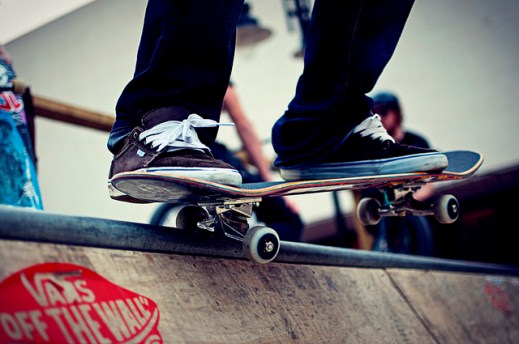
As a skater lands an ollie in the Vans Skatepark in Orange, California, the sound of hard polyurethane wheels slamming against a hollow birch ramp emanates throughout the warehouse, entangling with distinctive sounds made by other participants. The listener is made acutely aware of each skater’s instrument and stylistic approach to performance. What differentiates the rider on a board in the skatepark from a guitarist playing in a rock club? Just as the materials of the electric guitar and its signal chain inform the sonic nature of the instrument, the skateboard and its engaged terrain sound out unique and identifiable characteristics of each device. I spoke with a skater at Flipside Skateboard Shop in Athens, Ohio about the specifics of wheel construction and his own personal preferences:
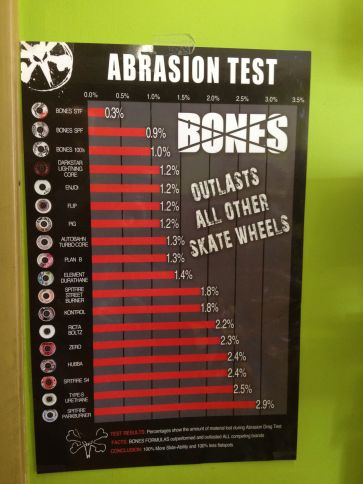
Abrasion test chart, Flipside Skateboard Shop, Athens, Ohio
Just like the layered wood of an electric guitar body, boards are made through a multistep manufacturing process that involves layering thin plies of wood. Maple is most commonly used with the relative flexibility of the deck determining qualities of audible resonance as a skater ollies or railslides. And trucks, which function as axles, can be heard grinding along a surface such as pool coping, a painted curb, or a handrail.
In order for these materials to make sound they must be controlled by a rider and engage with some kind of terrain. The combination of what materials are chosen and how they are used result in a rider’s unique approach. In the skatepark, skaters swathe themselves in clothing, pads, and helmets while riding devices wrapped in visual signposts of self-expression that sound out the priorities of the particular rider.
Sonic Style
Following Henri Lefebvre, Iain Borden speaks of the skateboard as a “lived component of the body, its actions and its self-image in relation to the terrain” (28). Similarly, from my time spent at skateparks in Ohio and California, I have noted the malleability of terrain as a domain to express one’s own unique style. Skaters use their devices as instruments, playing the park, repeating phrases, overlapping with sounds emitted from their peers. All the while, advertisements adorn both bodies and instruments and maneuvers mimic the iconic moves of sponsored skaters viewed in magazines. Visiting Focus Boardshop across the street from the Etnies Skatepark in Lake Forest, California reminds the observer that the elusive, focal point of style in the world of skateboarding is not only confined to the visual realm. As reissued decks from Powell Peralta, Slimeball wheels, and multiple videos adorn the walls of the shop, teenage skaters hang out, asking to bend and stand on decks and spin wheels, all the while watching and listening to newly released videos. Just as guitars and synthesizers reflect the users aesthetic outlook, the look and sound of skateboards signal to a skater’s audience (often other skaters in the park) what kind of skater he or she is.
Tara Rodgers’ insightful article on wood paneling on synthesizers for Sounding Out! has its analogue in the spiritual aura of the object in skateboarding. Bound up in this aura are genre-shaping histories that have taken the sport in innumerable directions. Whether it is the catwalk ethos of Vision Street Wear, Danny Way’s connection with Monster and Red Bull energy drinks, or enjoi’s self-referential marketing, the graphics that wrap around skate gear carry with them weighty connections to the sport’s most original moments. These moments are, of course, defined by marketing campaigns, hosted in influential magazines such as Thrasher and Transworld, and the zietgeist of the time. Intertwined with these branded materials is the sonic quality of the instrument. The sound of the instrument itself reflects the particular ethos of the skater who selected it. In the clip below, an employee working at Focus Boardshop in Lake Forest, California talks about the particular way his board’s sound reflects the idiosyncratic nature of its components. Notice how he skater speaks about the sound of his bearings as a direct link to his style, connecting to Borden’s idea of the board as a lived component of the body.
During my visit to the community skatepark in Athens, Ohio I come across two skaters who have returned to the sport after a two-decade break. One skater sports a longboard with 70a wheels so soft you can’t hear him skate through the concrete pool. Immediately after interacting with the longboarder, another skater finishes a session in the pool at the Athens skatepark with a long slide. I ask him about the role of his wheels and what he calls “the best sound in the world”:
Soft Wheels
Hard Wheels
Skaters related the histories of their boards to me with a sense of fond nostalgia. These histories functioned, primarily, as a mode of individuation, through which those observed were seen refining their identities within the community through conversation. As more time is spent at each of the parks, I begin to notice communal flows of conversation between skaters and their engaged terrain as well. Competitive aspects to out-do each other, synchronized maneuvers, and vocal responses are percolate the soundscape. As listeners perform and performers listen, connections with well-formed cultural codes of improvisational music begin to emerge.
Jamming the Skatepark
Improvising musicians often use the context of the jam session as an opportunity work out new ideas and rehearse repertoire. Minton’s Playhouse in New York is one of the original sites for the jazz jam session. Here, “cutting contests” allowed players the opporunity to outplay each other with virtuosic displays of improvisational prowess. Musicians play to hear each other individually and as a unit, often pushing each other to extremes. The sound is composed, listened to, and then reacted to. Skateparks provide a similar atmosphere. A trick (like an ollie) is immersed in the sonic flows of the surrounding skaters. The skatepark is simultaneously encouraging and competitive, forgiving and relentless.
When I visited the Vans Skatepark on National Go Skateboarding Day park employees tempted skaters to display their best moves throughout the park with the promise of free swag. The environment remained friendly and encouraging as skaters rose to the challenge, welcoming the pressure.
The rituals of the skatepark are varied in their scope. When a skater lands a difficult trick, it is common to hear the tapping of board tails on the ground; applause. Vocal reactions to maneuvers (landed or failed) are also quite common.
What sets the sonic atmosphere of the skatepark apart from the sound of skating outside the park is the palpable lack of intruding sounds from the outside world. As communities continue to accept the skatepark as part of their permanent landscape, the once transgressive sound of the sport takes on a new meaning. The scrapes and slides that once signaled intrusion are now contained in a controlled space. While visiting these jam sessions, it became clear that the sounds of the skatepark remain a mostly male-dominated activity. While the instruments and terrain remain available to the wider public the sound of the skatepark reflects a relatively closed environment often shrouded in platitudes of youth culture. However, once a sense of acceptance and experimentation is cultivated, some other aspects of the skatepark are revealed. The skatepark is a place to play and explore the range of one’s repertoire. It is a place to engage with the limitations of the instrument and one’s own physical faculties. And, it is an environment that encourages friction, noise, and distortion. The skatepark is a communal amplifier, obscuring and reflecting sound as the players immerse themselves in the ultimate sounding board.
Bonus Material:
While immersing myself in the sounds of the skatepark for this project, the idea came up to reimagine the sounds of the skatepark as a musical composition. I asked musicians Michael Deakers, Casey Foubert, Junior High, and Ryan Richter to make a piece that used any portion of the recordings of the four skateparks I visited. Their work reflects a deep connection to the rehearsed and improvisational aspects of music-making and skateboarding. The sounds of these pieces emerged from hours of practice and spontaneous decisions allowing for a particularly effervescent creative outcome. To hear these, check out out my Soundcloud here.
—
Featured Image, “Grinding” courtesy of Luke Hayfield Photography
—
Josh Ottum holds an MFA in Integrated Composition Improvisation and Technology from UC Irvine and is currently a PhD student at Ohio University in the School of Interdisciplinary Arts. His research interests include sound, energy extraction, Van Dyke Parks, Southern California, library music, and synthesizers. As a singer-songwriter, composer, and producer, Josh has released multiple records on various labels, completed numerous international tours, and composed music that has appeared on MTV, AMC’s Mad Men, and NPR.
—
REWIND! . . .If you liked this post, you may also dig:
“Tofu, Steak, and a Smoke Alarm: The Food Network’s Chopped & the Sonic Art of Cooking“–Seth Mulliken
“Sounding Out! Podcast Episode #5: Sound and Spirit on the Highway“–David Greenberg
“Sound-politics in São Paulo, Brazil”–Leonardo Cardoso
Share this:


Current Top Posts





April 2021

January 2020

November 2019

October 2019

August 2019

April 2014

November 2017

March 2015

December 2017

October 2015
 Sounding Out!
Recent Comments