
Make a Noise Joyful: Cirm in the Old English Exodus


Series co-editors Dorothy Kim and Christopher Roman
When the narrator of the Old English poem Exodus declares “Gehyre se ðe wille” (Let him hear who will), what sounds is he asking us to attend to? [Note: Text from Peter Lucas’s edition, 7b. All translations are author’s own.] This post argues that the Old English noun cirm (noise, shout, outcry) challenges our conceptualization of noise. In the Anglo-Saxon corpus, cirm most often refers to the indistinguishable, non-linguistic hum of a crowd, rather than the meaningful utterance of an individual. This accords with the popular view of noise in sound studies: whether medieval or modern, noise (as opposed to meaningful sound) is associated with alterity, disruption, and violence.
However, and strikingly, in the Old English Exodus, words for noise describe not only the terrible sounds of the drowning Egyptians as the roaring waters of the Red Sea rush over them, but also the survival of the Israelites. I argue that this cirm is a mark of the Israelites’ triumphal assertion of their continued presence and plenitude, a celebration of the fact that they can still be a multitude despite captivity. That cirm may not sit easily within our definition of noise should provoke not a redefinition of cirm’s joyful use, but a reconceptualization of Anglo-Saxon noise.

‘Amalek Attacks Israel and Is Defeated’, in the Old English Hexateuch, British Library, MS Cotton Claudius B IV
What is Noise?
“Noise” has a range of meanings, but most often implies “unwanted sound” as R. Murray Schafer argues in The Soundscape (73). Following the work of Jacques Attali and Jeffrey J. Cohen, noise has been associated with alterity, difference, and monstrosity. Noise, as opposed to sound, may be non-linguistic or disordered: nonsense, babble, the roar of a jet engine. According to David Novak’s contribution to Keywords in Sound, noise is not present in nature, but is created by modern technology (129). In the modern world, noise is often considered negative: cities have rules about noise pollution, apartment buildings set quiet hours, and airplane passengers don noise-cancelling headphones. In the pre-industrial age, noise was not exempt from criticism, though the word could also be applied to more pleasant sounds, like birdsong.
In the European Middle Ages, Valerie J, Allen argues in “Broken Air,” noise was often figured as violent, transgressing boundaries, inappropriately closing the distance between sound producer and sound receiver (310 and 317-318). According to Macrobius, it was not silence that was the opposite of sound, but noise (311). Grammar, which was “devoted to the pursuance of ratio through sound,” was ethical; noise was therefore considered “a kind of audible violence; corruption [wa]s something one can hear” (305). But some medieval noises were more ambiguous: the Old English word dream (joy, joyful sound) could also be applied to the terrible sounds of Hell or the terror of Judgment Day, as in Kazutomo Karasawa’s analysis in “OE dream for Horrible Noise in the Vercelli Homilies.” Likewise, “clamor,” which originated as a (mostly) negative noise, became an important legal instrument, as discussed by Richard Barton in “Making a Clamor to the Lord: Noise, Justice and Power in Eleventh- and Twelfth-Century France.” But in general, we tend to assume medieval noise is negative, or marks its producer as other.
Noises in Exodus
The Old English Exodus, found in the c. 1000 manuscript known as Bodleian MS Junius 11, is a notoriously difficult and complex poetic adaptation of the Old Testament Exodus 12-14. The author and date of composition are unknown, though it is often considered quite early, perhaps as early as the eighth century as Paul Remley and Lucas argue. Few institutions were rich enough to own a complete Bible. The author of Exodus may have had access to a written Latin version of Exodus, or may have been exposed to the text via the liturgy, especially the liturgy of the Easter Vigil.
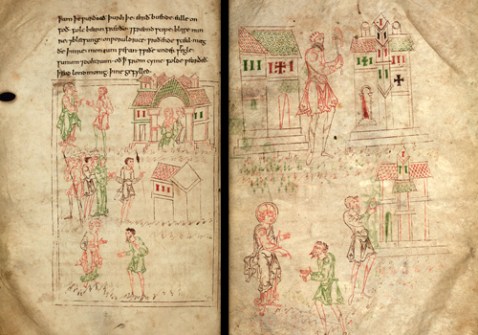
The Junius Manuscript, Oxford, Bodleian Library, MS. Junius 11, pp. 84-5
Exodus delights in sensory details, but until recently, I had always thought of Exodus as primarily visual – the gleaming of war-gear, the glittering of Egyptian spoils washed up on the shore, tents and a pillar of cloud to protect the Israelites from the desert sun, and a pillar of fire to guide them. But the poet is also attentive to the larger sensory world, including the world of sound and noise. Those who accept the poet’s opening challenge to his audience (“Gehyre se ðe wille!” [Let him hear who will!]) will recognize that the poem is in fact filled with sounds – the battle trumpets that provide order and structure to the movements of the army, the rushing and later silencing of waters, the terrible evening songs of wolves eager for battle, the awful rasping of the blade Abraham draws to sacrifice Isaac in the poem’s digression on the patriarchs, the triumphant songs produced by Israelite men and women in praise of God after the Egyptians are defeated. In what follows, I focus on the multiple deployments of a single word for noise (cirm), applied to both Israelites and Egyptians, asking what this word can reveal about Anglo-Saxon conceptions of noise.
It has often been remarked that the poet resists easy distinctions between Israelites and Egyptians, applying similar vocabulary to both, and this is certainly illustrated by the poet’s sonic play. In a climactic scene near the end of the poem, the drowning of the Egyptians in the Red Sea is accompanied by horrible noises:
Storm up gewat
heah to heofonum, herewopa mæst;
laðe cyrmdon (lyft up geswearc)
fægum stæfnum. Flod blod gewod:
randbyrig wæron rofene, rodor swipode
meredeaða mæst. Modige swulton,
cyningas on corðre. Cyrm swiðrode
wæges æt ende; wigbord scinon.
[A storm went up high to the heavens, the greatest of cries of the army; the hostile ones cried out with doomed voices (the air grew dark above). Blood pervaded the water: ramparts were broken, the greatest of sea-deaths lashed the sky. The brave ones died, kings in a troop. The noise fell silent at the end of the water; battle-boards shone. (460b-467; emphasis added)]
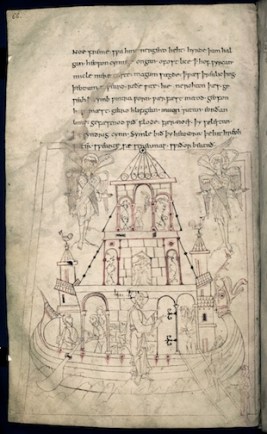
The Junius Manuscript, Oxford, Bodleian Library, MS. Junius 11, p. 66.
Cirm occurs twice in this passage, first as a verb (cyrmdon) and then as a noun (cyrm). The manuscript reading in 466b is cyre (choice). Lucas emends to cyrm because cyre is not a poetic word, and I would argue that the echo with the Israelites’ cyrm (107) must be deliberate. Even if we accept MS cyre, the passage still includes the verb cyrmdon (462a), and other sonic vocabulary (herewopa, “army’s cries” [461], and fægnum stefnum, “doomed voices” [463]). The noun occurs roughly 60 times in the corpus; the verb 17 times (DOE).
In the Old English corpus, cirm is often negative, applied to the tortures of hell or the terror of Judgment Day, and indicates a particularly loud sound (DOE, Lucas). According to the DOE, the noun means “shout, cry, shriek” or “noise of non-human origin, clamour.” The Egyptian cirm is obviously threatening, the meaningless cries of men who, like a raging storm, lash out in terror as the waters close over their heads. Even the visual horror of blood mingling with water maintains sonic affiliations: this line is a rare example of internal rhyme in Old English poetry (flod blod gewod). The end of the Egyptian threat is marked by the silencing of their voices and cirm, metaphorically a silencing of the army’s advance against the Israelites.
Given the negative associations with noise in both medieval and modern sound theory, that the Egyptian defeat is accompanied by their terrible cirm may not seem particularly surprising. Strikingly, this is not the only such noise in the poem. Near the beginning of the poem, the Israelites celebrate their initial escape from Egypt by producing not just any noise, but cirm. On the third day, after the pillar of cloud has appeared, the Israelites awaken with trumpets, and seeing the pillar,
Folc wæs on salum,
hlud herges cyrm.
[The people were joyful, loud was the noise of the army. (106b-107a; emphasis added)]
If cirm is threatening, loud noise, associated with difference and violence, why would the Israelites produce it? I would like to suggest that cirm suggests not merely loud noise, but crowd noise. The Israelites’ cirm is not an assertion of difference, or the meaningless babble of a drowning, almost non-human army, but an assertion of triumphant plenitude. Their joyful cirm is a fulfillment of God’s covenant with Abraham, which the poet will remind us of later in the poem (435-442). Just as God promised Abraham innumerable offspring, his support of the Israelites in their exodus signals that they will continue to be a multitude (as they certainly are in this battle, in which they have 600,000 fighting men (224-233).
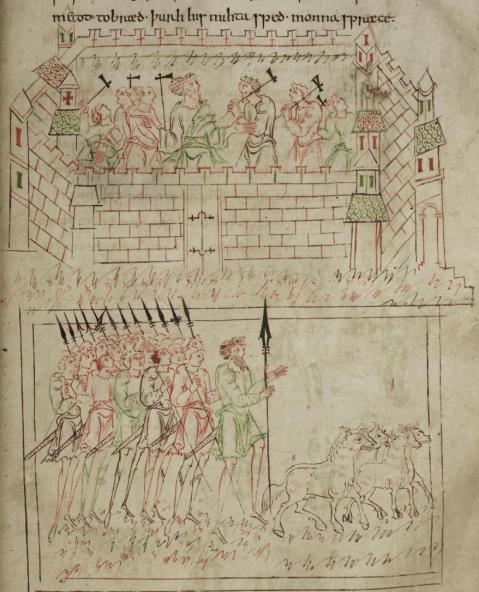
The Junius Manuscript, Oxford, Bodleian Library, MS. Junius 11, p. 81.
In fact, the Israelites’ triumphant crowd noise is echoed at the end of the poem as well. After the defeat of the Egyptians, who make terrible cirm as they perish in the Red Sea (460b-467), the Israelites issue more celebratory sound, this time transformed from crowd noise to harmonious music:
Æfter þam wordum – werod wæs on salum –
sungon sigebyman (segnas stodon),
fægerne sweg
[After these words – the troop was joyful – victorious trumpets sang a beautiful sound (battle-standards stood). (565-67a; emphasis added)]
The Israelites’ cirm (107), which they produced while on salum (joyful), is balanced and echoed by the celebratory sounds of the end of the poem, also produced by a people who are on salum (565). Whatever threat the Israelites’ assertion of plenitude and cirm may have made possible is mitigated by replacing that cirm (noise) with a beautiful sound (fægerne sweg), a harmonious, if also loud and multiple, expression.
According to Attali, music can be used to produce order, but “noise is violence: it disturbs. To make noise is to interrupt a transmission, to disconnect, to kill. It is a simulacrum of murder” (26). In this sense, the Israelites’ crowd noise in the desert is violent – it threatens the order of the Egyptians, or the hierarchy the Egyptians have sought to impose on the Israelites in their captivity. But because this story ends in the triumph of the Israelites, told from the point of view of their Christian descendants, it celebrates this assertion of communal power and communal violence without fully othering them. The true violence is inflicted on the Egyptians by God in the Red Sea, allowing the Israelites to reassert their normativity, their cohesion, their power, and their non-otherness. While the drowning Egyptians produce cirm, it is silenced because the cirm of the Israelites has conquered them. Noise, or at least cirm, is therefore not merely negative or disruptive; it is a powerful claim to be blessed by God, an assertion of belonging rather than a boundary crossing.
—
Featured Image:Detail of a miniature of the plague of hail (Exodus 9:22-25), Add MS 15277, f. 7r
—
Jordan Zweck is an assistant professor in the Department of English at the University of Wisconsin-Madison. She specializes in early medieval vernacular literature and culture, especially Old English, and is interested in documentary culture, media studies, and sound studies. She is currently completing a book on Anglo-Saxon epistolarity and early English media, examining the representation of letters in vernacular texts such as letters from heaven, hagiography, and poetry. She is also working on a second book on sound, noise, and silence in Anglo-Saxon England, a portion of which is forthcoming in Exemplaria. Zweck is a recipient of the University of Wisconsin-Madison Center for the Humanities’ First Book Award, has held a resident fellowship at the Institute for Research in the Humanities at UW-Madison, and has won several teaching awards.
—
REWIND!…If you liked this post, you may also dig:
‘A Clateryng of Knokkes’: Multimodality and Performativity in “The Blacksmith’s Lament”–Katherine Jager
Mouthing the Passion: Richard Rolle’s Soundscapes–Christopher Roman
Sounding Out! Podcast #54: The Sound of Magic-K.A. Laity
Share this:

SO! Amplifies: Think About Sound App and Map
 SO! Amplifies. . .a highly-curated, rolling mini-post series by which we editors hip you to cultural makers and organizations doing work we really really dig. You’re welcome!
—
What is it about the environmental soundscape which makes us ‘tune-in’ or ‘tune-out’ to particular sounds? Do we as humans tend to seek out quiet zones for our acoustic pleasure or are there those among us who find urban soundscapes a more comforting prospect? Researchers at Glasgow Caledonian University in the UK have developed a mobile phone application to allow the personalized assessment of such questions regarding environmental soundscapes. I developed the free Think About Sound interactive map–downloadable as a mobile app and viewable online–to allow users to experience various locations in Glasgow by using 3D audio recordings and panoramic visuals.

Think About Sound is a novel tool which shifts the traditional paradigm of environmental soundscape assessment using an experience sampling methodology. Over the last decade, smart phone ownership has increased immeasurably; I applied the technology here in order to allow local, in-situ soundscape assessment as participants go about their daily routine. Based on the Adobe PhoneGap Build platform, the application has been developed using HTML, CSS, and JavaScript, employing jQuery Mobile to provide a simple and clean navigational structure to the user. Crowdsourcing data in this way has enormous potential to create rich and diverse data sets, where both qualitative and quantitative descriptions of environmental surroundings can be gathered in a flexible and non-invasive way.
By using a self-reporting methodology, Think About Sound removes the listener from traditional laboratory-based soundscape evaluation and locates them in real world experiences as they go about their day-to-day activities. The application aims to find out the various types of sound encountered as users understand them, asking how users feel before and after a recorded sound event and enabling them to describe the circumstances in which they heard the sound event. Think About Sound also asks listeners to provide semantic descriptors for the sound, toward the ultimate aim of creating more sophisticated environmental sound maps which communicate both location-specific sound information and the subjective effect of sound upon the listener.
To further enrich the experience, data sent from the application can be viewed online at http://www.thinkaboutsound.co.uk/ with an accompanying map where the public can view and audition submissions using the familiar Google map format. You will also find links to download the app in multiple formats.
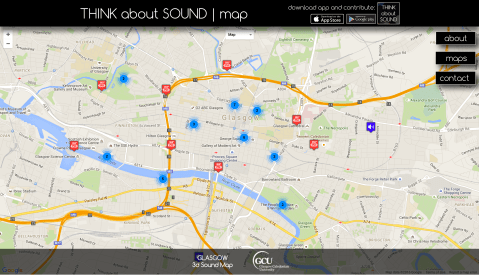
I hoped that by collecting data in this way and to this scale, that I can obtain and share a greater understanding of how we perceive soundscapes. The next steps for the project includes the development of audio technology to analyze sound recordings, automatically predicting annoyance, valence (the emotional value associated with a stimulus), and the arousal features of environmental sounds for particular users.
While locale remains important, this research has far more reaching implications beyond my local region. Submissions on an international level can help us to understand how we perceive our environmental soundscapes, help shape local noise policy, and provide others with an understanding of sounds in their local area. What I want from you, the reader, is your help via contributions to this worldwide soundscape project. Stop for a minute and take in your sonic surroundings. What can you hear? How does it make you feel? Comfort? Anxiety?. . .Stop for a minute, listen and think about sound.

—
Adam Craig is a Ph.D researcher studying at Glasgow Caledonian University in the UK within the School of Engineering and Built Environment. After obtaining a first class honours in his undergraduate Audio Technology degree in 2011, Adam went on to embark on a Ph.D concentrating his research on using advanced audio technology for the creation of environmental sound maps. He Is currently a member of the AudioLab Research team at GCU and is a member of the Institute of Acoustics and the Audio Engineering Society. Out with his academic research, Adam teaches sound engineering to high-school students at a community based service within his local education authority, and at West College Scotland.
—
REWIND!…If you liked this post, you may also dig:
SO! Amplifies: Ian Rawes and the London Sound Survey–Ian Rawes
SO! Amplifies: Cities and Memory–Stuart Fowkes
SO! Amplifies: #hearmyhome and the Soundscapes of the Everyday–Cassie J. Brownell and Jon M. Wargo
Share this:


Current Top Posts





April 2021

January 2020

November 2019

October 2019

August 2019

April 2014

November 2017

March 2015

December 2017

October 2015
 Sounding Out!
Recent Comments