
“Welles,” Belles, and Fred Allen’s Sonic Pranks: Making a Radio Auteur Laugh at Himself
 Welcome back to From Mercury to Mars, our series of posts (in conjunction with Antenna) that reflect on Orson Welles’s radio career, and the upcoming anniversary of its highlight, “The War of the Worlds.”
When scholars discuss the effect of that play on people, they often fall into reveries about its most serious dimensions — what the Martian Panic says about human susceptibility, about the power of the media, about sound and the unknown. But it’s important to realize that, besides being terribly humorless, this approach also isn’t historically just. Although Welles was — like some of his listeners — spooked the night of the event, in the days that followed he and many others came to recognize some humor in the the whole thing, too. Later in life, Welles focused on that dimension of his memory, repeatedly recalling with laughter that when the actor John Barrymore (something of a “grand old man” of the American stage in 1938), heard the Martian invasion broadcast he tearfully decided to free his beloved dogs, so they could taste freedom before meeting the inexorable doom.
 Such tall tales aren’t trivial. Actually, we misunderstand the WOTW escapade if we don’t recognize that immediately adjacent to modern America’s propensity for panic stood its equally fascinating capacity to laugh at itself. Both tendencies do cultural work, often in concert with one another. With that in mind, this week our Mercury to Mars series moves from the macabre (see Debra Rae Cohen’s piece on Welles and Dracula) to the ridiculous, focusing on the relationship between Welles’s puffed-up fame and how it was lampooned by Fred Allen, one of the great absurdist comics in modern entertainment, and perhaps the most creative radio comedian of his era.
To introduce this crucial entertainer and to explain why his relationship to Welles matters so much, we are lucky to have one of the most important voices in radio studies today: Kathleen Battles, Associate Professor of Communication at Oakland University, author of a paradigm-shifting study of the relationship between radio and policing, Calling All Cars: Radio Dragnets and the Technology of Policing (Minnesota, 2010). Battles is also one of the co-editors of a book you should all be reading, assigning, and handing out like Halloween candy — War of the Worlds to Social Media: Mediated Communication in Times of Crisis (Peter Lang, 2013).
Here’s a taste, just to get you started.
– nv
—

Contemporary public memory of Orson Welles seems bent on remembering him as mercurial, imperious, haughty genius, driven in equal parts by ambition and artistic vision. It is hard to remember that this image of the auteur – not Welles but “Welles” – was one crafted not by the man alone, but by a host of actors and other performers, all with their own interest in attaching themselves to such a “genius.” As Welles’s reputation grew in the wake of the “War of the Worlds” broadcast, furthering his transformation into “Welles,” it was simply a matter of time before he became a fodder for another kind of auteur, the radio comedian. One of the most popular was Fred Allen, who made a career archly satirizing the cultural conventions of the day, with the radio industry itself being one of his favorite targets. “Welles” was too rich a subject to forego.
This post explores two key moments of Allen’s satire. The first came on November 9, 1939, when Allen’s show featured a comic skit, entitled “The Soundman’s Revenge, or, He Only Pulled the Trigger a Little, Because the Leading Man was Half Shot Anyway,” a radio skit that deftly mimes the Mercury/Campbell style to comic effect. The second is from three years later, October 18, 1942, when Welles himself appeared on Allen’s show, joining in the fun as the pair rehearse Les Miserables, with Welles gamely mocking “Welles.” In these two short skits, Allen and his team of writers and performers quickly dismantle what had become the more recognizable elements of the Mercury/Campbell style–as exemplified in Welles’s version of A Tale of Two Cities–including the elevation of Welles to the genius “author” of the plays, its narrative and performance techniques, and the use of sound effects.

Orson Welles as Mr. Arkadin in his film of the same name, 1955.
Mercury Theater was strongly marked with the authorial imprint of the real Welles, but the legend of “Orson Welles” was also crafted quite deliberately by CBS, and then later by show sponsor Campbell’s Soup, for their own aims at cultural legitimacy. As Michele Hilmes argued, such moves were key to legitimizing the medium as operating in the “public interest” (183-88). Here is a clip from just after Campbell Soup began sponsoring the Welles program:
As other writers have pointed out, such as Debra Rae Cohen in her entry to this series, Neil Verma, and Paul Heyer, the show was among the best in emphasizing the sonic properties of radio to maximum effect in storytelling. The quality acting of members of the Mercury Theater, the music of Bernard Herrmann, the ambitious use of sound effects, and some stellar examples of adapting literary tales make the show worthy of praise.
The emotional and narrative power of Welles himself is evident in the Mercury Theater dramatization of A Tale of Two Cities. Taking on Dickens’ sprawling classic in one hour certainly demanded some creative choices. One was to open with Dr. Mannette’s letter from the Bastille prison, with Welles as Mannette emotionally dictating the words that would later serve to betray his own family.
This is contrasted against the later reading of the same letter in a courtroom scene, where the emotional poignancy of Welles’s performance is counterpointed against its dry reading as a piece of evidence.

The sound effects team from The March of Time in a 1930’s publicity photo. On the left is Ora Nichols, who would later develop sounds for The War of the Worlds.
Dynamic use of sound effects was another key element of the Mercury/Campbell style. From his work in March of Time and The Shadow, which both used sound effects to enact key narrative devices (Time varied times and locations, the Shadow’s invisibility), Welles used his own radio program to push the boundaries of what such effects could achieve. In A Tale of Two Cities, sound effects are used to punctuate key moments, none to greater effect than the final scene in which the sound of the guillotine serves as the morbid backdrop to Carton’s final, famous speech of self sacrifice:

Cover art for “Fred Allen Looks at Life,” a 1971 vinyl release by Bagdad Records.
All of these tendencies are key to Allen’s “Soundman’s Revenge,” in which Orson Welles and the Campbell’s Playhouse become “Dorson Belles” and “Finnegan’s Playhouse,” with the evening’s entertainment an adaptation of Jack and Jill fetching a pail of water.
Belles, acted by Fred Allen, tells his listeners that “My program is famous, and rightly so, for my sound effects, conceived in solitude by me.” The skit reaches ridiculous heights during a dramatization of “Jack’s” first meeting with “Jill.” As Jack and Jill wax enthusiastically at each other merely by repeating each others’ names, the host breaks in to tell listeners that “This dialogue, ladies and gentleman, is not to be found in the original Mother Goose version. It has been interprellated by Dorson Belles. We return you now to the play.”
The always potential high culture pretentiousness of Mercury/Campbell aesthetic choices are brought to the fore by the ridiculous choice of a Mother Goose nursery rhyme as the “play” within the skit. But other things do as well. The skit opens in typical Mercury first person narrative style, where Jack tells the tale from his own perspective in a ponderous, overwrought dramatic fashion. Jack does not live in postcard ready New England, he lives in a “land of penury and misery.” He does not merely make a mess while preparing his dinner, but “licks the albumen of owl’s egg off his fingers.”’

In its most pointed reference to Mercury style, the skit directly plays off a memorable moment in War of the Worlds when, as Professor Pierson narrates his travels in New Jersey, he states that “I saw something crouching in a doorway, and it rose up and became a man. A man armed with a large knife.” Here is the clip:
In similar dramatic style, Jack narrates his journey up the hill, hauling his “heavy oaken pail” and asks “What was that huddled form crouching in my path? Was it a girl? It was!”
The comic tour-de-force, however, comes with its satire of sound effects. Allen’s team goes for broke as listeners laugh along to the gradual undoing of the hapless Theodore Slade, Welles’s sound effects engineer in the skit, who is driven to madness by the excessive number of effects. Slade makes many mistakes throughout, but his errors really add up when Jack kills his father and he describes the “long arm of the law” reaching out, coming from the north on horseback, the east by train, the west by “aeroplane,” and the north by sleigh. Each description is punctuated by its appropriate sound; hooves, whistles, engines, and of course, sleigh bells.
It works the first time, but when Jack dramatically asks if he and Jill can escape each of these modes of capture, Slade plays the wrong effects. When Jack tells us he stabbed the Sherriff, Slade plays a gunshot. This time, when Belles chastises him, Slade lets loose, telling Belles that he is going “nuts,” then trying to rectify the mistake by killing the Sherriff again. Belles yells out that “this is confusing!” to which Slade retorts, “you’re telling me!” As Jill tries to continue the scene, telling us she is shooting herself, Slade plays the train whistle. Finally Jack narrates that Jill, the Sherriff, and his father are dead, and that “I alone live.” Slade replies, “yeah, but not for long,” and after listing off years worth of complaints, shoots Belles. Belles, in a pitch perfect rendition of Welles’s weekly closing of his radio show, says “This is Dorson Belles, signing off permanently. Pending rigor mortis, I remain, obediently yours.”

Fred Allen on the cover of Time, April 7, 1947. Art by Ernest Hamlin Baker.
Perhaps Welles was offended, or perhaps he yearned to be in on the joke. He certainly seemed to relish the chance for that opportunity, when he appeared as a guest on Allen’s show, 3 years later on October 18, 1942. Here he plays along in the skewering of his own genius image, tied to his authorial control over all his projects. As the cast nervously awaits the arrival of the great “Welles,” Allen tries to calm them. Once “Welles” enters the studio, Allen himself comes in for his own ribbing. “Welles” tells him that they will be performing a new version of one of Welles’s early radio dramatizations, Les Miserables. Here Welles successfully mocks both “Welles” and Allen, insisting on sole authorship, giving an overwrought performance, using the first person singular mode of delivery, and most humorously by reducing Allen’s contribution to a few sound effects.
In those few moments where Welles himself cannot help from laughing along with the mockery, “Welles” becomes Welles, and we in the audience get to laugh with, not at, the man.
While CBS, Campbell Soup, and the press turned Welles into “Welles,” Allen undermined that move, puncturing the grandiose myth, a project in which Welles himself was only too willing to participate. By breaking it down to its constituent elements, the “Soundman” and Les Miserables skits celebrate the unique style of the Mercury/Campbell radio productions. Yet, they also pierce its cultured veneer by pointing to the unsung efforts of the always-necessary team to make radio performances work, and skewering the pretentiousness of the program’s extra-textual discourses. In the process Welles and Allen mutually constructed and deflated each other’s reputation as radio geniuses.
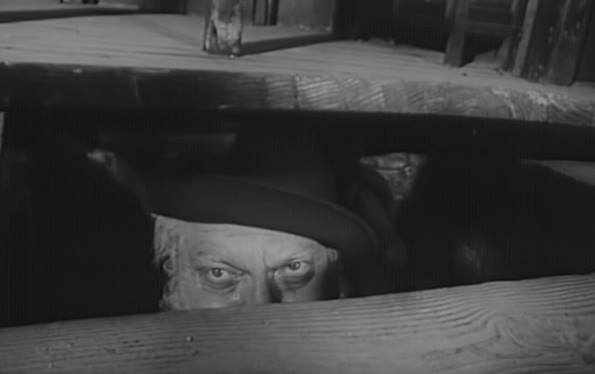
Orson Welles as Falstaff in his Chimes at Midnight, 1965.
—
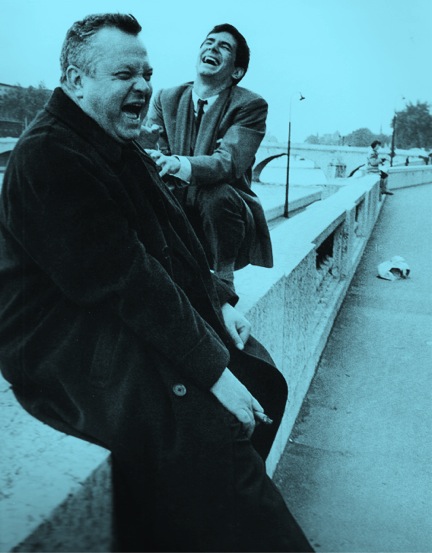
Featured Image: Orson Welles and Anthony Perkins sharing a laugh on the set of The Trial.
—
Kathleen Battles is Associate Professor and Graduate Director in the Department of Communication and Journalism at Oakland University (MI not CA). She is recently co-editor (with Joy Hayes and Wendy Hilton-Morrow) of War of the Worlds to Social Media: Mediated Communication in Times of Crisis (Peter Lang, 2013), a volume that seeks to draw connections between the War of the Worlds broadcast event and contemporary issues surrounding new media. She is also the author Calling All Cars: Radio Dragnets and the Technology of Policing (University of Minnesota Press, 2010). Her research interests include Depression era radio cultures, the interrelationship between radio, telephones, and automobiles, media and space/time, the historical continuities between “old” and “new” media, and contemporary issues surrounding sexuality and the media.
—
 Want to catch up on the Mercury to Mars series?
Click here to read Tom McEnaney’s thoughts on the place of Latin America in Welles’s radio work.
Click here to read Eleanor Patterson’s reflections on recorded re-releases of the “War of the Worlds” broadcast.
Click here to read Debra Rae Cohen’s thoughts on vampire media in Orson Welles’s “Dracula.”
And click here to read Cynthia B. Meyers on the challenges and rewards of teaching WOTW in the classroom.
While I’ve still got you here … be sure to join our WOTW anniversary Facebook group. Next month we’re planning exciting events around the anniversary of the Martian Panic on October 30, 2013 from 7-10 EST, and hoping to get as many of you as we can to liveTweet the Invasion broadcast. Sign up to join in!
Share this:

SO! L.A.: Sounding the California Story

 Editor’s Note: Welcome to the second installment in our month-long exploration of listening in observation of World Listening Day on July 18, 2012. For the full introduction to the series click here. To peep the previous post, click here. Otherwise, whip out your most oversized sunglasses, kick back, and listen to Bridget Hoida’s California. –JSA
—-
STOP.
Do not read along with me “in your book.”
Resist the temptation to follow along with your eyes.
Click play. Listen.

Sunset in the San Joaquin Valley
If I had things my way, I would whisper these stories to you as we sat in mesh folding chairs on the poured concrete porch of my Central Valley childhood home. If I had things my way, I would refill your glass with lemons and gin, and we would breathe in the sweet, summer smell of rotting blackberry brambles. If I had things my way, we would wait until the sun set against a Tokay harvest, taking with it the harsh triple digit temperature and leaving us nothing but the quiet of a delta breeze and moonlight. If I had it my way, I would ask you to lean in close as I whisper with canonical voices:
“This is a story about love and death in the golden land, …”
“I remember that moment exactly, those exact words registering in my mind like the notes of a solo…”
“Bobby Gene was a tattletale he told everything he heard…”
“You must not tell anyone what I am about to tell you…”
“My history is murky, and I wanted it [ …] that way so I could be free to tell whatever I wanted. ”
“I’ll tell you what I suppose from your silences and few words and you can tell me if I’m mistaken. You’ll have to speak up with the real stories if I’ve got you wrong…”
“And so they talked and told tales of their region, and I listened. Long into the night I listened until I dropped off to sleep and my father would pick me up onto his lap as he continued to talk about the Revolution…. And every camp was different, none existing for more than six or seven weeks, then off we would go to the next harvest, where new people would gather and there would be new tales to be told and heard. I knew when I was six years old that the one thing I most wanted from life was to be a storyteller.
The storied sound of California
-All Voices
Shush…. Listen.
Linger with me on the drawn-out drawl of the stories I was raised on. Of the stories I was raised upon. For this is the sound of the California story: A myriad of voices sounding out narratives onto the page. Conflicting, concurring, spoken-over and rewrote…no one lasts longer than the next harvest, the next filmic “Action!” This is the sound of the storied terrain of interwoven melodies spoken upon the California soil that I call home.
1.
In or around 1995, I fell madly in love with Joan Didion. It’s not so much Didion the woman but rather the sound of Didion’s words that have me so hung up. My obsession began in the stacks of the Bancroft Library at UC Berkeley. I was assistant to the assistant librarian there and during my lunch hour I would take the dumb waiter up to the roof, eat a Kaiser roll with apricot jam, and read dime store copies of classic novels. I chose the roof because I like to read aloud, and in libraries at the time, reading aloud, especially to yourself, was expressly forbidden.

So there I was on the roof of Bancroft, with my roll, my jam, and my dime store copy of Play It As It Lays. I opened the page and read something about snakes and Iago. A mother died, the town of Silver Wells was won, and then lost, in much the same way a marriage slips into divorce. And then it happened. I stumbled across a line that changed the way I thought about words. Page 7, the first full sentence of the top paragraph, on the right: I might as well lay it on the line, I have trouble with as it was.
And after that line a whole lot of white space.
Beautiful, brilliant, blank white space.
As though in the silence of the rooftop, of the view, Didion was screaming to the reader, to me, something louder than words. In that white space there was sound and it was deafening.

2.
Later, when I decided to get a Ph.D. in creative writing, and although I couldn’t say as much on paper, examine, among other things, the commonality of language in California writers and the sonic devices of oral storytelling, I came across a quote from Didion, in interview, that said:
I had the technical intention to write a novel so elliptical and fast […] it would scarcely exist on the page at all…white space. Empty space. […] A white book to which the reader would have to bring his or her own bad dreams…
And although I adore everything about her I almost wished she hadn’t said it. Or that I hadn’t read it, because the thing about Didion is that statement… the part about the blank space… and the nightmare… it was already there. On the roof of the Bancroft library with my Kaiser roll and apricot jam, when the air tasted like September, I brought my own bad dreams because in that brilliant bit of white space I heard the scream.
3.
I like the white page. I prefer stories to plots. Plot for me is how the narrative moves from one space in time (from one line on the page) to the next. Story is how the narrative sounds. Story is voice. Plots are where girls meet boys and girls lose boys and girls get boys back. Stories are the shuffle and stop of scuffed shoes walking railroad levees, old men clearing phlegm, the surprise of an elastic bikini band as it snaps against the freshly burnt back of a burgeoning starlet. And the sounds of words as they smack unbridled against the page.

a traditional page by John Steinbeck

a white page by Joan Didion
4.
When I read Didion we are on my porch and I hear her voice. When we think of writing, when we imagine reading, we think of quiet moments that exist alone with fixed type on a printed page. But as a reader, and more importantly as a writer, I have never felt this way.
5.
Voice, to paraphrase Emily Dickinson, is the “slant” you bring to your version of “the truth.” Plots are recyclable. Hell, you can buy one on eBay, to be sure. But a writer’s voice is different. I don’t read a book to figure out what happens next. I read to hear the whisper of the author’s voice. If they whisper well, I turn the page.
6.
From John Steinbeck to Gertrude Stein, John Fante to Susan Straight, Larry Levis and Mary Hunter Austin to William Saroyan and Shawna Yang Ryan, there is commonality of sound and language that I’m willing to claim composes an aural palimpsest of sorts. A voicing over, both literally and figuratively of native daughters and native sons held up on the tongue of the golden state.
The cadence, the rhythm, the obsession with things past. The aching nostalgic longing. The reflection. The fear. The reclamation. The imagination. The witness of an agrarian undoing. Sleepy Hollow moments reborn—again and again on western soil. The feeling of home. The feeling of home slipping away. The feeling of self, self-made in the image of home, slipping away alongside it. There’s a certain Californianess to it.
7.
What if we found a way to consider the sound these “fixed texts” emote? What if we broke with conventional narrative structure and embraced a written technique that more adeptly mirrored the sound and cadence of spoken story telling? Then might it be possible that the very aurality that is “written over” on the read palimpsest is in fact the sound that also remains?
As a writer, a writer who believes in voice, who rejoices in sounds as the strike-like syllables against a now forgotten Olivetti key, my pursuit in writing not only a novel, but in writing a novel about California was how I could possibly enter into this conversation. How I might be able to raise my voice loud enough to embrace the crowd of such a respectable page. How I could construct my text in such a way that it would not only read, but also sound Californian.

a “docu-page” by Raymond Barrio
8.
In my struggle to voice not only my novel, So L.A., but also my protagonist Magdalena de la Cruz, I relied heavily on the patterns, soundscapes and literary devices of the collective California canon comprised of authors such as the ones I spoke of above. In So L.A. I was looking for a way to tell the story out loud while still operating within the conventional structure of a “type and text” book.
 9.
9.
My novel opens with Magdalena falling off a boat and then moves both forward and backward in time. This is how most people tell stories orally. They begin in the middle and then jump around, forgetting, amending, and calling attention to the most important parts, while the listener rarely ever exclusively listens but instead interjects and provides his or her own connections, observations and experiences. Eliminating quotations allowed me to access some of this interplay. It allowed me to question the reliability of spoken language. Spoken utterance does NOT always translate to precise hearing of the said words uttered. There is always interference—be it emotional (memory-sound triggers), psychological (felt meaning as opposed to said meaning), physical (honking cars, loud birds, eye rolls and sneezing) or linguistic (signifiers and unspoken gestures). Just because words are utter does not mean they are the same words that are heard. And not only did I want this, but I needed it on my page. Although I considered the docunovel (in the vein of Raymond Barrio), autho-interview collage (like Anna Deavere Smith) and autofictive exploration (ala Salvador Plascencia) I ultimately decided to abandon quotation marks.


a “sounded” page from The People of Paper
10.
This (“) says open. It says start.
This (”) says closed. It says stop.
But (“) and (”) also sound.
For me they sound like a particularly rough clearing of the throat. They sound like standing on a library rooftop, trying to confess your love with the passion of a librarian “with hiccups.”
“They” interrupt the eye. “They” provide visual cues for accessing character and I didn’t want Magdalena “to be seen.” I wanted her to sound.
Her voice required a fluidity and unreliability not attainable “in quotes.” Without conventional quotes I was free to wander inside the head and voice of my protagonist as I pushed the blur between what she was saying, what the listener perceived she was saying, and what other characters were voicing without visual interruption.
11.
Also important in my authorial access to sound (and the absence of sound) on the fixed and written page was the use of filmic microchapters (some only as long as a single sentence). A sentence that reads as a chapter, surrounded by all that stark and lovely white space, not only looks different from a classical bookish chapter, but it also sounds different. Read out loud, or quietly inside the reader’s head, it sounds out a particular meaning and resonated differently within the mind’s eye and ear.
12.
With so much of the present world turning virtual, author and storyteller Barry Sanders concludes, “We demand less from the historical accuracy of our stories. We even demand less of a truth. We are content with images and feelings. If it feels closer to the truth then it might as well be.” However I’d like to extend Sander’s assessment beyond image and feeling to include sound. In this newly constructed world of virtual storytelling we are again experiencing a shift (not unlike the shift from oral to written storytelling) that is also sound dependent and sonically informed. From the staccato sounds of Twitter as compared to the unconstricted and leisurely expanse of Tumblr, it is important to acknowledge that the twenty-second sound bite can be (and historically has been) used (and utilized) in fiction to make noise and call attention to lasting moments of profound revelation. Although Didion’s Maria may “have trouble with how it was” I find a certain sense of comfort in how it is provided we are all able to lean in close and listen. Listen past the interference of type, text and YouTube to the sound of words both on and upon the page as,
“These are tales told in darkness in the quiet at the end of the day’s heat…”
—
Opening Image Credit: “L.A. Sky at Sunset” by Flickr User David Vienna
Audio note: Voices used, with the exception of Bridget Hoida, are not the actual voices of the authors listed, nor are they meant to be representative of said authors.
—
Bridget Hoida is the author of So L.A. (2012). In a past life she was a librarian, a DJ, a high school teacher, and a barista. In this life she experiments with words and has taught writing at UC Irvine, the University of Southern California and is currently a professor at Saddleback College. Hoida is the recipient of an Anna Bing Arnold Fellowship and the Edward Moses prize for fiction. She was a finalist in the Joseph Henry Jackson/San Francisco Intersection for the Arts Award for a first novel and the William Faulkner Pirate’s Alley first novel contest. Her short stories have appeared in the Berkeley Fiction Review, Mary, and Faultline Journal, among others, and she was a finalist in the Iowa Review Fiction Prize and the Glimmer Train New Writer’s Short Story Contest. Her poetry has been recognized as an Academy of American Poets Prize finalist and she was a Future Professoriate Scholar at USC.
She has a BA from UC Berkeley, a MA in fiction from San Francisco State University, and a Ph.D. in Literature and Creative Writing from the University of Southern California. So L.A. is her first novel.
Share this:


Current Top Posts





April 2021

January 2020

November 2019

October 2019

August 2019

April 2014

November 2017

March 2015

December 2017

October 2015
 Sounding Out!
Recent Comments